Author: Camper English

  • An Attempt at Recreating the Canned Water Method for Clear Ice

    A couple weeks back I reported on the work of Richard Newell, who sealed boiling water in mason jars in a canning system and found that it made great ice with few bubbles in a directional freezing system

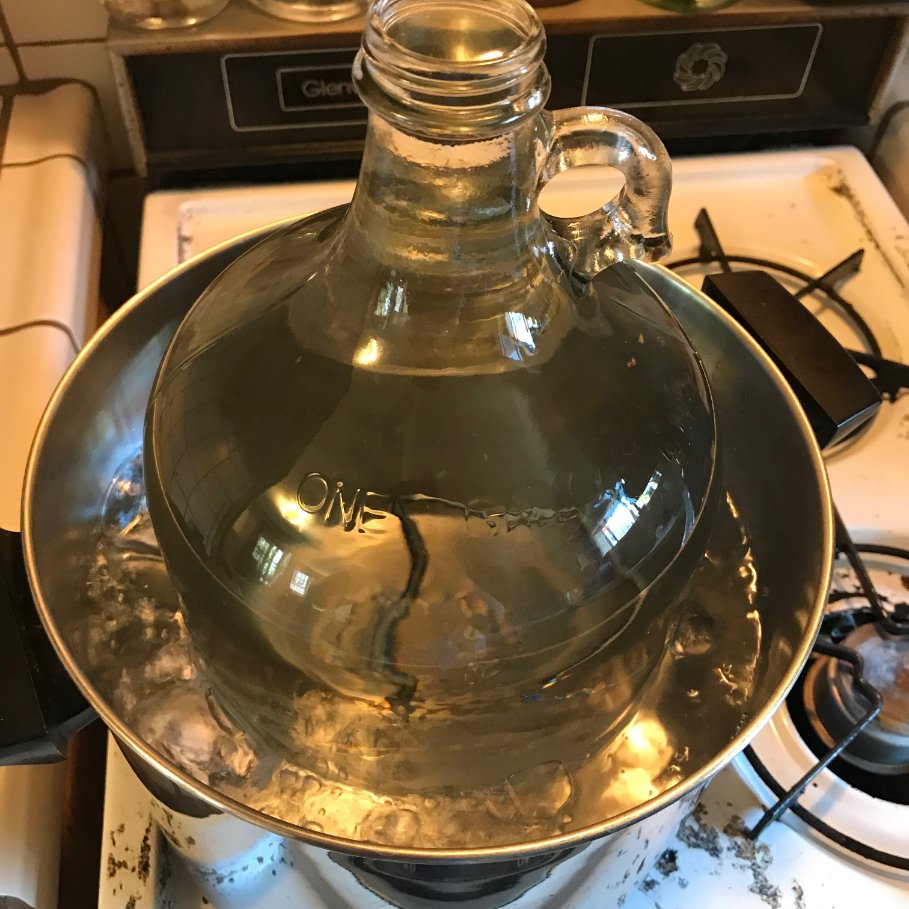
    I don't have a canning system but I thought I'd give it a try with what I had around the house. It turns out I had a big jug, so I used that as my mason jar. 

    I boiled water for quite a while inside the jar inside a pot, and then went to screw on the cap of the jug – only to find that I didn't have a cap that fits the jug :( 

    IMG-8994

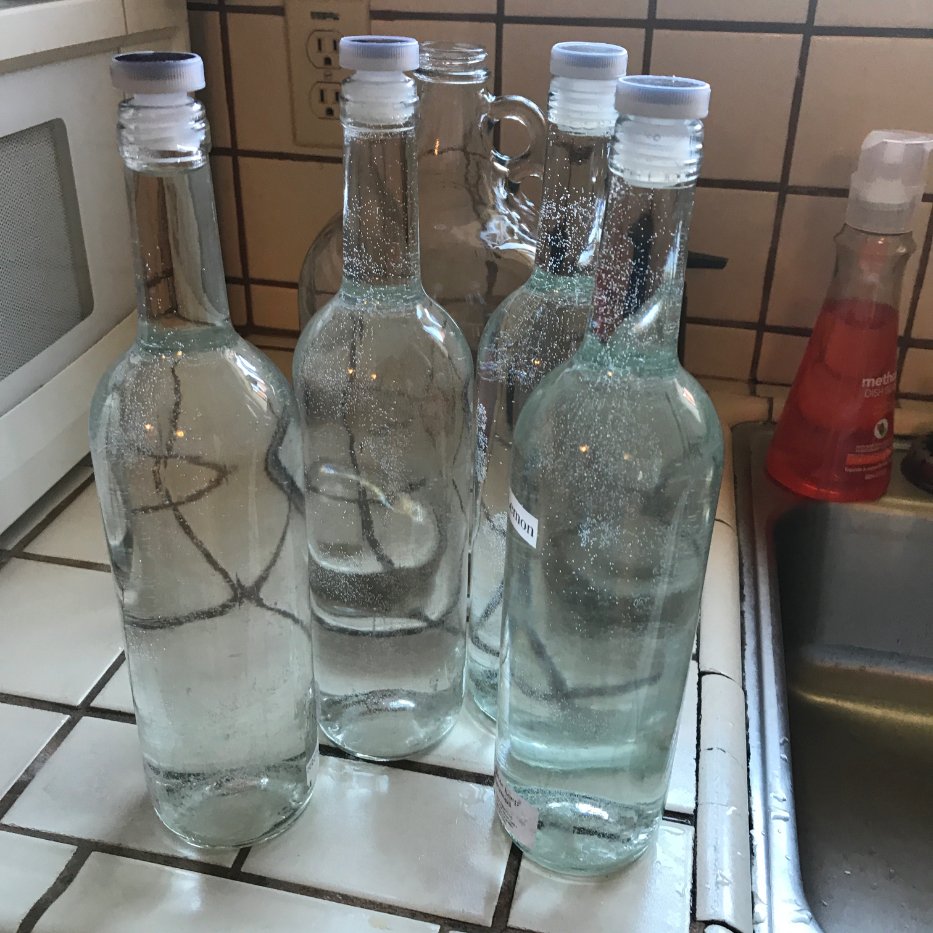
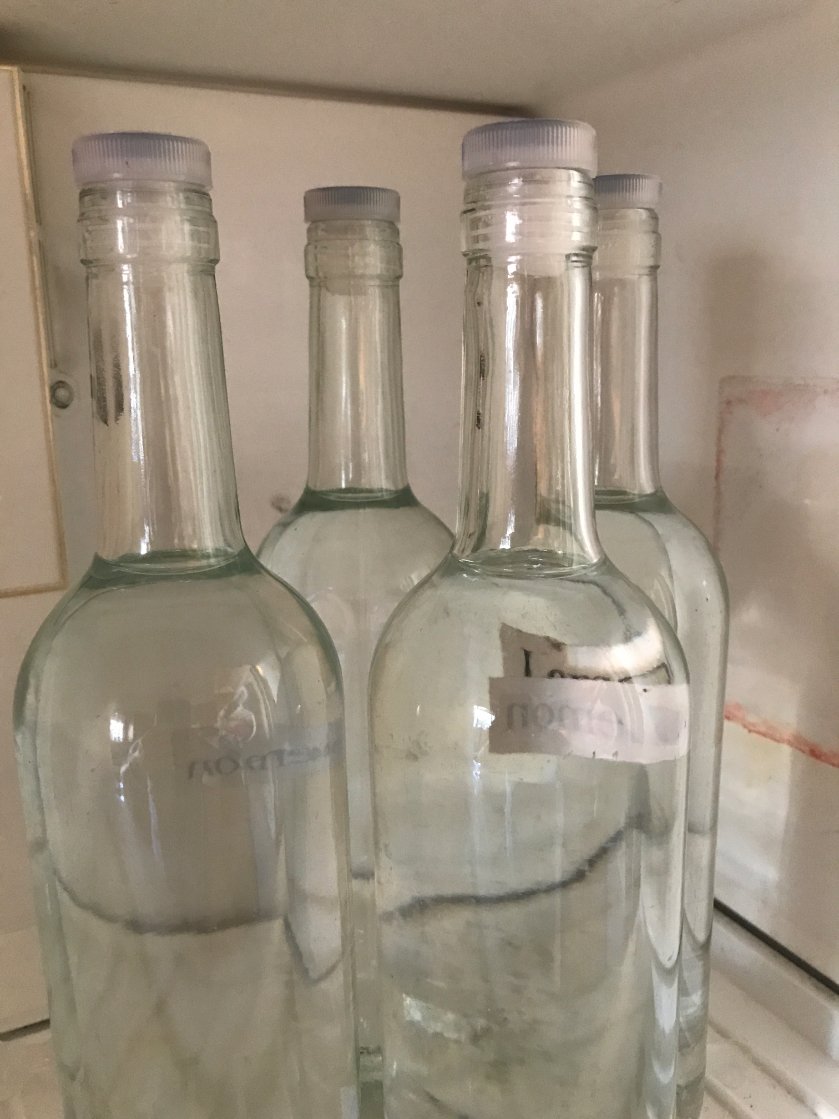
    So instead I transferred it to glass bottles for which I have plastic corks. As you can see, I filled these up all the way to the top before capping them. 

    IMG-8997


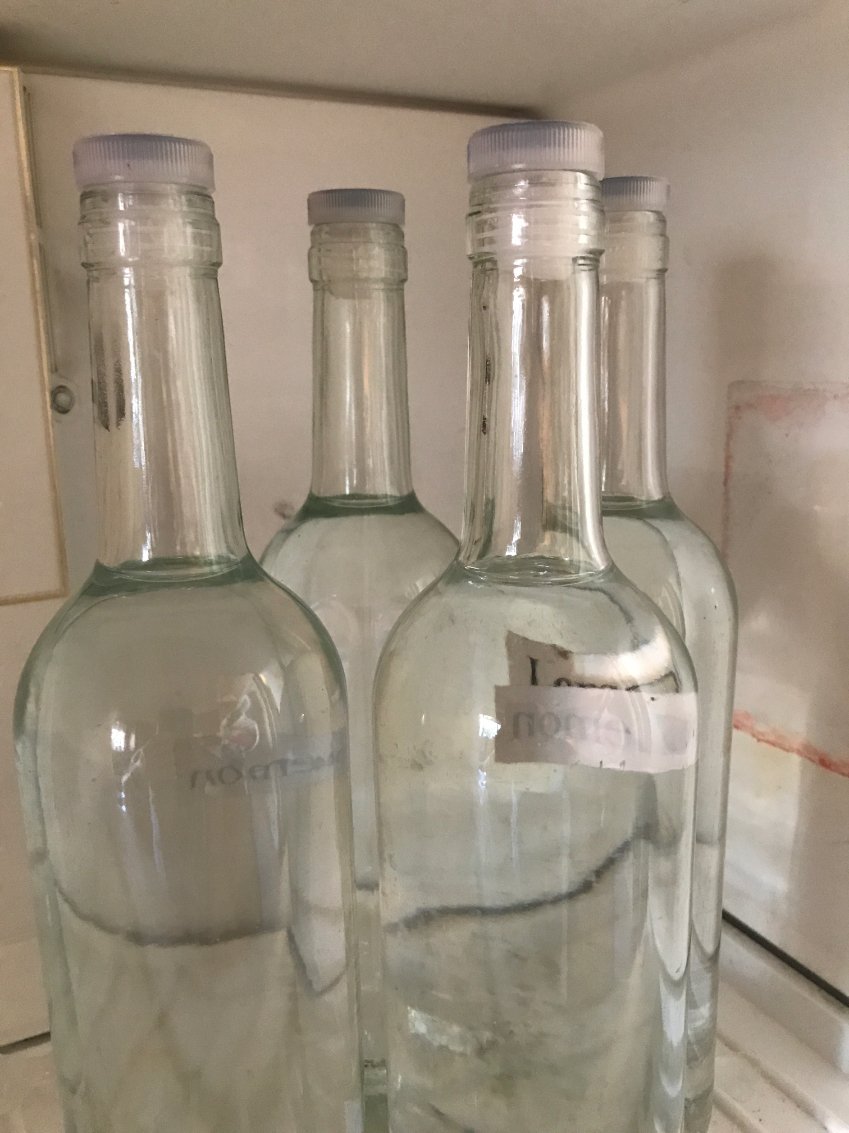
    I put the glass bottles in the freezer to cool down before transferring them to my cooler for directional freezing. As you can see, after chilling there is a lot more space in the bottle. 

    IMG-9003


    We know that hot water holds less air than cold water, so was this extra headspace the water reabsorbing air (meaning my corks weren't airtight) or that it pulled a vacuum as the water cooled? I'm not sure. 

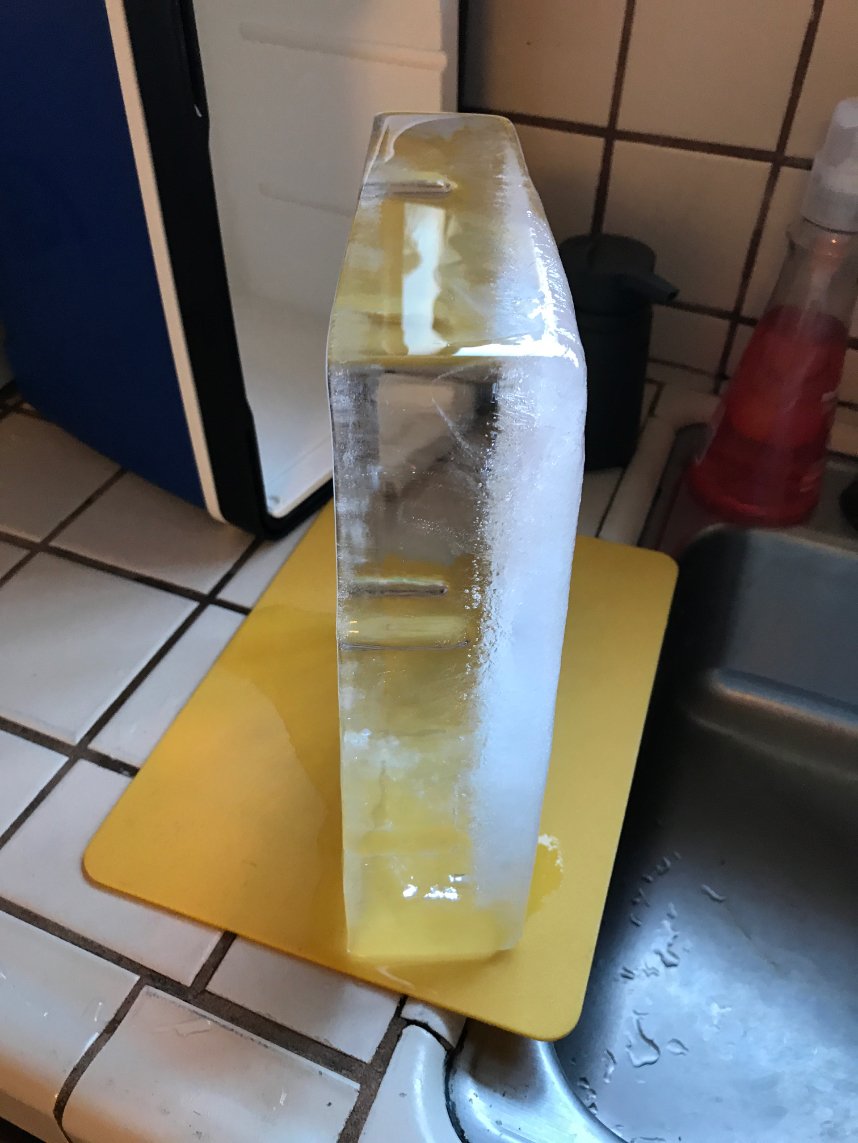
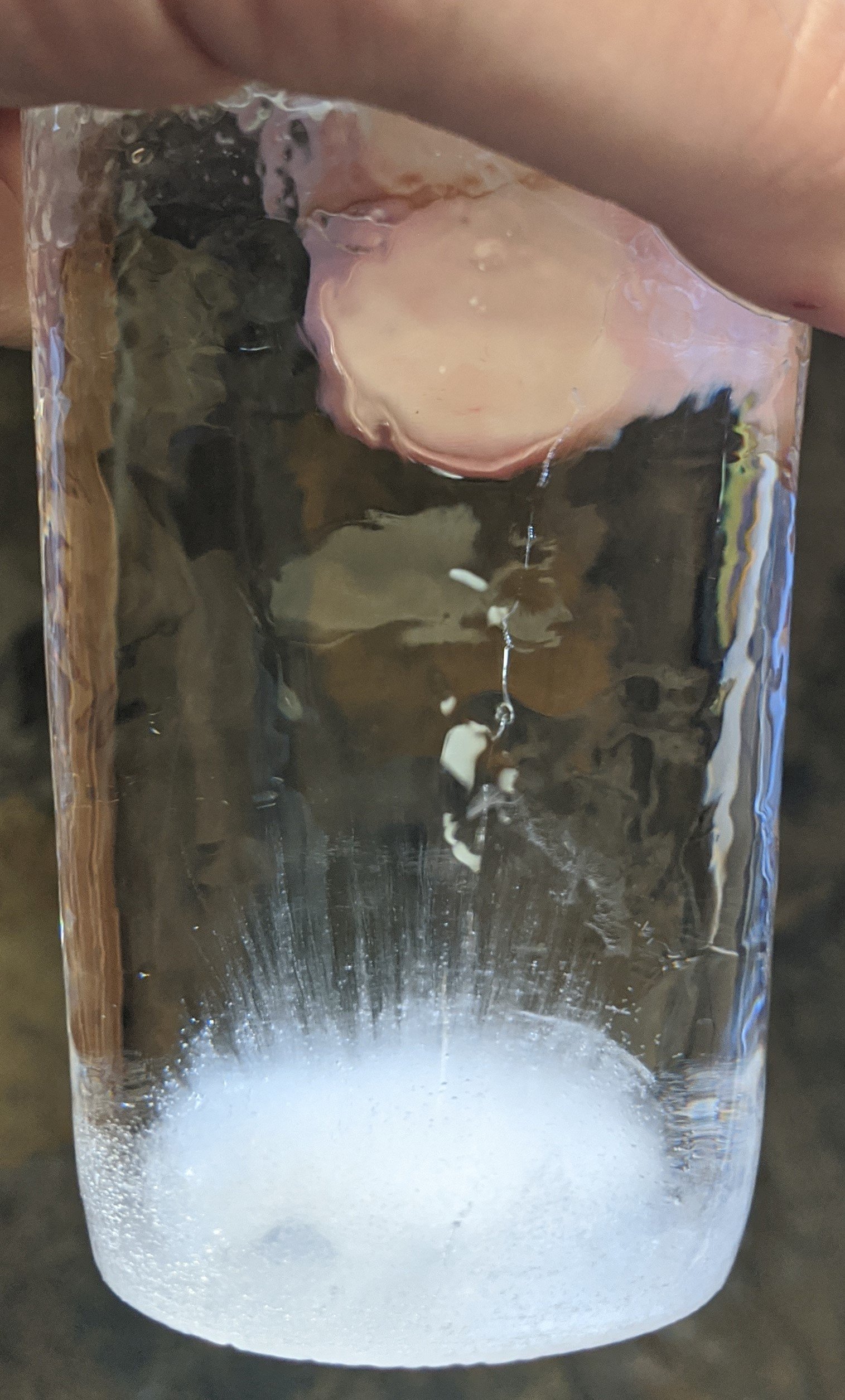
    I poured the bottles into the cooler and froze it. Unfortunately, it did not appear that using boiled water "sealed" in bottles made for clearer ice than usual via directional freezing. It looks to be about 25% cloudy ice, which is normal.

    I might have to try actual mason jars and seal them as Newell did initially to know if sealing up boiled water improves clarity in ice. 

    IMG-9009


    The index of ice experiments page on Alcademics is here.

  • An Attempt at Clear Spheres with an Upside-Down Thermos

    Alcademics reader Andy L commented on the post about how to Make Clear Ice Balls Using a Thermos with an idea: 

    Fill the ice ball with water and set the thermos upside-down on top of it like a dunce cap. This way the ice ball mold would still be insulated on the top half: Would directional freezing allow it to freeze from the bottom-up? 

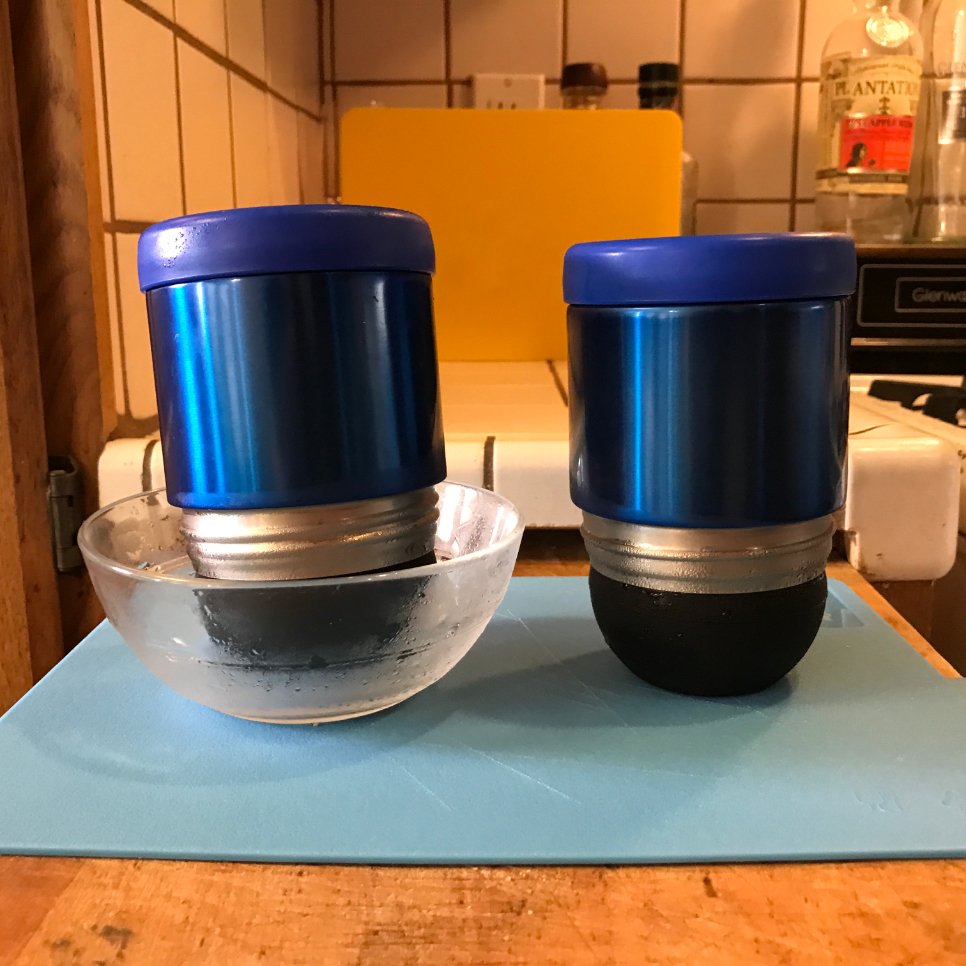
    Alas it seems not. I attempted to do this two ways:

    1. The ice ball on bottom, empty thermos upside-down on top. 
    2. The ice ball on bottom, partially-filled thermos upside-down on top. 

    The theory with the second set-up is that the water inside the thermos would provide additional insulation in case the air in the thermos wasn't doing it. 

    The set-up:

    IMG_8861


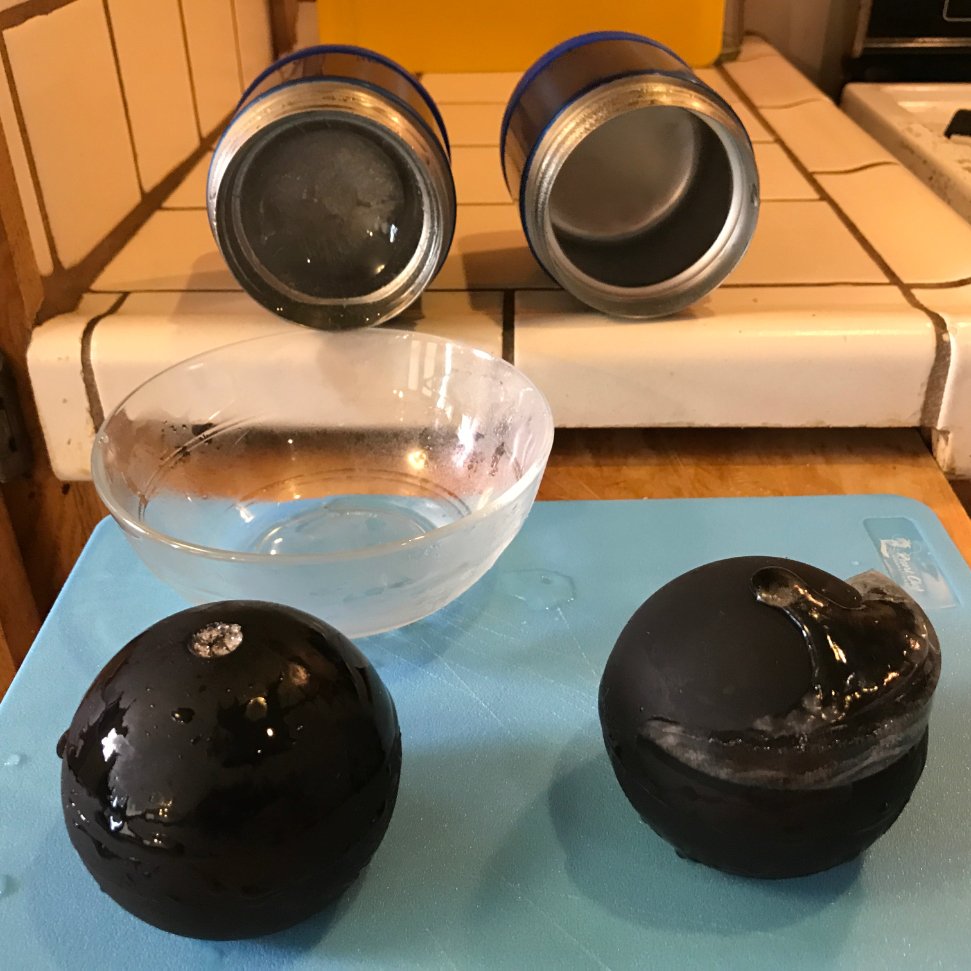
    The reveal. You can see that in the partially water-filled one on the left that the water remaining inside the thermos is frozen. On the right you can see where the water was pushed out the top hole as it froze. 

    IMG_8861

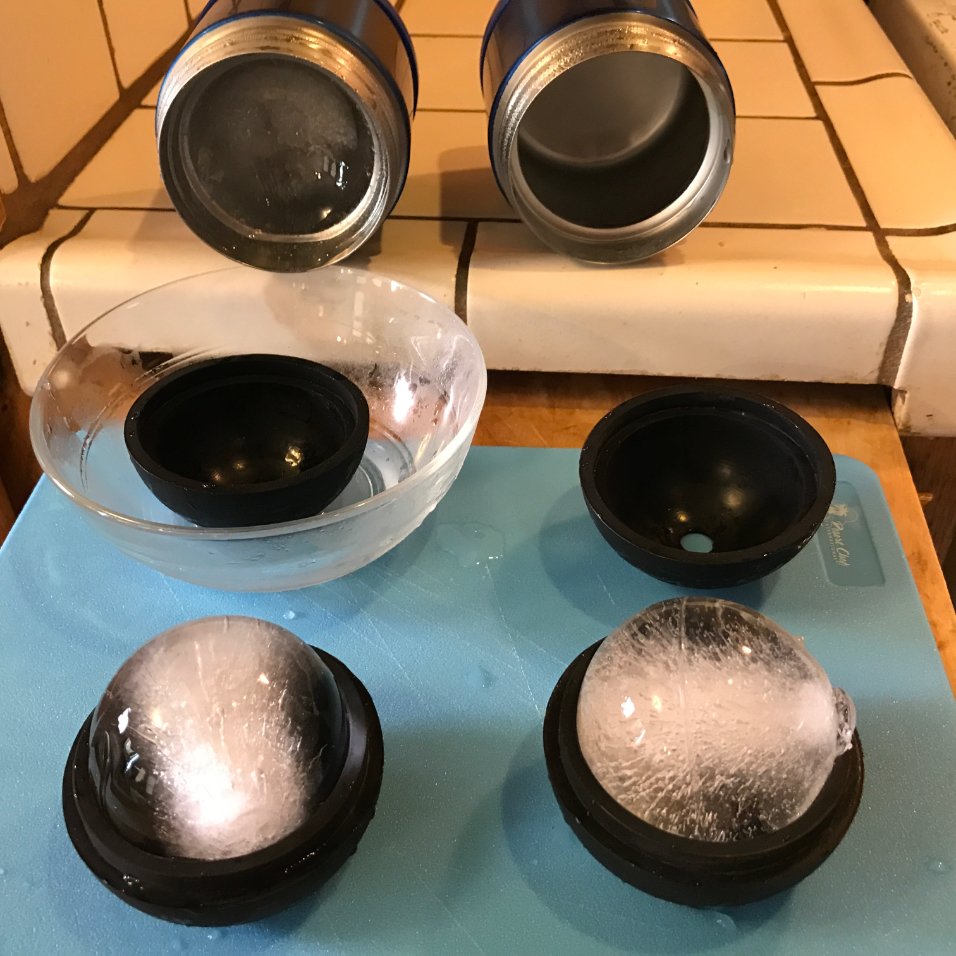
    The results: 

    IMG_8861


    In both set-ups, the cloudy part of the ice was a tornado-shaped column right up the center facing the hole (the sphere on the right is rotated sideways in the picture). So the center was the last part to freeze.

    Most likely when the first water froze it floated to the top and plugged the hole.

    Alas, it would have been great. We'll add this to the list of "experiments that didn't work" on the Index of Ice Experiments page.  


  • The Use of Fixatives in Tea-Flavored Gin: A Chat with Gerald Rowland of Coit Spirits

    It's a welcome exception to the hundreds of National Mimosa Day and other generic pitches about liquor I receive to get an email from someone who wants to talk technical details of production, and this post comes from one of them. 

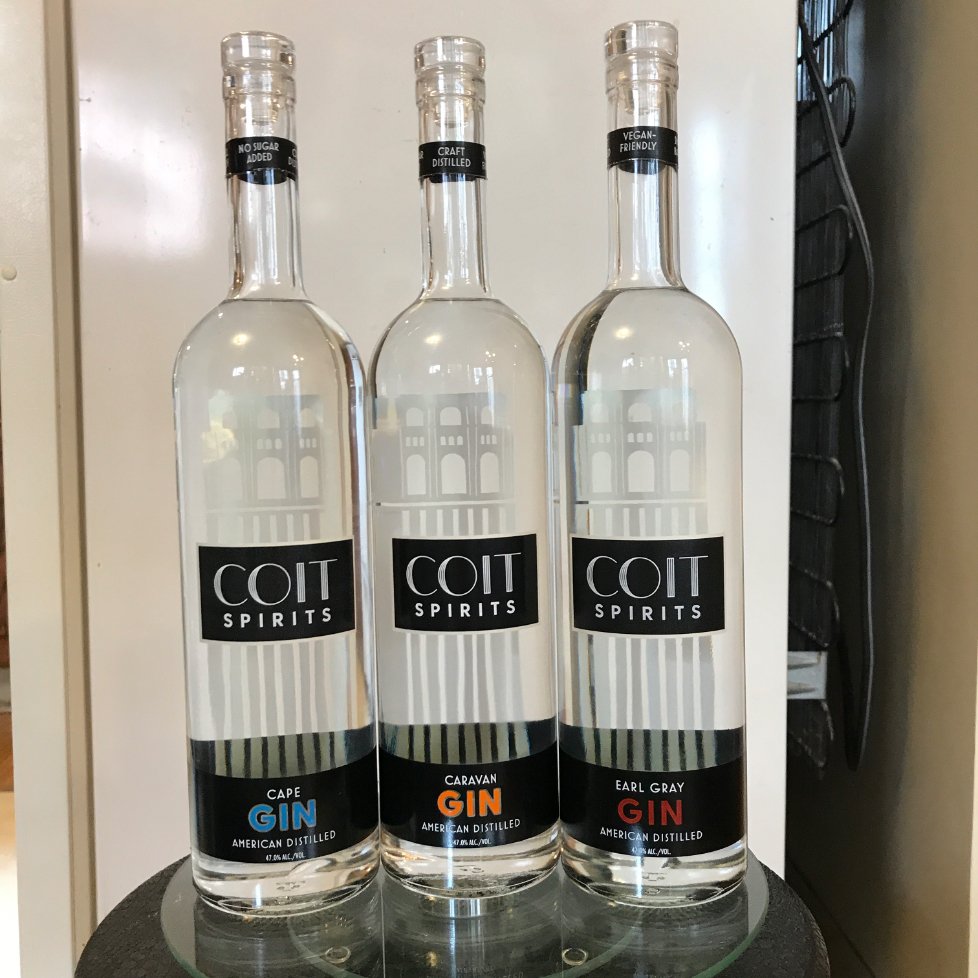
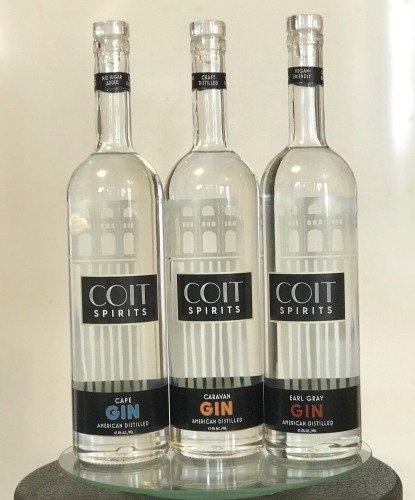
    Gerald Rowland of Rowland Cellars and more relevantly Coit Spirits sent me an email teasing information about using fixatives in the recipe for his three gins that each call for tea:

    Earl Grey Gin – with black tea and bergamot 

    Cape Gin – with fermented rooibos tea (red bush)

    Caravan Gin – with tea smoked over pine needles

    He wrote, "It took 12 months research on finding the correct plant based fixatives to stabilize the tea character that typically dissipates in 4-7 days. Normal gin botanical fixatives don't work."

    Was I intrigued? Yes, yes I was. 
    Coit spirits gins8


    Fixatives in Gin

    In my various distillery visits over the years, distillers would say that certain botanicals act not so much as flavors on their own, but as fixatives to other desired botanicals' aromas. 

    Aaron Knoll wrote a very informative article for Distiller Magazine about fixatives in gin. I'll share a few relevant quotes:

    The New Perfume Handbook describes a fixative as an “ingredient which prolongs the retention of fragrance on skin,” and is also sometimes described as “tenacity.” The other definition is summed up by The Chemistry of Fragrances as “a property of some perfume components, usually the higher boiling ones, which enables them to fix or hold back the more volatile notes so that they do not evaporate so quickly.” A fixative keeps the scent around longer. In the world of spirit production and distillation, we’re talking about the second definition.

    The Perfume Handbook, published in 1992, lists 42 separate botanicals with fixative properties. Orris root and angelica, the two most often cited by gin distillers as being fixatives, are both present; however, so are some other common gin ingredients, such as coriander and woodruff that are rarely—if ever—granted that status.

    The article concludes:

    The literature on the topic of fixatives suggests that the effect in spirits and gin may not be big—or even there at all. 

    Furthermore, even in a profession where there is a tradition of considering fixatives in the design process, perfumer Josh Meyer explains that the process is still more artistic than analytical. 


    Back to Coit Spirits and Gerry Rowland. He wrote, "Most gins that have tea in their recipe usually don’t advertise it on the label (some state tea, but I have to look for it and wouldn’t have known tea was used unless I was told) as the tea is unstable and progressively dominated by the other botanicals in the recipe over time." 

    For most of the content below I have copied and pasted and moved some stuff around from Rowland's email and our back-and-forth conversation. 


    Tea is in the Tails

    Black & Red teas brew at 200-212F to release their flavor [just below the boiling point of water], but London dry gin distillations are usually 176-185 F [just above the boiling point of alcohol].

    The tea notes in my experience will not come over unless it comes with the water late in the distillation. I have found the tea is water soluble, not alcohol soluble.

    To achieve this higher wash temp you use a lower ABV wash so the temp is higher to bring the spirit over. There is a second benefit at higher wash temperature, in that there is a true Maillard reaction of the botanicals in the wash providing a complex natural sweetness so these tea gins are made without adding sugar and yet still friendly to the palate putting them in a sip-able arena. 

    The tea [notes] comes over late in the distillation, usually after the tails cut of most London Dry Gin recipes as the root/bark botanicals are too harsh, triggering the earlier tails cut. The solution was to break away from traditional botanicals that trigger an early tails cut so you can capture the tea notes avoiding the harsh flavored botanicals.

    In other words, some botanicals of traditional gins would need to be left behind so that they didn't interfere with the tea notes in the tails cut. 

    Tea Fixatives in Gin

    I spent as much time solving this as I did working on the recipe and the above. The tea molecules are highly charged and bind with the other botanicals. In doing so there is a polymerization of botanical molecules that provide mouthfeel but the tea definition is lost as the molecule gets too large for our sensors to perceive them. This usually takes 4-7 days and occurs if the tea is distilled or steeped. 

    After 4-7 days steeping you have tannin expression but the subtle character of an individual leaf is lost. This fine tea character loss occurs irrespective if you steep in water or distill, the tea character immediately starts degrading post production of the liquid and after 4-7 days lapse post production the fine tea notes are gone.

    When distilling with tea the tails cut is before the tannin comes over so you capture the essence of the fine tea character note without the aggressive tannin body of the tea.

    So the tails cut of the gin is between the tea flavor and the tannins, if tannins come over at all in distillation. 

    There is an argument I have heard that gin doesn’t need fixatives, this might be true for spirit-based aromas & flavors of London Dry gins, but for water-based aromas & flavors missed in most LDGs (London Dry Gins) because of the earlier tails cut. In my experience I find them critical for water based aromas & botanicals. People who make tea extracts find the same as does the perfume industry and why we have fixatives from a century old industry.

    There may be a case that if you don’t have any water based flavors & aromas that fixatives don’t matter and this may be true for many LDGs. 

    For me the solution was to look to the perfume industry at fixative botanicals that the right lock & key configuration to bind onto the tea molecules active polarized sites to keep it a small and discrete molecule blocking its charged receptor sights from other botanicals. Although this creates a stable molecule larger than the tea molecule it is still small enough that we can perceive it with our sensors.

    Trial and Error and Three Fixatives

    When I look at a fixative being successful for Coit Gin it has needed to both protect the aroma and promote lingering. 

    The perfume industry uses the fixatives at much higher rates being at 100-1000 times higher than the rate I use in Coit gin to achieve tea stability. Fixatives in perfume can affect the product in 3 or more ways.

    1) They can be an ingredient directly providing an aroma.

    2) Provide fixative qualities to unstable aromas, protecting the aroma character.

    3) Increasing the persistence intensity and lingering ability of an aroma.

    As far as fixative use in Coit gin it’s for stability its strictly points 2&3 from above, protecting aroma character & increasing the longevity or persistence of the aroma.

    It took three fixatives botanicals to truly achieve stability and that were FDA-approved for consumption, as perfumes are topical whereas gin is internal. This took multiple parallel experiments to determine the rate of each fixative with each other.

    The first fixative took stability out to 30 days at which time a small change was noted indicating a second fixative was required as more of the first fixative didn’t help. The second fixative extended the stability out to 90 days with a small change requiring a third fixative. The third fixative achieved stability.

    If these experiments had been done consecutively instead of parallel it would take 1-2 decades before you would have these results. I tested many more than the 3 final plant based botanical fixatives when I went into production as no single fixative would do the job.

    Once we worked out the maximum levels to prove stability we had to retest to minimum levels so the fixative botanicals did their job but did not influence the character of the recipe.

    Parallels in Perfumery

    I asked Rowland if he could share any examples of perfume fixatives (certain he wouldn't want to reveal the specific three used in Coit gins) so that we could have an idea of how they work. He wrote: 

    I provide the following selection as an example from Eden Botanicals

    Note: I make no representation as to their FDA approval for use in USA.

    Some Common Fixatives:

    Amyris: Has a very tenacious, rich, complex odor that quickly fades out to a weak woody-balsamic scent, but is still a well-known fixative; it finds extensive application as a mild blender in numerous types of perfumes and blends well with lavandin, oakmoss, citronella, rose, Virginia cedarwood, etc.

    Clary Sage: Has an herbal-sweet, nut-like fragrance with unusual tenacity; somewhat heavy with a balsamic, ambergris-like dryout reminiscent of tobacco, sweet hay, and tea leaves. An excellent fixative that can be used with perfumes of a more delicate bouquet, and with bergamot, cedarwood, citronella, cognac, cypress, geranium, frankincense, grapefruit, jasmine, juniper, labdanum, lavender, lime, and sandalwood.

    Liquidambar (Styrax): Has a very rich, sweet-balsamic, faintly floral, somewhat spicy aroma, with a peculiar styrene topnote and resinous, animalic, amber-like undertones; to be used most sparingly and has excellent fixative qualities. An important element in lilac, narcissus, jonquil, hyacinth, jasmine, tuberose, and wisteria bases; it also blends well with ylang-ylang, rose, lavender, carnation, violet, cassie and spice oils. Benign solvent (ethanol) extracted Resinoid.

    Oakmoss: Has a heavy, rich earthy-mossy, bark-like and extremely tenacious fragrance with a high fixative value; blends well with virtually all other oils, including lavender and ylang-ylang. Used to lend body and rich natural undertones to all perfume types.

    The Choice of Fixatives for Coit Gins

    On the brand's website, they list that there are 10 botanicals in the Earl Grey gin. I asked if the three final fixatives were counted among them. 

    The fixative botanicals are counted separate as they are at so low rates and don’t contribute flavor. My mindset was when I provide the botanical number it is about botanicals that provide the flavor and you could identify in the gin spirit.

    I asked if the fixatives in Coit gins are detectable flavors, or if they're purely functional. 

    It took many months once finding the 3 to achieve the absolute minimum required of each when working in conjunction with each other.

    At these low levels if I increase a fixative botanical rate I can see a change in expression of the tea notes but cannot pick the characteristic of the fixative itself. So the rates at these low levels are very critical. Different rates will have different effects. Fixatives are very dynamic on their rate of use effect as to protecting the aroma, persistence of the aroma and subtly influencing the aroma it is working on to swing it from a slightly savory floral note to a slightly sweeter floral note.

    All 3 fixatives originate from plants i.e. root, leaf, flower, bark, stem. I also tested many highly processed plant compounds and other non-plant compounds to see what worked best, but none of the alternatives were as good as the 3 I found. In Coit’s case I was fortunate with the 3 that I found, were all of plant origin and in alignment of my mindset of a natural, vegan friendly product.

    I didn't get the vegan-friendly thing until I later read the fixative article in Distiller magazine linked above, which states, "Throughout the history of perfume, the most important fixatives have been heavy, animal-derived products. Musk from civets and ambergris from whales are among those derived from fauna, however, distillers tend to draw their fixative heritage from the flora side of things."

    So all of that is very interesting, and nothing I'd spent much time thinking about previously. I hope you enjoyed geeking out with me. 


    Other Products

    Worth mentioning is that Coit Spirits also has a bourbon on the market and potentially a fourth gin on the way. 

    The bourbon is as transparent as the gin. From the website:

    Indiana Straight Bourbon Whiskey, High Rye, Four Grain, 49% ABV

    Distilled and aged on site in Indiana at MGP 

    Unique for MGP is the 4 grain bourbon, the corn and rye provide the backbone, the wheat uplifts both aroma & flavor, and the barley harmonizes the three.

    Straight Bourbon Whiskey, straight from the barrel, assembled, proofed and into the bottle. No charcoal or cold filtration. 49% ABV


    And about that fourth gin we may see in the future:

    I am also working on a truly indigenous gin to the Pacific Ocean and coastal Pacific Ranges of the West Coast USA. I am 2+ years into this recipe and 80% there but still working on the finish.

    Some producers have a ‘local or native gin’ these usually contain botanicals that were never indigenous to their region with local but ‘introduced botanicals’ or cross bred sub species; for example a citrus developed/cross bred in Riverside so technically from the USA, but citrus as a species never existed indigenously in the USA in the first place.

    So credit to those producers for being creative but it highlights the difficulty in a truly indigenous recipe that I am working as opposed to native or local.


    I look forward to trying the gins (and bourbon) out now and the native gin down the line. 
     

    Coit spirits gins6

  • Canning Water to Degas it for Clearer Ice

    Today's post comes from the work of reader Richard Newell. We'll call it the "canned water" technique for improving ice clarity. 

    We know that the cloudiness in ice comes mostly from trapped air and impurities, which usually are pushed to the center of an ice cube when it freezes. The technique of directional freezing just relocates the air to one end of an ice cube/block rather than eliminates it. [see all the ice posts on Alcademics here]

    Many people have attempted degassing the water to remove the air in various ways – mostly by boiling it, but others have tried putting it under a vacuum. As far as I know, nobody has been successful at fully degassing water so that the ice made with it comes out perfectly clear. 

    Today's post unfortunately isn't a fully-degassed ice system either, but it does seem to point to a fairly large visible improvement by using water that has been "canned" – using a canning technique but canning water alone appears to improve the clarity of ice made with that water. Newell used an Instant Pot to do the canning, making it super easy. Traditionally-canned water also works. 

    Let's start with Newell's conclusions:

    • Vacuum is a good (if not essential) method of home degassing of water [in an Instant Pot]
    • "Canning" is a convenient way to "pull a vacuum" on water with simple equipment
    • A pressure cooker is not required to get good results
    • Distilled water makes little or no difference (assuming your starting water is not too bad)
    • Boiling (without a vacuum) does not do an adequate job of degassing [without sealing].
    • All of my results also depend upon top-down freezing.

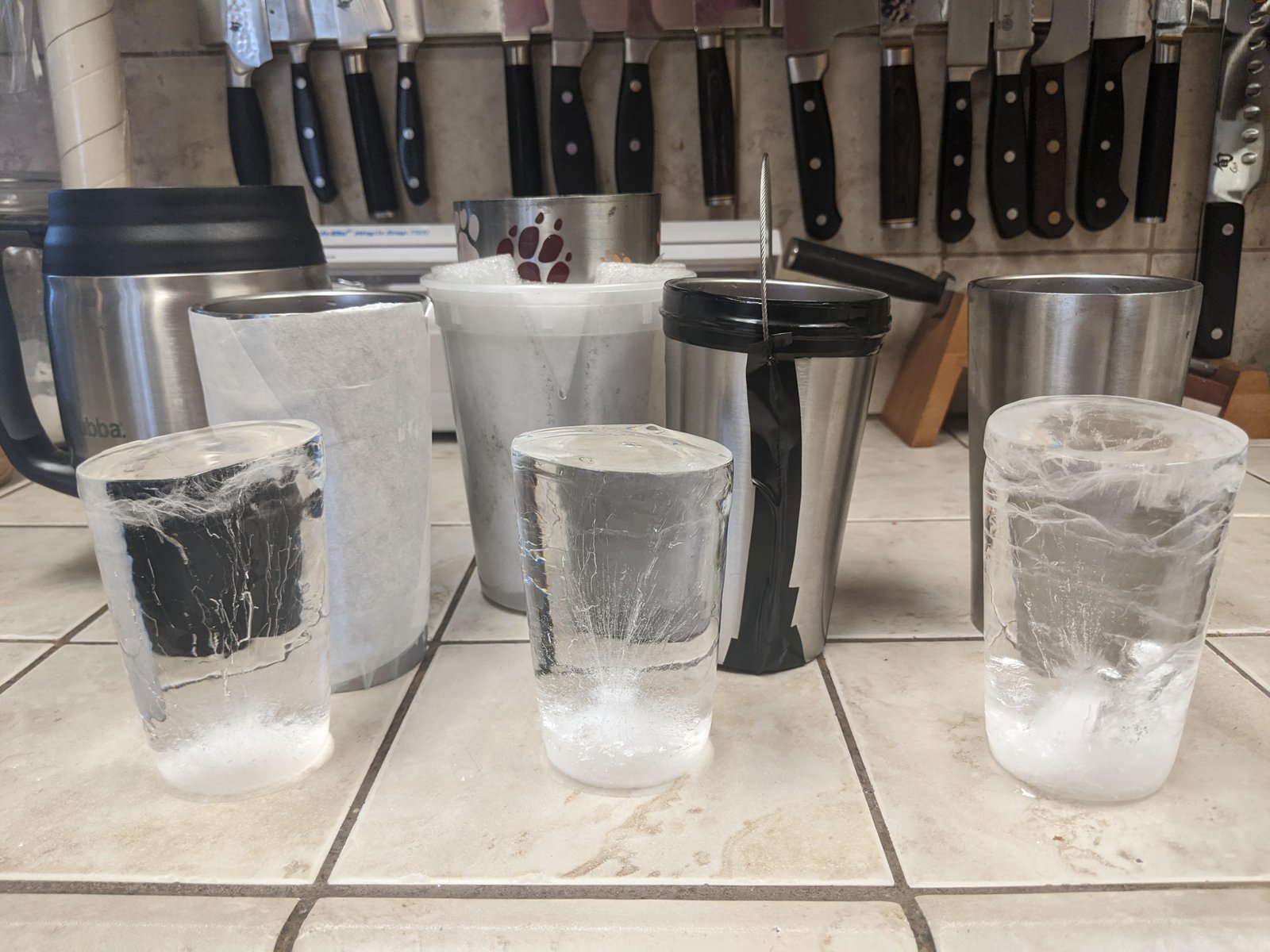
    The below image is of "canned water" that was cooled and then set into aluminum thermoses to freeze with directional freezing. Note that there's just a tiny amount of cloudy water at the bottom. 

    Unnamed

    This is compared with non-degassed water in the same thermoses:

    Non-degassed


    We went back and forth in email so this is an edited version of a series of emails and later experiments. Newell says:

    I have had success in removing the gas in the water using a combination of boiling and vacuum with various set-ups, some more complicated and labor intensive than others. Then, I discovered this simple and nearly foolproof technique: Use traditional canning techniques and "can" the water in a pressure cooker. Especially with an instant pot type cooker this is dirt simple and doesn't require much labor or monitoring.

    Then, I use the top-down freezing technique to make blocks of ice that I then mold into spheres. [The image above is "canned water" frozen inside insulated thermos, so directional freezing from top-down.]

    I use filtered water, mainly since the local tap water tastes so bad. I fill some mason jars with the water with a 1 to 1.5 inch head-space, put on the lids and rings "finger tight" only and set them in a water bath in the cooker.

    I put them in the electric pressure cooker for at least the 8 minute automatic cycle, and walk away until it completes. When it is done, I release any remaining pressure, remove the jars, and fully tighten the bands.

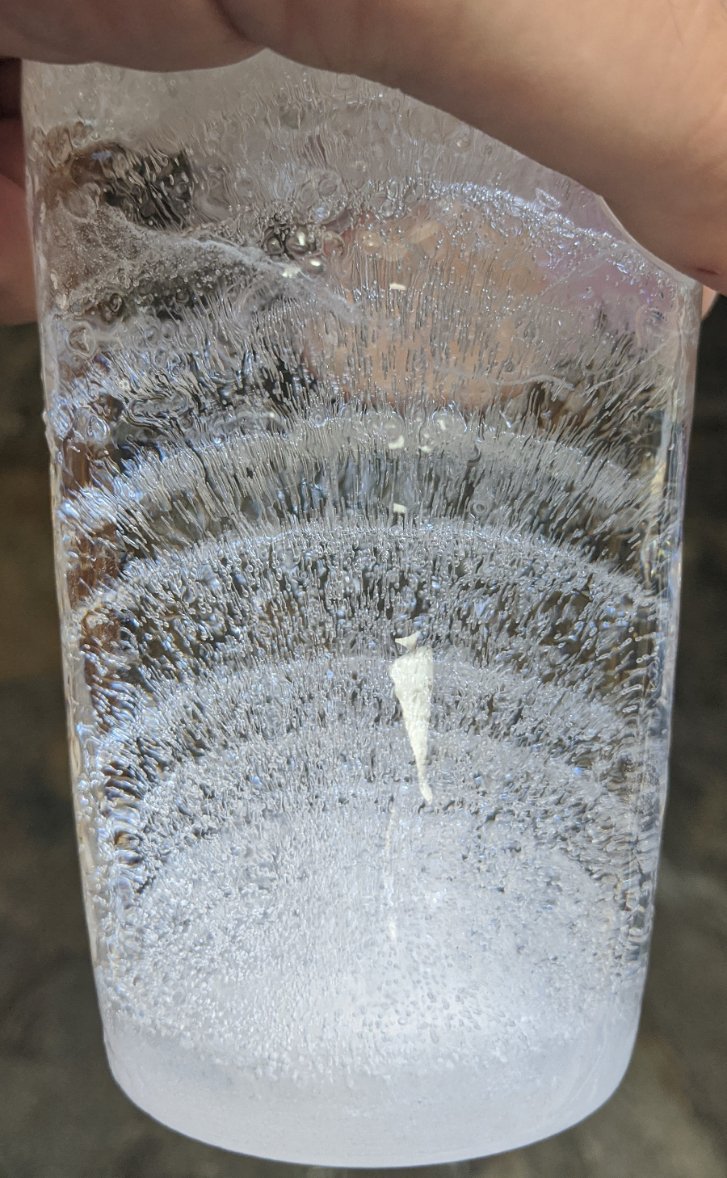
    As you can see, there are no bubbles, and the top-down freezing left almost no minerals in the top section of the ice. The bottom-most part, is of course, cloudy. After a lot of experiments, too numerous to detail, this method is the most simple and foolproof I have found.

    I confirmed that Newell was using glass jars, not fully filled with water and not submerged completely in water, and that there is air headspace in the jar when he does it. This is important because my assumption would have been that any headspace in the jar would contain air that would reabsorb into the water. 

    The head-space fills with steam during the pressure-cooking, and when the jars cool the steam condenses and creates a vacuum, sealing the lid. So, the head-space is essential to pull the vacuum used to seal the jars during cooling. The lid acts as a one-way valve: during heating the lid lets steam escape (which is why you don't tighten the bands completely before cooking; the jars might explode), and then during cooling the lid gets sucked down to the jar and seals. The drop in pressure actually causes some more of the hot water in the jar to boil as the headspace cools.

    Thus, there really is not that much air in the jar to reabsorb… the head-space is filled mostly with water vapor. I think the vacuum may help remove any remaining dissolved air in the water. I typically leave the jars sealed overnight, and freeze the water from them the next day, though I don't know for sure that this delay is necessary. But, it easily fits into my work flow and has become my habit.

    I asked why tighten the bands (the lids) at all, and just pour it into the molds at this point? 

    That might work, but I haven't tried it. I always let the jars seal and pull an internal vacuum, as I described above. The jars usually seal themselves without tightening the bands, but just to make sure, I usually still tighten them during cooling.

    Back when I was experimenting with simple boiling, I tried going direct from the stove-top to the tumbler, but it didn't really help. I suspect that the water, even when boiled for a long time, was never degassed enough. I believe that reduced pressure is an essential step, as the only experiments I have done that succeeded have all used a partial vacuum as part of the process.

    I tried boiling followed by a vacuum, and this did work well. One way I did this was with a vacuum sealer (like a Food Saver brand bag sealer) that has a vacuum pump. You can buy an attachment for most of these type devices that fits over a mason jar to pull a vacuum in it without having to heat/boil it (to seal a jar of nuts, coffee, or flour, for example). But, this was a big nuisance and a bit dangerous to use with hot water. I also experimented with valves and other complications.

    Then, I hit upon the pressure canning scheme, which boils the water (actually, at a higher temperature, due to the pressure), and pulls a vacuum inside the sealed jars during cooling, and is dirt simple.

    Then Newell did some additional experiments: 

    • Using distilled water in the same set-up
    • Rather than canning under pressure in an Instant Pot, doing the traditional canning technique that would be used to sterilize Mason jars 

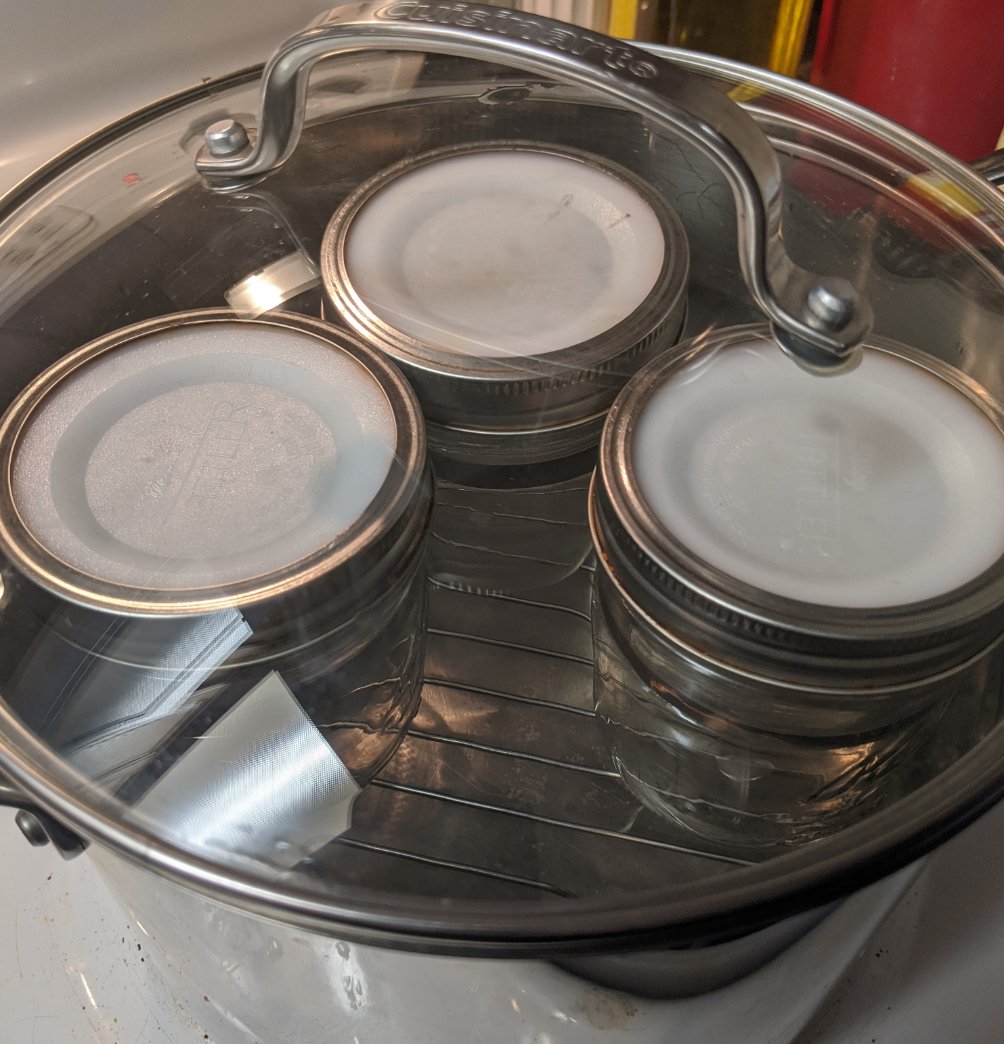
    I "canned" some water using low pressure (i.e., atmospheric-only, or "no extra pressure") where the boiling point of water is about 212 F. (Note, I am near sea level). This gave essentially the same results as "high pressure" canning using a conventional pressure cooker, or equivalently, an electric pressure cooker like an Instant Pot, that adds about 15 psi and hence water has a higher boiling point (about 250 F.).

    Note that I have a grate at the bottom of the pot to lift the jars a bit off of the bottom of the pan. As anyone who has done much canning knows, if you put the jars directly on the bottom of the pan over the heat, the violence of the boiling can break the jars.

    I boiled this for roughly 20 minutes, to make sure the water in the jars reached the full boiling point. Then, I removed the jars and fully tightened the bands, and let them cool. 

    The results after top-down freezing look essentially identical to when I used the high pressure cooker (see below). Nice and clear with no bubbles except the artifacts at the bottom. 

    Traditional Canning Set-up and Resulting Ice:

    Non-pressure de-gassed iceNon-pressure de-gassed ice

    One more experiment, using the "canned water" technique with distilled water. 

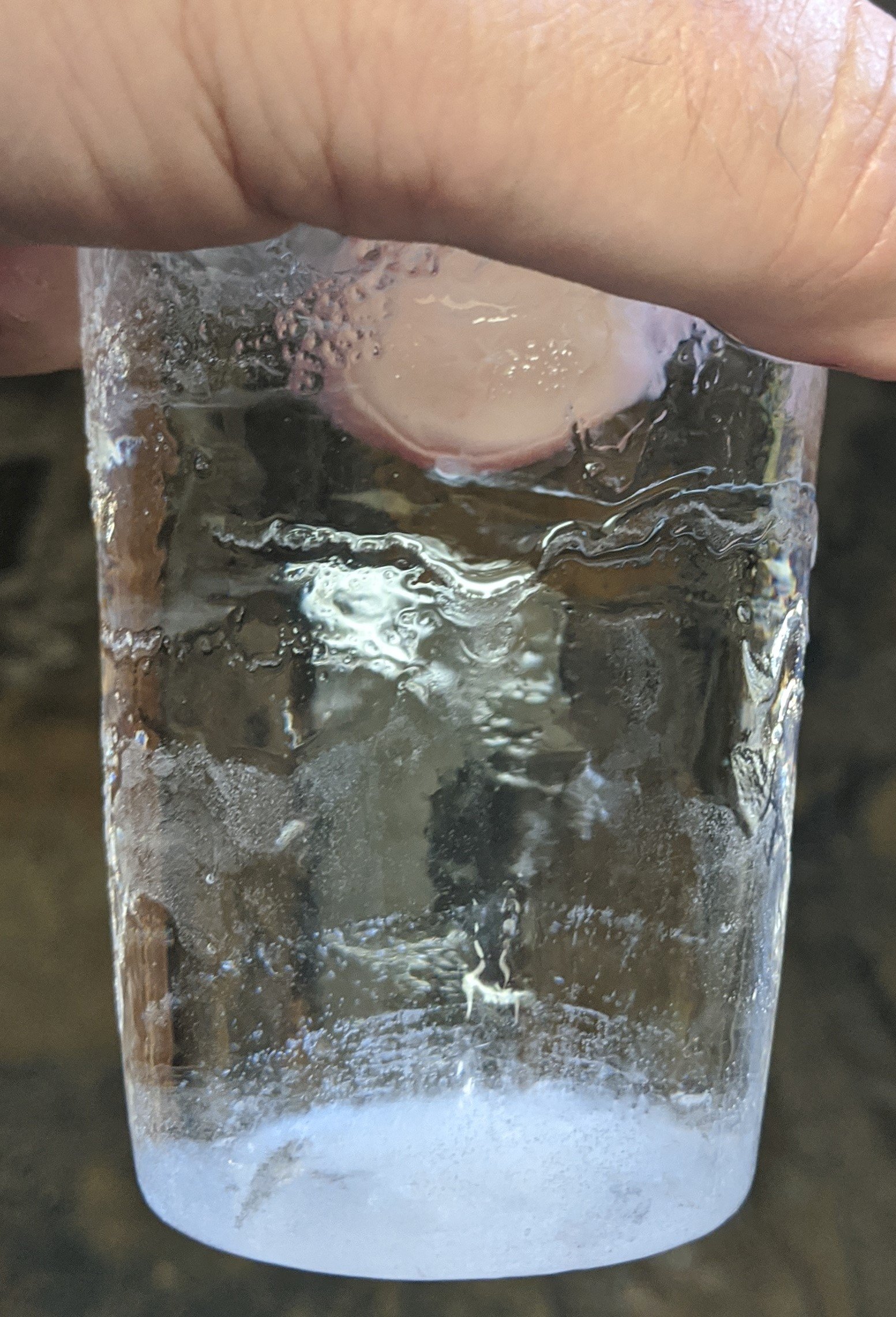
    Finally, I also ran an experiment with distilled water. I took a quart of my usual filtered water and distilled a pint of "extra pure" water from it. This I ran through my usual pressure-canning de-gassing process, and then froze it. Here is the result (below). The distilling made no noticeable difference. Still clear in the middle (due to the de-gassing), but still having the same artifacts at the bottom after top-down freezing.

    So, you don't need a pressure cooker to de-gas the water. A simple pot and a mason jar will do the trick. Distilling is a waste of effort.

    Distilled de-gassed ice

    Another conclusion 

    My belief is that as long as the jars seal and form an internal vacuum during cooling, the results will be satisfactory.

    In conclusion, it appears in this set-up is effective at reducing cloudiness in ice.


    Analysis

    If the pressure in the canning step in the Instant Pot is not crucial, then perhaps the main factor is that after boiling, the mason jars are sealed. Many of us ice nerds have tried boiling the water and then freezing it (with some improvement in clarity but in my estimation not worth the added effort)

    So it appears that the sealed water doesn't reabsorb nearly as much air when kept under a vacuum as it would when cooling from boiling unsealed. I had always figured that water would naturally reabsorb most of the air when it was cooled to come to equilibrium (after being sealed or not), but maybe not!

    This makes me want to do a bunch of experiments (or, you know, inspire you to do some experiments and share your results):

    1. Repeat this "canned water" method just to verify it works for others
      1. The ideal set-up would be a double-walled aluminum or other deformable container that could be canned and then put into the freezer while still sealed. 
      2. Or I suppose we could just sacrifice a mason jar – can the water and then make an insulated sleeve for the mason jar to encourage directional freezing.
    2. Repeat this "canned water" method but put the water in an Igloo cooler set-up like we do for traditional directional freezing to see if it improves ice clarity.
      1. This should be compared with boiled, uncanned water.
      2. It's possible that the large surface area of the cooler would allow for more reabsorption of air into the water as it freezes.
        1. If this experiment fails, it would be interesting to try putting some sort of lid or just a layer of plastic wrap on top of the water to see if it improves clarity. Actually it would be interesting to do this with just regular water/boiled water! 
    3. Buy some commercial canned water like this or this,  though I wouldn't really expect them to have been canned at high temperatures. 
      1. And see what happens when your stick it in the freezer. Likely the can would burst as water expands when it turns into ice, but then cut open the can to see the cloudiness of the ice inside. 
      2. Or get it super cold first, then open the can and transfer it to a directional freezing system.


    So… long post and lots of homework, but it's been a while since anyone seems to have come up with an improved technique so let's get to work. Thanks much to Richard Newell for doing the work and sharing it with us. 


    The index of ice experiments page on Alcademics is here.


  • Cherries Frozen Into Ice Balls

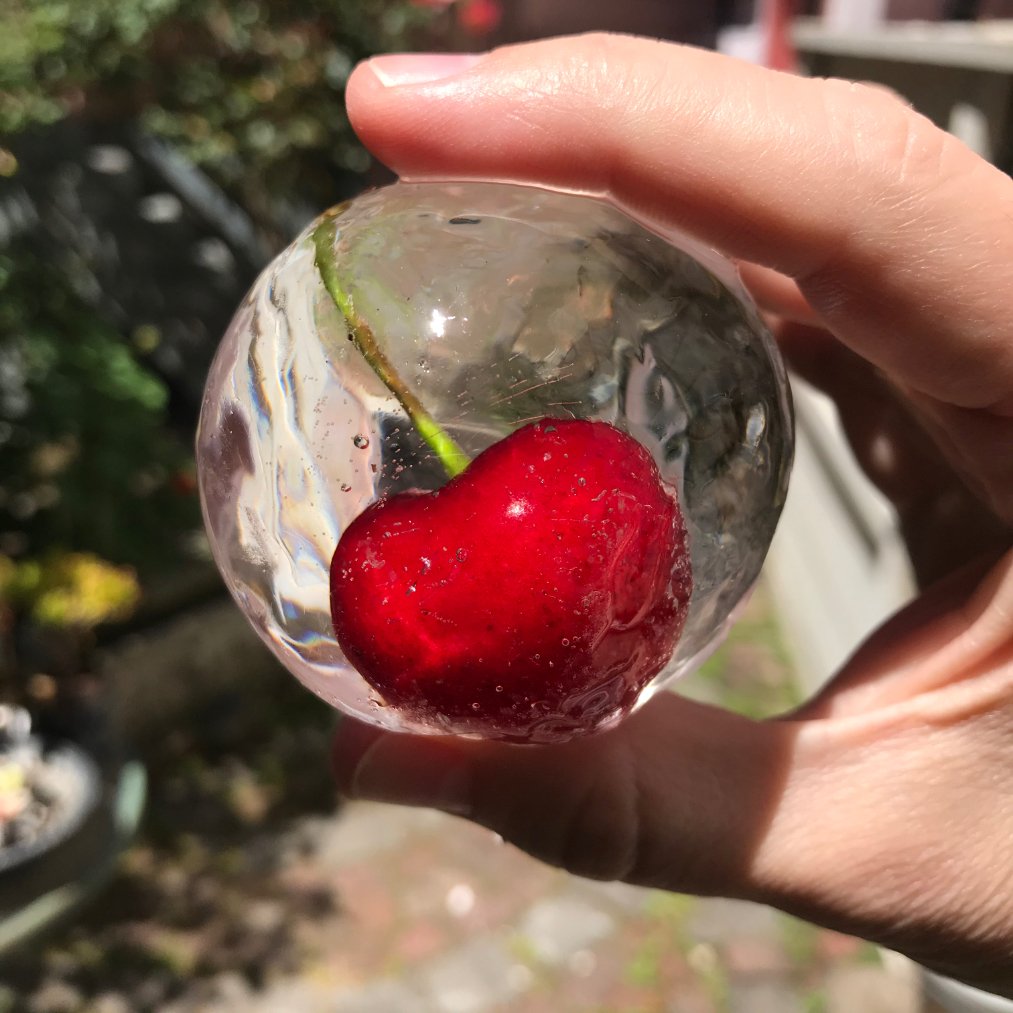
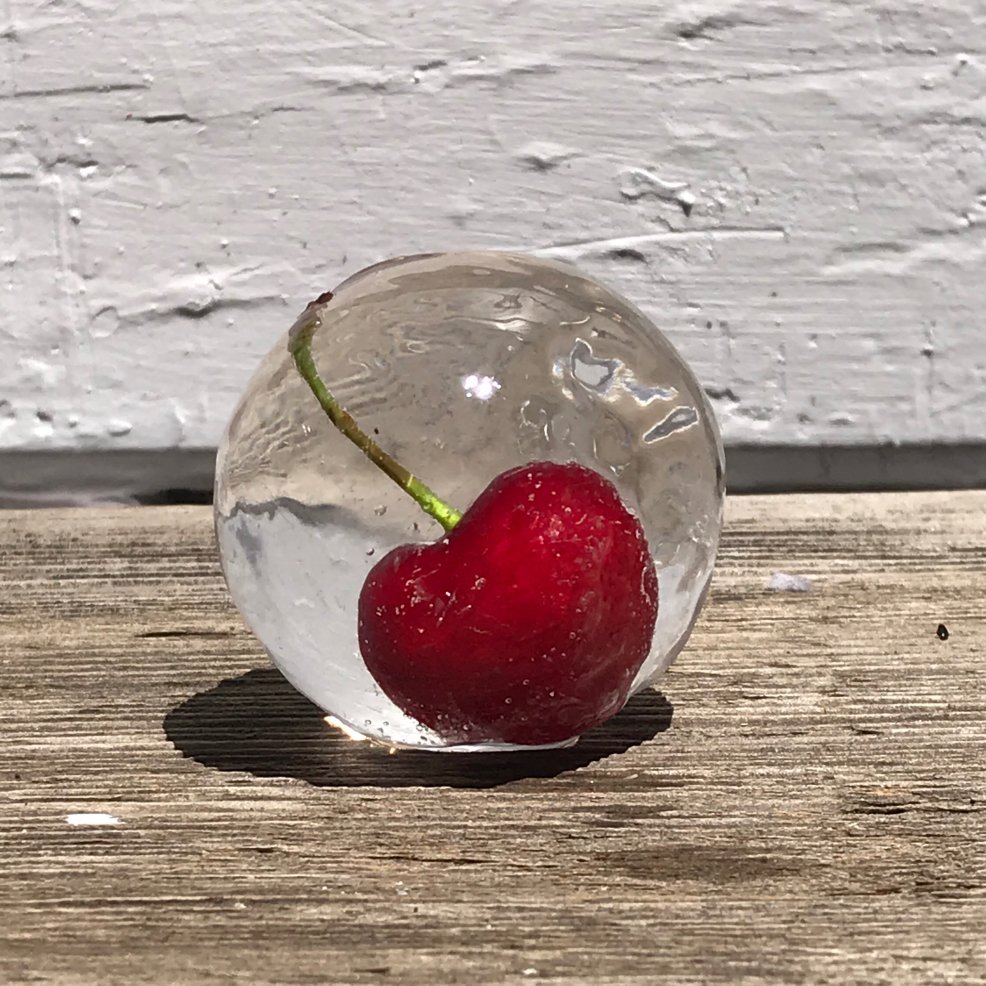
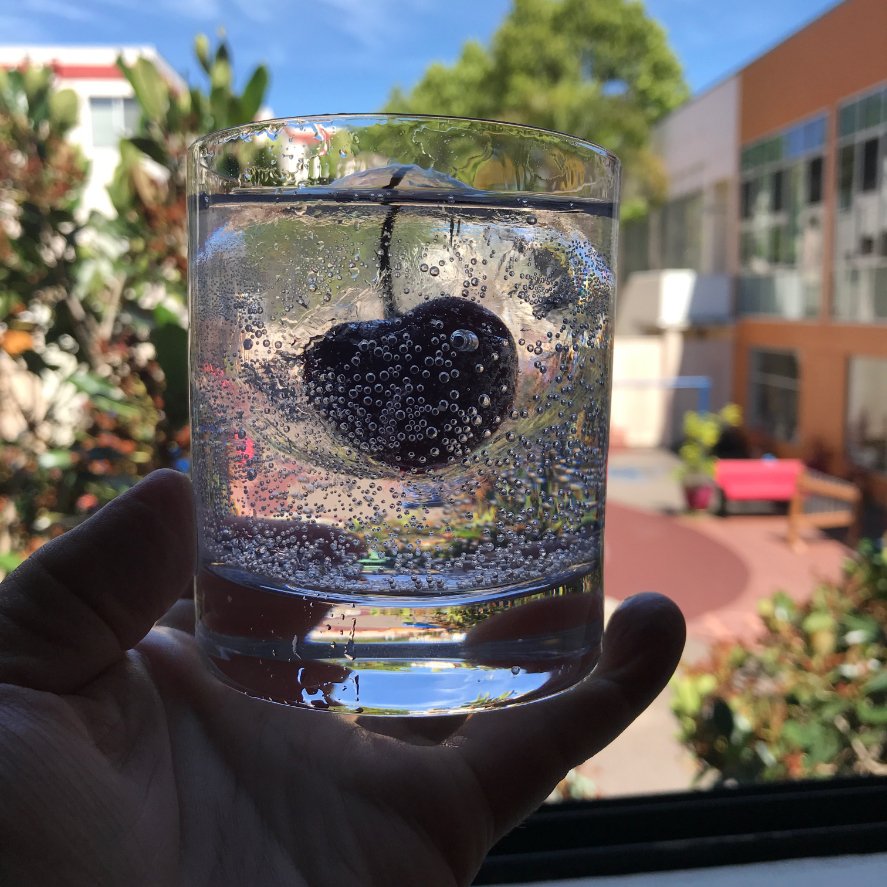
    This came out great!

    Using this technique with the Thermos Funtainer and ice ball molds I put some cherries inside ice ball molds atop the Thermos and froze them. 

    Nothing complicated, these looked awesome.

    IMG-8755
    IMG-8755
    IMG-8755

    For all the clear ice projects on Alcademics, check out the Index of Ice Experiments page

  • Ice Blocks with Objects: Sharks and Sunglasses

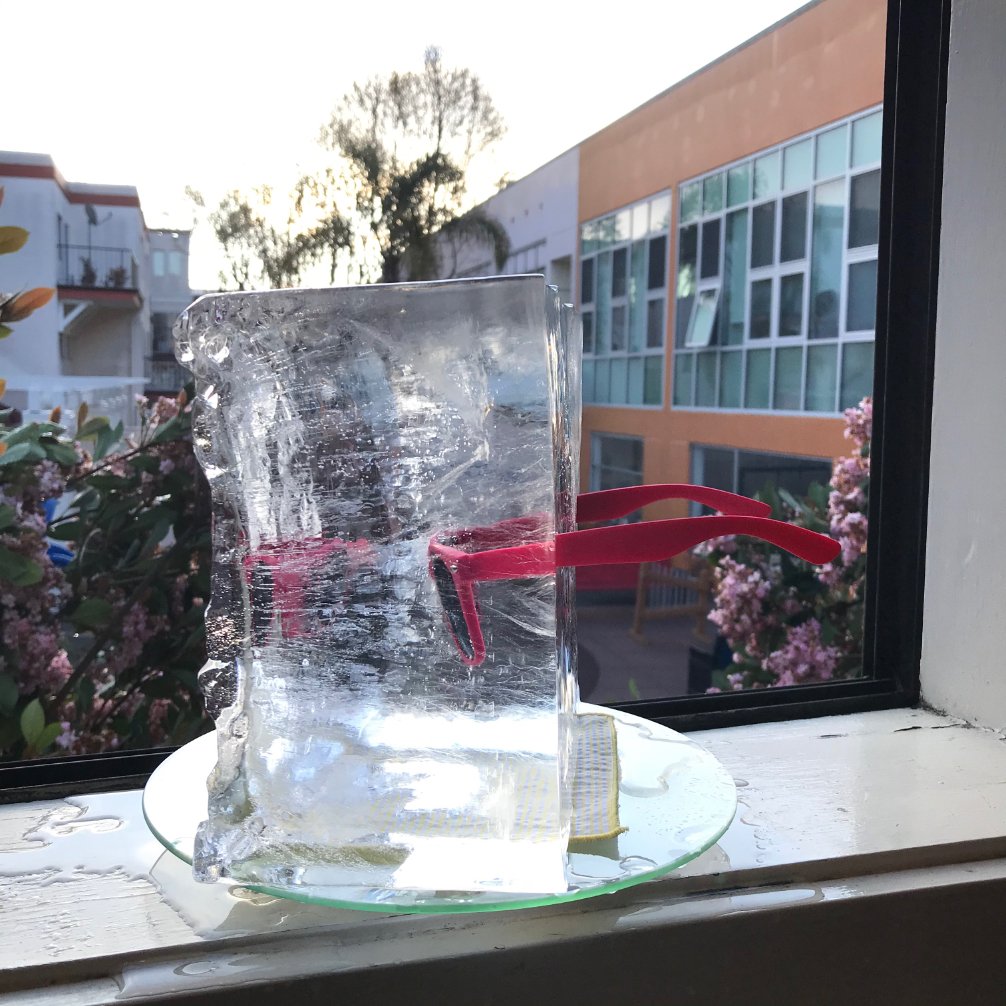
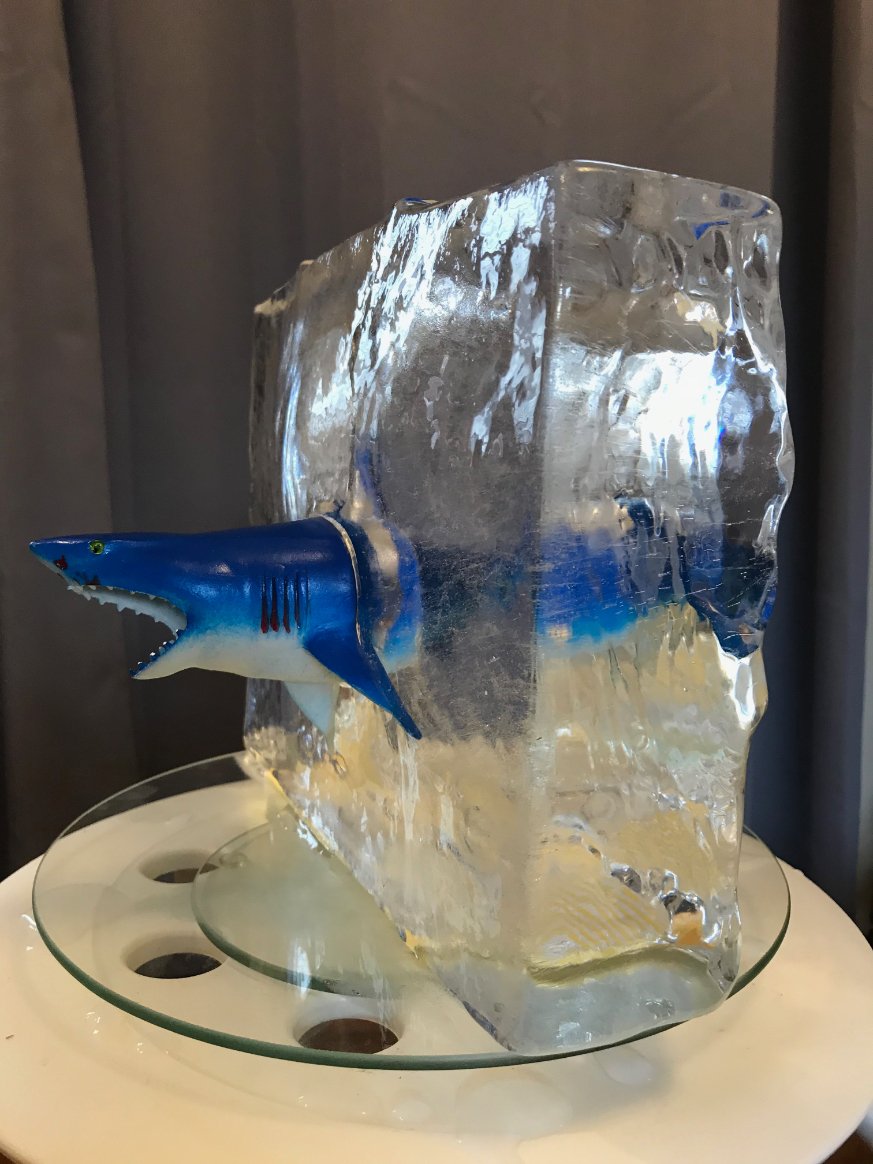
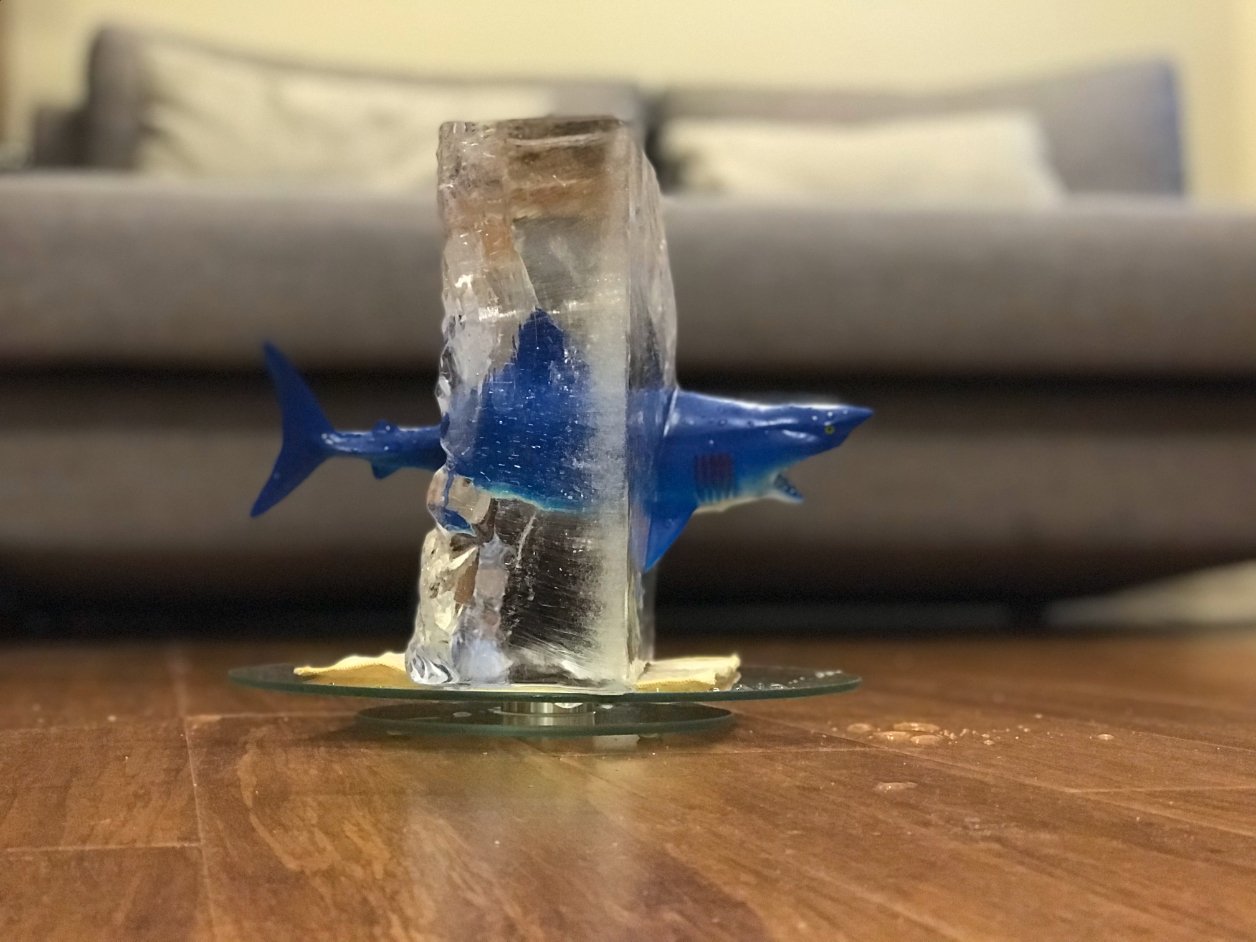
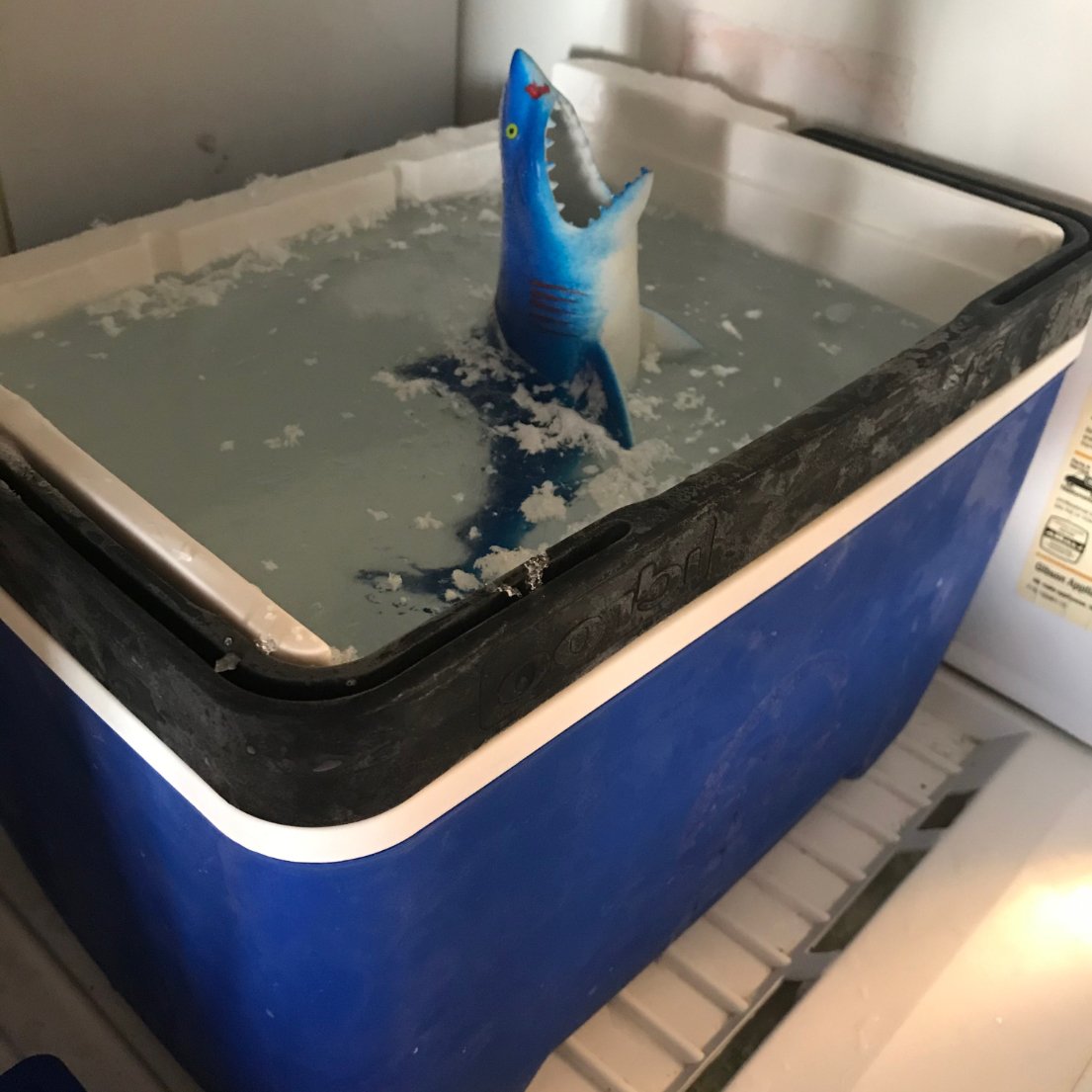
    While sheltering-in-place at home, I've taken to doing some (more) silly ice projects. For these I used the basic Igloo cooler method and placing objects near the top of the water line so that they'd freeze into the clear part of the ice after freezing. 

    For the sunglasses, I rested a stick over the top of the cooler and tapes the sides to it so that the lenses were in the water. 

    For the shark, as you can see I stood it upright in the cooler (originally taped to the same stick) and let the clear ice freeze downward.

    In both cases I removed the block from the cooler before it was fully frozen (2-3 days) so that there would be only clear ice.


    Sunglasses In Ice Block  - 23
    Sunglasses In Ice Block  - 23
    Sunglasses In Ice Block  - 23
    Sunglasses In Ice Block  - 23


    Shark In Ice Block  - 55
    Shark In Ice Block  - 55
    Shark In Ice Block  - 55
    Shark In Ice Block  - 55
    Shark In Ice Block  - 55
    Shark In Ice Block  - 55


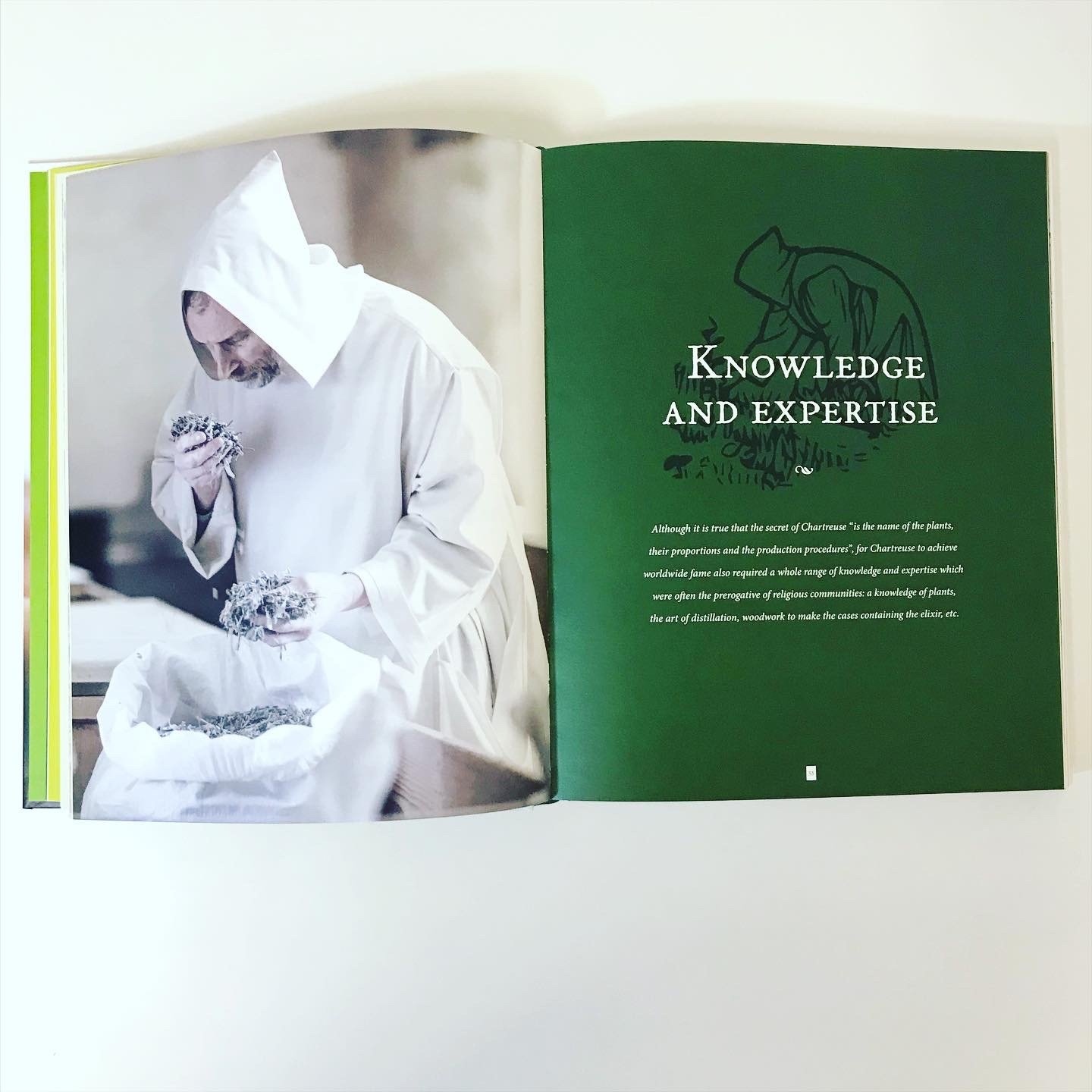
  • A New Book on Chartreuse Corrects the History of the Brand

    2AF7ED1D-A044-4FE2-B9B1-3D53BC6831D3Chartreuse, a liqueur made by Carthusian monks with a recipe dating to 1605, has been made in 6 different distilleries in France and Spain over the centuries. The monks dedicated to its production do so in silence and isolation, while the brand Chartreuse is run by an outside company. They handle the sales and marketing and all that jazz. 

    While the marketing company has done their best to put the brand history on their website and keep their importers and brand ambassadors trained on it, this was done largely without much input of the fathers of the order. So finally the marketing company and the fathers got together and produced a brand book that includes brand history, special bottlings, and other information. The monks looked into their vaults and records. 

    I have a copy of the book but haven't had time to read it yet. At a book launch event in San Francisco, we learned that in writing this new book they learned a lot of new information – and past misinformation about the brand history. One fact they brought up is that they had a special anniversary release bottling a few years back but then just learned that it was on the wrong anniversary and they were something like 50 years off.

    Also the dates on the various monasteries/distilleries where Chartreuse was made have all been adjusted. I was working with Tim Master who works for the US importer on brand history a bit over a year ago for a project and getting really detailed info versus what was publicly available, but even that information was slightly off since he'd not yet had access to the info in this book.   I wrote up a blog post about the location and dates of all the Chartreuse monasteries, but it turns out all the dates were slightly off so I need to update that post. 

    At the book launch they gave us bookmarks with all the distillery dates and locations on it so a quick check revealed where I was off. I'll need to do a super thorough review of what I wrote about the brand's history (I think I wrote about 4000 words on it) after reviewing this new book. 

    So where do I get this book, you ask? There's only one place: It's available for sale at CocktailKingdom.com

    The book is about 350 pages with a history, photos, timelines, etc. For a booze history nerd, it seems pretty essential. 

    896F0C67-7ADD-41CE-9878-A329B7D29F88
    896F0C67-7ADD-41CE-9878-A329B7D29F88
    896F0C67-7ADD-41CE-9878-A329B7D29F88

  • My Favorite (Nerdiest) Blog Posts About Cognac

    Cognac has long been a category marketed as a luxury item like jewelry or precision watches: You don't need to know how it's made (they seem to be saying), just trust in the brand. 

    But over the years, particularly in the past couple years, I've been able to learn a bit more about the category. Like whisky and later gin (anyone remember when every brand's botanical mix was a secret?), cognac brands seem to be coming around to transparency. Consumers (nerds and otherwise) want to know where their food comes from, and their booze too. 


    6a00e553b3da20883401b8d19a7019970c


    Long story short, in this post I've pulled together some of my favorite previous cognac writing. 


    All About Cognac. This post, from 2009(!) is an intro to the category. 

    The Complicated Aging Process for Cognac, as Seen at Cognac Hardy. This (2015) was the first time I really got to know about how dynamic aging can be in cognac production. 

    What's the Difference Between Cognac and Armagnac? A charticle.

    A Visit to Merlet Cognac and Liqueurs in France. I've been to a bunch of cognac distilleries (click the cognac tag at the bottom of this post to scroll through all the cognac posts) but this one was interesting because they also make liqueurs. 

    Between the Heart and the Tails, the 'Seconds'. A post dedicated to a narrow cut of cognac- and rum! 

    A Fascinating Interview with Remy Martin Cognac Cellarmaster Baptiste Loiseau. A really interesting (so says me) article that gets to the heart of what interests me about cognac: It is a directed exercise; cognac is crafted, not just blended from random barrels. 

    Ramping up Aromatics in Cognac: How Camus Does it.  Camus cognac showing the numbers on how they try to make their cognac aromatic. 

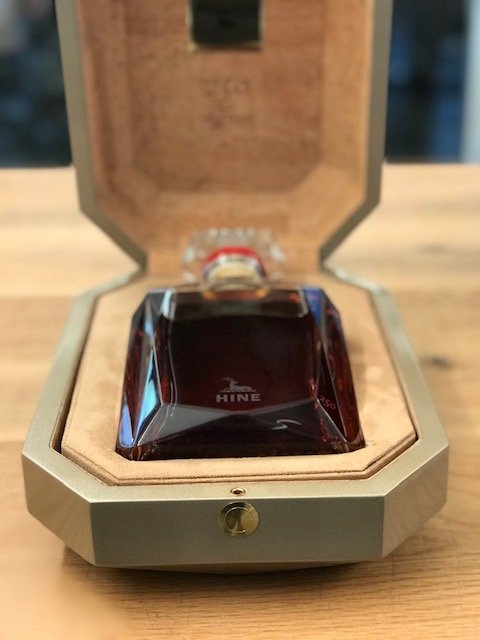
    Cognac Hine series – A wrote a series of posts (sponsored by Hine importer Hotaling & Co) about how this brand of cognac is produced. I learned so much doing so, particularly around early landed cognac, aging conditions, and additives. 


    I hope my fellow cognac nerds will take time to read through some of these. 


  • Dilution and Additives in Cognac (Hine Series Part 6)

    In a series of posts I've been nerding out about cognac production, after sending a list of 100 questions to Hine cognac's cellar master Eric Forget, and combining that information with what I can pick up in books and elsewhere.

    In this post, I'll talk about diluting and additives used in cognac. There is a lot that happens in between taking cognac out of a barrel and it being sealed up in a bottle.

    The posts in this series are: 

    1. Cognac from grapes to wine

    2. Cognac distillation and the impact of distillation on the lees.

    3. Wood and barrels used for cognac.

    4. Aging conditions for cognac.

    5. The strange exception of early landed cognac.

    6. Dilution and Additives in Cognac.


    Dilution in Cognac

    As mentioned in an earlier post, dilution in cognac does not necessarily come all at the end just before bottling. Diluting alcohol with water is actually an exothermic reaction – it creates heat. And heat blows off more volatile aromas. Much of what is done in cognac's gentle handling is specifically designed not to blow off volatile aromatics. 

    So cognac is often diluted slowly over the years – a little bit more water is added at certain intervals during aging, and a final amount at the end before bottling (well, most likely while marrying the blend that will rest before bottling). According to Cognac by Nichos Faith, they don't bring it down below 55% ABV while aging though, as it needs to be stronger to interact with the wood in the barrel. (Cognac is distilled to 70% initially and at least at Hine they dilute to 62-65% before putting it in barrels.) 

    The water used for dilution at Hine is reverse osmosis filtered totally neutral water so that there is no flavor impact on the spirit.

    Some producers, however, dilute with petits eaux.  Petits eaux ("small waters") is made by putting water into an old cask. This will pull some of the alcohol out of the wood and end up at around 20% ABV after six months, according to Cognac. This water is used to further slow the rate of dilution. [Note that in most places it is spelled "petites eaux," just not in the Cognac book.]

    Faith's book says petits eaux are used by "reputable" producers, but Hine's Forget says they do not use petits eaux because "There is a negative impact in term of finesse." 

    Another reason to dilute cognac slowly is saponification – if not done correctly, the brandy can take on soapy flavors, as Faith writes, "When brandy is blended with water, molecules of fatty acids clash and the result is the sort of cheap, soapy cognacs found in all too many French supermarkets." 

    I would love some time to compare quick-diluted soapy-cognac with properly-reduced version to see how soapy soapy cognac is.  


    Ck Mariot photography


    Boisé

    Some call boisé cognac's dirty secret. It is woody water made from boiling wood chips down into a thick liquid. This liquid is added to cognacs to make them woodier without the cost of new wood barrels. As Faith writes, "It thus provides a shortcut for those wanting to add a touch of new wood to their cognacs – and an alternative to buying new casks which now cost up to £500 each, which equates to over a pound per bottle of cognac. "

    Forget says that boisé is often used in wine production (I had no idea, but it makes sense), but Hine does not use it in their cognac. Faith writes that there is no limit on boisé used in cognac, unlike other additives. 

    I wonder about making some boisé at home to make "barrel-aged" cocktails without the barrel…. I'll have to think about that next time I get some wood chips. 


    Sugar

    According to Faith, it is permissible to add up to 8 grams of sugar per liter to cognac, and certainly it is very common to add sugar especially to young cognacs. In the case of Hine, Eric Forget says their VSOP and XO expressions do have added sugar, but not the rest of the line. He says, "It is a common habit for all houses to deliver a little sweetness."
     

    Caramel

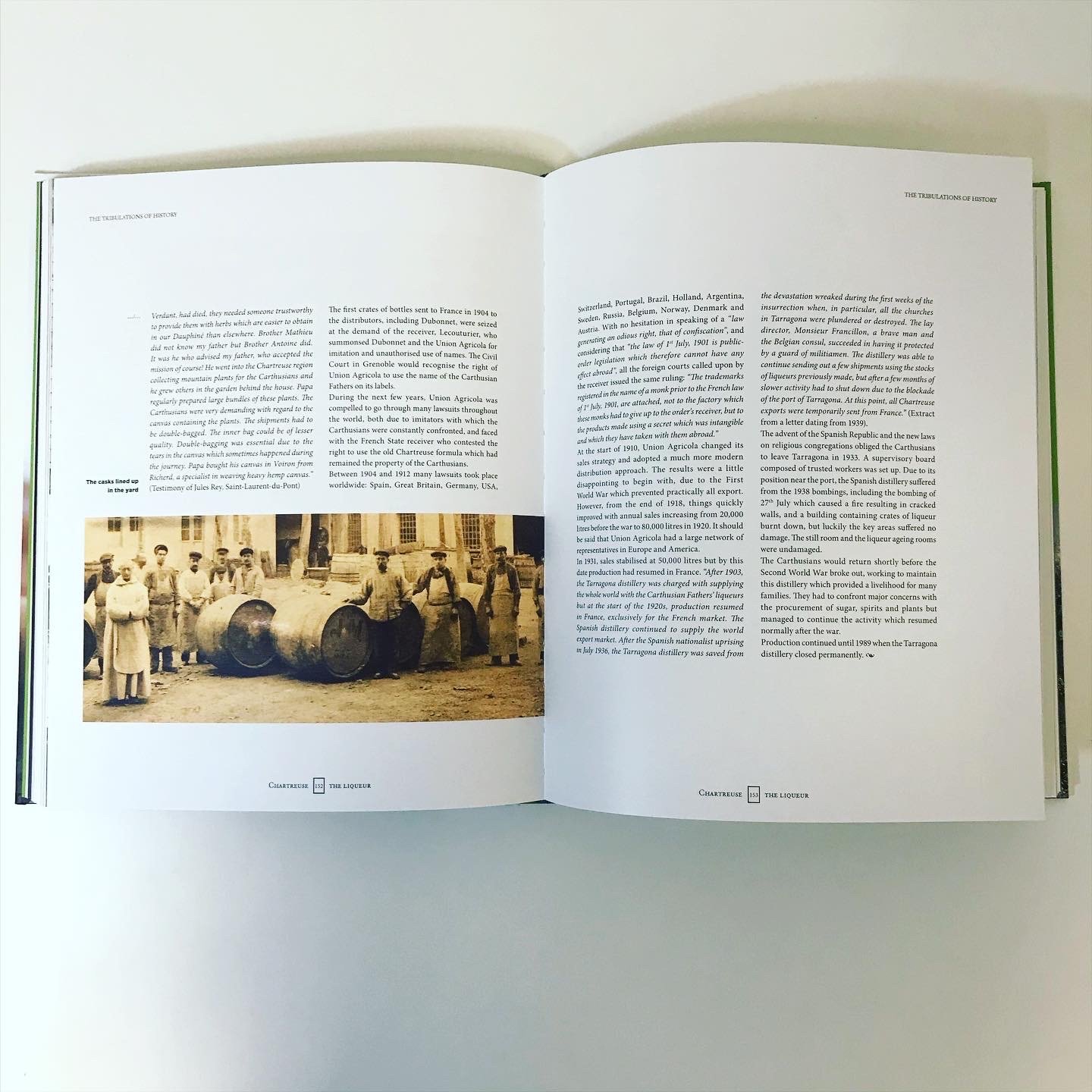
    Coloring caramel, which should be flavorless, is a common additive not just in cognac but scotch whisky, rum, tequila, and pretty much all aged beverages except straight bourbon where it is not allowed. 

    Most producers will say that adding caramel is for "consistency only" and not to make the products appear older by being darker, but in cognac some producers are actually honest about it. For Chinese/Japanese markets in particular cognacs are often made darker than the same cognacs sold elsewhere. (Nicholas Faith writes that they are often made "richer" as so they can be diluted with ice as they are frequently consumed.)

    Forget says that Hine does not make their products for other markets extra dark. 


    Medsker_Hine_Day02_125


    Filtration

    Forget says Hine is filtered, "Like all the houses of cognac, at room temperature and then again at cool temperature. Cognac is very rich in oils and if some are [removed] during the filtration, and if the filtration is well conducted, there is no negative impact on the quality. It is also necessary to export in cold regions." 

    Typically spirits below 46% ABV are chill-filtered for just this reason – when the spirits get cold, oils can come out of solution and look cloudy. Consumers, generally speaking, associate this with the spirit being bad or moldy or something; and cognac is nearly always bottled at 40% ABV, so all cognac (that I know about anyway) is chill filtered. Forget says this is only done for visual reasons. 

    If you ever want to see the effect, take a 46% or higher spirit (probably whiskey) and add some cold water to dilute it a bit. Place a glass of this and a glass of full-strength spirit in the freezer and compare after they chill – you can see the cloudy bits in the diluted one. 


    Marriage

    I did not ask Forget specific questions about how long after creating blends does the cognac sit in large vats to "marry," to come into harmony with itself so that it doesn't taste disjointed. (To be fair, I'd already asked him 100 questions at this point.)

    But when I inquired if I'd missed anything or if anything else could impact the blending process, he said two factors I hadn't mentioned were having bad wood (which is a problem I think we're seeing in all the small batch American whiskies – people are so concerned with distilling they forget to pay attention to the barrels); and the other potential problem is not allowing enough time for marrying the blend before bottling. 


    So, this is the last official post in the series sponsored by Hine cognac. I've learned so much, and yet I still have so many questions! But that's the nature of learning -  you're never done, it's always a journey. I hope you were also able to enjoy the ride. 
     

    IMG_7157


    Note: This series of posts has been sponsored by Hotaling & Co, importers of Hine cognac. 

  • Mocktail Thesaurus – Alternatives for the Word Mocktail

    Many people have an extreme dislike of the word "mocktail," and a thousand and one Facebook discussions later, I've decided to put all the suggested alternatives for the word in one place.

    So if you're looking for a new section heading for your bar menu, or you're a journalist writing the 4000th Dry January story and need some new words to use, this list is for you!


    Non alcoholic menues

    Menus from PrettyUgly (Toronto), North Shore Distillery (Chicago), Zona Mexicana (San Francisco), Zyankali Bar (Berlin), Sushi By Bou (Multiple locations)


    Please let me know if  I missed something! 

        1. 0% ABV
        2. 86 ABV
        3. abstinence drinks
        4. alcohol free
        5. all ages show 
        6. almost cocktails
        7. barely legal
        8. baseless
        9. boozeless
        10. chauffeur's choice
        11. cocktail adjacent
        12. coolers
        13. designated drivers
        14. drinks for your endurance
        15. driver friendly
        16. driver's choice
        17. dry cocktails
        18. dry liquids
        19. even keel
        20. fauxtails
        21. free-spirited cocktails
        22. freetails
        23. gentle spirit
        24. g-rated
        25. immaculate concoctions
        26. jerk soda
        27. junior varsity
        28. kiddie cocktails
        29. lie-bations
        30. liver friendly 
        31. loopholes
        32. low test
        33. maternatinis
        34. minor indulgences
        35. no ABV
        36. nolo
        37. nocktails
        38. no knocktails
        39. non-alcoholic 
        40. nonnies
        41. nontoxicants
        42. no octane
        43. no proof 
        44. not just for kids
        45. not quite cocktails
        46. not-tails
        47. n.w.a. (nothing with alcohol)
        48. on the wagon
        49. pacers
        50. PG
        51. placebos
        52. preggatinis
        53. rated E for Everyone
        54. refrainers
        55. refreshers
        56. safe for work
        57. shallow end
        58. sober drinks
        59. soft cocktails
        60. soft drinks
        61. spirit-free
        62. teetotalers
        63. teetotaler tipples 
        64. temperance drinks
        65. tonics and refreshers
        66. uber juice 
        67. unleaded
        68. virgin
        69. volcano sacrifice
        70. Volstead approved
        71. without alcohol
        72. without proof
        73. zero alcohol
        74. zero-proof


    Got other ideas? Let me know!