I was in Jamaica a couple weeks ago visiting rum distilleries. Much like on Barbados (where they are called rum shops), Jamaica has a huge number of bars (and churches) per capita.
The bars line the sides of the roads and are usually little more than 1-room shacks. They have the best names, so given that we spent about 3 hours each day (each way) driving around the island, we made it a car game of finding the funniest-named bars on the island.
The San Francisco temporary bar TSK/TSK, which will sometime this year be reincarnated as Horsefeather, featured several alcoholic slushies on its menu.
Slushmaster Mitchell Lagneaux said he was often asked for his advice on how to make them delicious, and rather than writing the same advice over and over he thought he'd point them to this post on Alcademics instead.
So here goes. The below is all courtesy of Mitchell Lagneaux.
There are a few ways one can go about making adult slushies for the masses. You can fill the machine with Slushie mixers, add a bit of booze, or a lot of booze, flip a switch, and an hour later its game on. Nothing wrong with this approach but sometimes you want to achieve a frosty, brain freezing booze bomb with more of a fresh taste, or maybe there isn't a mixer that fits the occasion. I don't know, pick your excuse to not use a margarita mix. Here's a guideline to help you achieve the coolest of cool, the coldest of cold, sweet yet refreshing, adult slushie.
First, if you are looking to serve slushies in a bar or for an event, you want to consider the portion sizes of the beverage. This is going to help you later on with tracking cost. Lets say you want to serve a slushie at 10 ounces. There will probably be at least 2 ounces of liquor in the cocktail. In order to freeze up you are going to need to add quite a bit of water. Think about how much ice you put into a blender when making a frozen drink. You should be filling the blender with ice if you want to get that heavy frozen consistency. So I recommend adding twice the water to booze when assembling your ice palace.
So already we have 2oz booze + 4oz water= 6oz total liquid.
Now it's time to think about the modifiers. Lemon, lime, pineapple, coconut? Sugar, honey, crazy house made syrup? You probably already have the drink in mind that you want to make though. The thing is, the drink is not going to come out tasting the same once frozen as when it's shaken or stirred. The drink is going to taste thin and diluted. So we need to beef up our mixers. Lets take, for example, a Daiquiri.
Some might make a non-slushie Daiquiri like so:
2oz rum 1oz lime .5oz simple syrup.
But when making a Daiquiri that's going to be colder that a witch's teat, we need to add a bit more sugar to the mix. Adjusted, our Daiquiri might look as such:
2oz rum 1oz lime 1oz simple syrup.
Testing Proportions
If you're like me you are going to want to test the drink out before letting the world taste you masterpiece. I've heard of some people weighing ice, or letting a cup of ice melt and seeing how much water it's made up of. The most simple way I can tell how to test out what your frozen beverage is like this.
Make a modified Daiquiri (2oz rum, 1oz lime, 1oz simple). Build this bad boy in a shaker, fill it with as much ice as you can, shake it till the wheels come off, and when you strain the cocktail, measure it. What do you have? Let's say 7oz.
7oz total – 2oz rum – 1.5oz lime – 1oz simple syrup = 2.5 water (dilution)
Lets add another 1.5oz of water to get the drink to the level of water required to freeze. That's brings us to 8.5oz per cocktail. And there you have the serving size. It should taste bit sweet but once frozen the drink should balance itself out. If you feel like it's too sweet or sour make the adjustments as needed.
Now that we have a basic formula for making our slushie we need to have some batched and ready for when it gets low.
Spending time abroad made me appreciate the metric system. Let just remove the "oz" from our recipe and replace it with "mL" and it's that easy.
Refilling Routine
The last, and one of the most important things in my opinion when it comes to serving slushies is the time at which you refill the machine. It typically takes at least an hour for a full machine to freeze the liquid. With that being said, the lower you let the batch go before you add more, the longer it's going to take to get cold.
I recommend topping up the machine when it's about half way down. A trick I've learned is to roll, or rack it once you fill it. This means pour in more of your batch. Next, take the same container you used to fill the machine, fill it back up with the slushie you just topped, and do this 3 or 4 times. This is going to get all of the liquid in the machine to the same temperature, resulting in a faster freeze. Otherwise the new batch will sink to the bottom and the frozen portion will float at the top.
In pot-still distillation we always talk about the cuts: the heads and tails that are discarded (or recycled), and the hearts cut that become the spirit that ends up in the bottle.
But some distillers make another cut between the heart and the tails called the seconds. (Say it with a french pronunciation seh-kuhnndz rather than like seconds on a clock.)
At Privateer Rum in Massachusetts, they make a special rum called The Queen's Share that is a redistillation of just seconds. We'll get to that in a second.
Seconds in Cognac
The first place I heard the term seconds was in Cognac, and frankly I don't know much about it. Luckily for us, Privateer Rum's head distiller Maggie Campbell was trained by Hubert Germain-Robin, a frenchman who has distilled fantastic cognac-style brandies in California since 1984. Campbell was able to fill me in on how this cut of the spirit is used in some cognacs.
To review the process: Cognac is distilled twice in pot stills. The first distillation is the wine distillation. The second one is called the brouillis or low-wines distillation. In cognac, since they only distill for a small part of the year after the grape harvest/fermentation period, they do not make a separate product out of the seconds, but they do often recycle them back into a their next batch of wine bound for distillation, or in the next batch's second distillation.
Note that in single-malt scotch whisky and in some other spirits production they also put the heads/tails back into the first or second distillation, just to get all of the usable alcohol out of it. So this isn't unique to cognac or the seconds. But different brands/categories decide where they "re-pitch" (put into the next distillation batch) the heads, tails, and sometimes seconds. These may be in different places.
Campbell says of seconds in cognac:
In Cognac each distiller has their recipe as to where they re-pitch each one and claim how it changes the flavor of the following distillates.
Some producers redistill the heads and tails and put them into the wine, and others put them into the low wines (brouillis).
They say if it goes into the wine the ABV is significantly raised on the first installation causing the rest of the distillations to be higher in alcohol. Apparently when it goes in the wine there's less concentration of congeners and lighter flavor brandy is made. This is what Martel does.
If the heads and tails go into the brouillis (second distillation) then it makes it richer and deeper. This is what Hennessey does.
Note that doesn't account for the seconds and where they go. Next time I'm in cognac I'm going to research this further.
Seconds in Rum and the Queen's Share
So at Privateer Rum, they do not re-pitch the heads and tails at all so that they don't affect the heart of the distillation or build up.
But the seconds are collected during each distillation and saved. From the explainer sheet:
As the hearts run off the still they become more powerful & flavorful approaching the tails cut. Even once these tails have overpowered the hearts and we’ve made our cut, some of these rich hearts are still intertwined with the bitter tails. At this stage we collect… the ‘seconds’.
These seconds (collected over many runs) are redistilled (a third distillation); the tails of this distillation are discarded; and this special batch of rum is then aged separately.
This is what made up the release of the first single barrel of Privateer's Queen's Share. It was aged 3 years and bottled.
If you've read this far, I've got bad news for you: There wasn't very much of it and it's probably long-since sold out.
If you are able to add an aquarium pump to the mix, you can make clear ice from the bottom up without any cloudy parts at the end; a method that mimics how professional ice block machines work.
Today we'll talk about how to make clear ice with an aquarium pump and no cooler, and how this same method allows us to freeze objects in an ice block also without an insulated cooler.
While I've always favored the non-electricity Directional Freezing method, Alcademics reader fang2415 prefers to use an aquarium pump without (much) insulation. This takes up little less space in the freezer, and it seems like a much faster method than with insulation – as below, he says he gets a 4-liter ice block every day!
In short, fang2415 places an aquarium pump at the top of an uninsulated container of water in the freezer, just barely insulating the top of the container with bubble wrap to help prevent it freezing over. He then found that this also works to freeze objects inside ice blocks.
He describes the method:
The method is really simple: basically it's the same thing I now do to make most of my ice using an aquarium pump in a plain Tupperware-style plastic 5L container, but this time I threw a bottle inside the container and used tinfoil as a cover since the bottle was too tall for the lid to it.
I've been making all my ice this way recently, and every day I get a big beautiful 4-liter-or-so block of ice. The only real annoyance is cutting the pump out.
I filled the container up to about .5 inch from the top and stuck my 150 L/H aquarium pump to the side just below the surface. Usually I aim the pump so that the outlet goes across the middle of the surface, but this time I kept it to one side so that the jet went around the side of the bottle's neck.
I've found that insulation barely matters with the pump method, although I usually cover the top with two layers of bubble wrap to reduce freezing at the top. Tying the bubble wrap with string works just fine; it just means that you need to knock the top ice-collar off at the end.
After chiseling the pump out (which is probably the most difficult part of the process), I had a bottle with the top conveniently exposed inside a large squarish block of clear ice.
He then chisels out the aquarium pump and cuts or runs water over the outside edges to smooth out the block of ice and make the bottle label more legible.
Thanks once again to dedicated ice nerd fang2415 for not only doing the experiments, but for taking pictures and sharing with the Alcademics audience!
Throughout the year I post new drink books to Alcademics, because I love drinking and books. Below is all of them put together so that you can make your holiday wish list for yourself or see them all together to pick presents for friends and family.
Know of a book I missed? Let me know and I'll add it.
Culture and Fun
You Suck At Drinking: Being a Complete Guide to Drinking for Any and All Situations in Your Life, Including But Not Limited to Office Holiday Parties, Weddings, Breakups and Other Sad Times, Outdoor Chores Like Deck-building, and While in Public, Legally and Illegally By Matthew Latkiewicz
Cocktails of the Movies: An Illustrated Guide to Cinematic Mixology by Will Francis , Stacey Marsh
Imbibe! From Absinthe Cocktail to Whiskey Smash, a Salute in Stories and Drinks to “Professor” Jerry Thomas, Pioneer of the American Bar (Updated and Revised Edition) By David Wondrich
Contraband Cocktails: How America Drank When It Wasn't Supposed To by Paul Dickson
Narrative Cocktail Books
The Cocktail Chronicles: Navigating the Cocktail Renaissance with Jigger, Shaker & Glass by Paul Clarke
Ten Cocktails: The Art of Convivial Drinking by Alice Lascelles
Cocktails from Specific Bars
The Dead Rabbit Drinks Manual: Secret Recipes and Barroom Tales from Two Belfast Boys Who Conquered the Cocktail World by Sean Muldoon, Jack McGarry, Ben Schaffer
Experimental Cocktail Club: Paris, London & New York by Romée de Goriainoff, Pierre-Charles Cros, Olivier Bon, Xavier Padavoni
Cuban Cocktails: 100 Classic and Modern Drinks by Ravi DeRossi, Jane Danger, Alla Lapushchik
Tujague's Cookbook: Creole Recipes and Lore in the New Orleans Grand Tradition by Poppy Tooker
I wrote a story for Popular Science on the science of barrel aging. The story was inspired by a trip to The Glenlivet where I tasted a 50-year-old whisky without any smoky qualities – but 50 years ago this and most whisky would have been at least lightly peated.
So I went into the article specifically looking for what happens with the smoke, but ended up writing about wood interactions as well.
To do the story, I read several wood science articles sent to me by Diageo whisky ambassador/smart-guy Ewan Morgan, spoke with Dr Bill Lumsden from Glenmorangie, interviewed Bryan Davis from Lost Spirits, and illustrated the story with a chart from Lew Bryson's excellent book Tasting Whisky.
Hopefully I didn't get anything wrong. Read it here.
I've done a few years' worth of ice experiments here on Alcademics, and sometimes bartenders contact me on how to solve ice problems. (That should be my new reality show: Ice Whisperer.)
Here is the index to the ice experiments on Alcademics, where you'll find how to make clear ice blocks, clear ice cubes, clear ice spheres, and many other ice successes and failures.
One bartender was curious about some ways to present bottles in ice yet still be able to read the labels. I presented a few ideas and have probably found a solution that works for the bar (that I'll share when it's open), but this method is something that does work but wasn't a great fit for that particular program.
Anyway, enough with the backstory. Look at this cool spinning bottle!
This technique uses directional freezing (freezing inside an insulated cooler with the top off so that it only freezes from the top-down), with the bottle raised high so that it's in the clear part of the ice block.
Method for Freezing a Bottle in a Clear Ice Block:
1. Fill a picnic cooler with water.
2. Place some sort of stand on the bottom of the cooler. I used a plastic box in one experiment and an oversized metal piece that looks like a napkin ring in another. Anything that lets water move through it is ideal.
3. Place the bottle on its side, diagonally across the cooler. Note that very tall bottles may not fit in your cooler. Fill the cooler with water to an inch or two above the bottle.
4. Leave the top off the cooler and let it freeze for a couple of days.
5. When the block freezes either all the way through to the bottom of the cooler, or (better year) just to the point at which it starts to become cloudy at the bottom part of the block, remove it from the freezer. Tip over the cooler and let the block slide out.
6. Let the ice slowly warm to temper it, then use an ice pick (the three-prong one is my preferred tool for this task) to scrape off the cloudy section. You can break off the cloudy ice in any creative way you want. As you can see, for the Tanqueray I did a super cool nugget-style chipping, while for the Plymouth Sloe Gin I did a scrape on only one side so that it's super flat on the front surface.
As you can see, the top of the bottle is at the corner of the block, so you can easily open it and pour from the bottle still.
Example One
Looking down on the cooler with a big napkin ring at the bottom on which the bottle will sit.
The bottle sits on the stand with enough water to cover it.
From the bottom: Now to chip off that cloudy layer!
Ta Da!
Example Two
Frozen block with bottle. You can see the yellow of the plastic open box I sat the bottle on.
At Tales of the Cocktail, I attended a seminar led by Ian McLaren and three scientists, all from Bacardi. It was called Genie in a Bottle: How Spirits Age.
Being part of a gargantuan spirits company they were able to call upon the science that had been done in the past and specifically for this seminar about how spirits change in the bottle. I think there is a general acceptance that in opened bottles stored for many years, spirits get a little bit flatter in flavor. In this seminar they took it way further than that.
The most important information is on this slide:
Here are a lot of notes:
Temperature: They found that for heat, degradation really occurs at 100 degrees Fahrenheit (37.8C). They tracked the temperature of bottles as they were shipped around the world to see if they ever reached that in the process of getting from the distillery to the store, and found that when it happened, which was unusual, it was in the process of getting from the truck to the boat – on the docks- so they put in place some systems to prevent that for their most temperature-sensitive products.
Heat accelerates aging processes including oxidation, evaporation, adds cooked fruit notes to high sugar content liqueurs, affects the flavor of flavored spirits with low pH, so that's particularly citrus flavors.
40F (4.44C) is the optimal temperature at which to store spirits
Light impacts spirits too, not just by adding heat. Aged spirits like bourbon and scotch can lose a significant amount of their color (which impacts our perception of their flavor).
Light effects are impacted by bottle color (amber will have the least impact), bottles with more glass exposed (so Angostura bitters with its oversized label would be less impacted than a clear, printed bottle), the type of light source (direct sunlight, LED, fluorescent light) though it's not an easy determination of which is the worst (sunlight is really bad though) because it's the combination of the light's frequency and wavelength, and proximity to the light source.
Oxidation changes flavor: Acetaldehyde from oxidation reaction can be good in small quantities – adds fruity aromas; but in larger quantities it transforms in acetic acid (vinegar). Gin loses citrus flavor and gains "moth balls" flavor. Whisky loses its creamy fatty acids, gains fruity but then rancid and nail polish remover flavors. Rum gains vinegar aromas.
Oxidation happens not just with heat and light, but also headspace in the bottle (the St. Germain bottle was cited as one particularly badly designed as you get a lot of headspace as soon as you open it), how frequently you open it (as that changes the equilibrium in the bottle- each time the air above the liquid gets exchange with fresh air), the type of closure (corks allow oxidation; screw caps less); and pour spouts can have an effect even if you cap your bottles at the end of the night.
So to reduce oxidation you should keep precious liquids in small brown bottles with screw caps rather than 1/3 empty bottles with corks.
That was just a fraction of what was shown at the seminar, but I hope it's helpful.
I cringe every time I see the back bar against the windows (in San Francisco I always think that when I see Zuni Cafe, Absinthe, my local liquor store's wine selection, and the new Black Sands, but at least it doesn't usually get that hot in SF), but hopefully they move through product quickly so that the effects are not as dramatic.
McLaren showed a lot of slides of brightly-lit LED and fluorescent-lit back bars, with particularly bad ones being when the spirits sit on a light box as that adds heat as well.
So maybe all those candlelit, brick-walled speakeasy-style back bars aren't so bad after all.
I was sent a sample of a new carbonation device called the Bonne O, and in trying it out I had a lot of questions about how it worked. That lead me to learn a bunch of new (or needing repetition) facts about it.
The Bonne O carbonator is different from a Soda Stream carbonator in two fundamental ways:
Instead of a CO2 tank, it takes tablets that work like giant Alka-Seltzer tablets to create CO2
You can carbonate more than just water. With Soda Stream (at least the current models), you carbonate only water and then add syrup to it to make soda. With this device you can add other ingredients into the carbonating chamber.
But I was confused as to how specifically it works. You add most of the liquid and any solid ingredients to the bottle that will be carbonated, then on the base of the machine the fizzing tablet to one chamber, and the sweetening/flavoring syrup to a separate chamber. That last part particularly confused me.
So I emailed with Bonne O inventor Darren Hatherell. He explained to me (and also did a good job of it on this blog post, from where I stole most of these images), and now I'll explain to you.
The Stuff You're Carbonating Must Be Cold, But the Chemical Reaction Should be Warm
For maximum carbonation, you must have cold liquids, as cold liquids hold more carbon dioxide in solution. However, the particular acid-base Alka-Seltzer-style fizzing reaction in the Bonne O works best when the liquid added to the fizzing tablet is warm. (To verify this, try adding Alka-Seltzer to warm vs cold water and see how much longer it takes to fizz.)
They way they got around needing both cold and warm liquid is: The device takes the temperature of the liquids in the bottle (it sucks some into the machine from the top), and if it's too warm for effective carbonation, it just beeps at you and won't even try to carbonate. If it's nice and cold, however, it sucks in that liquid and heats it to an ideal temperature before sucking it into the carbonation chamber with the fizzing tablet.
This warm liquid (and dissolved tablet) doesn't go back into the bottle. It stays in the chamber and you dump it out at the end. Keep reading for how and why…
Sugar Makes Foam And That's Bad
The main reason you don't put syrup flavors into the Soda Stream is that when you carbonate syrupy water, it foams up and out of the bottle, then will clog up the gas system, perhaps only to explode later. Sugary things make foam.
The Bonne O gets around this by holding the syrup in a separate flavor chamber (you can add flavors to the bottle, including solid ingredients like strawberries, but the stuff in the bottle ideally shouldn't be super sugary).
When you hit the button to turn it on, the Bonne O sucks in liquids from the top of the bottle into the carbonation chamber where it fizzes and creates CO2 gas, and pushes out the syrup or other liquid from the flavor chamber (along with the newly-created CO2 gas) into the bottom of the bottle. So the space in the bottle from the stuff that was sucked out is replaced with the syrup or other stuff from the flavor chamber. Thus the flavor chamber always has to be full, even when you're not flavoring your liquid.
So if you're just carbonating water, you add cold water to the bottle and water to the flavor chamber. (Same if you're carbonating a bottle of tequila, which I did live at Tales of the Cocktail – you put tequila in both the bottle and the flavor chamber.)
If you're carbonating a soda or cocktail like a Gin & Tonic using tonic syrup, you add the gin and water to the bottle and the tonic syrup to the flavor chamber. If you were going to carbonate a cocktail with a liqueur like a Margarita, you might want to put the liqueur into the flavor chamber instead of mixing up the full cocktail first. I haven't experimented with adding something syrupy to the bottle to see what happens.
The Downside To Both
The downside to a Soda Stream is that you ultimately add carbonated water to syrup, which will reduce its overall carbonation.
The downside to the "keep the syrup separate" model of the Bonne O is that if you're a perfectionist you have to do some math to get your cocktail right: Some of the liquid in the bottle will be sucked out and discarded to be replaced by the syrup, so you have to control for the change in volume.
The bottle holds 750ml
The flavor chamber holds 142 ml
Thus, you need 142 ml extra un-sweetened liquid that will be discarded from the bottle.
Let's Do Math!
For example, if you used Strong Tonic syrup to make a carbonated G&T, the brand recommends 1 part syrup to 2 parts gin to 4 parts water. For the final 750 ml that you will make, that means each "part" is 1/7th of 750 ml:
107 ml syrup 214 ml gin 428 ml water
But not all of that goes into the bottle- remember the syrup goes into the flavor chamber. The flavor chamber holds 142 mls, so you can add the full 107 ml of syrup to it, and then top it off gin and water. But how much? We need 35 ml total of non-syrup to get to our 142 ml.
So the total of non-syrup (that's the gin and water combination) will be 750ml (that's what fits in the bottle) + 35ml extra for the flavor chamber = 785 ml of gin/water.
So 785 ml of gin/water in a proper 1:2 ratio is: 262 ml gin 524 ml water
Checking our math on actual quantities used in final drink:
Flavor Chamber: 107 ml syrup + 35 ml gin/water in 2:1 combo (12 ml gin and 24 ml water) Bottle: 750 ml gin/water in 2:1 combo (250 ml gin and 500 ml water)
But remember that 142 ml of the bottle is discarded. 750 – 142 = 608 ml gin/water combo will actually go into the drink, plus everything in the flavor chamber, which makes our total of each ingredient:
Syrup: 107 ml
Gin from flavor chamber = 1/3 (35ml) = 12 ml Gin from bottle = 1/3 x (750-142 = 608) = 203 ml Gin total = 215
Water from flavor chamber = 2/3 (35ml) = 24 ml Water from bottle = 2/3 x (750-142 = 608) = 405 ml Water total = 429 ml water
So our final recipe is:
Mix 262 ml gin and 524 ml water and make sure the combo is very cold. Fill Bonne O bottle to top with this combination.
Add: 107 ml Strong tonic syrup to flavor chamber plus rest of gin/water combo (35ml) to flavor chamber.
Add carbonating tablet to carbonation chamber and press the button to carbonate the liquid.
 The bars line the sides of the roads and are usually little more than 1-room shacks. They have the best names, so given that we spent about 3 hours each day (each way) driving around the island, we made it a car game of finding the funniest-named bars on the island.
 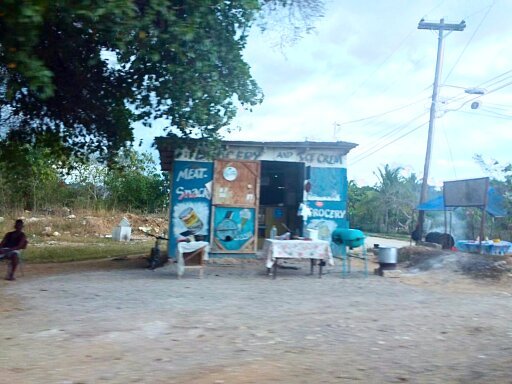 Rum Face Bar