Author: Camper English

  • The Trouble with Tequila

    There's a new study released by Sarah Bowen of North Carolina State University in Raleigh and Ana Valenzuela Zapata of Mexico that says the tequila industry is ruining small farms.

    I've seen several stories in the media reporting on this and I think many of them are missing a large piece of the puzzle.

    Basically, the study asserts that because more tequila brands are taking control of the agave fields, the small agave farmers are suffering. They can't sell their agave to brands as much on the open markets, because the brands now own their own fields. Additionally, the commercial agave farming by the large brands is more pesticide intensive and harmful with water run-off and other typical commercial farming problems.

    What is less discussed is that the reason these brands bought agave fields is because small agave farmer's crop quality and availability were too inconsistent. There was a great agave shortage in the 1990's the caused a huge impact on the industry. Some brands raised prices by a large amount to cover the increased cost of agave. Other brands traded down from being 100% agave tequila to mixto tequilas. I think that Herradura's El Jimador brand was in this category. It went from 100% to mixto back to 100%. How are they going to guarantee that it remains a 100% agave product? By buying fields.

    But because of the shortage in the 1990's, all the small farmers planted agave instead of other crops. As the crop takes 6-10 years on average to harvest, there is now resulting glut in the agave market, and another expected shortage to begin in the next couple years.

    You could understand why a tequila brand wouldn't want to buy agave on the open market when the market is like this. They can't guarantee consistency in their product unless they control the supply of the raw ingredient that can't be corrected in the short term.

    Additionally, controlling your own ingredient means that you not only control the amount of it, but also the quality. And there is a definite cachet in having estate-grown agave.

     Last week at the launch of the Gran Centenario Rosangel tequila in New York, spirits supertaster Paul Pacult said, "The best tequilas that I know of come from estate-grown agave."

    Another factor to keep in mind on this study is that co-author Ana Valenzuela Zapata is an advocate for increasing biodiversity in agave. In a book she co-authored with Gary Paul Nabhan called Tequila: A Natural and Cultural History, she discusses the fact that agave as it is currently grown is a genetically uniform monoculture that's propagated asexually, which makes it  especially susceptible to plagues of disease that could wipe out the entire industry (as only one strain of agave is allowed in tequila) like Phylloxera did to the European wine industry in the late 1800's.

    This doesn't in any way disqualify the study's argument that small farms are suffering due to large tequila producers buying their own fields, and that industrial farming is worse for the environment. I just think that people should realize it's the inconsistency and often low-quality of small farm agave that caused the major producers to buy their own fields in the first place.
  • Bay Area Distillers Messing with Agave

    Hey, it's double-bonus tequila Friday here at Alcademics!

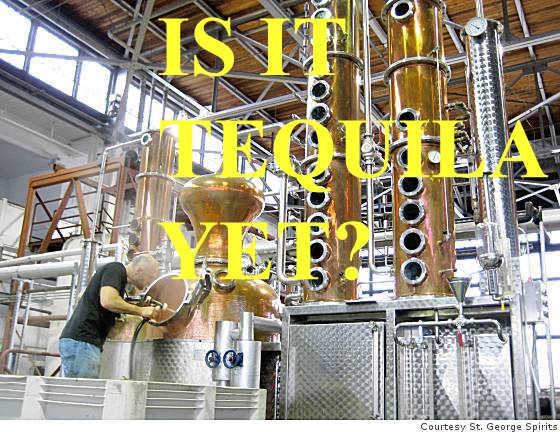
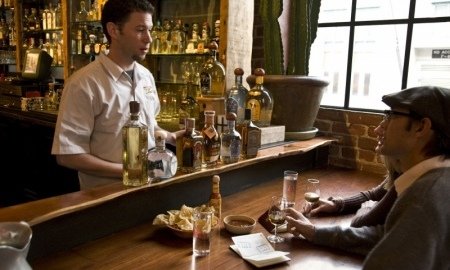
    I just learned that my Chronicle story on Bay Area distillers and business owners making tequila here or in Mexico went live today. The print story should be out this Sunday, in the newly-merged Food & Wine sections.

    Tequilatime copy

    Read the story here.

    Highlights

    • Julio Bermejo of Tommy's Mexican Restaurant is building his own distillery in Mexico.
    • Miles and Marko Karakasevic of Charbay Distillery and Winery made tequila in Mexico at the famous La Altena distillery.
    • Lance Winters and Jorg Rupf shipped agave to Alameda and distilled it there. This lead to a series of unusual efforts.

    Each distiller is taking an entirely different approach to the process.

    Go read it, there are some juicy news items in there.

  • Drinking by Degree

    Check out my story in the February issue of San Francisco Magazine. It's about tasting clubs around the city where you earn prizes or a degree by working your way through the menu.

    TresAgavesfull

    I focus on the Tequila Passport program at Tres Agaves, but also mention programs at Tommy's Mexican Restaurant, Forbidden Island, and Barclay's in Oakland.

    Read the story here.

  • Ice Balls Made Easy

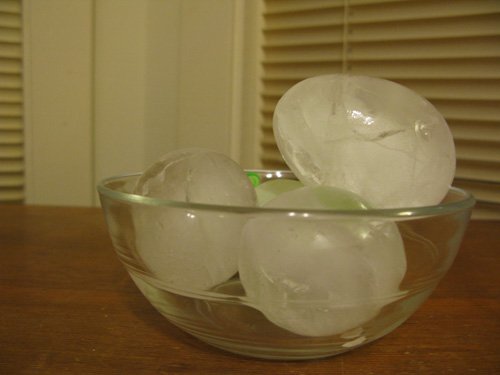
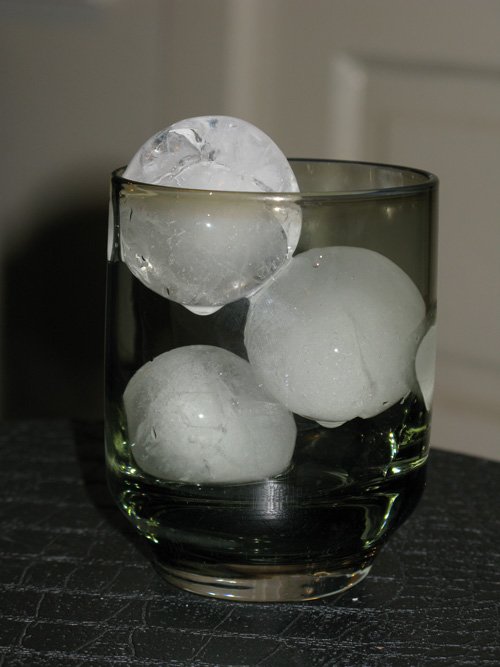
    While everyone in their right mind would love one of those fancy giant ice ball makers that go for $1300 and up, they're not the most practical solution for the home mixologist.

    [Note: since this post went up we've come up with lots of great solutions for clear ice balls and other ice technology. Check out the Ice Experiments Index Page.]

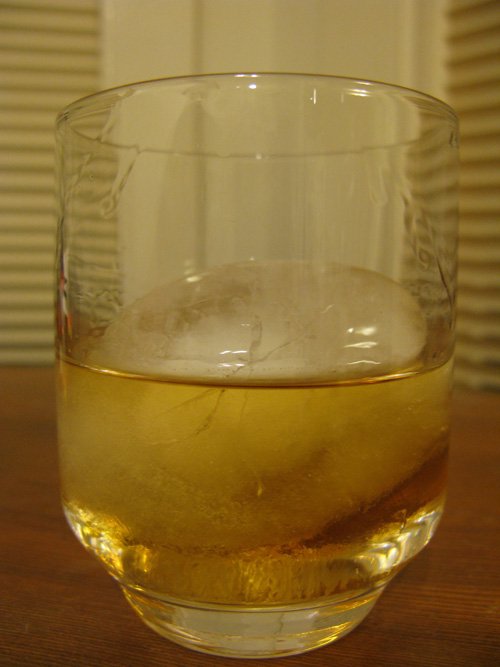
    So I used my superbrain and did all sorts of math with equations and integrals and all, and came up with a way to make these at home:

    Orbsinbowl
    Threecubesshortglass Iceinglass
    (glasses by CB2, by the way)

    To see my highly scientific secret method, continue reading after the jump…

    (more…)

  • Bar-Bary Coast

    Barbarycoastmap
    Wolfgang Weber from the Spume blog and Wine & Spirits Magazine has started a Google map of "classic" (in one way or another) eateries and drinkeries along the Barbary Coast Trail in San Francisco.

    I've never walked the trail myself but now that he's turned it into a bar crawl I'm much more likely to give it a try.

    The map is editable If you happen to know of any classic spots along the path that aren't labeled yet I think you can add them.

  • Heaven’s Dog Preview

    On Monday I had the chance to check out Heaven's Dog, the new Charles Phan (Slanted Door) restaurant and bar opening on in San Francisco on Friday.

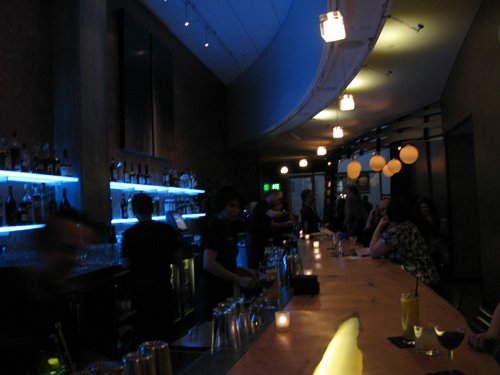
    On closer inspection, bar and restaurant would be a more adequate description of the place. There's a small noodle bar/kitchen on one side- almost an adjacent business connected by the bathroom hallway, and a section of the larger, L-shaped room for seating. The long part of the "L" is the bar, cut out of a beautiful, curving vertical slice of a tree, and there is so much room behind it there were more than eight bartenders working at the same time on Monday night. The small part of the "L" is the seating for the restaurant.

    HeavensDogBarDarkSmall


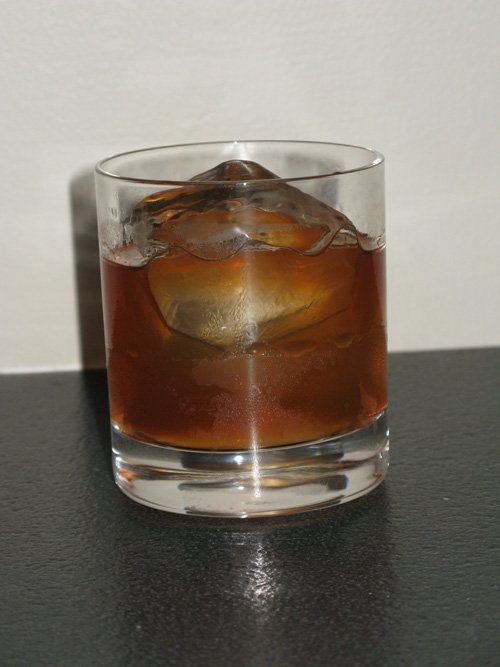
    The cocktail menu consists entirely of Charles H. Baker (author of The Gentleman's Companion) drinks. I forgot to bring home a drink menu but the drinks I tried were largely acidic citrus rather than juicy, and very booze-heavy. One drink is simply dark rum with honey syrup and a twist of lemon stirred over a huge hand-carved chunk of ice. Another drink uses the pineapple gum syrup made by Small Hand Foods for Pisco Punch all over town, but in a different way… that I can't recall exactly but it was my favorite drink of the night.

    HeavensDogIceSmall

    When I last wrote about this bar, I noted the all-star staff. Well, it got even starrier. Erick Castro of Bourbon & Branch will be joining for a couple days a week. Also working one shift will be Erik Ellestad, the blogger making every cocktail in the Savoy Cocktail Book, whom I wrote about in a Chronicle story a while back. 

    That also makes it a four-Eric bar. Erik Adkins, Eric Johnson, Erick Castro, and Erik Ellestad. So when you check out the place, make sure to ask for Eri(c)(k).

  • A Vintage Pisco Punch Story

    I was stumbling through the internet the other day and came acrross this vintage story on Pisco Punch, written by Lucius Beebe and published in Gourmet Magazine in 1957.

    Some choice quotes:

    Once in the hands of Duncan Nicol it was translated, as by consecration
    in the name of a divinity more benevolent than all others, into Pisco
    punch, the wonder and glory of San Francisco's heady youth, the balm
    and solace of fevered generations, a drink so endearing and inspired
    that although its prototype has vanished, its legend lingers on, one
    with the Grail, the unicorn, and the music of the spheres…

    He meant it, too, about the two drinks to a customer. If a favored
    patron like Fire Chief Scannell or James Flood, the Nevada bonanza king
    who was himself once a saloonkeeper of note (both of them were known
    tosspots), wanted more, he could walk around the block, thus qualifying
    as a new customer. When millionaire John Mackay, perhaps the richest
    man in America at the time, wanted a third, he like everyone else raked
    his silk hat off the stag-horn rack, walked demurely around the block,
    and returned to get if. Nobody took liberties with Nicol…

    Pisco came into the fullest flowering of its celebrity, became a generic term, and entered the local language. A writer in the California Alta
    elegantly referred to a drunken character as “more than piscoed.” Neill
    C. Wilson, the western historian, coined the simile “as comfortable as
    a Pisco jag.”

    If you're a pisco nerd like me, it's a must read.

    Duncannicol

  • Sharing the Sherry Shrub

    In Gary Regan's weekly cocktail newsletter, he shares with us Neyah White's recipe that won the Vinos de Jerez cocktail competition. The recipe is below. It sounds easy because it's only two ingredients, but naturally one of those two ingredients involves seven other ingredients and takes two weeks to make.

    To see the recipes for the runner-up winners by Nate Dumas of the Clover Club, Joel Baker of Bourbon and Branch, and Daniel Eun of PDT, you'll have to go to Gary's website. They're a pretty amazing variety of drinks.

    Sherry Shrub

    Adapted from a recipe by Neyah White, Nopa, San Francisco.

    Winner of the 2008 Vinos de Jerez Cocktail Competition

    22.5 ml (.75 oz) House-Made Shrub*
    60 ml (2 oz) La Gitana Manzanilla sherry
    1 lemon twist, as garnish

    Stir over ice and strain into a small sherry glass.  Add the garnish.


    *House-Made Shrub

    Adapted from a recipe by Neyah White, Nopa, San Francisco.

    1 quart fresh elderberries, trimmed from stems

    1 cup fresh huckleberries

    5 cups evaporated cane sugar

    1 quart cider vinegar

    1 oz kosher salt

    5 brown cardamon pods

    1 oz. jigger of white pepper corns

    In a large bowl, mildly press fruit with
    bottom of shaker tin till every berry is at least bruised.  Muddle
    spices in a mixing glass till all the corns are at least cracked.  Add
    sugar, cover and let sit 5 hours or until a good syrup has formed (this
    should happen in a cool place, refrigerate if not available.)  Add salt
    and vinegar and stir till salt has dissolved, cover and return to cool
    storage and let age for at least a week.  Then filter successively
    through a china cap then a cheesecloth.  Bottle in clean, sterile
    bottle leaving a few inches of air under the cap.  It is now ready to
    use, but another week of aging allows for a deeper, more lingering
    flavor.  The beauty of this cocktail is seasonality and custom
    flavors.  It must be stressed that this is a seasonal concept and it
    should be made with whatever produce is peaking the week you make it.

  • The History of the Ice Trade

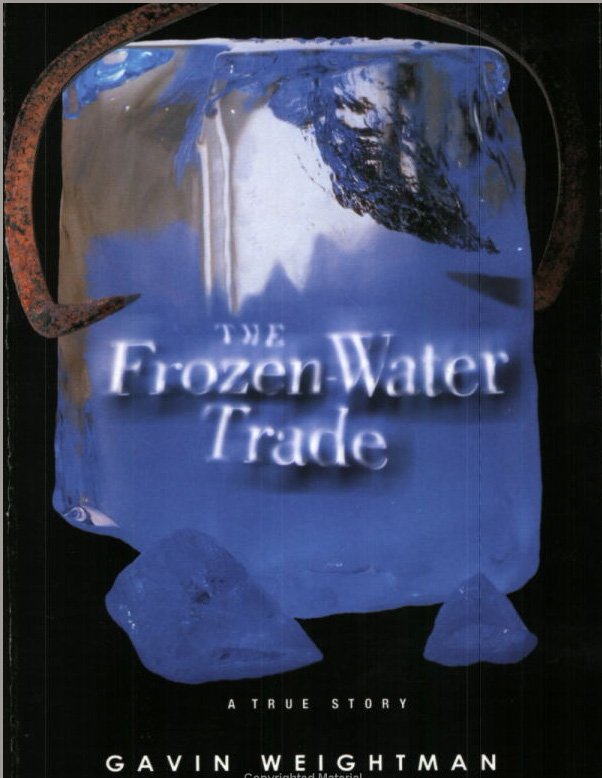
    Frozenwatertrade I recently finished reading The Frozen Water Trade: A True Story by Gavin Weightman. The book is the story of Frederic Tudor, whose wacky idea of cutting ice in winter from ponds in Massachusetts and selling it to people in warmer climates in the summer turned into a 100 year industry until refrigerated ice became readily available. Tudor's ice was shipped as far as Martinique, India, San Francisco (around the tip of South America where there was plenty of ice already), New Orleans, and throughout the American South.

    Of course, my interest in the book was purely cocktail-related. The sale of ice was directly responsible for the creation of drink categories including juleps, cobblers, and smashes, and created the need for cocktail shakers as well as straws. Iced drinks became popular with Englishmen in India, but didn't catch on in England (not for lack of trying to sell it there). American cocktails stood out from English and other ones in their need for ice (as evidenced by books like Recipes of American and Other Iced Drinks), and grew in format and in number because of this ingredient.

    As we know the cocktail was an American invention and probably its first native cuisine, we can probably chalk up a lot of the credit for America's famous drinks and bartenders (pre-Prohibition) to this one guy who created a world-wide industry out of nothing but freebies- frozen lakes, sawdust to keep it cold through the summer, and room in ships' holds as ballast on trading routes.

    The book itself isn't the "page-turner" as described on the cover, nor does it delve too deeply into the discussion of the impact on cocktails, but with an understanding of what came later in American cocktail history, it's fascinating for its implications. 

    An index of all of the ice experiments on Alcademics can be found here.

  • Party Tips from Esquire

    I think it's a little odd to put your New Year's party tips in the January issue of a magazine instead of December, then to give away all the content online before it's even January, but that's why I'm not a rich and famous magazine editor.

    Nor am I a David Wondrich, who wrote all the booze stories for the issue. They include:

    Esquire's Guide to Hosting

    A complaint about oversized Martini glasses

    And batch-sized recipes for party drinks: the Gin Daisy, Manhattan, and an original drink called the Saint Valentine (umm, wrong month again?) that includes rum, port, Grand Marnier, and lime juice.

    Esquirenye