Category: cocktails

  • Coffee liqueurs make a splash in cocktails

    Here's my new story in the San Francisco Chronicle on Sunday, June 30.

    Coffee liqueurs make a splash in cocktails

    by Camper English

    The craze for organic, shade-grown, micro-roasted slow-drip coffee has percolated into the cocktail world. Bartenders are improving classic coffee drinks, finding ways to harness the beans' bitter, aromatic qualities rather than just the caffeine kick.

    Most cold coffee cocktails served in the past 20 or so years have been variations of the vodka espresso (better known as the espresso martini) credited to British bartender Dick Bradsell and made with vodka, espresso and Kahlua and Tia Maria coffee liqueurs. Nopa bar manager Neyah White updated this drink about three years ago, creating the Blue Bottle martini with Blue Bottle espresso, vodka and Araku coffee liqueur. It was, and is, "a ridiculously big seller," White says.

    Coffee liqueur got a good bit more serious with the April release of Firelit Spirits Coffee Liqueur, made with coffee from Oakland's Blue Bottle coffee roasters and brandy from distiller Dave Smith of St. George Spirits in Alameda.

    Continue reading the story here

    Coffee liqueurs by Camper English in the San Francisco Chronicle

    Mike Kepka / The Chronicle

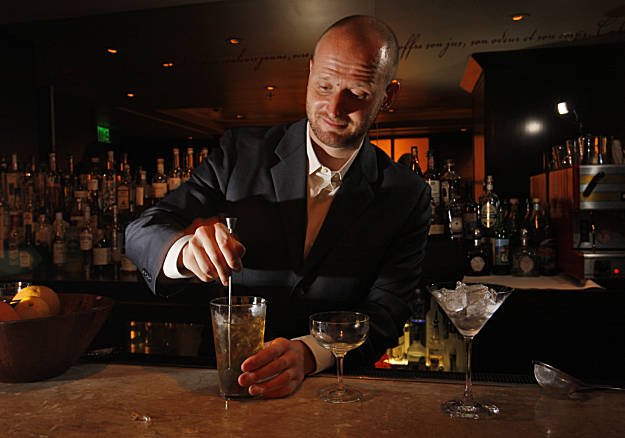
    Reza Esmaili at Smuggler's Cove makes a Rear Admiral's Swizzle with Firelit coffee liqueur.


  • Home Bar Recommendations: One of Each

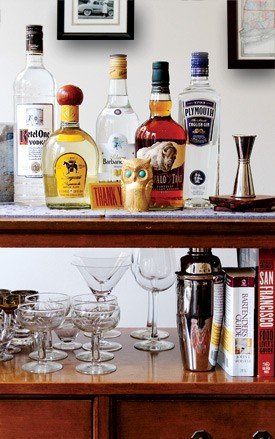
    OneofeachWhen Jonny Raglin and Jeff Hollinger were looking to open Comstock Saloon (hopefully this month), they had a big limitation to work with: the size of the back bar. It only has room for one or two types of each base spirit. This is a challenge for Raglin in particular as between his former post as Bar Manager at Absinthe and his consultant gig at Dosa on Fillmore he was working with probably 30 different types of gin alone. 

    This inspired a story I wrote for the April edition of 7×7 magazine. I also spoke with Martin Cate of Forbidden Island who had the luxury of choosing over 200 rums for the bar, but that didn't leave room for much else. Before opening he sent out an email requesting advice on one of each tequila (blanco, reposado, anejo) for the bar. I also spoke with Marcovaldo Dionysos, who was very selective when choosing the bottles for Clock Bar. He said he had to balance familiar brands that consumers know with less-recognized spirits he'd prefer to work with. 

    In the story I asked each of Raglin, Cate, and Dionysos to pick one of
    each- vodka, tequila, rum, whisky, and gin- that would work the best in
    the most cocktails, while also being good enough for sipping. The
    results should point home mixologists who may also not have room for 30 brands of gin toward the one bottle to buy.

    The Ultimate Five-Bottle Bar, Perfect for Apartment Dwelling

    by Camper English

    What happens when the city’s top bartenders are forced to choose? Introducing the ultimate five-bottle bar, perfectly sized for apartment dwelling. 

    Click the link above to read the story. In the print edition there are also recommendations for one each of sweet and dry vermouth and an orange liqueur/triple sec.

  • Better Cocktails Creep Into the Castro

    My first story written for 7×7 Magazine is now online. 

    Castro's Last Stand

    Long a bastion of bad drinks and a good time, the city’s biggest party neighborhood is slowly but surely learning how to wield a muddler.

    by Camper English

    Badlands
    While the Tenderloin, Mission and Haight are reveling in white whiskeys and raw sugars, in the Castro, bartenders are still called bartenders, and the drink of choice is more likely to be an appletini than something made with absinthe. From Martuni’s to Moby Dick, drinks in the gay sector are still mixed with vanilla vodka, Long Island Iced Teas make up the happy-hour specials, and mojitos come in more than one flavor. Popular venues, like Toad Hall and Badlands, skip the cocktail menu altogether.

    As of late, however, there have been a few glimmers of change. 

    Read the rest on the 7X7 website

  • Why Can’t I Get a McDonald’s Hamburger at Chez Panisse?

    In response to my recent story in the San Francisco Chronicle on high-end bars becoming more accommodating to patrons' requests, many people wrote into the comments about how snooty bartenders are who won't give you the drinks that you want.

    The Chronicle's commenters are a notoriously (and often hilariously) opinionated bunch, so I don't take offense to anything they say. By and large, they were all terribly upset with Erick Castro of Rickhouse's quote:

    "Three years ago it was OK to be rude. It used to be 'I'm not making a
    cosmo and you're a horrible person.' Now we say, 'I'm not making a
    cosmo, but I'm making you something better than a cosmo.' And if they
    like (the drink) they trust you for the whole night."

    Commenters were offended that a bartender is so arrogant as to think he knows better than the customer, and offended that a bartender wouldn't make the customer what he wants.

    I know that in the case of Rickhouse they don't carry cranberry juice, so they actually can't make a Cosmo. I believe all of the other drinks cited by commenters cannot be made at Rickhouse either- drinks with Midori, 7UP, Malibu, etc. They do not carry these products on principle, and thus cannot make drinks with them.

    So Rickhouse can't/won't make a Cosmo, and that makes people mad. But does it also infuriate them that Chez Panisse (probably) can't make a McDonald's hamburger?

    Would you be surprised at Chez Panisse if you asked your waiter for a McDonald's hamburger and they steered your toward something similar and better, like a grass-fed, free-range beef burger on a fresh-baked bread roll with organic ketchup? Would you consider them arrogant? Call for the waiter to lose their job?

    Only if you can't see the difference between McDonald's and Chez Panisse; between fast food and fine dining. And that is the image problem that cocktail bars have. Many people still think every bar is a McDonalds, when most bars that make the news are evolving toward something better. 

    The better cocktail bars are not actually suffering from this lack of understanding- there's a huge demand for them, in fact, and in my experience the places selling $10 cocktails are affected less in this recession than places selling $6 ones. So despite complaints, better cocktail bars are safe, for now.

    The funny thing is that speakeasy bars were originally a theme concept,
    but evolved into a practical concept: hiding the bars from people who
    don't yet know that not every bar serves Bud and has sports on TV.

    Some people worry that the perceived arrogance of the bartenders in these places will make this better-drinking era a trend rather than an ongoing movement. I think that's a valid concern, as fine cocktails are very trendy right now. I'd hate to see this movement lose momentum as there is so, so much further to go with it.

    As was the point in my original article, bartenders are learning how to talk to patrons in a nicer way to steer them away from lesser-quality or marketing-driven drink choices and into better ones. But is there more that can be done- in the media or by bartenders/bar owners- to make a clearer break between the fast food version of bars and the ones more like fine dining?

  • SF Cocktail Geography

    Sfist_logo Jay Barmann from SFist.com attended my talk at SF Chefs.Food.Wine and kept the handout. Today he's posted my categorization of nearly every type of cocktail program in the city, which is good, because formatting html is a pain.

    The categories I made up so don't get too hung up on them- it's just how I see them.

    Read it here

    I've been thinking of giving that talk again, because PowerPoint is forever. Let me know if you're into it and maybe I can put something together.

  • Oakland Names Official Cocktail

    … and it's the Mai Tai.

    Or maybe not. (Apparently they don't fact-check the newspaper's blogs.) Instead it was official Mai Tai day in Oakland, and they're trying to get the drink recognized as the city's official cocktail.

    For a debate on the origin of the Mai Tai, read this, and for Trader Vic's version (in which he says he invented the drink at his Oakland bar) read this.

  • Bartenders Hitting Their Hoes

    For some reason, the San Francisco Chronicle didn't choose the above title for my story that comes out Sunday August 30th. I can't think of why.

    More bars growing own cocktail ingredients

    Camper English, Special to The Chronicle

    Friday, August 28, 2009

     Victoria D'Amato-Moran grows tomatoes, Asian pears, Fuji apples, blackberries, roses and many herbs in her South San Francisco garden. Sooner or later, everything in it winds up in her cocktails.

    "Except the zucchinis," she says. "I haven't figured out how to use those yet."

    Gartenders2

    The Bay Area has long been home to the farm-forward cocktail movement – initially personified by Scott Beattie, then of Cyrus restaurant, who sourced produce from neighbors' fruit trees for his bar. Lately, more bartenders are doing the gardening work themselves, for the same reason that backyard gardeners seem to have appeared everywhere.

    The extra effort may not save money, and the drinks may not taste noticeably fresher to the customer, but you can bet they do to the proud garden tender who grew part of your gimlet from seed.

    Read the rest of my story in this Sunday's Chronicle about bartenders who also tend to gardens, including Duggan McDonnell, H. Joseph Ehrmann, Daniel Hyatt, Scott Stewart, Thad Vogler, and Lane Ford, and the bars Fairway Cocktail Lounge, Cyrus, Elixir, Alembic, Cantina, Fifth Floor, Bar Agricole, Starbelly, Sprcue, Brix, and Etoile. Gosh I'm thorough.

    Also: there's a recipe for Jacques Bezuidenhout's Sagerac, a version of the Sazerac made with fresh picked sage, and Scott Stewart's Lonsdale No. 3 made with fresh basil.

    Gartenders1

  • The Ultimate Test of your Liquor Cabinet

    Not only is the Laphroaig Project delicious and surprisingly tropical for its ingredients, it's a test of your liquor
    cabinet. If you have all of these ingredients at home you are a huuuuge cocktail geek.

    The Laphroaig Project was created by Owen Westman at Bourbon & Branch and it's
    also available at Rickhouse, both in San Francisco. It contains:

    • Green
      Chartreuse
    • Yellow Chartreuse
    • Laphroaig Islay Single Malt Whisky
    • Luxardo Maraschino liqueur
    • Peach bitters
    • Lemon juice

    What? Yes. The recipe is here.

    And if you can make it without shopping, I think you are cool. 

  • Heirloom Tomatoes, Ripe for Drinking

    It's tomato season and all the local restaurants are rolling out the tomato carts and tomato specialty dinners. The bartenders are getting in on the action too.

    Zing At Range, Carlos Yturria's famous Sungold Zinger is back on the menu, made with Sungold Zinger cherry tomatoes, No. 209 gin, lemon, agave syrup, and salt.

    The bartenders at Range restaurant in San Francisco have started two blogs, by the way. Cocktail of the Day lists the daily cocktail served at the restaurant, and Inside the Blood Bank (from which I stole the picture) is a more general bartender and drink blog.

    Elsewhere in tomato drink news, Carneros Bistro & Wine Bar in Sonoma is serving a tomato basil martini with your choice of gin or vodka.

    And as part of the tomato dinner Sent Sovi in Saratoga greets guests with a Lemon Boy Bellini. Tomato Bellini? That sounds oddly delicious.

  • History of the El Diablo Cocktail in Trader Vic’s Books

    I was trying to find the first reference to the El Diablo cocktail recently.

    Mexican El Diablo


    1/2 lime


    1 ounce tequila


    1/2 crème de cassis


    Ginger Ale


    Squeeze lime juice into a 10-ounce glass; drop in spent shell. Add ice cubes, tequila, and crème de cassis. Fill glass with ginger ale.

    Searching the web, the earliest reference I read to it was from Trader Vic's books of 1946 and 1947.

    I asked tiki expert Martin Cate, who has these books, if he knew if the drink was a Trader Vic original. After his research it's still not entirely clear, but the research is interesting in itself.

    Martin says:

    IT IS in the 1946 TV Book of Food and Drink- It is
    called a "Mexican El Diablo" and it IS singled out as an original
    cocktail.
     
    IT IS in the 1947 TV Bartender's Guide again as a
    "Mexican El Diablo", but does not declare it an original- although that book
    does not specify.
     
    It's not in the TV Kitchen Kibitzer
    1952
     
    IT IS in the TV Pacific Island Cookbook of
    1968, but now called "El Diablo" only
     
    IT IS in the TV Bartender Guide Revised 1972 as an
    "El Diablo", but does not say it's his.  This edition DOES call out
    original drinks.

    Thanks Martin!

    If anyone finds an earlier reference to the El Diablo or Mexican El Diablo, please let me know.