Previously the Wall Street Journal had posted an excerpt from my book Doctors and Distillers, so I wasn't expecting this review from wine writer Eric Asimov to come in.

Previously the Wall Street Journal had posted an excerpt from my book Doctors and Distillers, so I wasn't expecting this review from wine writer Eric Asimov to come in.
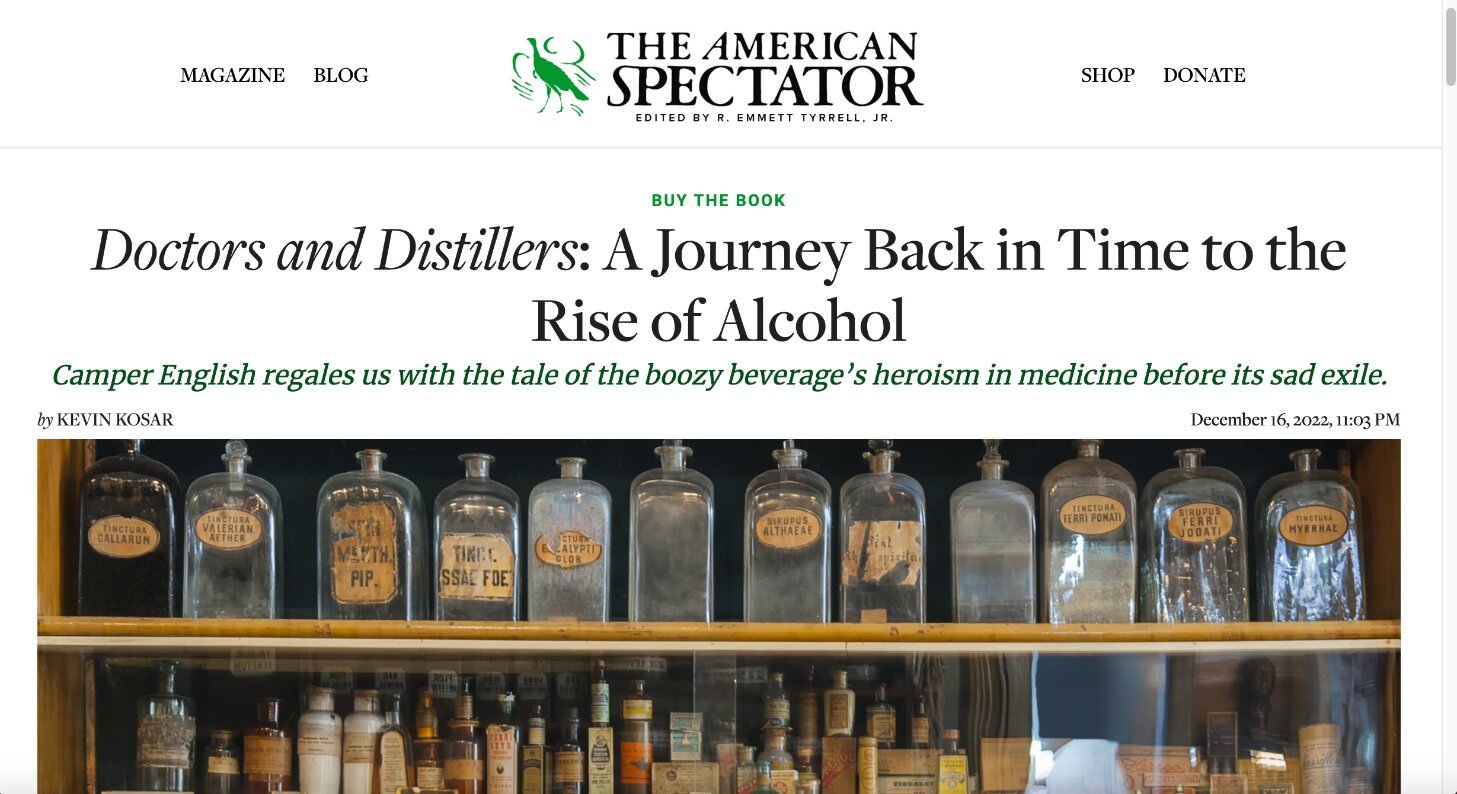
A very nice review by Kevin R Kosar in The American Spectator!
Walk into the average American grocery store and you will see the spices in one aisle, herbal cures in another, and beer and wine somewhere else. Over-the-counter medicines have their own section, and drugs are locked up behind the pharmacist’s counter. And distilled spirits, well, you likely will not find them on the shelves — they typically are exiled to dedicated liquor stores. Separate products for separate purposes, all packaged, marketed, and sold separately.
This state of affairs developed only in the past century, as one learns from Camper English’s diverting Doctors and Distillers: The Remarkable Medicinal History of Beer, Wine, Spirits, and Cocktails (Penguin, 2022). Hitherto, these foodstuffs were united in the form of boozy health tonics and curatives, which the sick or simply thirsty acquired from apothecaries, monks, barbers, or other medicine men.
…
Camper English’s Doctors and Distillers is a delightful way to journey back in time and see the many and often crazy ways that drink and medicine merged. Having finished reading this expansive book, nonetheless my yearning for those remarkable days of yesteryear remain. So off to a bar I shall go, where I can relive them by paying a mixologist to serve me an elixir of Fernet-Branca and cola, or perhaps a slug of herb-loaded Jägermeister.
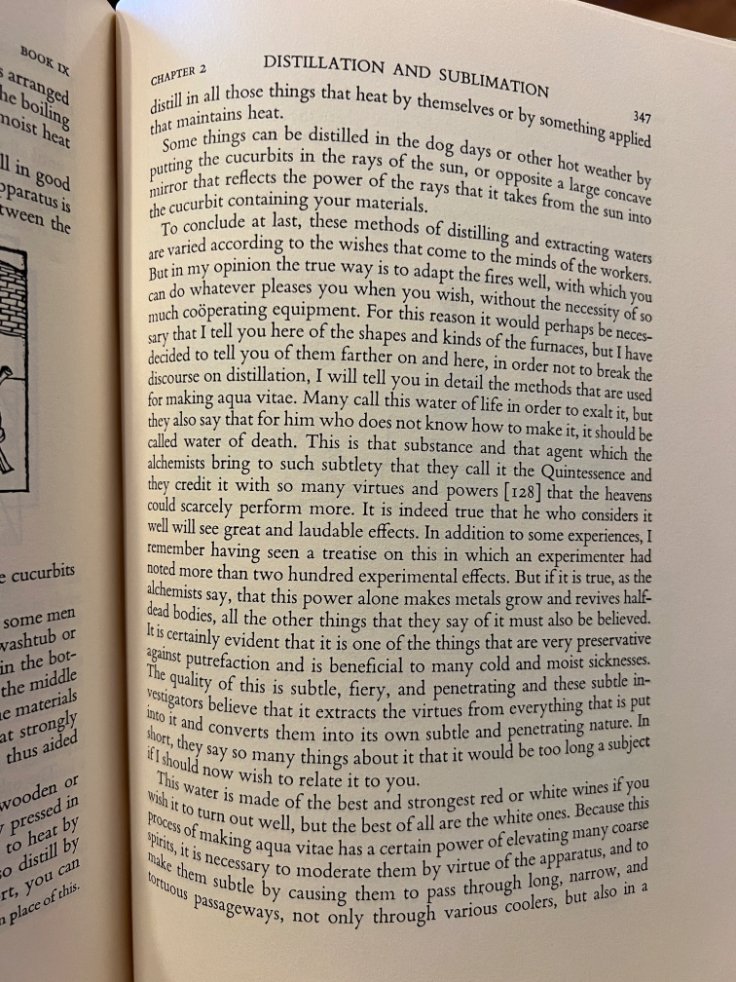
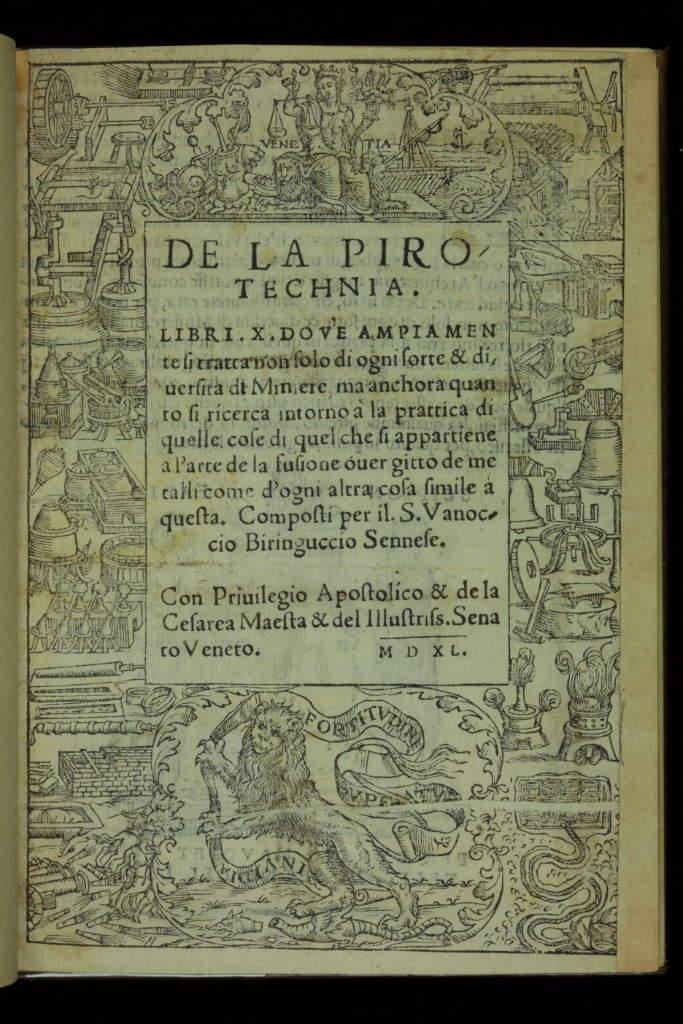 I read about a reference to distillation in the Pirotechnia, so I decided to look up the book.
 To conclude at last these methods of distilling and extracting waters are varied according to the wishes that come to the minds of the workers. But in my opinion the true way is to adapt the fires well, with which you can do whatever pleases you when you wish, without the necessity of so much coöperating equipment. For this reason it would perhaps be necessary that I tell you here of the shapes and kinds of the furnaces, but I have decided to tell you of them farther on and here, in order not to break the discourse on distillation, I will tell you in detail the methods that are used for making aqua vitae.Many call this water of life in order to exalt it it, but they also say that for him who does not know how to make it, it should be called water of death. This is that substance and that agent which the alchemists bring to such subtlety that they call it the Quintessence and they credit it with so many virtues and powers [128] that the heavens could scarcely perform more. It is indeed true that he who considers it well will see great and laudable effects. In addition to some experiences, I remember having seen a treatise on this in which an experimenter had noted more than two hundred experimental effects. But if it is true, as the alchemists say, that this power alone makes metals grow and revives half-dead bodies, all the other things that they say of it must also be believed. It is certainly evident that it is one of the things that are very preservative against putrefaction and is beneficial to many cold and moist sicknesses. The quality of this is subtle, fiery, and penetrating and these subtle, fiery, and penetrating and these subtle investigators believe that it extracts the virtues from everything that is put into it and converts them into its own subtle and penetrating nature. In short, they say so many things about it that it would be too long a subject if I should now wish to related it to you.
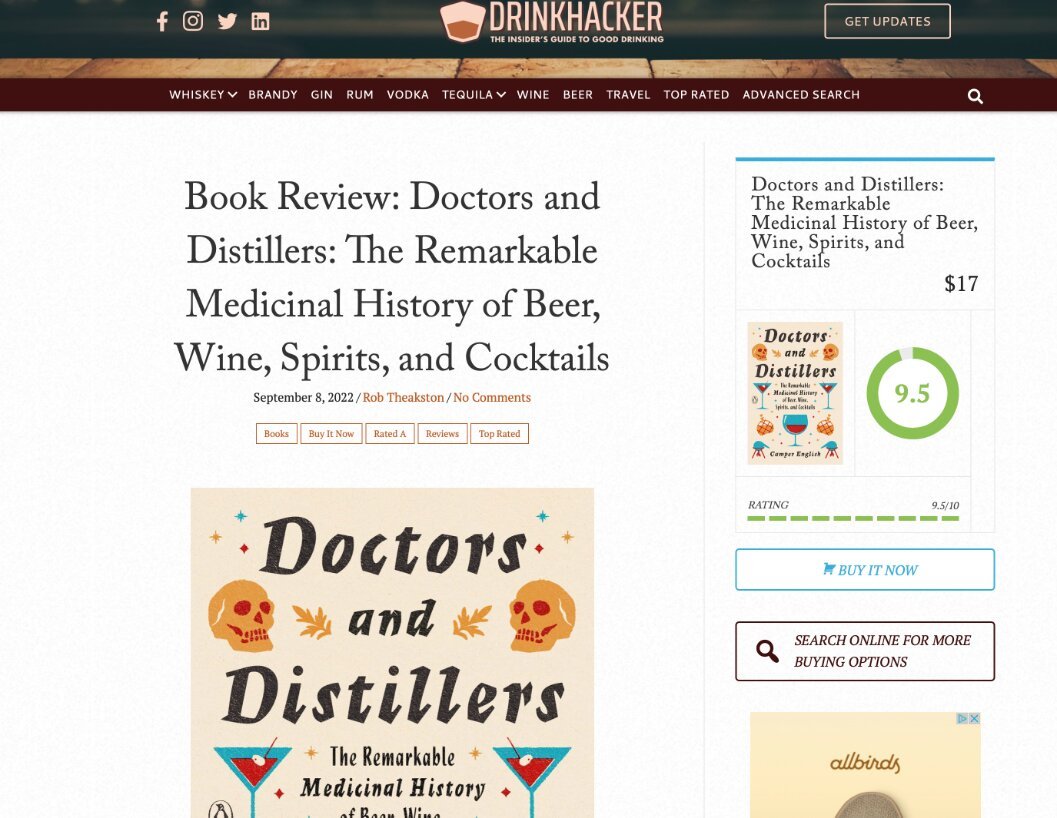
DrinkHacker posted a nice review of Doctors and Distillers.
English does an excellent job diving deep into the symbiotic history between medicine and alcohol, but he skillfully avoids the dry, academic presentation of information with a light touch and informal accessibility usually absent in alcohol history books.
Reviewer Rob Theakston gives it an "A" or a 9.5 out of 10. Read it here.
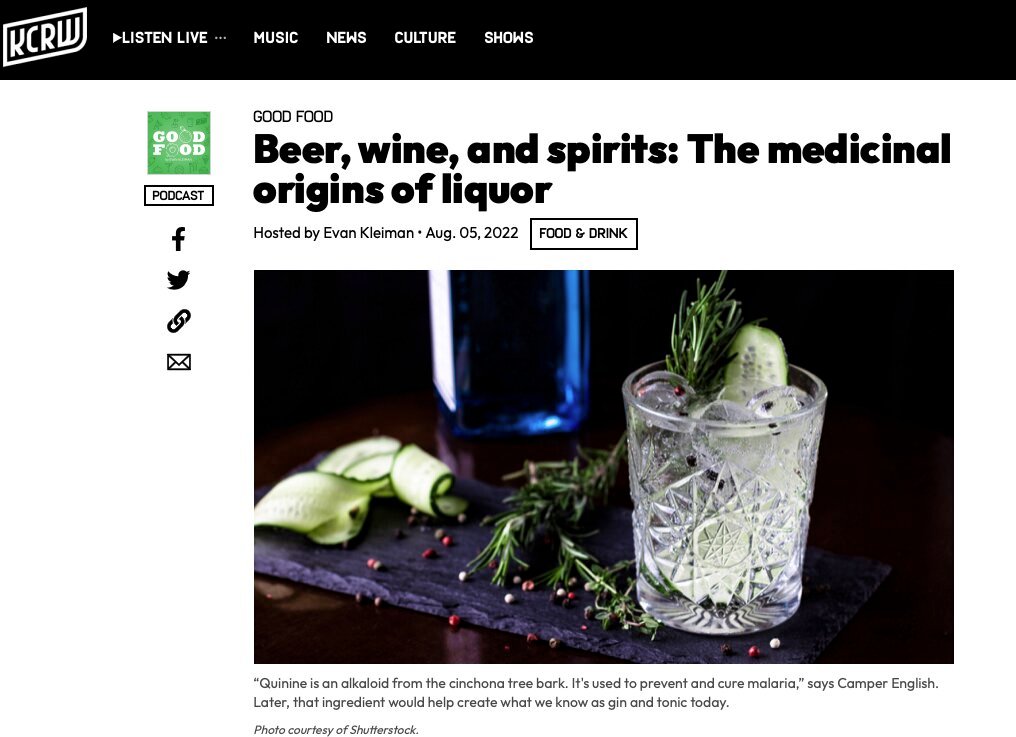
According to the What's Health Got to Do With It? podcast on WJCT news, Doctors and Distillers is one of the best medical books of 2022.
Listen to the podcast in which I'm a guest in the second segment.

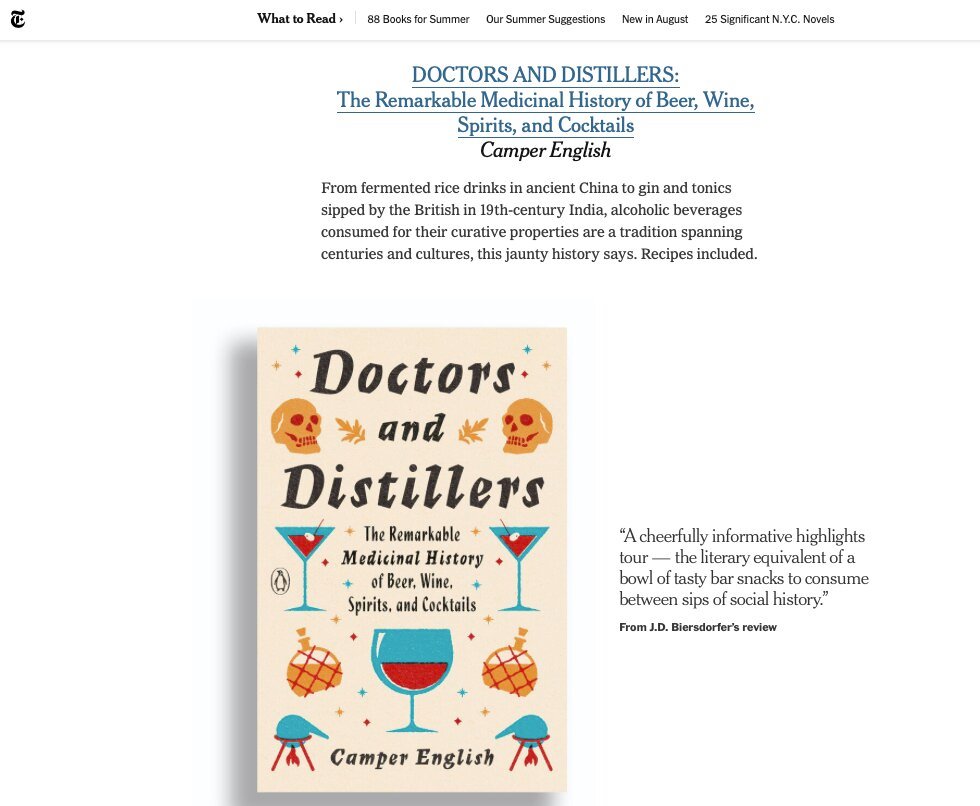
Along with the review, the New York Times put Doctors and Distillers on their list of book recommendations for the week. Awesome!


For the Washington Examiner, Jacob Grier reviews Doctors and Distillers:
The recipes are a welcome addition, since, as befits the subject matter, Doctors and Distillers is not a dry text. The history is lively, told without getting too bogged down in details of medieval medicine, fermentation, and distillation. Mix the drinks as one goes and you may end up not only with a new favorite cocktail but also a fun story of its medicinal roots to accompany it.

The UK title of Doctors and Distillers is A Perfect Tonic. It's the same book otherwise.
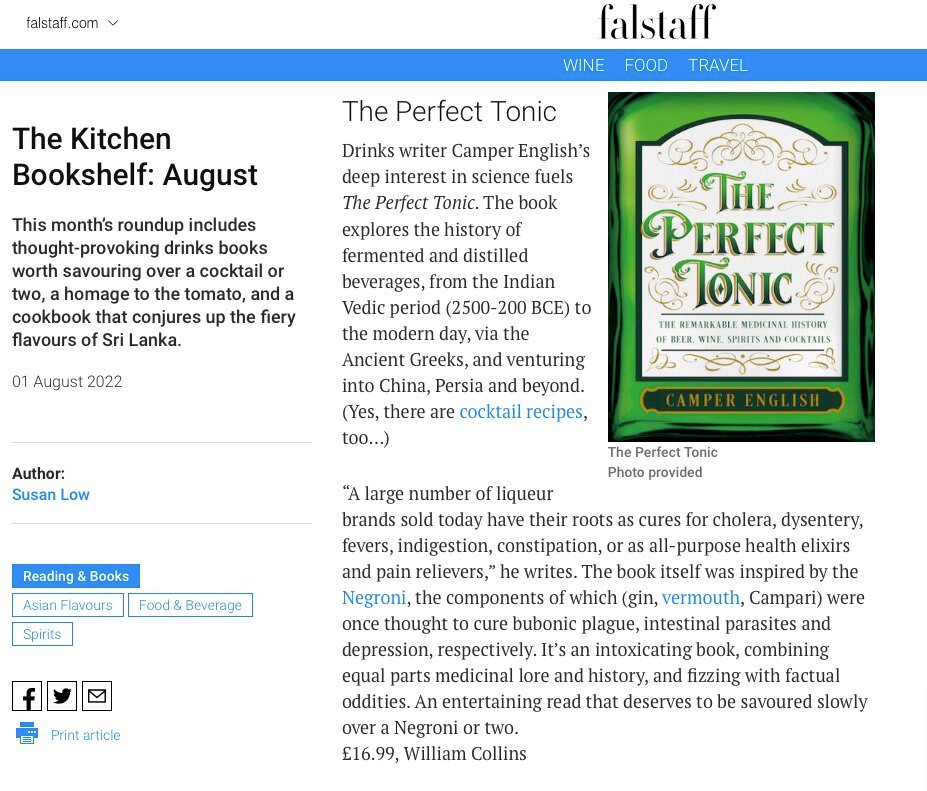
A Perfect Tonic was reviewed in Susan Low's The Kitchen Bookshelf column in Falstaff International.
She writes:
Drinks writer Camper English’s deep interest in science fuels The Perfect Tonic. The book explores the history of fermented and distilled beverages, from the Indian Vedic period (2500-200 BCE) to the modern day, via the Ancient Greeks, and venturing into China, Persia and beyond.
…
It’s an intoxicating book, combining equal parts medicinal lore and history, and fizzing with factual oddities. An entertaining read that deserves to be savoured slowly over a Negroni or two.
I'm very pleased with that review!