I wrote up a short ditty on the Pickle Back (A shot of whiskey- usually Jameson- with a pickle juice chaser) for the Los Angeles Times Magazine's March issue.
Read it here.
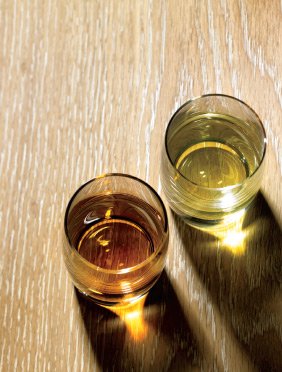
(Photo by Brian Leatart)
I wrote up a short ditty on the Pickle Back (A shot of whiskey- usually Jameson- with a pickle juice chaser) for the Los Angeles Times Magazine's March issue.
Read it here.
(Photo by Brian Leatart)
In Ireland a few weeks ago, I had Irish Coffee three times in as many days. Irish Coffee was invented in Ireland and is credited to a bar at the Shannon airport. Then it was recreated in San Francisco at the Buena Vista. Its popularity in the US helped it travel back to Ireland where became popular around the country.
At the Chapter One restaurant in Dublin, they have the most elaborate preparation of the Irish Coffee in town. They add Jameson Irish Whiskey and 2 tablespoons brown sugar to a pan and caramelize it for 10 minutes and grate fresh nutmeg on top. They add half the amount of coffee, then light the pan on fire for just a second and blow it out. They add the other half the coffee then pour it into the glass.

Then they add the cream on top. Unlike the other Irish Coffees I've had, the cream was fairly warm as opposed to refrigerator-cold. Most of the fuss of an Irish Coffee seems to be about the cream. I address this in last week's post on FineCooking.com.
It turns out different countries have conflicting definitions for cream, and even in the US you have to know the difference between "whipped" and "whipping" cream to get it right.
The good news is, once you buy the right cream you don't have to whip it very much yourself- just don't stir the coffee first, and pour it over the back of a spoon. More info is in the post here.
In early February I visited the Jameson Irish Whiskey distillery – actually two of them.
The original Jameson distillery is in Dublin, but it is no longer made there. In 1971 it moved to the Midleton distillery in Cork. The reason is because in the late 1960's Irish Distillers was formed, a merger of Jameson, Powers, and Cork distilleries.
In Dublin there is a visitors' center and restaurant. We went there first. I've got to admit, they did a really good job making a non-working distillery look working, using dioramas and original distillery parts but with fake ingredients pumping through them.


The next day we went to the new distillery in Cork. But actually it's the new-new distillery, located next to the old one.


Here we skipped the typical tour in favor of an in-depth one.
Jameson Fun Facts


 Another magazine I write for that is not usually online is Caviar Affair, for which the tagline is, "Celebrating wordly indulgences and luxury living."
That's so *me*, right? Actually it really is, except that other people indulge me in the luxury to which I've become accustomed.
Anyhoo, they did put the new issue online. Unlike much of what I write for other publications, there is a definite emphasis in my stories for this magazine on stuff that you can buy, rather than, say, ruminations on flavor combinations and the deeper meaning of cocktail culture.
The whole issue online is here.
For this issue I wrote some stuff on vodka, some on rare scotch, a bit about my trip to Guatemala, and information about some new cocktail bars.

My San Francisco winter drinking guide in 7×7 Magazine is coming online in bits and pieces.

Here are some:
I am a big fan of distillery waste. Not bathing in it, but learning about it.
In most cases where a grain is distilled into whiskey or vodka, the spent grain (after all the sugar has been removed to be fermented) is sold off as animal feed. In Cognac (at Hennessy anyway) the spent lees (grape parts) are taken to an industrial distiller to get more alcohol out of them, and the "heavy sediments" of the grape juice go for cattle feed and for use in pharmaceutical products. In tequila production, the spent fibers from the agave pinas are sometimes put back on the fields as fertilizer, sometimes mixed with the heads and tails of distillation.

(There is a lot of leftover vegetation in tequila production.)
Many sugar cane distillers (either at the sugar factory for rum or at the distillery for rhum agricole) burn the spent sugar cane stalks to heat the steam engine that powers the distillery.

(Spent sugar cane to be burned at Rhum Clement distillery on Martinique.)

(Huge steam-powered gears at Rhum Clement distillery on Martinique.)
The heads and tails are the waste products of distillation, made up of alcohol, water, and undesirable flavor compounds that distillers don't want in their final products. These are also recycled. In scotch whisky, these are put back into the still for the next batch of distillation. (Somehow they never build up and overwhelm the spirit- weird.) Many companies sell the heads and tails to industrial distillers who make pure spirit, cosmetics, and other products. Some use this alcohol as fuel to heat their distilleries in winter.

(The condenser at Fettercairn.)
Speaking of heat, many (if not most) distilleries are mainly powered by hot water; heated either by an oil burner or by burning waste materials like the sugar cane stalks mentioned above. The hot water heats the stills to convert the liquids into steam. Cold water is also needed in the condensers of the still to convert the alcohol in steam form back into liquid form. Typically this cool water comes from a nearby stream or river. After it is used in the condenser it is now hot water, which isn't usually suitable for dumping back into the water stream from whence it came until it is cool. In some distilleries such as the one for Blue Ice Vodka, this hot water is used to lightly heat a warehouse in the winters.
What About the Water in the Still?
On my recent trip to the Isle of Jura, The Dalmore, and Fettercairn distilleries I learned about more industrial waste. This made me very happy.
For some reason nobody talks about the leftover water from distillation. Distillation is really just separating alcohol from water in order to concentrate the alcohol. Concentrate alcohol in beer and you get (unaged) whisky or vodka. Concentrate it in wine and you get brandy. The heads and tails contain alcohol and this is valuable so it gets recycled, but there is still the water left in the still.

(Stills at Fettercairn.)
At Fettercairn, Jura's master distiller Willie Tait explained it: After the first distillation, the leftover water also contains yeast bodies from fermentation. This water/yeast mix is called "pot ale," and it can be boiled down into a high-protein syrup used as cattle feed or as fertilizer.
After the second distillation the leftovers are mostly water with a high copper content with some congeners. Tait said this mixture is called the "spent lees," which is confusing because in cognac this means something different. I also failed to write down how this water is recycled if it is at all, so I have more fun facts about distillery waste to learn!
Last week I visited the Isle
of Jura, The Dalmore, and Fettercairn distilleries in Scotland. These
brands are all owned by White &
Mackay. This post is about visiting the Fettercairn distillery.

(Fettercairn marked with red pin. Map made with Google Maps)
From The Dalmore distillery we went on yet another gorgeous drive over two mountain ranges to reach Fettercairn, a distillery named after the town where it is located. As you can see on the map below, after you come down from the mountains where much of the vegetation is heather (brown at this time of year) like low scrub bushes, you hit the eastern farmlands with rich soils and plenty of water coming off the hills.

The Fettercairn distillery is about a five-minute walk from the center of Fettercairn with its one pub and stone arch commemorating a pit stop from Queen Victoria. It is surrounded by fields and there are cattle grazing across from the distillery.
The distillery is full of much original equipment from 1824 with a few technological improvements. They no longer do floor maltings (I think only five or six distilleries still do) but otherwise things look pretty old-fashioned here.

(Fettercairn Distillery. Cows in foreground.)
The mash tun is an old copper-topped one with mechanically-driven (see below) stirrers inside. The drainage at the bottom of these older mash tuns is different from newer models, so to compensate the barley must be ground to a courser level.


(Above: Copper-topped mash tun. Below: Inside the mash tun.)
The distillery also has wooden washbacks where fermentation happens. Most wooden washbacks I've seen are made from Doug Fir pine from Oregon.

(Wooden washback)
Unlike at The Dalmore distillery that uses the brown-colored peat-rich river water, Fettercairn uses water from an underground spring for mashing, fermentation, and reducing to barrel proof. It is crystal clear and rich with minerals- you can taste a sort of metallic-granite flavor and it is very drying in the mouth, almost a tannic feeling.

(Stills at Fettercairn)
Fettercairn has two pairs of stills and the still for the second distillation (the "spirit still") has a pretty unique feature.
On yesterday's post about The Dalmore I noted that the still has a reflux box (don't know the technical name for it) in which cold water runs around the top of the neck of the still to encourage only the heavy flavor molecules to cross over.
At Fettercairn they do this in a different way: during the part of the distillation when they're getting the heart of the spirit (the part that will actually be put in barrels rather than recycled), cold water runs down the outside of the neck of the still. I've never seen anything like this on a still before.
It's hard to capture in pictures, so I took this short video. I think this is supercool, but I'm a nerd.
After the whisky is distilled and put into barrels it is stored in traditional dunnage warehouses- old, earthen floor warehouses in which barrels are stacked no more than three-high. There are thick walls and in this case a slate roof. The walls are super moldy and reminded me a lot of the aging warehouses in Cognac.
In these dunnage warehouses (about 12 of them for Fettercairn, all local), there is not a great deal of temperature difference between the top and bottom row. This is quite different from a racked warehouse (think of the tall bourbon warehouses), in which casks are stacked several stories high and temperature, evaporation, and rate of aging vary greatly in different parts of the warehouse.
Now for the bad news: Fettercairn is not available in the US. Even in Scotland its pretty rare to find it as a single-malt. They released a new bottling called Fior that's really tasty and they can't keep it on the shelves. They also sell some 30-year-old and 40-year-old expressions but who can afford such things?

We tasted several barrel samples and they were really wild- a 2004 ex-bourbon had a salty finish and a bourbon grain taste. A 1997 sherry refill cask sample tasted fruity-savory with flavors of sundried tomato and cranberry. The 1974 and 1973 ex-American oak hogsheads were insane floral explosions of lilac, jasmine, rose, and other candied flower flavors.
I assume that most all Fettercairn goes into blends, as most whisky goes toward blends even if it is from a notable single-malt. I do wish they sold this single-malt in the states because:
1. It tastes good.
2. Unicorns!

Last week I visited the Isle of Jura, The Dalmore, and Fettercairn distilleries in Scotland. These brands are all owned by White & Mackay. This post is about visiting The Dalmore distillery.

(The Dalmore distillery indicated by red dot. Map from Google Maps.)
From Jura, we took a boat to the mainland and then drove diagonally northeast to reach The Dalmore. It was a long and gorgeous drive into the Highlands that took the better part of a day.

(The Dalmore distillery)
There are many things that make up the final flavor profile of a single-malt scotch, including the variety of barley, the peating levels of it, the water used in the mashing and fermentation, the size and shape of the stills, the size and type of barrels used to age it, where the barrels are aged, and of course the length of aging of the whisky.
The water for The Dalmore comes from Loch Morie, and inland lake. The water then runs through a river to the distillery that is located on another body of water, the Cromarty Firth. As the water travels through a whole lot of peat on the way, by the time it reaches the distillery it is brown in color. This water, not filtered, is used in the mashing and fermentation, and to dilute the whisky to barrel proof for aging.
You can see how it might add to the flavor of the whisky.

(Peat-filled brown water flowing into The Dalmore distillery.)
In the previous post I talked about Jura's tall stills that produce a light and fruity spirit full of high esther notes like pear. At The Dalmore the stills are quite differently shaped and this impacts the spirit.
Photography wasn't allowed in the still room so you'll have to make due with my artistic renderings below.
The stills for the first distillation almost look decapitated- they just stop with a flat top and the lynne arm is not a gentle curve from the top, but a tube sticking out from a foot or two below it.

(Artistic rendering of stills at The Dalmore. Not to scale.)
The still for the second distillation isn't quite as ugly, but it's even more interesting. I think this is the first time I've seen a water-filled reflux section on a still in Scotland. On the tubular pipe near the top of the still is a section that is rinsed with cool water inside.
This makes it difficult for light elements to reach the top of the still, leaving the more robust heavy molecules to cross over to the condenser. You get a spirit that's a lot less light and esthery, very much unlike Jura we'd visited the day before.

Thus The Dalmore comes off the still as a big bold heavy liquid before it goes into wood. It is then the job of the Master Blender, Richard Patterson in this case, to tame the spirit as it ages and shape it into the final product.
I thought that the role of the Master Blender was simply to take what was given to him- a bunch of scotch in barrels- and mix it together, but it is much more than that, at least at The Dalmore.
Patterson chooses the types of barrels (going to Jerez to pick out the sherry ones personally) in which the spirit will be aged, decides on the flavor profile he's seeking for a particular bottling, manages the aging process and checks up on the spirit to see how it is doing as it develops, and puts the blends together. It is product development, wood management, and blending.
Keep in mind that this is still just for a single-malt scotch whisky, a blend of whiskies from the same distillery. A vatted malt or a blend would involve whiskies from other distilleries and grain (column distilled) whisky also. Patterson does this for the Whyte & Mackay blended scotch whisky that is not available in the US.

On this trip I learned a great deal about the different roles of the master distiller and the master blender, and how some spirits need gentle nudging as they age to get them to the right final flavor profile, and others need an aggressive and more hands-on approach to bring them into line. Funny enough, the lighter, softer spirit is made on an island and the full-bodied bruiser comes from the Highlands.
Last week I visited my 50th distillery/blending house at the Isle of Jura. What made it extra special is that we hit it at 1:30 in the morning.
Though the Isle of Jura is closer to mainland Scotland than Islay, to reach it you take either a plane or ferry to Islay then another quick ferry to Jura. (Jura is the red dot on the map below. Islay is the island to its left.)

(Map produced using Google Maps.)
Jura has far fewer inhabitants than Islay- I think around 200 compared with Islay's 3500- and just one distillery compared with Islay's eight. We arrived on the island after a drive and boat trip, then had time for dinner and a visit to the pub.
It was after we left the pub (they kicked us out at 1:15AM) that we noticed the lights were on in the distillery. "Do you want to see it now?" asked Willie Tait, Jura's Master Distiller, to the last two journalists standing.
"Um, yeah!" we said, and in we went.

(Late night in the distillery.)
The next morning we gathered up everybody for the real tour. Tait calls Jura "A Highland whisky made on an island," which is short for "unpeated." Islay/island whiskies are known for their smoky flavor, which comes from drying sprouted barley with peat smoke.
In the olden days when the first Jura distillery was built back in 1810, the whisky would have been heavily peated as the barley would have been dried locally.
Jura had no distillery for a long time- the current one opened in 1963- and by then everything had changed. Most barley is dried in large commercial facilities then shipped to distilleries. Each distillery can specify the level of peatiness of their malted barley (in phenolic content), and Jura for the most part specifies none at all.

(Malted barley ready for use at Jura.)
The barley is brought to the distillery, milled to break it up, then washed with hot water to release sugars, fermented, and distilled.
The stills on Jura are quite tall- 28 feet- and this produces a spirit that is very light in body, emphasizing the high esther notes ("pear drops") in the whisky.

(Tall stills at Jura.)
Jura is aged in a few kinds of wood. Much of it is what Tait called "American oak." These casks are ex-bourbon barrels that also were used to age scotch and have been rebuilt into hogshead sized barrels that are a little bigger than the bourbon ones. Unlike "ex-bourbon" barrels that are also used on Jura, the American oak barrels aren't still soaking with bourbon and don't add as much character to the spirit- they just let it age slowly without flavoring it so dramatically. Jura also uses ex-sherry butts in smaller amounts.
Tait emphasized that with Jura the point is to get the distillation just where you want it, then not mess around with the spirit too much in the barrel. (You'll see how this is the opposite of what happens at The Dalmore in another post.) Most Jura starts off in American oak then can be finished in other casks to nudge it a little in one direction or the other.

The main Jura bottlings are the 10 and 16 year-olds. The 10 is full of pear flavor and Tait says he would even recommend it served on the rocks as a pre-dinner aperitif. The 16 is more full-flavored and rich, striking a nice balance between friendly flavors and the depth that comes with aging.
Jura does use some peated barley in its production. The Superstition bottling uses 13% malted barley peated to 40ppm phenol, with the rest un-peated barley. Tait calls it a gentle introduction to peated whiskies. I call it tasty.
The last bottling, which is new to the US market, is the Prophecy. It was distilled in 1999 from all peated barley, and aged in some Limousin oak and Oloroso sherry along with the usual American oak and ex-bourbon casks. It's bottled at 46% and non-chill-filtered. So I guess that one is an island whisky made on an island.
Much more to come from my trip in later posts…
After my visit to the Bowmore and Auchentoshan distilleries, our group stopped by the headquarters of their parent company, Morrison Bowmore. (This company is in turned owned by Suntory, and is distributed in the United States by Skyy Spirits.)

There we met with Senior Blender Iain McCallum, who is sort of a legend even though he’s less than 40 years old. He's engaging, fast, fun, and smart as heck. If given the opportunity to attend an event he hosts, I highly recommend it. (If given the opportunity to go out drinking with him afterward, I recommend that too even though he may hand you a shot of Malibu mixed with coffee liqueur.)
In the aged spirits category, a brand may choose to promote its distiller (in charge of distilling), warehouse manager (in charge of aging), distillery manager (in charge of the whole process locally), or the master blender. We spent time with Bowmore's distillery manager on Islay and Auchentoshan's distiller in Glasgow.
The blender's job is (obviously) to blend whiskies from the various barrels into the final product to stay consistent with the desired flavor profile of the bottling. (Single malts are not single barrels, remember, and they may come from various years as long as they're distilled at a single distillery.) This person will not only assure quality of product, they'll have an incredibly good/trained nose and palate for doing this.

In the blending room, we sampled a few new bottlings coming out from Auchentoshan and Bowmore- but not for several months. More on those at a later date.
We also had the honor of tasting Bowmore Gold, which is every bit as wonderful as I remember it. The Black, White, and Gold Bowmore expressions are long-aged in Vault No. 1, the below sea level barrel warehouse on Islay. The thing about long aged Islay whiskies, particularly Bowmore with its lower phenol (smoky) content than other Islay whiskies, is that after a long time aging the smoke starts to dissipate and new flavors come through.
I finally had the opportunity taste the Black Bowmore, one of the most thrilling (also expensive) whiskies I’ve ever tried. It had a few flavor notes in common with Bowmore Gold (I was again reminded of the “banana sandpaper” that doesn’t exist in nature ), plus papaya and mango notes, and a mysterious and slightly darker nature. Wonderful, wonderful stuff.

(Iaian McCallum with a bottle of the original Black Bowmore.)
The only disappointing (I use this term very relatively) part about the visit is that I didn’t get the chance to try the White Bowmore. But that gives me a pretty good reason to come back.

