Published Feb 10, 1926, San Francisco Chronicle
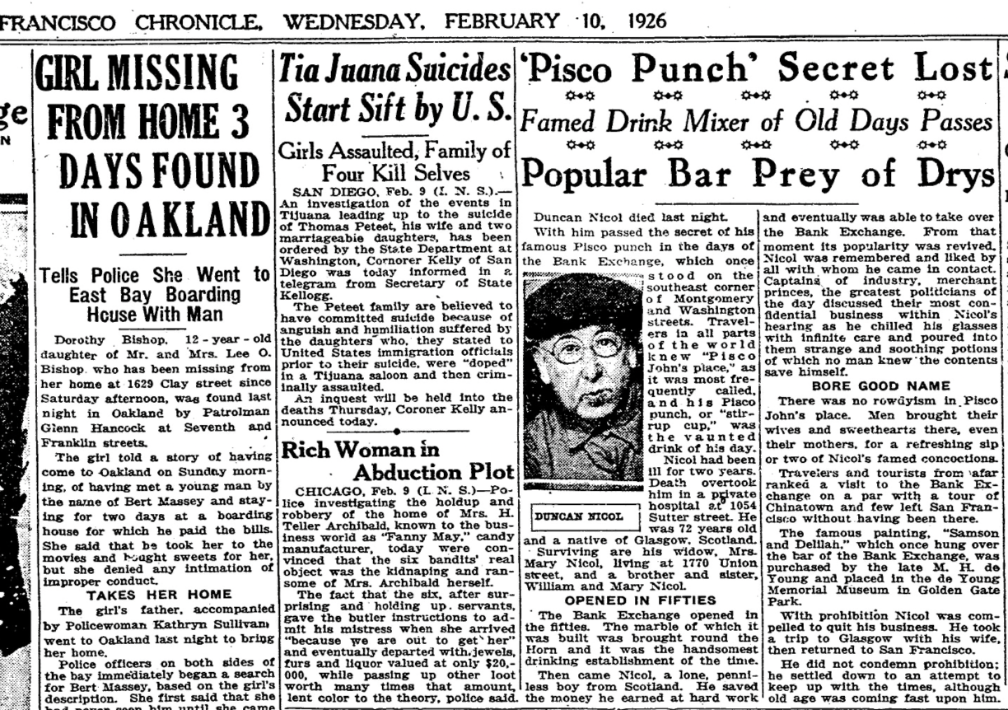
‘Pisco Punch’ Secret Lost
Famed Drink Mixer of Old Days Passes
Popular Bar Prey of Drys
Duncan Nicol died last night.
With him passed the secret of his famous Pisco punch in the days of the Bank Exchange, which once stood on the southeast corner of Montgomery and Washington streets. Travelers in all parts of the world knew “Pisco John’s place,” as it was most frequently called, and his Pisco punch, or “stirrup cup,” was the vaunted drink of his day.
Nicol had been ill for two years. Death overtook him in a private hospital at 1054 Sutter street. He was 72 years old and a native of Glasgow, Scotland.
Surviving are his widow, Mrs. Mary Nicol, living at 1770 Union street, and a brother and sister, William and Mary Nicol.
OPENED IN FIFTIES
The Bank Exchange opened in the fifties. The marble of which it was built was brought round the Horn and it was the handsomest drinking establishment of the time.
Then came Nicol, a lone, penniless boy from Scotland. He saved the money he earned at hard work and eventually was able to take over the Bank Exchange. From that moment its popularity was revived.
Nicol was remembered and liked by all with whom he came in contact. Captains of industry, merchants princes, the greatest politicians of the day discussed their most confidential business within Nicol’s hearing as he chilled his glasses with infinite care and poured into them strange and soothing potions of which no man knew the contents save himself.
BORE GOOD NAME
There was no rowdyism in Pisco John’s place. Men brought their wives and sweethearts there, even their mothers, for a refreshing sip or two of Nicol’s famed concoctions.
Travelers and tourists from afar ranked a visit to the Bank Exchange on a par with a tour of Chinatown and few left San Francisco without having been there.
The famous painting, “Samson and Delilah,” which once hung over the bar of the Bank Exchange, was purchased by the late M. H. de Young and placed in the de Young Memorial Museum in Golden Gate Park.
With prohibition Nicol was compelled to quit his business. He took a trip to Glasgow with his wife, then returned to San Francisco.
He did not condemn prohibition; he settled down to an attempt to keep up with the times, although old age was coming fast upon him.
Leave a Reply