Author: Camper English

  • I’ve Been Distilling Some Things

    Wine was (probably) first distilled into eau de vie in the practice of trying to make medicines and perfumes like rosewater and wormwood water. Distilling these herbs would make a preserved medicine that would last beyond the herbs' seasons. Today we'd call them hydrosols and essential oils. 

    These were water based distillations, and it was only when the technology became good enough that the wine could be separated into concentrated alcohol and water that alchemist physicians noticed distilled wine's wonderful properties. 

    In preparing for my seminar for Tales of the Cocktail, Secrets of the Earliest Distillation Books, I decided to try to replicate early water-based distillates. I purchased a still online, one like this, though there are a lot of variations. (I bought one with a temperature gauge but don't think that was necessary.) 


    71RM+eajVNL._SL1500_


    Note that distilling alcohol is illegal at the federal level in the US, though I am unsure if it is allowed in some states, much like marijuana. In any case I have only been distilling infused waters in it. It has been very interesting! 

    Below are notes I took. After the first few experiments, for green herbs I learned to boil the water first and only toss the herbs into the water in the still at that point. This was to try to have less wilted/boiled herb flavors. 

    Distilling Experiments
    • 35 grams wet rose petals in 250ml water in home distiller – earthy green aroma, intense, somewhat rose-y but more distilled green plants
    • star anise – so much that next distillation was still tons of oil
    • lemon blossoms
      • green, like almond shells note along with the floral that's not in the aroma of the steam but in the liquid
      • settling down in flavor as it cools?
      • took cuts – very sweet and floral high notes (how lavender shocks) first segment, then more green notes not so great, then at end more floral petals like rosewater but flat rather than high notes – you could see taking cuts and recombining
    • Juniper – old dried herbs, then rosemary spice and dusty woodiness
      • then crushed some and added to still – all of the evergreen forest floor notes came out, greenness and pine needles
    • Crushed black pepper
      • tastes just like black pepper, not a lot of new flavors, not spicy i don't think
    • dehydrated cranberries
      • not much flavor at all, and black pepper of prevoius batch in the way
    • dried mint. – tasted stewed with mintiness, stewed aspect gross
    • Dried ginger- not spicy but nice and perfume, ginger flavor but not ginger spice and bite
    • dried basil – swampy!
    • sesame seeds – a little farty, but then peanut butter
    • horseradish  – tangy, maybe it was the vinegar or cream of tartar, with some nice green notes but sublte- great
    • freeze dried wasabi – earthy but super mild, no spice
    • aniseed smelled as expected
    • licorice seed smelled as expected, great
    • Strawberries- smell amazing,  tastes ambrosial,  subtle though, great next day – like Strawberry Starburst
    • Lime juice only – weird, perfumy, I would guess artificial if I didn't know, not that powdery pasteurized taste, but I would guess watered down preserved lime juice. And obviously if distilled lime juice were the answer someone would have done it.
    • Lime shells after squeezing, cut in half (so quarters now) – sweeter, more body, still perfumy, rounder flavor profile. nice finish. I think it's just oils combined with the flesh. at end of run started tasting cooked
    • Lime peels only – lime lime essential oil but a touch more cooked
    • parsely – soapy and green and intense and disgusting!
    • mint – stems – spearmint but quickly turned stewed
    • Rainier Cherries – good but not as flavorful as strawberries; not useful, the flavor didn't last in the fridge either, neutral
    • Canned fruit cocktail – tastes just like fruit cocktail! 
    • fennel seeds- wonderful and delicious like the seeds

    Later, I carbonated the strawberry water in a Soda Stream (it has no particulates or sugar so it didn't fizz over) and it was fantastic! I also carbonated canned fruit cocktail hydrosol; it was also good. 


    D8DACA10-3B01-48EE-AECC-738792E8A4D7


    D8DACA10-3B01-48EE-AECC-738792E8A4D7
    D8DACA10-3B01-48EE-AECC-738792E8A4D7

  • Doctors and Distillers in The Washington Post

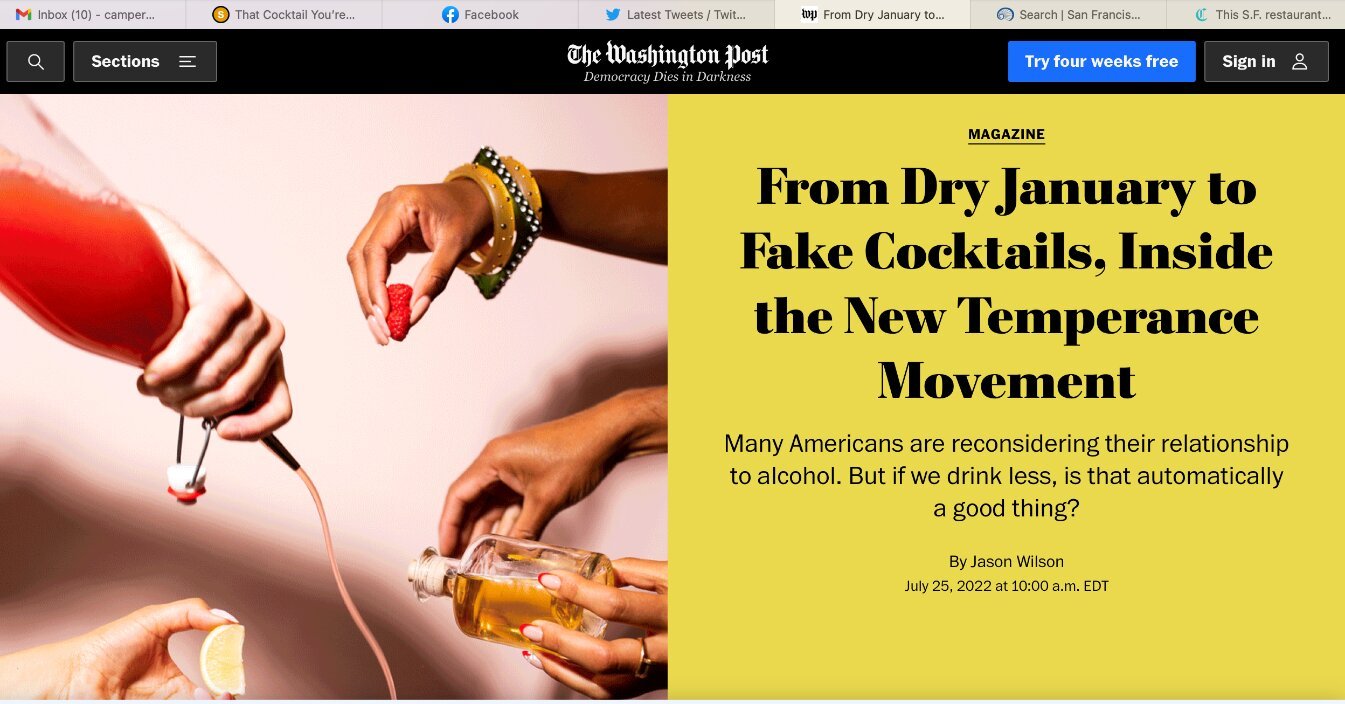
    Jason Wilson wrote up a great story in The Washington Post Magazine considering the modern "low and no" movement, the threat (or not) of neo-prohibitionists, and thoughts about "mindful drinking" and health of alcohol in general. 

    Screen Shot 2022-07-26 at 10.11.54 PM

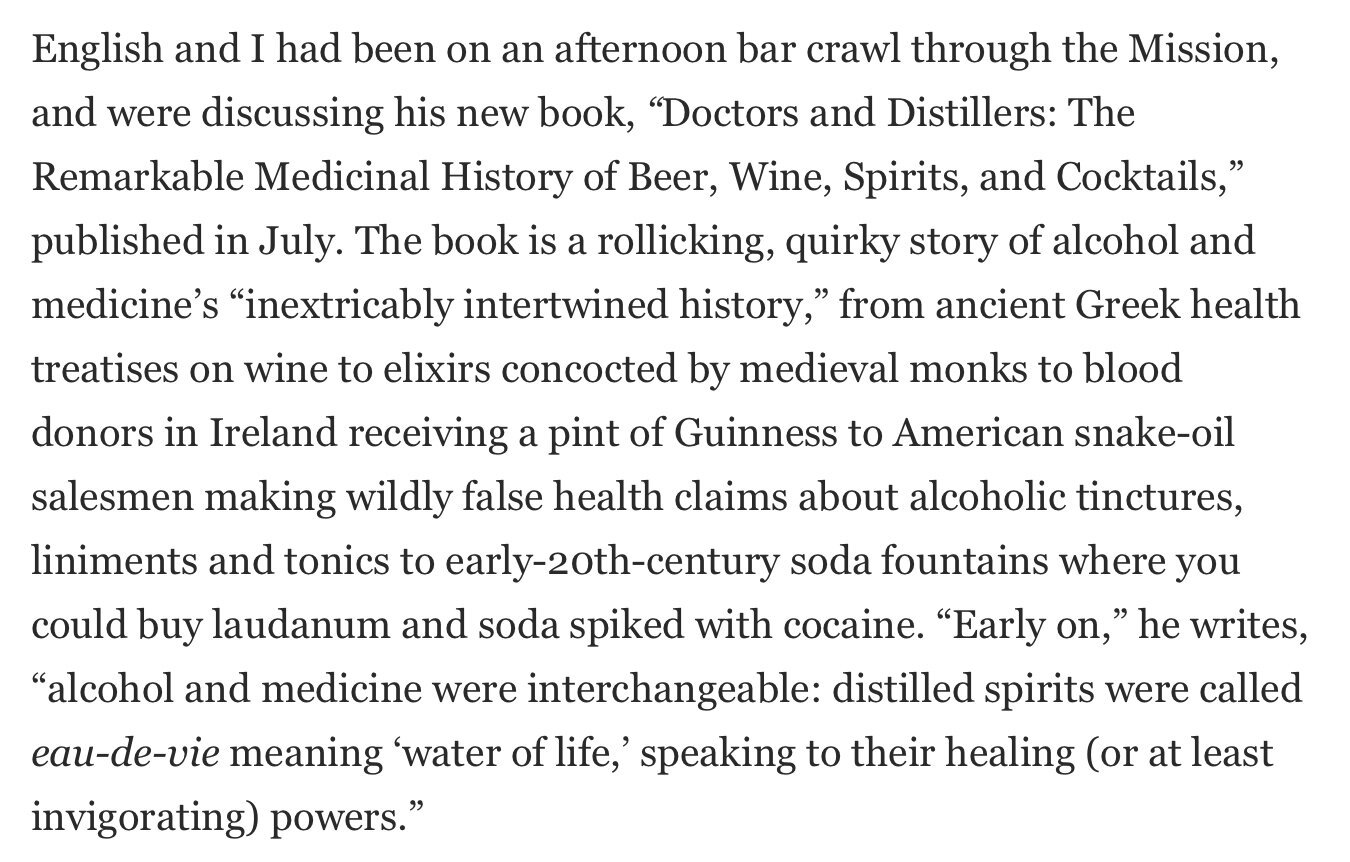
    He interviewed me for the story and provided a fantastic partial book summary:

    Screen Shot 2022-07-26 at 10.12.33 PM

    Read the full story here. Learn more about Doctors and Distillers here

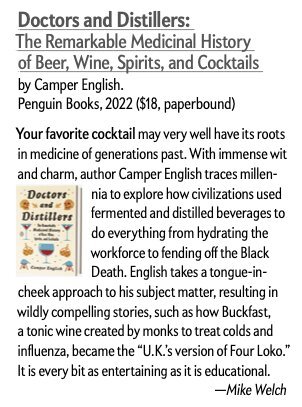
  • A Review of Doctors and Distillers in Scientific American!

    My very favorite magazine, Scientific American, published a review of Doctors and Distillers in the August 2022 issue. Needless to say I'm delighted with it!

    Read it here!

    Screen Shot 2022-07-21 at 9.00.39 AM
    Screen Shot 2022-07-21 at 9.00.39 AM

  • A News Segment With Me on ABC News

    A quick interview with me on ABC News to promote Doctors and Distillers. 

    Screen Shot 2022-07-21 at 8.50.31 AM

    They call me a "master mixologist" which is most definitely not true, but I did write a heck of a book! 

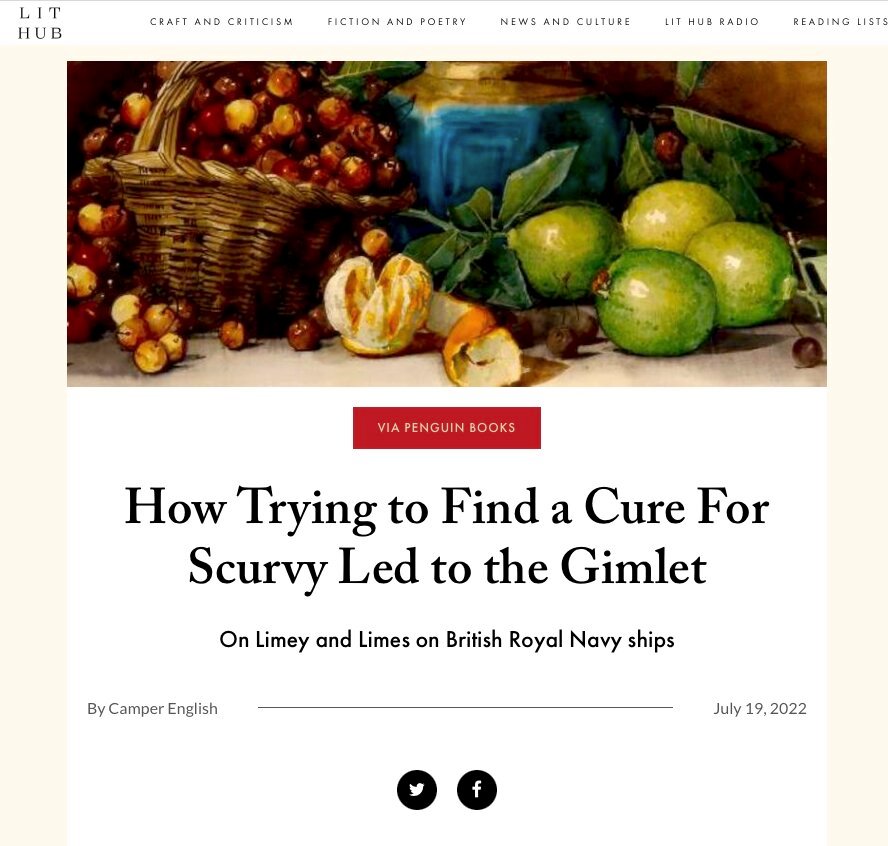
  • Read An Excerpt About Scurvy from Doctors and Distillers on LitHub

    LitHub published an excerpt from Doctors and Distillers, a section on scurvy. Coincidentally, they did so on National Daiquiri Day.

    Read it here

    Screen Shot 2022-07-19 at 3.32.35 PM

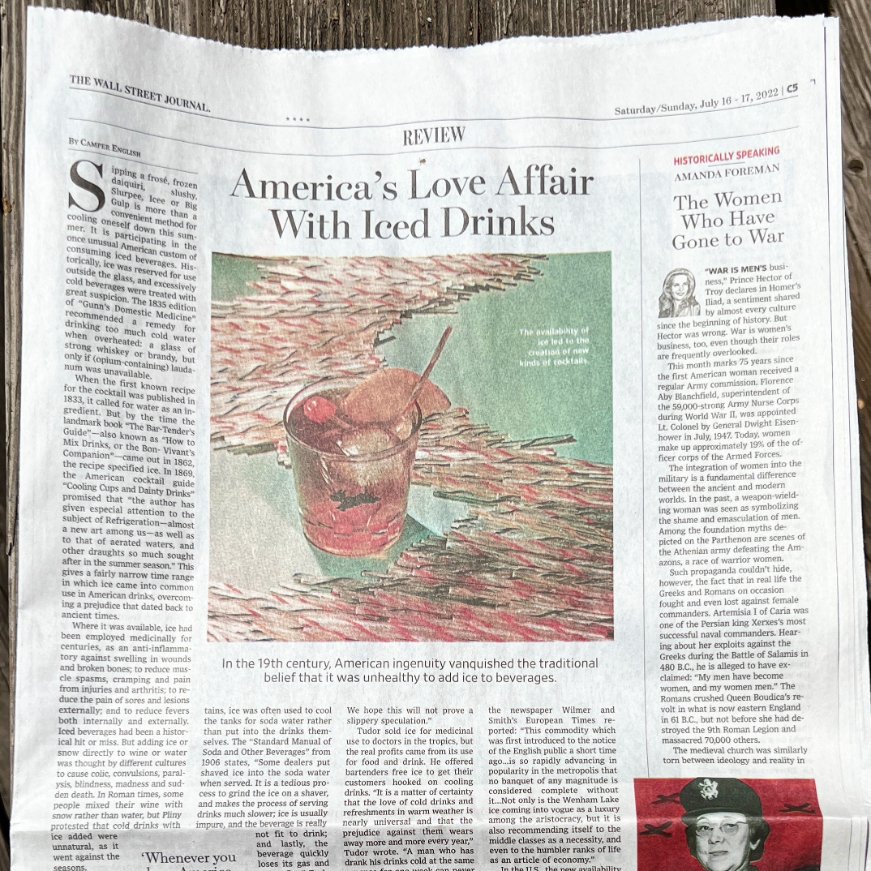
  • An Excerpt from Doctors and Distillers in the Wall Street Journal

    The Wall Street Journal published a short excerpt from Doctors and Distillers this weekend!

    Read it here – subscription required


    4EBCE2E2-9FD9-4A1C-B7A4-E068892EA32B

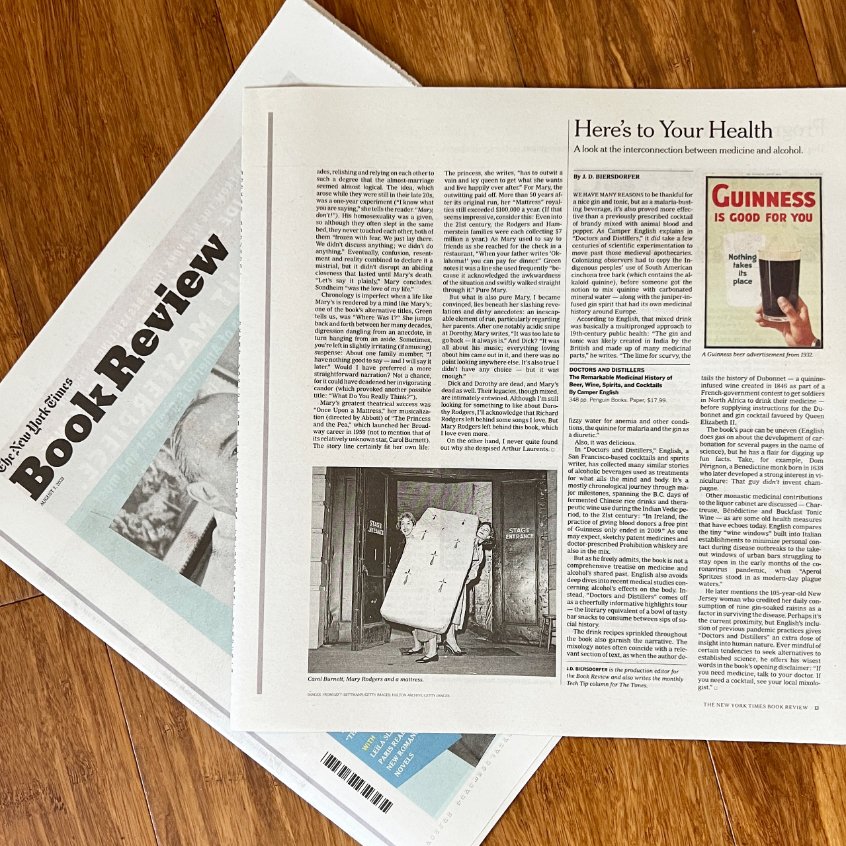
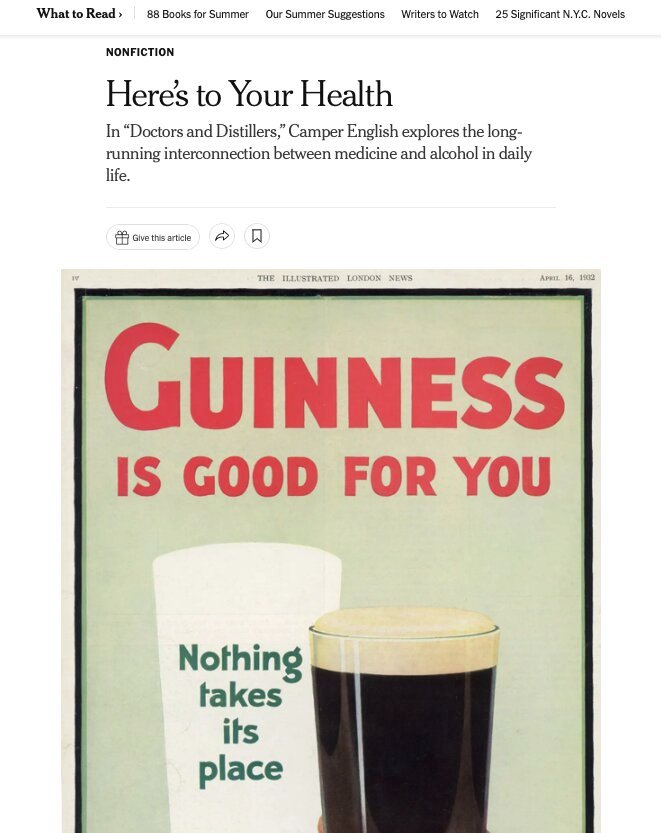
  • New York Times Review of Doctors and Distillers

    Here's the review of Doctors and Distillers in the New York Times!


    Here’s to Your Health

    NYTimes Book Review 08072022In “Doctors and Distillers,” Camper English explores the long-running interconnection between medicine and alcohol in daily life.


    Some review excerpts: 

    In “Doctors and Distillers,” English, a San Francisco-based cocktails and spirits writer, has collected many similar stories of alcoholic beverages used as treatments for what ails the mind and body. It’s a mostly chronological journey through major milestones, spanning the B.C. days of fermented Chinese rice drinks and therapeutic wine use during the Indian Vedic period, to the 21st century: “In Ireland, the practice of giving blood donors a free pint of Guinness only ended in 2009.”

    “Doctors and Distillers” comes off as a cheerfully informative highlights tour — the literary equivalent of a bowl of tasty bar snacks to consume between sips of social history.

    Perhaps it’s the current proximity, but English’s inclusion of previous pandemic practices gives “Doctors and Distillers” an extra dose of insight into human nature. Ever mindful of certain tendencies to seek alternatives to established science, he offers his wisest words in the book’s opening disclaimer: “If you need medicine, talk to your doctor. If you need a cocktail, see your local mixologist.”

    Screen Shot 2022-07-07 at 2.30.02 PM

  • The Virtues of Aqua Vitae, from a 1512 Book

    A very important early book on distillation is Hieronymous Braunschweig's The Virtuous Book of Distillation

    It is otherwise known as the Large Book on Distillation, and it was first published in 1512, after the Small Book in 1500. I believe it was first printed in German, then translated into Dutch, then translated into English I think in 1527 but I'm not positive. 

    You can read some about it in Doctors and Distillers

    The full title of the book is actually: The vertuose boke of distyllacyon of the waters of all maner of herbes with the fygures of the styllatoryes, fyrst made and compyled by the thyrte yeres study and labour of the moste co[n]nynge and famous mayster of phisyke, Master Iherom bruynswyke. And now newly translate[d] out of Duyche into Englysshe Nat only to the synguler helpe and profyte of the surgyens, phisycyens, and pothecaryes, but also of all maner of people, parfytely and in dewe tyme and ordre to lerne to dystyll all maner of herbes, to the profyte, cure, and remedy of all maner dysseases and infirmytees apparant and nat apparant. And ye shall vnderstande that the waters be better than the herbes, as Auicenna testefyeth in his fourthe conon saynge that all maner medicynes vsed with theyr substance, febleth and maketh aged, and weke. Cum gratia et preuilegio regali.

    And as you can tell, it can be a challenge to read in this old English style and spelling. 

    But in preparation for my Tales of the Cocktail seminar this year, I decided to "translate" from olde English spelling into modern spelling an important section: The Virtues of Aqua Vitae.

    The old English text is archived here. For the page scan of this page, it is here.


    The Virtues of Aqua Vitae

    The aqua vitae is commonly called the mistress of all medicines for it eases the diseases coming of cold. It gives also young courage in a peron and causes them ot have a good memory and remembrance. It purifies the five whites (?) of melancholy and all of the uncleans when it is drunk by reason and measure. That is to understand five or six drops in the morning fasting with a spoonfull of wine using the same in the manner afforsaid the evil humors cannot hurt the body for it will dry them out of the veins.

    It conforts the heart and cause a body to be merry. It heals all old and new sores on the head coming of cold when the head is anointed therewith and a little of the same water held in the mouth and drunk of the same.

    It causes a good color in a person when it is drunk and the head anointed therewith the space of 20 days. I heals alopecia or when it is drunk fasting with a little treacle it causes the hair well to grow and kills the lice and flees.

    It cures the Reuma (?) of the head when the temples and the forehead therewith are rubbed and a spoonful taken in the mouth. It cures Litargiam (lethargy?) and all ill humor of the head. It heals the rosome (rosacea?) in the face and all manner of pimples. It heals the fistula when it is put therein with the luce of Celandine (?).

    Cotton wet in the same and a little wrung out again and so put in the eyes at night going to bed and a little drunk thereof is good against all deafness. It eases the pain in the teeth when it is a long time held in the mouth. It cause a swell breath and heals the rotting teeth. It heals the canker in the mouth in the teeth, in the lyps, and in the tongue when it is long time held in the mouth. It causes the heavy tongue to become light and well speaking. It heals the short breath when it is drunk with what when (?) as the figs be sodden in and vanishes all flumes (?)

    It causes good digestion and appetite for to eat and takes away the bulking. It dries the winds out of the body and is good against the evil stomach. It eases faintness of the hart, the pain of the milte (?), the yellow jaudice, the dropsy the ill limbs, the gout in the hands and in the feet, the pain in the breasts when they are swollen, and heals all diseases in the bladder and breaks the stone.

    It withdraws venom that has been taken in meat or in drink with a little treacle is put thereto. It heals the flanks and all diseases coming of cold. It heals the burning of the body and of all members when it is rubbed therewith by the fire 8 days counting.
    It is good to be drunk against the sodein dede (sudden dead?). It heals all scabs of the body and all cold swelling anointed or washed therewith and also little therof drunk. It heals all shrunk sinews and causes them to become soft and right.

    It heals the tertian and quartan fevers when it is drunk an hour before, or the fevers become on a body. It heals the venomous bites and also of a mad dog when they be washed therewith. It heals also all stinking wounds when they be washed therewith.


    The virtues of aqua vitae

  • SCIENCE Magazine Reviews Doctors and Distillers!

    Screen Shot 2022-06-03 at 10.32.21 AMI'm so thrilled that Science wrote a review of Doctors and Distillers. Science is one of the most important academic journals in the world, and if you're a scientist it is a career goal to get into the publication. I didn't get in for doing any science, but for writing about the history of science. I'll take it!

    It is still six weeks before the publication date of Doctors and Distillers (July 19, 2022) but it has already achieved my ultimate goal of critical success. 

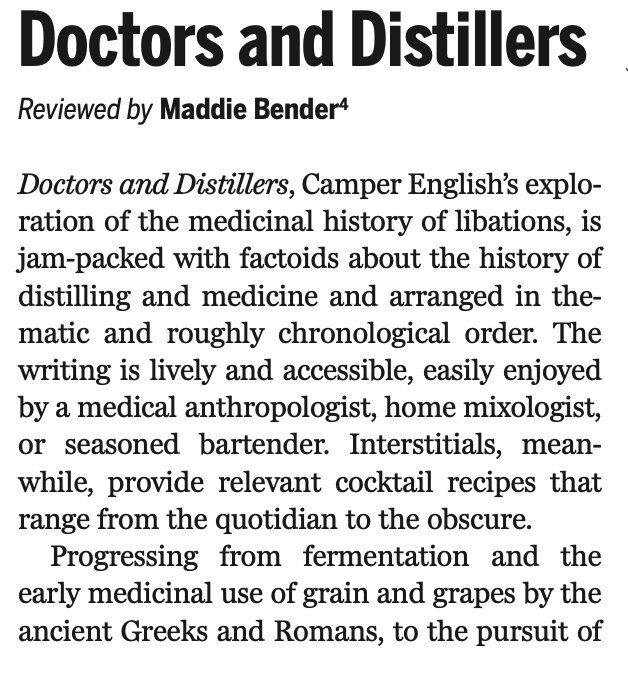
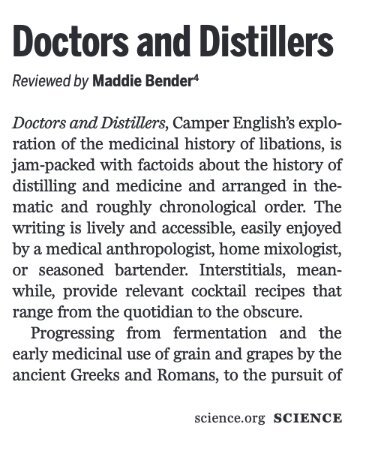
    Doctors and Distillers

    Reviewed by Maddie Bender

    Doctors and Distillers, Camper English’s exploration of the medicinal history of libations, is jam-packed with factoids about the history of distilling and medicine and arranged in thematic and roughly chronological order. The writing is lively and accessible, easily enjoyed by a medical anthropologist, home mixologist, or seasoned bartender. Interstitials, meanwhile, provide relevant cocktail recipes that range from the quotidian to the obscure.

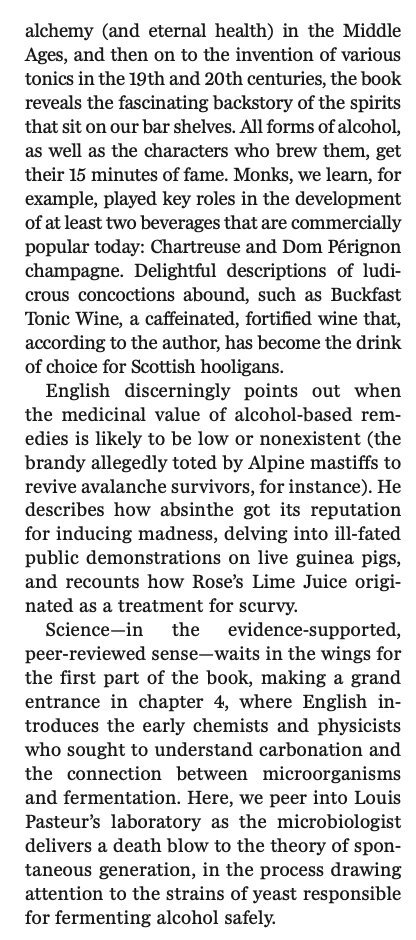
    Progressing from fermentation and the early medicinal use of grain and grapes by the ancient Greeks and Romans, to the pursuit of alchemy (and eternal health) in the Middle Ages, and then on to the invention of various tonics in the 19th and 20th centuries, the book reveals the fascinating backstory of the spirits that sit on our bar shelves. All forms of alcohol, as well as the characters who brew them, get their 15 minutes of fame. Monks, we learn, for example, played key roles in the development of at least two beverages that are commercially popular today: Chartreuse and Dom Pérignon champagne. Delightful descriptions of ludicrous concoctions abound, such as Buckfast Tonic Wine, a caffeinated, fortified wine that, according to the author, has become the drink of choice for Scottish hooligans.

    English discerningly points out when the medicinal value of alcohol-based remedies is likely to be low or nonexistent (the brandy allegedly toted by Alpine mastiffs to revive avalanche survivors, for instance). He describes how absinthe got its reputation
    for inducing madness, delving into ill-fated public demonstrations on live guinea pigs,
    and recounts how Rose’s Lime Juice originated as a treatment for scurvy.

    Science—in the evidence-supported, peer-reviewed sense—waits in the wings for the first part of the book, making a grand entrance in chapter 4, where English introduces the early chemists and physicists who sought to understand carbonation and the connection between microorganisms and fermentation. Here, we peer into Louis Pasteur’s laboratory as the microbiologist delivers a death blow to the theory of spontaneous generation, in the process drawing attention to the strains of yeast responsible for fermenting alcohol safely.

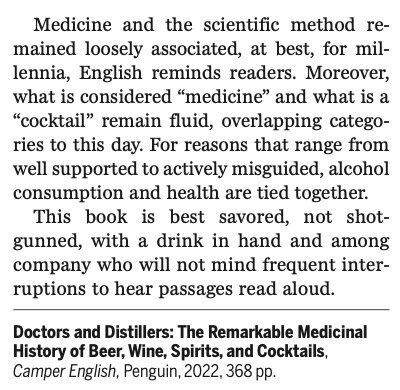
    Medicine and the scientific method remained loosely associated, at best, for millennia, English reminds readers. Moreover, what is considered “medicine” and what is a “cocktail” remain fluid, overlapping categories to this day. For reasons that range from well supported to actively misguided, alcohol consumption and health are tied together.

    This book is best savored, not shotgunned, with a drink in hand and among company who will not mind frequent interruptions to hear passages read aloud.


    Screen Shot 2022-06-04 at 2.20.32 PM


    Screen Shot 2022-07-03 at 5.38.54 PM
    Screen Shot 2022-07-03 at 5.38.54 PM
    Screen Shot 2022-07-03 at 5.38.54 PM


  • Alton Brown Recommends Doctors and Distillers

    Sharing this write-up about my book from Alton Brown:

    Alton Brown Recommends Doctors and Distillers
    Alton Brown Recommends Doctors and Distillers

    "Alton Brown has given us season after season of food television goodness with multiple shows, including the iconic Good Eats and most recently Good Eats: Reloaded and Good Eats: The Return.  He’s also written his fourth Good Eatscookbook, Good Eats: The Final Years, a compilation of five seasons of applications (recipes) from Good Eats: Reloaded and Good Eats: The Return, including one season’s worth that Brown developed during the pandemic but hasn’t made into shows (and he’s not sure he ever will). It’s a hefty volume that will make you want to go back and binge watch Good Eats shows—after you’ve made yourself a nice snack, of course.

    We asked Brown about the books he’s read and loved lately, and it’s a fun collection that includes a history of spirits (alcohol, not ghosts) and a book he calls the last word on written English."


    He writes of my book Doctors and Distillers:

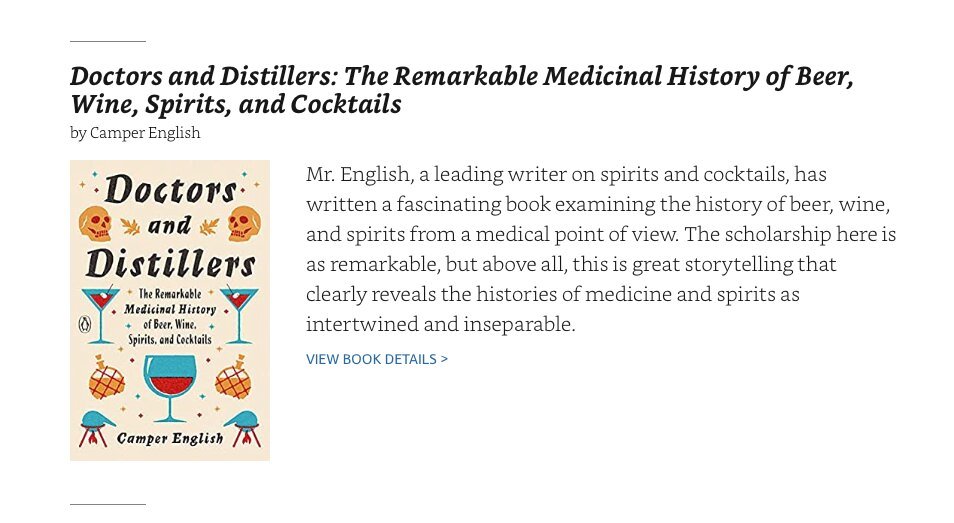
    Mr. English, a leading writer on spirits and cocktails, has written a fascinating book examining the history of beer, wine, and spirits from a medical point of view. The scholarship here is as remarkable, but above all, this is great storytelling that clearly reveals the histories of medicine and spirits as intertwined and inseparable.

    Buy the book here!