Over the past year I've noticed the Gibson popping up on cocktail menus, so I decided to have a deeper look and write about it for Details.com.
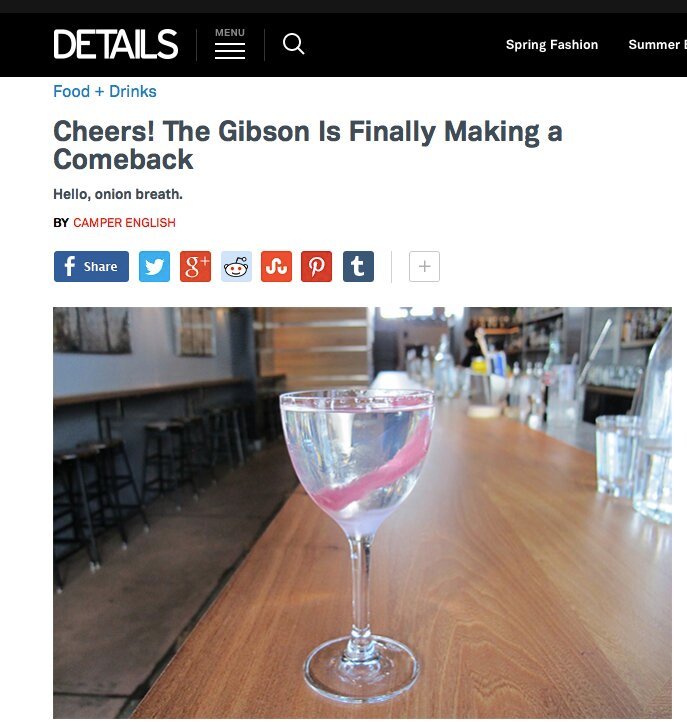
Over the past year I've noticed the Gibson popping up on cocktail menus, so I decided to have a deeper look and write about it for Details.com.
This fall I visited 12 armagnac houses in France. Some produce armagnac by blending aged eau de vie, some buy eau de vie and age it, some distill and age, some make wine, distill, and age, and some do all of it.
De Montal is produced by a coop of grape growers called CPG for Compagnie des Produits de Gascogne, located in Nogaro. De Montal is a brand they make produced for the export market. The company is made of 60 members, all grape growers in the Bas Armagnac region.


Distilling at De Montal
The facility is a huge operation and they make a lot of table wine. The still room is pretty big as well, with three continuous armagnac stills named Athos, Porthos and Aramis for the three musketeers, with a bust of D'Artagnan watching over them.

This year they were producing 5000 hectoliters of spirit. They distill the spirit up to 61-62% ABV in their stills for all their brands made on-site.


They say there is no law about the size of barrels in armagnac, unlike in tequila for example. Thus their 3 stars is aged all in big vats rather than barrels.

Here are some notes on stuff I tried, I believe all at 40% ABV:

My visit to Domaine de Pellehaut armagnac was super quick, and so also is this post.
The production facility is actually pretty huge. They grow vines, make wine, distill, and age on site.

They produce armagnac from the Tenareze region exclusively. Though they own the vines, they don't own the stills: they are serviced by one of the famous roving distillers. These distillers pull up, distill the wine, and move along to the next place.
Cows on the property, which are housed adjacent to the winery, are fed grape scraps to eat.

We tried a bunch of cognacs in the tasting room. Here are some notes that you will probably not find useful.

Maison Janneau armagnac is located near the town of Condom. It is the #1 exported brand of cognac, and it was purchased 10 days before my visit.
The brand was founded in 1851. In the 1970s it was sold to Martell cognac, then Martell was sold to Seagrams, then when Seagrams broke up it was sold to an Italian importer, then just sold to Spirits France. It is not currently for sale in the US, but that could certainly change.

Making Armagnac at Janneau
Janneau does not own vineyards. They purchase wine from about 20 different producers and distill it themselves. They purchase wine from all the top four grape varietals grown in both the Bas Armagnac and Tenareze regions.
They have both a typical armagnac column/continuous still and pot stills. They are one of just 3 armagnac houses that uses pot stills. They say that double pot still distillation is better for young armagnac.

The pot still for the first distillation is a huge 100 hectoliters still. It produces 40 hectoliters of spirit at 32% ABV after the first distillation.
The spirit is then split up and put into smaller stills for the second distillation. Each of the 25 hectoliters stills is filled with 20 hectoliters of spirit. During distillation, the first 50 liters are heads, then the heart is 700 liters at around 70-72% ABV, then the tails are 600 liters. In total, 100 hectoliters of wine produces 1400 liters of eau de vie using the pot stills.
Heads and tails are redistilled with the next batch, not discarded.

Dilution and Aeration of Armagnac
Armagnac needs a lot of aeration during aging, according to my hosts. The distiller says that the aeration doesn't diminish the aroma or blow off much of the alcohol in the aging spirit, but it helps homogenize together the brandy while aging. (In armagnac, standard procedure is to combine aging barrels' contents together and redistribute them each year, rather than letting the barrels get empty as they evaporate due to the angels' share.) As far as I can tell, this is pretty unusual or at least not discussed in other spirits.
Brandy typically comes off the still at 70% ABV when they double distill in pot stills. They dilute it to 65% before putting it in the barrel (when they single distill, they distill it up to 65% and don't need to dilute). They reduce the proof by 5% ABV each year until it reaches 50% ABV in three years, then decide how to use it – for which bottling. Each year when they do this they purposefully aerate the armagnac.
We happened to be there as they were dumping out some barrels to redistribute – they pour the brandy through a metal grate to help it aerate.

Aging and Bottling
Janneau's headquarters are quite amazing: It looks like an office with a garage entrance next to it, but then they gave us the tour. The structure is actually a gigantic barn with huge ceilings. We went down to the basement level where there were barrels aging beneath the ground floor offices, then another level beneath that. It was built, out of wood as far as I can tell, in 1851.


We also visited a large and newer warehouse with metal racks for the barrels.

One of the unique characteristics about armagnac is that often the aging facilities are combined with the offices and are centrally located. (There are more examples of this I'll talk about in other armagnac distillery visits from this trip.) Some aging warehouses are right near the centers of town – crazy given the amount of flammable liquids stored inside.
Janneau produces two different lines; the classic and the single-distillery line. Confusingly, the single-distillery line is all double distilled armagnac. But this allowed us to taste some comparisons: I tried an 18 year old single- and double-distilled armagnac blend versus an all double-distilled bottling. The one with some single-distilled armagnac had more body and texture, while the double distilled was thinner with more woody notes including allspice.
For my second armagnac distillery visited, this was pretty overwhelming in a good way.

Marquis de Montesquiou is an armagnac brand owned by Pernod Ricard. It is their smallest production facility of all their brands, according to cellarmaster Eric Durand. The brand was created after WWII.

Eau De Vie
They do not own vineyards nor a winery: they purchase eau de vie (distilled grape brandy) and produce armagnac with it.
The eau de vie they buy is primarily from the Bas Armagnac region, but they do buy some from the Tenareze which Durand says adds structure and freshness. They buy primarily from 10 producers, a little bit more from others.
The grape varietals they use are:
They buy only eau de vie distilled in the traditional continuous armagnac still. They have contracts with several distillers.

Aging and Blending
We visited the warehouse, named the Cathedral for obvious reasons. It holds 1000 barrels. It was built in 1975, and it looks it.
They age only in local Gascon oak in 400 liter barrels. They buy 20-50 barrels per year- not a lot! Some of the eau de vie is aged in the producers cellars – this is because some of those are more humid than this drier one. It is moved to this warehouse later.

Durand says if you add water to dilute armagnac all at once it's called "breaking" the armagnac. Instead they dilute slowly 3-4 times over the course of aging. Durand says when you add water little by little it increases fatty acid sedimentation, which is apparently a good thing during aging. (They will come out just before bottling as they chill filter.)

If cognac is tequila, armagnac is mezcal: Smaller, wilder, and more rustic. I covered the history and production of armagnac in yesterday's post.
In this post I'll cover some of the differences between these two French grape brandies. One difference I forgot to mention below is that they're produced in different parts of France!
| Armagnac | Cognac |
| Four primary grape varieties | One primary grape variety (ugni blanc) |
| Usually distilled once in a continuous still. | Distilled twice in pot stills. |
| Features vintages as well as blends | Features more blends, few vintages |
| Is consumed more locally | Is more an export product |
| VS = 1 year minimum | VS = 2 years minimum |
| Often ages in local Gason oak barrels | Ages in Limousin/Troncais oak barrels |
| Often distilled to lower proof ~57% | Distilled higher ~70% |
| Grapes cost the same price whether from Bas Armagnac or Tenareze | Grande Champagne grapes way more expensive than from other regions |
| More sandy soils in region | More chalky soils in region |
| Allows for an unaged product "Blanche De Armagnac" | Technically, no unaged variant permitted |
Beyond production differences, the two aged brandies taste significantly different.
In my opinion, cognac tends to have a very sturdy but subtle backbone of aged grapes, while the aromas are are often delicate, ethereal, and floral.
Armagnac I think of as "foresty," meaning there are often flavors I associate with the forest floor: wood, mushrooms, herbs, dirt. Mmm, dirt.
It's okay to drink them both.

Armagnac is a French grape brandy most similar to cognac, but ultimately very different in production and flavor profile.
In this post I'll cover the basics of armagnac. In the next post, I'll discuss the main differences between cognac and armagnac.
Armagnac History
Armagnac Region
Armagnac is produced in the Gascony region of France, south of Cognac and more inland. They produce a lot of wonderful delicacies in the region and also foie gras that is the product of animal torture. In addition to grapes, they grow a lot of corn, which is used to force feed ducks.
The region has its own microclimate with the Pyranees mountains on one side and pine forests on the other to block winds.

There are three terroirs/appellations in the region. These are often found on the bottle labels. Hardly any armagnac is produced in the Haut Armagnac – only 1%.

Ten grape varietals are allowed to be used in armagnac, but in reality people only use the first four:
Baco is a hybrid grape and was going to be disallowed in armagnac (I believe this was due to an EU law), but they decided it would be allowed only for distillation, not table wine so it remains.
Folle Blanche was the main pre-phylloxera grape.

Distillation and Aging
Grapes are harvested in the fall and the wine is distilled throughout the winter. All distillation must be finished by March 31.
As with cognac, the ideal grapes are low in alcohol and high in acid so that their flavors will compound through distillation and the wine is less likely to spoil in the weeks or months between harvest and distillation. (No sulfur is added to preserve the wine.)
The wine is distilled on the lees, but only on the fine lees so it doesn't gunk up the stills.
95% of armagnac is distilled in an Alambic Armagnacais, a small, sometimes mobile, continuous column still. The mobile stills have names, and producers will request the same stills each year. 25% of stills are wood-fired; the rest are gas.
The rest is distilled in pot stills, usually the typical cognac stills. Only 3 producers use pot stills.
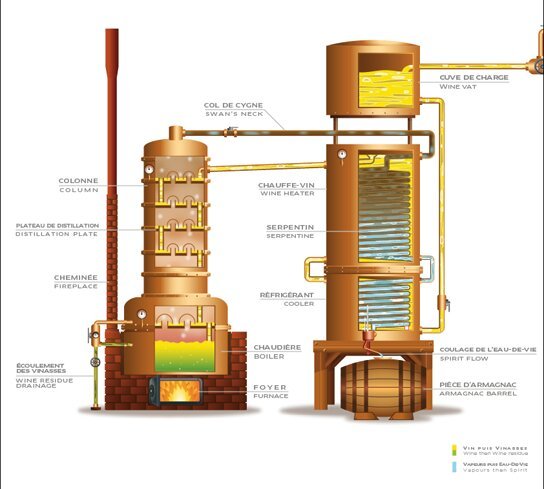
This video does a good job at showing how armagnac flows through the continuous still. The good stuff begins at 1:30.
The plates inside the stills have what the bourbon distillers call "bubble caps" in different shapes – spiders, mushrooms, centipedes, or little houses.


In the continuous still, the vapor and wine are in contact with each other. This isn't the case in pot stills. There are no heads and tails cuts in continuous stills.
The maximum number of plates allowed by law is 15. Some distillers use as few as 3 plates, but the average is probably 5-8 plates.
Aging Armagnac
Armagnac is aged in large 400 liter French oak barrels. Many barrels are made from the local Gascon oak aka Black Oak. This wood has wide grains and most of it is given a medium-heavy toast.
Limousin and other French oak barrels with narrow grains are also used. I'm not sure of the ratio of local to non-local barrels.

As with cognac, armagnac typically goes into new barrels for 6 months to 2 years of its life, then is transferred to used/older barrels so that the wood won't dominate the flavor.
Armagnac producers make a point of aerating their brandy while it ages, typically when mixing a bunch of barrels together and redistributing it. Typically when they move the brandy around in the aging warehouses they don't roll barrels – they pump out the brandy and pump it into other barrels.
Different grape varietals are often aged separately.

Minimum Aging Laws for Armagnac
Blanche de armagnac is unaged armagnac, but it is rested a minimum of three months in non-reactive containers, typically stainless steel. Once a batch has been declared that it will be blanche de armagnac, if it sits in tanks but doesn't sell they're not allowed to then age it in wood.
In fact this is the same with all armagnac: for each season the growers must declare which parcels will be for wine, blanche de armagnac, and armagnac.
Additives in Armagnac
Typical additives in armagnac include coloring caramel (8-10 g/l is typical), sugar, and boise. The latter is wood flavoring to immitate age. The BNIA says it's not commonly used in armagnac, but they would.
Those three additives combine to form the "obscuration rate." A company can measure the "gross" ABV, which is the number that goes on the bottle as measured by a hydrometer. The "real" ABV is measured in a laboratory, usually by redistillation. The difference between the "real" and "gross" ABV must be less than 4%. So rather than having a legal limit on sugar or caramel or boise, they have a limit on the total additives using the obscuration rate measurement. The BNIA representatives says it's rare that the obscuration rate is more than 2%.

Learn more about armagnac from the BNIA's website.
In the next post, we'll cover the difference between cognac and armagnac.
Last year I visited Limoncello di Capri located on the island of Capri south of Naples in Italy. The liqueur is assembled on the island from ingredients produced on the mainland, including the lemon peels. These come from the Sorrento area nearby.

The Sorrento region has a long history with citrus. During the Greek/Roman period there were lemon trees planted for their beauty in the area. In the 17th century Jesuits started cultivating lemons to use as disinfectant against cholera. The beginning of the 19th Century saw the use of the pergola system I'll talk about in a minute.
Limone di Sorrento IGP – Lemon Laws
The lemons here as well as the limoncello are IGP products – Protected Geographic Indication like AOC or DOC. The IGP are includes both Sorrento and Capri. Here are some of the IGP Limone di Sorrento laws I was able to pick up:
The name for the lemons of the region is Ovale de Sorrento. The fruits take about one year to grow, though the tree flowers 3-4 times annually and they harvest fruit several times as well. The soil is volcanic and helps produce less acidic lemons than in other areas, but these lemons require special care to thrive in this region at all. We visited a lemon grove called Il Giardino di Vigliano.
*Note that somehow I destroyed all my pictures from this trip, so these photos come from Stephanie Fray of Conundrum Marketing.

The lemon trees/branches are grafted onto wild orange tree rootstock. Those roots are bigger and hardier and live longer (200 years) than typical lemon trees, so they extend the life of the lemon trees.
Some of the trees have wild orange roots and base of the trunk, followed by a grafted regular (not wild) orange trunk, and then lemon branches grafted onto that (like some sort of citrus turduckin). They can only graft during April and May, and have only a 60-70% success rate in grafting, so this is not easy to accomplish.

In the winter, the region cools down and gets windy, so they use the pergola system to protect the trees. Chestnut wood pieces make an awning structure over the top of the trees, and in the winter nylon netting or pagliarelle is spread across the top.
Pagliarelle (which sounds like "pie-a-rella") is just an old covering made from small wood slats. Both these coverings keep the temperature more stable in the cold months. In the photo below, the little houses actually hold the wooden slats which can be spread out over the pergola.


Northern Lemons vs. Southern Lemons
I previously visited another limoncello facility south of this area along the Amalfi Coast, and was surprised to see how different the lemons are grown while not being very far apart. Read about my visit with Pallini Limoncello here.
Those lemons are of the variety sfusato. The trees grow on terraced cliffs and the branches are supported by a pergola. (In Sorrento the pergola just holds up the roof.) Those lemons also grow faster and larger, have less essential oil in their peels, and are more acidic, according to my hosts.
Harvesting and Peeling Lemons for Limoncello di Capri
Limoncello di Capri purchases from about 30 different growers. They do not own the orchards but they employ 2 people whose job is to check on the quality of the lemons from the trees through the bottling process.
This is all tracked, so that the company could look at a bottle's serial number and tell you where the lemons came from used in it.
The lemons are hand-harvested and transported to the processing facility. Then they are soaked, then sprayed and brushed/polished.
Next they go into the peeling machine. Eighty Five percent of the lemon – all the fruit part – is discarded as they only want the peel.


The peelers at this facility are adapted cantaloupe peelers that can peel lemons 4 at a time. Here it is at regular speed:
And in slow-motion:
The peeled lemons are put into plastic bags, vacuum sealed to remove air, and frozen in 6 pound bags. They are frozen because they will be used to make limoncello year-round, while the lemon harvesting is only for part of the year.


Limoncello Laws
There are IGP laws for IGP Limone di Sorrento limoncellos, which can be produced in Sorrento and on Capri.
That number is the quantity of whole lemons used. So, since Limoncello di Capri uses 15% of the lemon (the peel), that means there are 330 x .15 = 49.5 grams per liter of lemon peels used.
Life Gives You Too Many Lemons
With 85% of each lemon discarded, I asked about any recycling/reuse. They said that some lemons are in fact juiced. Some of the lemons are composted, some are disposed of as industrial waste, and the city uses some as a disinfectant in its water treatment program.
Assembling the Limoncello on the Island of Capri
Capri is an island a short ferry ride from the town of Sorrento. It is full of windy roads and tall cliffs, which means there are great views from nearly everywhere on the island.
If I understood correctly, not only is Limoncello di Capri the only commercial limoncello made on the island, it is the only production facility of any kind on the island.
It was also the first brand to use and trademark the name "limoncello" meaning "little lemon", but plenty of other people used the term. The Italian Supreme Court ruled that limoncello was a generic name in 2002, so they got a bit stiffed on that one.
The lemon peels are removed from their vacuum-sealed bags and added to 2000 liter tanks of 96% ABV grain alcohol. The lemon peels are infused for 5 days in the alcohol, and by the end the mixture is down to 87% ABV. They use lemon peels collected at different parts of the season to control for natural variation.
The lemon peels are then filtered out and sugar and water is added. The final sugar content is 240 grams per liter.


They bottle the product at 32 percent alcohol, which they say is slightly higher than other brands because the product is all natural and more alcohol is needed as a preservative. (They also say that only 20% of limoncellos are made with only lemons- the rest have flavorings and colorings.)
The bottled limoncello is then shipped out. They bottle on the island in the mornings and ship out the limoncello in the afternoons. Because the island only has small roads, their van can only take one palette of limoncello at a time. The driver loads up 7 palettes per day.
In bad weather, they can't get supplies in or limoncello off the island, so production goes on hold.
They produce 800,000 bottles per year at this tiny facility.
A Model of Inefficiency
It doesn't take an efficiency expert to see that this is a crazy system: Bottles, alcohol, sugar , and lemon peels are shipped over from the mainland, mixed together, then sent back to the mainland. It would make a lot more sense to do this all on the mainland, but they're sticking with the brand's heritage and producing on the island.
The brand history dates back to the 1800s, when hotel owner Vincenza Canale would prepare the drink for hotel guests. There were traditions of making homemade lemon liqueur but according to the brand nobody thought to commercialize it until much later. (As far as I can tell, commercial limoncello only began in the 1980s.)
The brand Limoncello di Capri was not launched until 1988 by the descendants of Vincenza.
We visited the little hotel where the brand was founded, Casa Mariantonia, which was apparently only the second hotel built on the island. There is still a lemon grove in the yard, where we had drinks.
I think of bottles of spirits with strong regional connections as postcards of flavor. Limoncello di Capri will always remind me of the sunny island where it's made.

In the fall of 2014 I had a really terrific visit to the distilleries for Molinari Sambuca and Limoncello di Capri, both located south of Rome in Italy.
History Lesson
Molinari Sambuca is an anise liqueur originally created in Civitavecchia, a port city north of Rome. Much like Schiedam in the Netherlands where the spices that came on ships ended up in local spirits (juniper for genever and other ingredients for liqueurs in that case), star anise reaching Civitavecchia wound up in in local spirits and gave birth to the category of sambuca.

Molinari was not the first brand of sambuca on the market- that honor belongs to Luigi Manzi and his Sambuca Manzi going back to 1851; also in Civitavecchia.
However it was Molinari Sambuca, created by Angelo Molinary in 1945, that became world famous (and is still the best-selling sambuca in the world). During the "La Dolce Vita" era in Italy the brand purchased TV ads and it became the second-best selling spirit in Italy after Aperol.
Today there are two Molinari distilleries. One is still in Civitavecchia (though they say the facility is now more for administration and a small production line) and the other is Colfelice, about a 1 hour drive south of Rome, where they make the majority of the product.

The company is still run by family members. Only one person per generation knows the exact recipe for Molinari, but after one of them was kidnapped and held for ransom many years ago they decided that they should also keep a copy in a vault.
Making Molinari
The primarily flavor of Molinari comes from star anise that is imported from southeast China. To prepare it, the fruits are harvested, the seeds are blanched to stabilize them, they are then partially crushed and essential oils are extracted through water distillation. I believe this all happens in China, though some refinement of the essential oils may occur locally. Most of the essential oil from star anise comes from the seeds.
*Note: I somehow lost most of my photos from the trip so I'm using those of Stephanie Fray of Conundrum Marketing.

There are other secret ingredients in Molinari. (Wikipedia notes that licorice and elderflowers are often found in sambuca but I'm not sure what's in this one.)
The sugar used for Molinari is non-GMO sugar derived from sugar beets. They say it has a high solubility which makes it good for use in liquids.
The base alcohol is distilled from wheat (they purchase, rather than distill it). Often that wheat is grown in France but it is distilled in Italy.
To make Molinari they combine demineralized water at 60-75 degrees Celsius with sugar so that it dissolves. They wait for it to cool then add 96% ABV alcohol and essential oils.
The mixture rests for 5 days in large tanks. It is then filtered with a 3 micron cellulose filter at room temperature. (Chill-filtering sambuca would cause the louche effect and remove many of those essential oils they just added.)


Molinari Caffe
 Molinari Caffe has been made since 2003 but it was just reintroduced to the US market this winter.
It is made primarily with two kinds of coffee: Aribica (from the Domonican Republic/Java region) and Robusta from Africa. The coffee is roasted in Italy before making the liqueur here at the distillery. It is not just a coffee liqueur – the base Molinari Sambuca is there as well so it's a coffee-anise liqueur.
The color comes in part from burnt caramel. My hosts tell me that if you use burnt caramel for coloring you don't need to declare it on the label per EU rules, but other caramel coloring does need to be declared.

Legal Regulations for Sambuca
Below are the EU regulations [file here as a PDF] for Sambuca.
 38. Sambuca
(a) Sambuca is a colourless aniseed-flavoured liqueur:
(b) The minimum alcoholic strength by volume of sambuca shall be 38 %.
L 39/42 EN Official Journal of the European Union 13.2.2008
(c) The rules on flavouring substances and preparations for liqueurs laid down under category 32 apply to sambuca.
(d) The sales denomination may be supplemented by the term ‘liqueur’.
Note that the regulations define sambuca as 'colourless' but there are red and green and black ones on the market at least in the UK. Not sure how that's allowed.
One Quick Recipe
 Molinari has hired the talented Gegam Kazarian to develop cocktails with the brand. We tried several of them at a tasting at the cocktail bar Barnum Cafe in Rome. The Cucumis Collins was my favorite of the bunch.
Cucumis Collins
By Gegam Kazarian60 ml Molinari Extra
30 ml Lemon Juice
60 ml Sparkling Water
60 g Fresh Cucumber
Cherry tomato
Lemon PeelMuddle the cucumber in a cocktail shaker then add liquid ingredients except sparkling water. Shake with ice and strain into collins glass. Add sparkling water and garnish with lemon peel, and cherry tomato, and a thin slice of cucumber.
Last fall I visited the growing, drying, and production facilities for Ancho Reyes chile liqueur near Puebla, Mexico. I learned a lot about chiles.

We flew into the city of Puebla, and the chiles are grown not far away in San Martín Texmelucan de Labastida.
Ancho chiles are the dried version of poblano peppers, much like chipotles are dried jalapenos.
Poblanos: The Reaping
We visited a field where the chiles for Ancho Reyes were being harvested. These fields are 2000 meters above sea level in a volcanic valley. Water comes down from nearby volcanoes and makes the fields very wet . We had to travel standing in the back of a big truck to get through all the mud on the roads. The water is good, because poblano chiles require lots of it.
In March and April the seeds are germinated and planted. They are delicate plants and require lots of care. The plants are supported by lines of string, so that they won't fall in the mud when the heavy peppers grow on them. It takes about 6 months before harvest.


Poblano chiles are harvested one time per year. The first ones harvested are sold as fresh green chiles.
Chiles that will become dried anchos are left on the vine longer than the ones harvested for fresh poblanos. Leaving them longer on the field concentrates flavors and sugars.


All There Is To Know about the Drying Game
Around a bend on a small street in the town of San Martín Texmelucan de Labastida, you come across a cement fence with cacti on the top in place of barbed wire. Behind it are guard dogs; a double-incentive not to hop over the top.

Inside is what looks like the foundation for a large building not yet started – a big patch of dirt, but it has been combed up to wide plateaus with narrow ditches dug through every ten feet or so. On top of those raised beds are zillions of drying poblano peppers in a limited rainbow of colors from red to brown, some still with their green stems sticking out.


Beneath the peppers are what looks like a hay mat (actually small encino oak), which allows air to flow around the peppers as they dry.
The chiles dry for between 15 and 30 days here, being flipped over every 3 days or so. The drying process both concentrates the flavor and sugar in the chiles, makes them shelf stable, and gives them more flavor complexity according to our hosts.
Not all chiles you'll find in stores are dried this way – many now come from China, where they are dried in ovens.
The Blend Of It All
The recipe for Ancho Reyes is "inspired by" a recipe from 1927.
The actual recipe is:
Guajilla peppers are hot and spicy, while pacilla are more earthy. Dried chiles come into the production facility in big bags.

The chiles are cut up with scissors. Some but not all of the seeds are discarded to get the right amount of heat in the final product.


Then the pieces of chli are infused into 1000 liter tanks of alcohol. About four of those huge bags go into each 1000L tank. They are stirred once per week and infuse for around 6 months.


Each of the three chile varieties are infused separately, then the product is blended at the end along with sugar. When they blend, there is no set amount of sugar – they match it to the heat of the product each time.
All the color of Ancho Reyes comes from the chiles; none is added.


Also: It is fun to drink.