Category: camper_clips

  • The Return of Blue Drinks: A Story from 2012

    People are all excited about blue drinks these days, but I first wrote about their return in 2012. Since Details magazine went away and the story is no longer online, I rescued this story from the Internet Archives. 

    Memories….

    Food + Drinks

    Blue Cocktails Are Back—and Now They're Ironic

    After years of worshiping brown spirits and classic drinks, booze fans at this year's Tales of the Cocktail convention in New Orleans turned the spotlight on a new color: blue. In particular, the sometimes-neon liqueur blue curaçao—often reviled as the antithesis of all things vintage and authentic—is back.

    Blue drinks have long been a mixologists' in-joke. When bartenders were getting serious about pre-Prohibition cocktails about five years ago, jet-setting New Zealand bartender Jacob Briars invented the Corpse Reviver Number Blue, a piss-take on the sacrosanct classic Corpse Reviver #2 that was enjoying a major comeback.

    Since then, he and other bartenders have been practicing "sabluetage"—spiking the drinks of unwitting victims with blue curaçao when no one is looking. The forbidden liqueur can now be found on the menus of a few of the world's best cocktail bars, including Jasper's Corner Tap in San Francisco, PDT in New York City (where it's mixed with other unfashionable ingredients, such as Frangelico and cream), and London's Artesian Bar (winner of the World's Best Hotel Bar award this week), where a new blue drink—called Blue Lagoon—also features Sprite and bubble tea.

    What has spawned this artistic blue period? According to a panel discussion on the topic this weekend, blue-curaçao-cocktail recipes date back as far as 1908 (predating the margarita and even the original Corpse Reviver #2), but the reappearance of the ingredient is likely more an elitists' embracing of the down-market and absurd—the mixological equivalent of trucker hats among fashion's hipoisie several years ago.

    There is also a consensus that perhaps everyone is taking all this classic-cocktail stuff a bit too seriously. Today's top bartenders may be walking encyclopedias of cocktail knowledge, but they're also aware that no one goes to a bar to hear an encyclopedia reading. Blue drinks are a reminder that drinking is supposed to be fun.

    "At the end of the day, people want to have a good time," says Artesian's head barman, Alex Kratena, as he demonstrated making his drink for the Tales of the Cocktail audience. Of course, his cheeky blue bubble-tea drink will run you about $23 back in London. If you're willing to sacrifice the cool factor, you could always join the hordes of partying tourists on Bourbon Street, one block away from the convention, gulping down blue drinks that are served in souvenir plastic cups—for half the price. Irony, as always, costs extra.

    —Camper English is an international cocktails and spirits writer and the publisher of alcademics.com.

  • All About Pechuga Mezcal: Meat Infused Agave Spirits

    6a00e553b3da20883401a5116faa74970c.jpgA few years ago (Feb 2014) I wrote a story about pechuga mezcal, one of the most in-depth ones I'd seen at the time. The story was for Details.com, and the website (and magazine) no longer exist. Thinking it's a shame that the story disappeared (the URL now redirects to the front page of GQ's website) I am pasting it here.

    Would You Like the Chicken, the Turkey, or the Rabbit? Inside the Weird World of Meat-Distilled Mezcals

    In anticipation of a new ham-flavored mezcal, our cocktail maven traces the roots of pechuga, the oddest bird in the agave-based spirit family.

    By Camper English

    This March, chef José Andrés' restaurant Oyamel in Washington D.C. will be the first place to debut Del Maguey's new Ibérico, a mezcal made with ham that costs $200 per bottle. The pig parts are a new thing dreamed up by the Spanish chef, but there is a history of putting animals into mezcal in Mexico that dates back a few hundred years before bartenders dabbled with bacon infusions.

    Most mezcals with meat available in the U.S. are known as "pechuga" mezcals; the word is Spanish for "breast." (Let's get this out of the way: We're not talking about mezcals with "worms" in the bottle, which are added afterward and are not actually worms, but usually arean indicator of a crappy product.) The first pechuga on the U.S. market came from Del Maguey; it is the same as the vegetarian Del Maguey Minero but infused with fruit, rice, and other ingredients and redistilled with a chicken breast hanging from strings inside the still. The technique isn't unique in the spirits world; many gins are made in a similar method called vapor infusion. Just not with livestock.

    Odder still, there is actually a market for this stuff. Several other brands—like Pierde Almas,Fidencio, Real Minero, Tosba, La Niña del Mezcal, Benesin, and El Jolgorio sell pechuga mezcals, though most use turkey (guajolote) rather than chicken. Pierde Almas also sells a conejo mezcal, which swaps in a rabbit, and I've heard a few mentions of a venison mezcal in Mexico, though it's not available in the U.S..


    From left: Chicken breast suspended during distillation; Del Maguey's pechuga bottle.

    HISTORICAL ROOTS

    If you ask the folks behind the mezcal companies, they'll tell you the pechuga tradition dates back centuries. The producers of Del Maguey's pechuga trace it back at least 75 years, and the creators of El Jolgorio say it's been around for 100 years through five generations of distillers. (This information comes through mezcal importers, rather than the small distillers living in remote villages in Oaxaca who may not even have phones to give interviews, let alone Internet.)

    According to the son-in-law of the distiller at Mezcal Vago (which has a corn-infused mezcal called Elote), the neighbors would request a special-occasion treat for events like weddings and baptisms. So the distiller got the idea to take the mezcal he'd already made, infuse it with dried corn from the family farm, and distill it another time. It proved so popular that they began bottling it commercially along with the base mezcal.

    WHAT'S REALLY INSIDE

    Del Maguey's version includes, in addition to the hanging chicken breast, an infusion of wild mountain apples and plums, plantains, pineapples, almonds, and uncooked white rice. According to importer Ron Cooper, the chicken balances the fruit. Fidencio's pechuga uses plantains, apples, pineapple, guava, and sometimes quince and pear, says Canadian importer Eric Lorenz. He also notes that Pierde Almas' version uses some combination of those ingredients, plus cloves, star anise, and a bag of rice, and then either turkey breast or rabbit.

    The fruits and spices, in all likelihood, once helped mask the taste of some lackluster mezcal in the early days of distillation in Mexico. Today, however, most if not all of the pechuga-style mezcals are made from the same mezcal that the importers sell unflavored—so you could try the before- and after iterations in a taste test if you like.

    Some of these ingredients are seasonally driven. El Jolgorio pechuga is made around the Feast of the Virgen de los Remedios (near September 1), while most others are made later in the year (November). The makers of Fidencio say their product is made specifically during the quince harvest.

    "Basically, when they had something to celebrate like harvest abundance," Lorenz says, "they pulled out all the stops to do so, including making their usual beverage better for this and other special occasions."

    BUT DOES IT TASTE LIKE CHICKEN?

    Cooper, the founder-importer of Del Maguey and basically the guy who kicked off the whole mezcal renaissance, says the taste of chicken mezcal is quasi-feminine when compared to the more masculine ham version. Other tasters rely on textural descriptions, invoking the words umami and unctuous for these mezcals.

    "Among the 15 or so pechugas I've tasted, truly the most prominent flavor in all of these is undoubtedly the fruit components," Lorenz admits. When I'm feeling extremely on my game (and when I'm no longer sober), I can indeed detect mild chicken- or turkey-broth hints . . . and I'm pretty sure those are the typical conditions under which everyone else believes they can detect the taste of the meat as well."

    Perhaps it's easiest to think about these meaty mezcals like the strawberry-rhubarb pie your grandmother bakes from ingredients in her garden that she brings to the family-reunion picnic—a long-standing homemade delicacy for special occasions. But instead of fruit in a pie, it's a carcass in agave juice.

    As for Andrés' Del Maguey Ibérico: It may not be like drinking bacon-flavored tequila, but it is made with the finest free-range, acorn-fed, black-footed Ibérico pig flown in from Spain. And I bet his family reunions are one hell of a good time. Where can you try it if you're not in D.C.? See our list below:

    26 AMERICAN BARS THAT SERVE PECHUGA MEZCAL,
    IN NO PARTICULAR ORDER

    1. OYAMEL, WASHINGTON D.C.
    2. LA URBANA, SAN FRANCISCO
    3. PRIZEFIGHTER, EMERYVILLE, CALIFORNIA
    4. THE PASTRY WAR, HOUSTON, TEXAS
    5. WILLIAMS & GRAHAM, DENVER
    6. JIMMY'S, ASPEN, COLORADO
    7. MEZCALERIA OAXACA, SEATTLE
    8. LIBERTY, SEATTLE
    9. MAYAHUEL, NEW YORK CITY
    10. TACO LU, JACKSONVILLE BEACH, FLORIDA
    11. TEQUILA MUSEO MAYAHUEL, SACRAMENTO, CALIFORNIA
    12. VERDE, PITTSBURGH
    13. CANTINA MAYAHUEL, SAN DIEGO
    14. PORT FONDA, KANSAS CITY, MISSOURI
    15. ESQUIRE TAVERN, SAN ANTONIO
    16. LAS PERLAS, LOS ANGELES
    17. GUELAGUETZA, LOS ANGELES
    18. MOSTO, SAN FRANCISCO
    19. CASA MEZCAL, NEW YORK CITY
    20. HILLTOP KITCHEN, TACOMA, WASHINGTON
    21. AÑEJO TEQUILERIA, MANHATTAN, NEW YORK
    22. PENCA RESTAURANT, TUCSON, ARIZONA
    23. LONE STAR TACO BAR, ALLSTON, MASSACHUSETTS
    24. COMAL, BERKELEY, CALIFORNIA
    25. SCOPA ITALIAN ROOTS, LOS ANGELES
    26. MASA AZUL, CHICAGO


  • What They Got Right – and Wrong – at ABV in San Francisco

    ABV in San Francisco won the Best New Cocktail Bar award at Tales of the Cocktail in 2015. 

    I decided to interview one of the owners, Ryan Fitzgerald, on what he feels they did right and wrong, and what changed from initial plans, when opening it. 

    There are some really good and interesting tips for other bar owners to consider; stuff about bar ergonomics and having bartenders working the floor. 

    Check out the story here.


    Abv liquor


  • What to Talk About, When you Talk About Armagnac

    I wrote a piece for Liquor.com on armagnac – not so much on armagnac generally, but on how bartenders might quickly describe to customers armagnac and how it's different from cognac. 

    I asked a bunch of people what language they use, and took the best responses.

    Screen Shot 2016-05-25 at 8.26.52 AM


    The story is here.

  • Vodka Made from Fog Water on Popular Science

    In my latest story for PopularScience.com, I wrote about the new Hangar 1 Fog Point Vodka, which was diluted with fog-harvested water from San Francisco; most of it from beneath Sutro Tower on Twin Peaks.

    IMG_5077

    In another deviation from their standard blend of grain spirit with grape, this product is distilled from 100% biodynamic wine from Bonny Doon – they actually purchased it in bottle, dumped the bottles and distilled. 

    Then the batch was diluted with 1000 liters of fog water that had been boiled and filtered through carbon. 

    Yesterday I visited Tilden Park in the East Bay, where a volunteer has two fog catchers hidden on the steep hills. It was unfortunately sunny, but our guide squirted water from a spray bottle to show us how the nets on the fog catcher pick up 50% of the water that passes through them – pretty impressive. The small fog catchers get from 1L per day, now up to 1.5L, and they expect them to pick up 3-5L per day in the foggiest season.

    Anyway, check out the story on PopSci.com!


    Hangar1 Fog PointFogCatcher


  • LASER STAVES! How whisky makers are using barrels toasted with an infrared ‘sun on a stick’

    StavesIn a post for PopularScience.com I wrote about a technology being employed to toast wine and now whiskey barrels with infrared light. 

    Buffalo Trace released their latest Experimental Collection bourbon with 6.5 year old whisky aged in barrels treated with infrared light. 

    The technology replaces the toasting phase of barrel-making, not the charring stage, and can be used to toast wood without getting it all smoky. 

    The process imparts different flavors to the bourbon, as they found out. 

    Check out the story on PopSci.com!


  • The Science of Barrel Aging on PopSci.com

    I wrote a story for Popular Science on the science of barrel aging. The story was inspired by a trip to The Glenlivet where I tasted a 50-year-old whisky without any smoky qualities – but 50 years ago this and most whisky would have been at least lightly peated.

    So I went into the article specifically looking for what happens with the smoke, but ended up writing about wood interactions as well.

    To do the story, I read several wood science articles sent to me by Diageo whisky ambassador/smart-guy Ewan Morgan, spoke with Dr Bill Lumsden from Glenmorangie, interviewed Bryan Davis from Lost Spirits, and illustrated the story with a chart from Lew Bryson's excellent book Tasting Whisky

    Hopefully I didn't get anything wrong. Read it here.


    Screen Shot 2015-11-28 at 1.02.54 PM
     

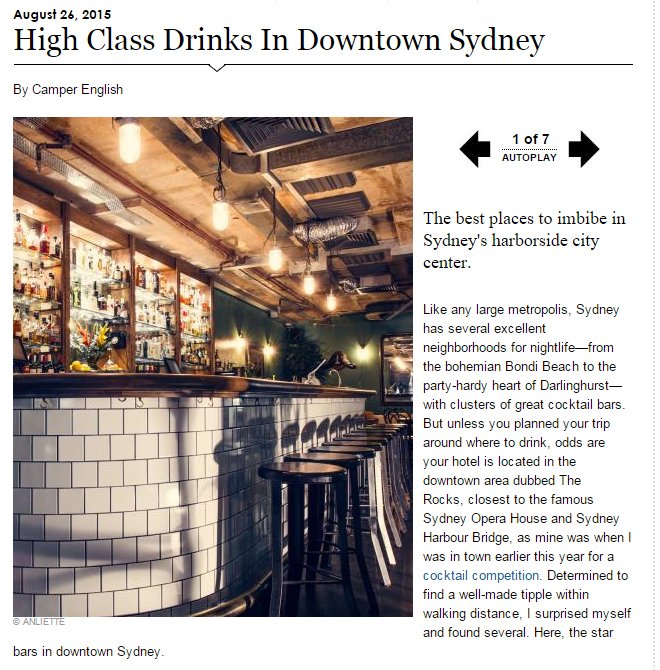
  • Cocktails in Sydney’s Downtown District

    While I was in Sydney for the Bacardi Legacy global cocktail competition earlier this year, I checked out a bunch of the bars.

    Here is a write-up I wrote for Departures.com of several of them more or less in the Downtown areas closest to the Opera House.


    Sydney bars


  • The 99 Items I Packed to Give a Cocktail Seminar…

    …and I didn't even make drinks. 

    I gave two full-length seminars and one mini-seminar at Tales of the Cocktail in New Orleans this year. For my seminar on Prehistoric Cocktail Technology, I went kinda big.

     Here is my packing list, without multiples. 99 things, dayumn. 

    • ice cream maker balls
    • cream
    • lemon + lime juice
    • knife
    • Filtration coconut vs wood 2sugar
    • simple syrup
    • eggs
    • orange flower water
    • East Imperial soda water
    • East Imperial tonic water
    • batch container
    • measuring containers
    • rock salt (1/2 cup container)
    • ladel
    • ice cracker tool
    • Bar towels
    • pipettes
    • Clamp post
    • clamps
    • plastic poster tubes with perforated red caps
    • aquarium filters- bio bags
    • coconut charcoal
    • mavea charcoal
    • coffee filters
    • Unfiltered cake vodka
    • Filtered cake vodka
    • dehydrated cake vodka
    • Milk
    • Bar spoon
    • Funnel
    • Clarified Zacapa
    • Test tube rack
    • Test tubes
    • Dehydrated blueberries
    • Dehydrated strawberries
    • Annatto seeds
    • Saffron
    • Cochineal
    • Magnifying glass
    • Blure
    • Tonic syrup
    • blue water
    • Acid Phosphate
    • Isi Siphon
    • CO2 cartridge
    • Blacklight flashlight
    • Salt
    • Black sheet
    • Cooked agave
    • Small plates
    • Wet naps
    • Clear bucket
    • Ammonium nitrate
    • Stir bar
    • Thermometer gun
    • 2-liter bottles
    • white wine vinegar
    • baking soda
    • funnel
    • Froth experiment2U-Fizz hoses
    • U-Fizz bakind soda tube
    • big pitcher
    • measuring cup
    • Burton Water salts
    • piloncillo pyramids
    • piloncillo syrup
    • clarified piloncillo syrup
    • Bottle of chill filtered scotch
    • Bottle of not chill filtered scotch
    • Juniper oil
    • Infusion of DJ blanco with baked pine shavings
    • Oak essence
    • Grape seed extract
    • Caramel coloring
    • Glycerin
    • pine shavings
    • baked pine shavings
    • Bonne-O Carbonator
    • Extension cord
    • Carbonator pills
    • Long tube with cap on one end
    • soda water Natural colors2
    • Insta-Foam
    • Bottle opener
    • Nuun for Alka-seltzer demo
    • Zacapa Rum 2 bottles
    • Don Julio Tequila Blanco 2 bottles
    • Don Julio Tequila Reposado 1 bottle
    • Don Julio Tequila Anejo 2 bottles
    • Don Julio Tequila 70 (70th anniversary clear anejo) 1 bottle
    • Label Maker
    • Extra Label Maker Tape
    • Sample cups
    • Tripod holder for poster paper
    • Tasting straws
    • Cinchona bark
    • Microscope attachment for computer
    • Bamboo Straws
    • 2 Ice chest/bucket
    • White background paper/Black background poster paper

    Plus I packed 200 baggies of dehydrated liqueur for my other seminar and some other stuff. Perhaps the greatest achievement was fitting it all into 3 suitcases.   

     Good times! Thanks to those who attended!


  • A Brief History of Popcorn in Cocktails

    In my latest piece for Details.com I wrote about the history and current status of popcorn in drinks, be it fat-washed in or garnished atop.  

    Details

    It turns out that a million different places are doing it, and I mentioned about half of them and the various ways they're incorporating the movie food into the drinks.

    Check it out here.