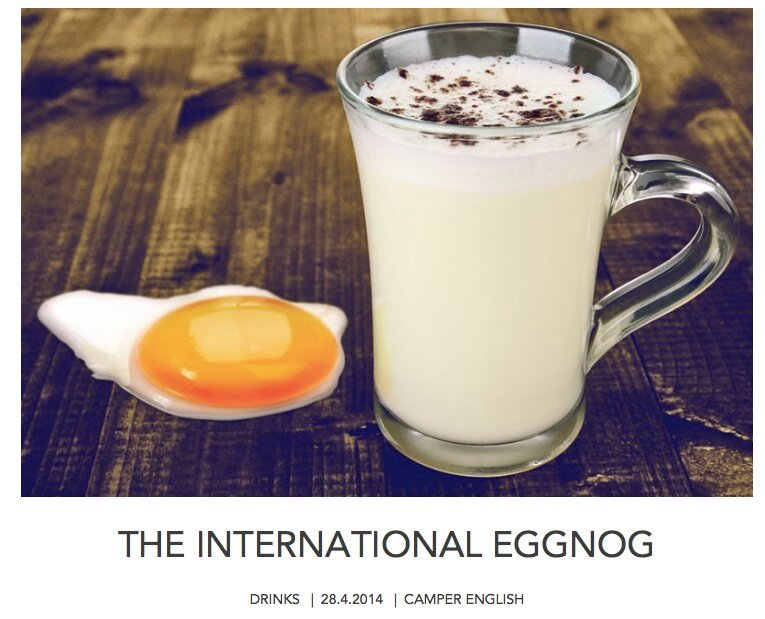
Way back in 2010, I wrote a story for Mixology Magazine about Eggnog. The story was published in German (I wrote it in English and they translated) but this year they put the English version of the story online.
It covers what I could learn about eggnog at the time (keep in mind this is 4 years ago), including the history of the drink and its possible relation to British egg drinks like posset and wassail, along with other American drinks like Grog and the Tom & Jerry.
It also covers international egg drinks, including:
This has been a great year for cocktails and spirits books- tons have come out, and the majority are written by well-respected bartenders and other experts. I haven't had time to read the majority of them, unfortunately, but below is a list of all the ones I know about.
Notable Cocktail and Spirits Books Published in 2014:
Whisky Books:
Whiskey Distilled: A Populist Guide to the Water of Life by Heather Greene
The Spirit of Gin: A Stirring Miscellany of the New Gin Revival by Matt Teacher
Distilled: From absinthe & brandy to vodka & whisky, the world's finest artisan spirits unearthed, explained & enjoyed by Neil Ridley and Joel Harrison
The fine folks at the Bay Area Newsgroup, which includes newspapers the San Jose Mercury, Oakland Tribune, Contra Costa Times, and others, asked me to write a long profile of Trick Dog's Caitlin Laman, so that's what I did.
The story comes out in this Sunday's Eat Magazine, an insert into all those papers. I'm not sure if it's going online in traditional format, but here it is in Issu, the online magazine format. If it comes out as traditional text I'll share the link.
They did a nice job! Lots of photos and a lovely layout.
The article also includes illustrated recipes by 8 Bay Area bartenders:
Caitlin Laman of Trick Dog
Suzanne Long of Longitude
Nick Kosevich for Mortar and Pestle
Antoine Nixon of Jack's Oyster Bar and Fish House
Russ Stanley of Jack Rose Libation House
Jimmy Marino of The Lexington House
Brandon Clements of The Village Pub
Andrew Majoulet of Rich Table
They asked for ten but chose eight – sorry if yours was one of the ones left out.
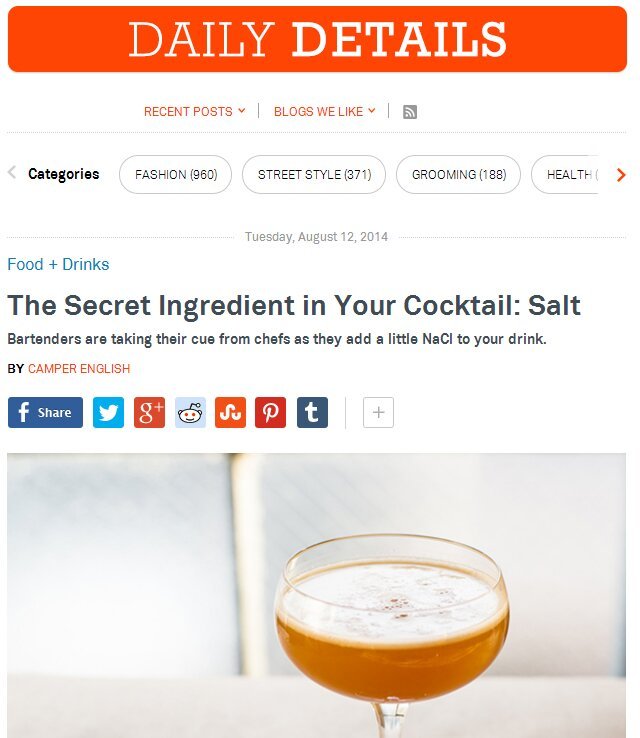
The first time I ever heard of such a thing (besides around the rim of a Margarita glass) was from Duggan McDonnell of Cantina. That was probably four years ago.
Now it seems that everybody is in on the secret and is using salt in their cocktails – whether they tell you about it or not.
Check out the story on Details.com about how and why and where bartenders are using salt in their drinks.
The winning cocktail of the 2014 Bombay Sapphire Most Imaginative Bartender competition was Remy Savage of Little Red Door in Paris. His drink, the Paper Anniversary, contained just three ingredients: gin, saline solution, and "paper syrup."
The homemade paper syrup specifically was meant to reference the government bank notes that were once printed at Laverstoke Mill that Savage had visited earlier in the week. That former mill is the future home of the Bombay Sapphire distillery. (We toured the site and I'll report on that in a later post.)
For his final drink, Savage was able to source actual bank notes printed at this mill and use them as a garnish.
As this was the World's Most Imaginative Bartender contest, the 14 international competing mixologists were encouraged to take inspiration from their visit to England and use it in their cocktail. Other contestants used the taste of British things we'd experienced like tea and jams, or they mimicked the vapor infusion process through which Bombay Sapphire is made.
Savage used the idea of the printing mill and the smell of books to inspire his paper syrup. He said, "I tried to think of what paper smells like. The challenge was to go from a smell to a taste."
His paper syrup contained a base of caster sugar and water, to which he added vanilla, fresh cut grass from outside the hotel, gentian root and (gentian-rich) Suze liqueur, and Laphroaig 10 year scotch for a touch of woody peat. I tried the drink and it was really quite close to paper – the sweet grassy vanilla on entry that quickly faded to a woody dryness from the gentian. Brilliant.
The dash of saline solution he says is a common touch they use at Little Red Door to kick up the flavor of cocktails. In this competition rather than a water or neutral spirit base, he used a base of Bombay Sapphire.
Paper Anniversary By Remy Savage of Little Red Door, Paris
45ml – Bombay Sapphire
15ml – Homemade paper syrup
1 dash – Salt solution
Stir all ingredients with ice and strain into a cocktail glass.
Paper Syrup:
For 800ml of syrup:
550g caster sugar
500ml of delicious parisian water
2 vanilla pods
Cook gently until it the sugar is dissolved. When it has cooled, add:
60ml of Suze liqueur
30ml of Laphroaig 10-year scotch
3g of dried gentian root
15g of clean fresh cut grass
Let infuse for 24 hours and filter syrup.
I'll post more about the contest and the other drinks the bartender created as soon as I get hold of all the recipes. There was a terrific diversity of flavors and styles that came from this contest challenging bartenders to use their imaginations.
In the Summer 2014 issue of Whisky Advocate magazine I have two articles.
This is a rye-themed issue and it's pretty great, so you should probably just get a subscription or run out to a retail store that carries it. They don't typically put anything from the print magazine online so that's the only way to read these.
Advanced-Level Barrel Aging – Of Cocktails
Bartenders are doing some amazing things with barrel aging. In the story I cite new/cool/innovated techniques from:
Tradition in San Francisco
Bergerac in San Francisco
Jamie Jones of Manchester
The Barking Dog in Copenhagen
Bon Vivant in Edinburgh
Manhattan Bar at The Regent, Singapore
Jack Rose Dining Saloon in DC
Liberty in Seattle
Pint + Jigger in Honolulu
Pomodoro in Boston
Half Step in Austin
Citizen Public House in Scottsdale
Ryan Chetiyawardana of White Lyan
Phew, that was a lot of bars to include in a one-page article.
The Rituals of Rye
Now that rye whiskey is back, what do you do with it? This story has a lot of new cocktails (like, a lot of cocktails), but I think the really interesting part is about which classic cocktails demand rye versus bourbon.
It includes recipes and/or quotes from:
Nathan Burdette of Los Angeles
Jonathan Smolensky of Canada
Vincent Toscano of Rye in San Francisco
Brad Peters of Hock Farm Craft & Provisions in Sacramento
Enzo Errico of Milk & Honey, New York City
Audrey Saunders of Pegu Club, New York City
Brian MacGregor of Wingtip, San Francisco
Chris Neustadt of Jimmy at the James Hotel in Chicago
Brian Means of Fifth Floor Restaurant, San Francisco
Anthony DeSerio of Splash restaurant in Guilford, Connecticut
Ted Kilgore of St. Louis
Andrew Freidman, Liberty, Seattle
Molly Wellmann of Japp's in Cincinnati, Ohio
Michael Callahan, Bartender-At-Large in Singapore
Abigail Gullo of SoBou in New Orleans
Tamir Benshalom, Bull Valley Roadhouse in Port Costa, California
Geof Anderson of Annunciation Restaurant in New Orleans
I've been bursting waiting for the Saveur 100 issue to come out so I could write more about Gamsei, a bar I visited in Munich this fall and included in the January issue of the magazine.
Gamsei comes from Matt Bax, the founder/co-founder of Der Raum and Bar Americano in Melbourne and Tippling Club in Singapore.
From the write-ups of Gamsei, it sounded like a place with a lot of rules (you have to wear slippers inside, no sugar in the drinks, no photos allowed) but much of that was either incorrect or more like a general policy than a rule.
The seating in Gamsei is on bleacher-style steps on either side of the central "bar", which is more of a low counter like you'd find in a science lab. Those slippers are for people who sit on the upper levels, so their muddy/wet shoes won't drip on the people below them.
I had also heard all about the hyper-local vision of the bar but not about the high-tech aspect of it. I was expecting a simplistic Japanese take on in-season cocktails, so the rotovap and liquid nitrogen came as a pleasant surprise.
Really, what Bax has done is just taken the idea of preserving local bounty and given it an exciting update. The bartenders forage in the forests (he said he checks with a plant expert to make sure certain things aren't poison before using them) and buy stuff at farmers' markets in season and use them fresh or preserve them using old-world techniques like fermentation, syrup-making, kombuchas, drying, etc. as well as new-world techniques like running infusions through the Rotavap so that they never spoil and flash-freezing other ingredients with liquid nitrogen.
As mentioned in the story, my favorite drink was the Lindenbluten, a local "lime blossom" (not the citrus tree) leaf and flowers frozen into an ice cube, and that ice cube used to chill and flavor house-carbonated local vermouth. Simple, elegant, beautiful. (But a terrible picture, sorry.)
At service, you get a mix of simple-looking drinks as well as some of the tricks you might expect from Bax – liquid nitrogen, beer foam, a drink in a flask. I had one that came with a a puff of cotton candy ("candy floss" to our European friends) that you use to sweeten a cocktail made with caraway liqueur, brandy, and riesling.
That puffy thing is cotton candy that you add to the cocktail to sweeten it.
All-in-all, the philosophy isn't that complicated and the rules aren't that strict. It's a unique set-up for a cool bar concept. Absolutely worth a visit when you find yourself in Munich. (And Munich is pretty darn worth a visit on its own- I've gotta get back there soon.)
Here's the menu from that day:
The arrows direct you from lighter starter drinks to richer heavier ones.
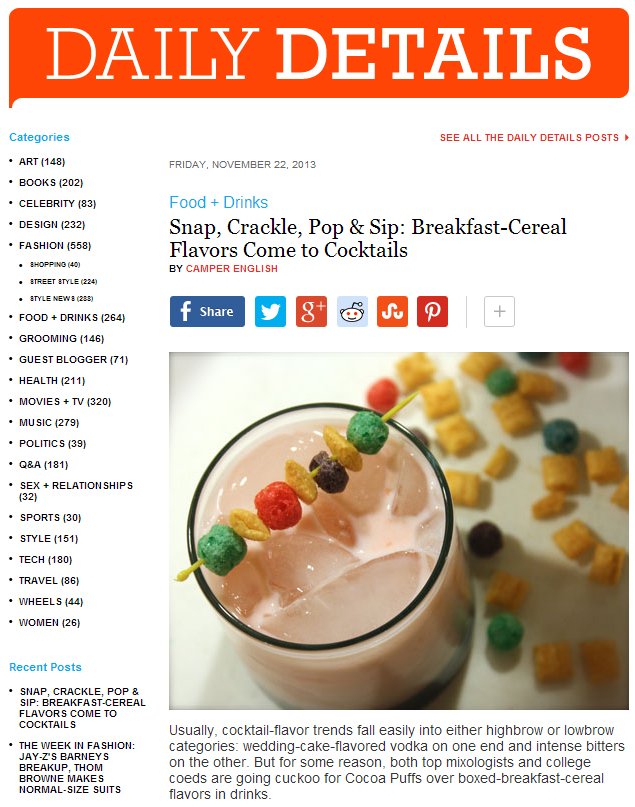
In my latest post for Details.com, I took a look at the multitude of ways that people are using breakfast cereal in cocktails.
Initially I thought I'd only find it in a few places but I think there are more than a dozen mentioned in the story and they're located everwhere from London to Bordeaux to Miami to San Diego. Some folks are serving them up in bowls with a spoon, while others are infusing cereal into milk or directly into liquor.
The last ingredient was described as, "House-made switchel, also known as swizzle or haymaker’s punch. A long forgotten ingredient, Wise’s nostalgic resurrection of this carbonated cross between sweet tea and apple cider is an appreciated addition to Imperial’s ingredient list."
So, a switchel sounds a lot like a shrub, a (usually) fruit-and-vinegar syrup. I followed up with Wise to ask him:
What's the difference between a switchel and a shrub?
His response:
There are many commonalities between switchel and shrub. The main difference is the role of fruit(s and veggies): shrubs, speaking in a general sense, are a way to preserve fruits of the season with vinegar. The switchel we make also incorporates vinegar, apple cider vinegar specifically, but does not rely on fruit for its flavor. Molasses, cider vinegar, and ginger are the key flavor agents in our switchel whereas in a 'strawberry shrub' (for example) the strawberry is the primary flavoring agent which is then effected by the vinegar. Switchel is a little closer to a root beer, ginger beer, or traditional ale.
Another fundamental difference is that our switchel is itself a drink, not an ingredient in a drink. Shrubs are delicious when you add water or soda but operate more as a syrup or sweetening agent; our switchel is meant to be consumable on its own. We bottle condition with yeast much like we make our tonic water for natural carbonation. The goal was to make something like a sarsaparilla rather than a syrup. Switchel, like tonic, can be carbonated or uncarbonated, we simply choose to do it this way.
We're very excited about this product and are pleased to see folks trying it for the first time and loving it. The cocktail on our menu that features switchel was an immediate hit and has become one of our best sellers. To my knowledge we are the only ones using it for cocktails and that is pretty exciting. It was something we stumbled upon when doing research for the Portland Penny Diner and its soda fountain component and have long desired to incorporate it into our beverage program. We've sat on the concept for almost a year until the season was right, and now we're seeing that our patience paid off. Resurrecting a quintessentially American beverage was our aim and our patrons are very much enjoying the fruits of that labor.
I'm no historian or scientist so my answer may still be lacking, but hopefully a bit of the back story and its application can at least clarify its intent and its differentiation from a shrub.
That's a pretty thorough answer. Thanks Brandon!
Switchel in the bottle and the Slings and Arrows cocktail