Category: trips

  • All About Orris: Harvest in Tuscany

    In Tuscany on a botanical trip with Bombay Sapphire, we learned how the orris root is grown and processed to use in the gin. 

    Iris beneath olive trees Orris Root Harvest Tuscany with Bombay Sapphire_tn

    Orris root is the rhizome of the Iris flower. Here in Tuscany they are grown on sloping hills between rows of olive trees. Nice space.

    Iris flower 7 Orris Root Harvest Tuscany with Bombay Sapphire_tn

    These iris flowers are not grown for their beauty, unlike other iris varieties, but for the quality of their rhizomes.

    Ivano hold roots Orris Root Harvest Tuscany with Bombay Sapphire_tn

    The rhizomes are bulbs on the base of the plants. Skinny roots shoot off the rhizomes. These are cut off. 

    Replanted iris Orris Root Harvest Tuscany with Bombay Sapphire_tn

    The plant tops, with a tiny portion of the rhizome attached, are replanted. 

    Peeling closeup Orris Root Harvest Tuscany with Bombay Sapphire_tn

    The orris is then hand peeled. 

    Pweeling orris root 7 Orris Root Harvest Tuscany with Bombay Sapphire_tn

    Dried peeled Orris Root Harvest Tuscany with Bombay Sapphire_tn

    Then it is left out to dry in the sun.

    Later it is aged. The floral aspect comes out only after this, when it is extracted into gin or perfume. 

  • Picking Juniper Berries in Tuscany: A Photo Album

    In May I visited Italy to learn more about the botanicals used in Bombay Sapphire. From Tuscany they get both the juniper berries and orris used in the gin. 

    Hills Tuscany Juniper Harvest with Bombay Sapphire_tn

    In the rolling hills of Tuscany at high elevations where there are few trees and many wildflowers are found the juniper bushes. 

    Bush Tuscany Juniper Harvest with Bombay Sapphire_tn

    They're kind of ugly, sprawling little bushes.

    Bush closerup 4 Tuscany Juniper Harvest with Bombay Sapphire_tn

    They're full of clusters of berries- more than I'd expect. We were there during the off season, so not many are the blue color of ripe berries. 

    Tuscany Juniper Picking with Bombay Sapphire harvesters2_tn

    Juniper is harvested by hand, using wide round baskets and short sticks. 

    Tuscany Juniper Picking with Bombay Sapphire wacking bush_tn

    They stick the baskets beneath a branch and whack it with the stick so that the blue, ripe berries fall off but the green, unripe ones do not. 

    Inspecting Tuscany Juniper Picking with Bombay Sapphire_tn

    Some of the needles stick to the berries. Any green ones that get in are sorted out later. 

    Tuscany Juniper Picking with Bombay Sapphire berries in basket_tn

    I tried it, but wasn't very good at it. 

    Camper pose Tuscany Juniper Picking with Bombay Sapphire_tn

    But then again, there weren't actually any ripe berries to harvest at this time of year. 

  • Casa Noble Distillery Visit

    Way back in February I took a quick trip to Mexico to visit the distillery La Cofradia, where they make Casa Noble tequila. They make other brands there too, but I was there as the guest of their flagship brand Casa Noble.

    A Beautiful Distillery

    La Cofradia is located about a mile outside of the town of Tequila in the Lowlands of Mexico about 45 minutes outside Guadalajara. In Mexico a few distilleries cultivate a garden-like environment but here they take it to another level. There is a central courtyard with trees, a duck pond, a little cafe, and a set of four cottages where visitors like me can stay. 
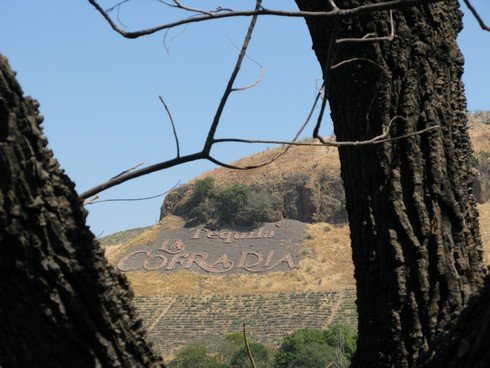
    La cofradia sign2_tn

    Casa Noble Tequila Production

    Casa Noble is a certified organic 100% agave tequila. In order to be organicaly certified you need to prove that the land has been organically farmed and not had chemicals used on it for a certain number of years. Casa Noble avoided that problem by purchasing virgin land in Nayarit and planting fresh agave there. Nayarit is one of the five states where it is legal to grow agave, though nearly all of it comes from the state of Jalisco where the distillery is located.

    Thus Casa Noble uses estate-grown agave. This is a growing trend in the tequila industry; producers owning or renting the agave fields so they can control the both the care and harvest of it, but also the price, avoiding the dramatic gluts and shortages of agave in the industry as a result of its long, 6-11 year growing cycle.
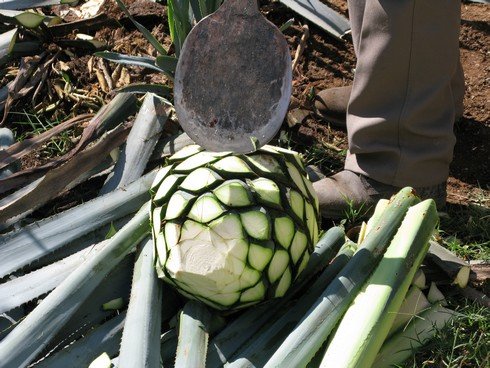
    Casa Noble jimador5_tn
    (Agave pina (pineapple))

    The fields in Nayarit are at an elevation of about 4000 feet, higher than some of the Highlands. Yet the agaves I saw at the distillery were much smaller than Highland agave I've seen. Those are often 200 pounds compared with the 110 pound or so average at Casa Noble (and thus only had to be split in half before baking; some Highland producers split theirs into quarters). They purposefully chose an isolated location for their fields, because they are organic: they wouldn't want airborne agave diseases to spread to their fields.

    After harvest, the agave pinas are brought to the distillery where they'll be baked, shredded, fermented, and distilled. Baking converts the complex sugars in the agave into simpler, fermentable sugars.
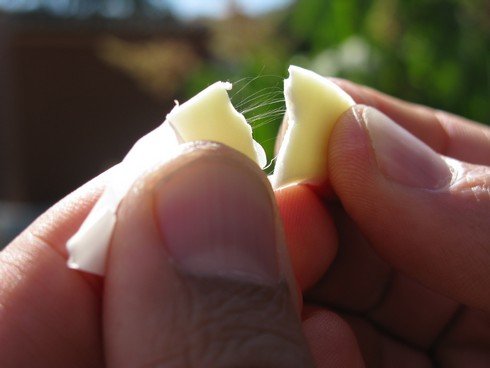
    Agave fibers1 Casa Noble_tn
    (Closeup of piece of agave. You can see the fibers. The sugars are stored between these fibers which is why agave is shredded after baking to release them.)

    Baking and Shredding

    La Cofradia has 5 hornos (ovens), 3 large 40-ton ones and 2 smaller 20-ton ones. The agave is steam baked for 36-38 hours. Then it cools before the next step. They hasten the cooling process by using large fans blowing through the two sides of the oven.
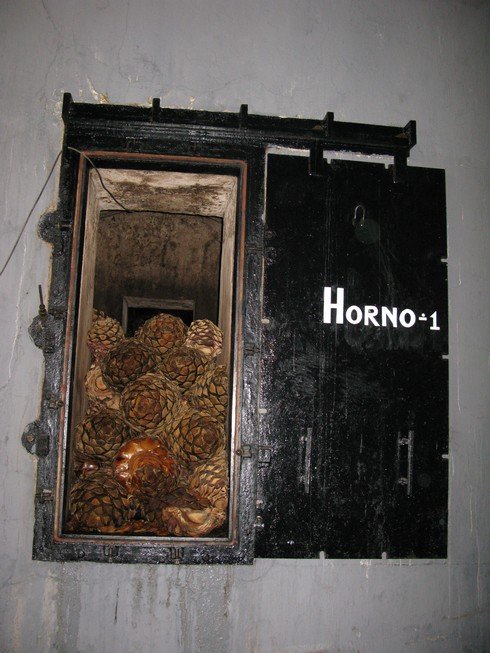
    Ovens Casa Noble distillery_tn

    When agave is cooking with steam, the first water than runs off the bottom is called "bitter honey" and it is discarded. The next mass of water is called the "oven honey" and this is collected. We sampled this water- its sweet, watery, and has a vinegar note to it. (David Yan, Marketing Director there, says he's used a refined version of this as a vinegrette on salads.)
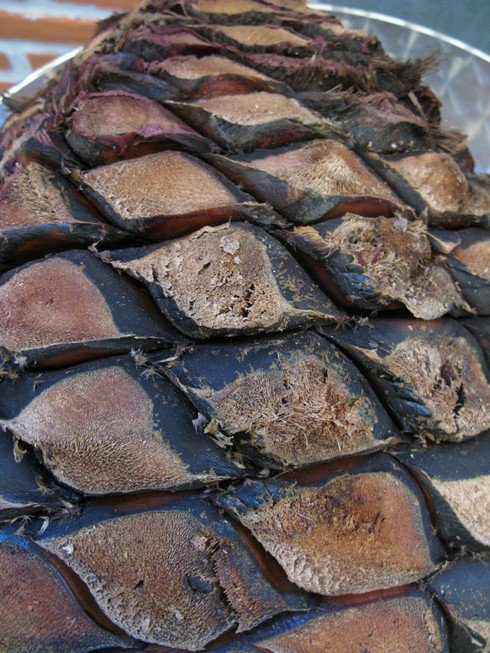
    Baked agave Casa Noble distillery2_tn
    (Baked agave.)

    After baking the agave is shredded to expose the fermentable sugars that can be washed out and fermented. At La Cofradia they have a unique system: First the baked agave pinas are put through a sort of wood chipper (not a roller mill) with water. This water is collected and they call it the "fat extraction."

    Next the chipped agave goes into a two "extractors" that are shaped like horizontal metal tubes. The first part of the extractor is like a corkscrew that compresses the fibers in the agave. Then it passes through to a set of paddles on a central axis that spins the agave fibers outward and washes them with water.  Apparently this helps separate the fibers without neccesarily shredding them.
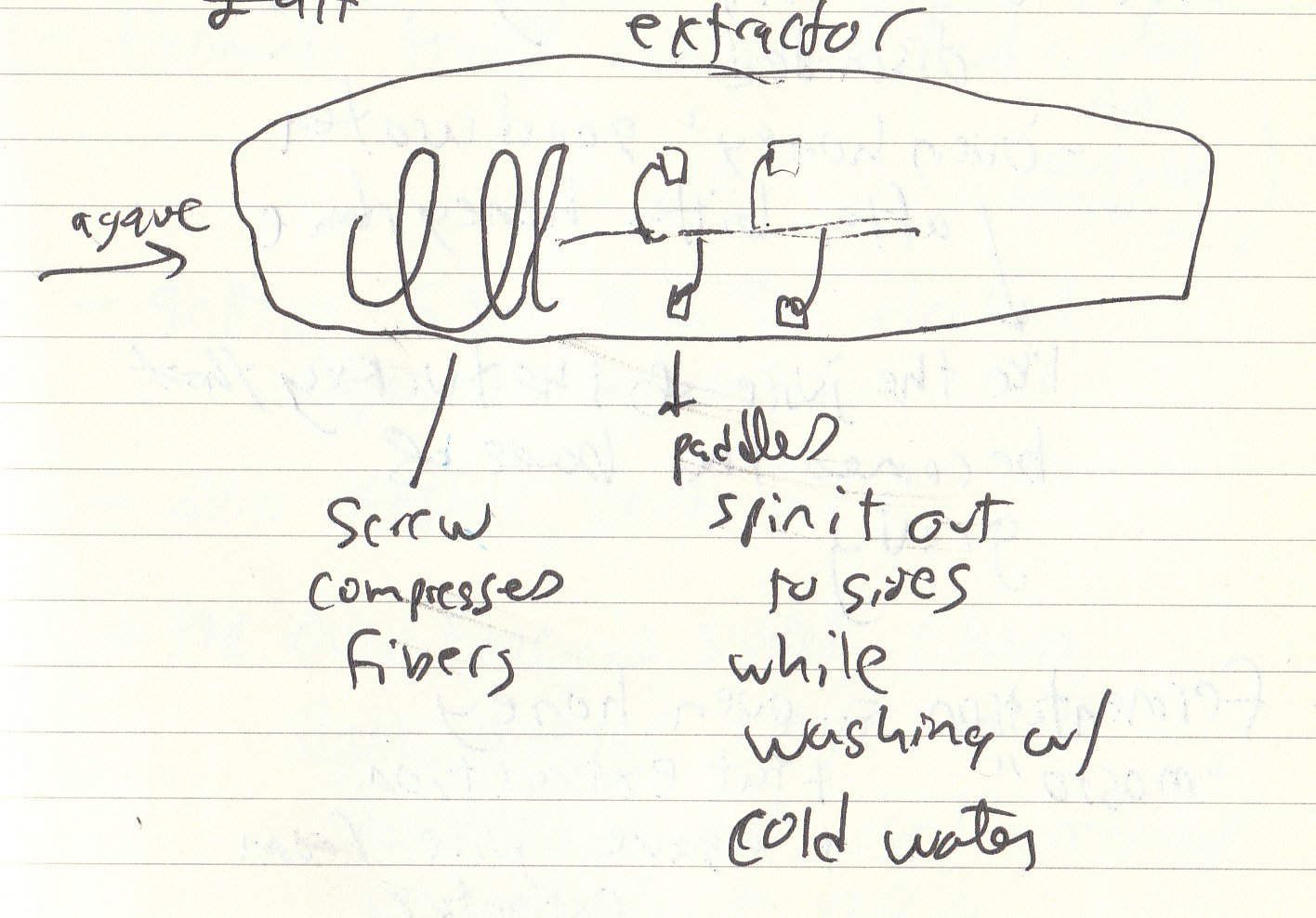
    Extractor diagram
    (Diagram of extractor from my notes.)

    Fermenting and Distilling

    Now, onto fermentation. They ferment the combination of the oven honey, fat extraction, and agave juice from the extractors. Yeast is added that feeds on the fermentable sugars and converts it into alcohol plus CO2. While filling the fermentation vats, they bubble air into the tank, which they say makes the yeast reproduce more. This increases their alcohol conversion by an extra 1-2%.
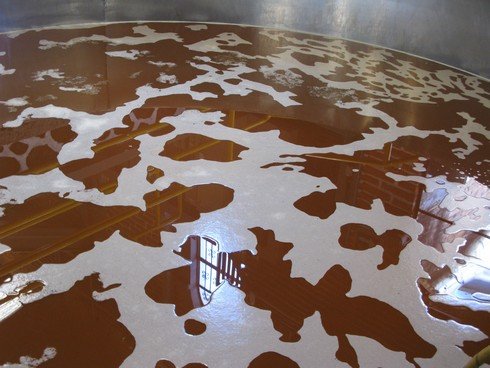
    Agave juice about to be fermented Casa Noble distillery_tn
    (Ready for fermentation.)

    After fermentation (3-5 days, depending on the time of year), the yeast has died and the juice is called "mosto muerto." Now it's time to concentrate the alcohol through distillation.

    At La Cofradia they have large and small stills for the first and second/third distillations. The first, large stillas are called "destroyers" and their job is to get rid of most of the heads and tails.The resultant spirit is 22% alcohol.

    Large and small stills Casa Noble distillery_tn
    (Destroyer stills closer, smaller stills further away.)

    The smaller stills are used for both a second and third distillation that refine the spirit. Though the first distillation cuts most of the heads and tails, there are smaller cuts on the second and third distillations. Both bring the alcohol to 55% ABV. (For most of the other brands that are produced at La Cofradia, they distill only twice. As this is the flagship brand they refine it more.)

    After distillation (or, in the case of the aged tequilas, after aging) the tequila is filtered through micro-cellulose fibers and diluted to proof. The blanco (only?) is oxygenated before bottling for 8-12 hours.

    Aging and Tasting

    The barrels for aging Casa Noble come from the Taransaud cooperage in France. They're new French oak with a light #1 char, and nobody else in Mexico uses these barrels.The tequila goes into the casks at 55% ABV from the still (not watered down before barreling).
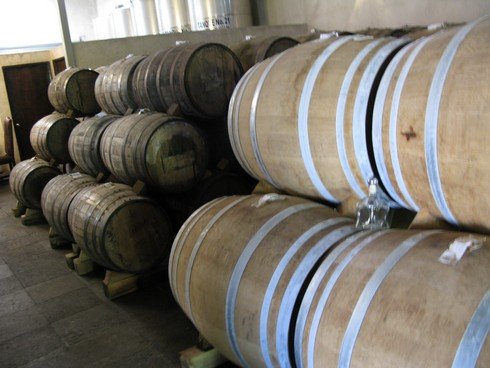
    French oak barrels casa noble distillery2_tn
    (New French oak barrels.)

    Interestingly, the tequila destined to be anejo (minimum 1 year aging) goes into new casks. The reposado (2 months to 1 year aging) goes into refilled caks. (More often, brands will use newer casks for reposado tequilas and older ones for anejo so that the wood affects the spirit more in a shorter time for the reposado.) They refill these casks for reposado 7-8 times.

    Cristal/Blanco: This tastes of nickel and minerals, white and red pepper, and "agave sticks" according to my tasting notes.

    Reposado: The reposado is aged for 364 days, the maximum amount before it would be in the anejo category. Reposado is aged in all 228-liter barrels. My tasting notes were: Boo-berry, strawberry cream popsicle, and white flowers.
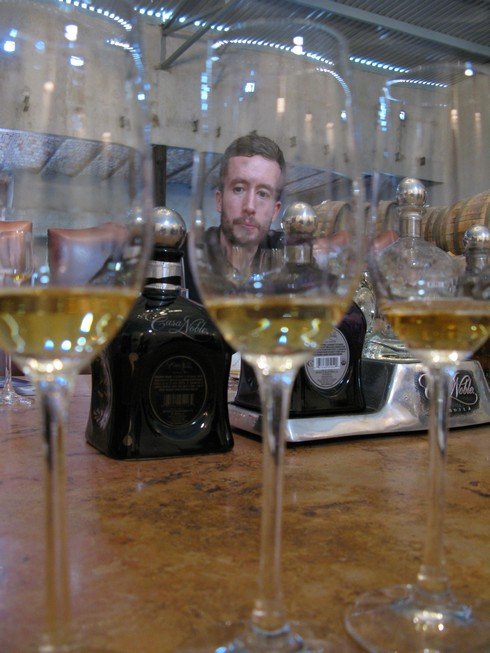
    Michael B Dougherty casa noble3_tn
    (Tasting.)

    Anejo: Here's where Casa Noble separates itself from the pack yet again. Though all barrels are new French oak from Taransaud, they actually use three different sizes of barrels: 114 liter, 228 liter (about the size of bourbon barrels), and 350 liter barrels. These are blended together to create the anejo.

    The anejo is aged for 2 years. (Anejo is aged a minimum of one year. Extra-anejo starts at three years.) You can definitely taste all three of the below flavor profiles in the anejo.

    We were given the opportunity to taste tequila aged in each of the three sizes of barrels, each of them for a little under two years.

    114 liter: bitter wood, used peanut oil
    228 liter: fruit, dusty Boo-Berry, most similar to the reposado
    350 liter: floral, strawberry juice, light

    Now, besides Casa Noble, I can only think of one other set of brands that ages their spirit in similar casks of different sizes: Jim Beam. Laphroaig and Ardmore both do "quarter cask" programs.

    So, Wow.

    This is a distillery that uses traditional methods in many ways (stone ovens, gentle agave processing) yet has built their system from the ground up (new agave fields, agave processing methods, distillation, aging). And it's all done in a lovely setting to which I'd love to return someday.
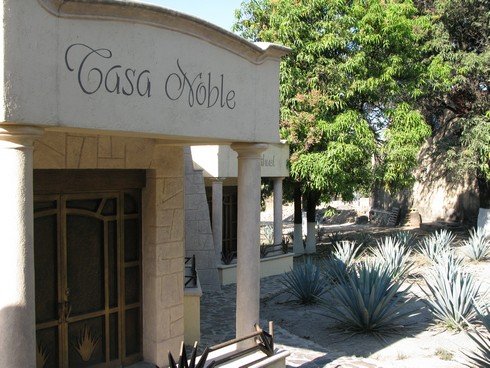
    Casa noble hotel5_tn


  • Angostura Rums Distillery Visit

    In my last post I talked about the history and production of Angostura Bitters. In this one I'll talk about the history and production of Angostura Rums. I visited the distillery on Trinidad in March 2011.

    History of Angostura Rums

    The House of Angostura was in the bitters business since 1824, but didn't enter the rum business until after their move to the island of Trinidad in 1875. At first they were dealing with bulk rums rather than distilling their own, but in 1945 they purchased their own distillery. It wasn't until the 1960s that the profits from rum outsold those of bitters. In 1973 they purchased the Fernandes Distillery located next door and incorporated those brands (including Vat19) into their production.

    According to the film we watched at the distillery, in 1991 they had a production capacity of 22 million liters of alcohol per year. According to their website, it's now 50 million liters. Wow! The distillery takes up 20 acres of land. They make both their own brands, rum for other people, and sell bulk rum. More on the other brands later.

    Column still Angostura Distillery Trinidad5_tn

    Production of Angostura Rums

    Currently all the products are made on enormous column stills. They say they've been experimenting with some pot still stuff, but they're not making anything yet.

    Column still Angostura Distillery Trinidad10_tn

    No sugar has been produced on the island since 2003, so all the molasses to make these rums is purchased on the open market. (10Cane, which is also made on Trinidad but I don't believe at this distillery, uses some fresh local sugar cane juice in their rum blend.) We tastes molasses off the grate where it is poured into the system- it reminded me of old-style black licorice.

    Molasses grate Angostura Distillery Trinidad4_tn
    (Grate through which molasses is poured.)

    For different rum products made at the distillery they use different strains of yeast. Their barrels are ex-bourbon barrels. These are reused to age rum three times before they're discarded or recycled. We weren't allowed to enter the aging warehouse as they said it's a bonded property. From outside, it didn't look nearly big enough to age all the rum produced here, but they said it's their only aging warehouse it turns out they have five other aging warehouses also.

    Aging warehouse Angostura Distillery Trinidad3_tn

    For further reading, I suggest Ed Hamilton's write up on MinistryOfRum.com. 

    The Line of Rums

    After the distillery tour we did a tasting of some of the rums with Master Distiller Jean Georges. Oh, by the way, the line of Angostura rums is finally coming to the US soon, and they are tasty. 

    Bartender group Angostura9_tn

    The 3-year reminded me (keep in mind my tasting notes aren't supposed to make sense to anyone but me) of the insides under-ripe banana peels, with a soft creaminess that wasn't too vanilla-y. 

    The 5-year, interestingly, is actually filtered to remove some of its color. It has the caramel-vanilla notes you'd expect from a rum of this age, but with a nice fuzzy texture. I was also picking up a lot of notes of liquid limestone. The finish had some mint/oregano spice to it and it was just a touch tannic. 

    Tasting jean georges angostura distillery trinidad2_tn

    The 7-year rum is actually the 5-year rum which is blended and then put back into casks to marry for 2 years. The nose is all warm caramel apple and cheesecake pie crust on this one, with a spicier mouth with notes of peppermint. It's also oily in texture and slightly ashy. 

    One thing Jean Georges said about all of their rums is that they have a short finish. "None of our spirits overstay their welcome. They do their thing and move on, leaving you to want another sip."

    Tasting jean georges angostura distillery trinidad4_tn

    I am not sure if their "single barrel" is coming to the US or not, but I enjoyed drinking that during my visit. Most of the time I drank that or the 7-year-old. When I wanted a mixer, I'd mix it with their soft drink Lemon Lime & Bitters, locally known as LLB. (Note to Angostura: you should consider bringing this to the US also in select markets.)

    Angostura also produces Zaya rum, The Kraken spiced rum (according to MinistryOfRum), Vat 19, and White Oak (which is very popular in Trinidad).


  • The History and Production of Angostura Bitters

    In March I visited the Angostura distillery in Port of Spain, Trinidad. They make not only Angostura Bitters here but also the line of Angostura rums and rums for several other brands. In this post, I'll focus on the bitters. 

    Bartender group Angostura3_tn

    The History of Angostura Bitters

    Angostura Bitters were created in 1824 by Dr. Johann Siegert. They were originally called "Dr. Siegert's Aromatic Bitters" and later renamed Angostura Bitters. (The folks from The Bitter Truth Bitters have some interesting information about a lawsuit over the name "Angostura" between these bitters and Abbott's Bitters.) 

    Old bitters bottle Angostura Distillery Museum_tn
    (One of the other Angostura Bitters bottles from around the world on display at the museum.)

    The bitters were created for tropical stomach ailments in Venezuela, as Dr. Siegert was the Surgeon General of Simon Bolivar's army.  In fact the town of Angostura is now called Ciudad Bolivar. The bitters were first exported to England in 1830.

    Simon Bolivar Angostura Distillery Museum_tn
    (Simon Bolivar)

    According to this good history on Angostura's website, Siegert's son exhibited the bitters in England in 1862 where they were mixed with gin. Thus the Pink Gin was born.  

    Ango pink rum3 Angostura Distillery Museum_tn
    (Angostura used to produce Pink Rum – rum laced with Angostura Bitters.)

    After Dr. Siegert died in 1870, his sons relocated the business from the politically unstable Venezuela to Trinidad in 1875. The company was renamed Angostura Bitters in 1904. Sometime shortly after this,  the son in charge of Angostura lost all of his money in bad business deals and Angostura was taken by his creditors.

    Why is the Angostura Bitters Label Too Big for the Bottle?

    For a competition of some sort, one brother designed the bottle and another brother designed the label. By the time they figured out they should have consulted each other on the size of each, it was too late to change. On the advice of a judge in the contest, they kept it as their signature. Here, our tour guide does a better job of explaining it in this 1-minute video.


    How Are Angostura Bitters Produced? 

    The secret ingredients for the bitters are shipped from wherever they come from to England. There the ingredients are put into coded bags and shipped to Trinidad. I believe they said they have a long-standing arrangement with customs that the bags are not inspected when they arrive in Trinidad to maintain their secret.  

    At the distillery, there are five people known as "manufacturers" who prepare the ingredients. They weigh out the relative quantities of each in a room known as the Sanctuary. The ingredients are then dropped into a crusher that crushes them all together as they fall into the room below – the Bitters Room. 

    At the base of the crusher are carts that hold the ingredients. We weren't allowed to take pictures in the room due to the high-proof alcohol vapors (but later did of the bartenders there), but we did get to peak into the crushed herbs. I remember seeing largish chunks of something that looked like gum arabic, and a lot of rice-sized grey grains about the size of lavender seeds, though I doubt they were because there was a lot of them. (There you go: gum arabic and lavender- make your own Angostura at home 🙂 )

    The crushed herbs then go into a "percolator" tank with 97% alcohol to extract their flavor.  After this infusion is done, the liquid is then transferred to another tank where brown sugar and caramel color are added. Then the liquid is transferred again and distilled water is added to bring them down to the 44.7% alcohol level for bottling. 

    This is all done in a relatively small room with a bunch of tanks in it. It's impressive that the world's supply of Angostura Bitters is made here. 

    Bartender group Angostura5_tn

    Later that day, they did publicity shots with the bartenders in the Bitters Room. They let the professional photographers take photos and let me take them without flash. As you can see the bitters tanks have the bottle labels on them. Except in this case, they actually fit. 

  • Jameson Irish Whiskey Distillery Visit

    In early February I visited the Jameson Irish Whiskey distillery – actually two of them.

    The original Jameson distillery is in Dublin, but it is no longer made there. In 1971 it moved to the Midleton distillery in Cork. The reason is because in the late 1960's Irish Distillers was formed, a merger of Jameson, Powers, and Cork distilleries.

    In Dublin there is a visitors' center and restaurant. We went there first. I've got to admit, they did a really good job making a non-working distillery look working, using dioramas and original distillery parts but with fake ingredients pumping through them.

    Old jameson distilleryoutside_tn

    Old jameson distillery bar2_tn

    Old jameson distillery mash tun_tn

    The next day we went to the new distillery in Cork. But actually it's the new-new distillery, located next to the old one.

    Jameson distillery cork2_tn

    Jameson distillery cork3_tn

    Here we skipped the typical tour in favor of an in-depth one. 

    Jameson Fun Facts

    • Triple-distilled, as opposed to most scotch's twice-distilled
    • The old pot still here is gargantuan, probably one of the largest in the world. That is no longer used in favor of two wash stills half the size- that are still pretty huge.
    • All of the pot-still whisky made here is made on the same four stills: two wash stills, 1 feints still, and one spirit still
    • There are also several column stills as Jameson is blended whiskey.
    • Redbreast (available in US) and Green Spot (not) are all pot-still whiskeys.
    • They also make Middleton, Powers, and Paddy here, plus a couple other brands
    • They distill Tullamore Dew here under contract
    • Most Jameson uses ex-bourbon and ex-sherry casks. Some (Rarest Reserve) uses ex-port barrels
    • Sherry butts are prepared by putting oloroso sherry (that has already aged the minimum of three years to be called sherry) into new casks for two years to prepare them.
    • Their pot-still spirit is a combination of malted and unmalted barley. If it's all pot-still whiskey, it is called "Irish pot still." Bushmills is "Irish malt" as it uses all malted barley.
    • They don't make a big deal about yeast strains here – use a "standard distilling yeast"
    • We nosed 100% malted distillate vs. malt/unmalt blend. The malted smelled more fruity and esthery than the blend
    • Due to the weather, there isn't a great temperature variation in the barrel warehouses, and only 2% angel's share per year
    • Jameson and Jameson 12 have opposite ratios of pot to column distilled spirit in them, though they don't say the ratios.
    • Jameson 18 tastes like green caramel apples
    • Jameson Rarest Vintage Reserve tastes like the inside of banana peels, coconut flakes, pineapple gum arabic. It is the yumz.
    • Only before 1800 was Irish whisky peated, and much of that would have been poteen rather than whisky. Around 1800 large-scale production became legal in Ireland and everyone moved to using coal rather than peat. So really in modern Irish whisky making there is no tradition of peating.

      Jameson distillery cork cooperage13_tn

    Jameson distillery cork warehouse2_tn

    Jameson distillery cork warehouse13_tn

  • Sherry Bodega Visit: Bodegas Hidalgo La Gitana

    In September 2010 I visited several sherry bodegas. Here are pictures and a few notes from Bodegas Hidalgo La Gitana, which is located in Sanlucar de Barrameda. 

    Bodega Hidalgo La Gitana2_tn

    (La Gitana is their most famous brand. It's a manzanilla; similar to fino but aged in Sanlucar.)

    Bodega Hidalgo La Gitana6 (2)_tn
    (The bodegas were wonderfully old, moldy, and dusty.)

    Bodega Hidalgo La Gitana bulfight poster2_tn
    (One of the old bullfight posters taped to the wall in the bodega.)

    Bodega Hidalgo La Gitana7_tn
    (Our host, a curmudgeonly sort who basically disagreed with everything we learned all week. We liked him anyway.)

    Bodega Hidalgo La Gitana6_tn
    (A view of the bodega.)


    • More humidity and less exreme temperature swings in Sanlucar
    • Flor is thicker and remains year round
    • Make a single-vineyard manzanilla. It may be the only single vineyard sherry
    • The vineyards and grapes not nearly as important as the place where the solera is
    • Sanlucar is the oldest part of the sherry region- producing wines there the longest
    • Most of the casks in these bodegas over 200 years old. They hate new casks. 
    • Replace staves with staves from old casks bought on market
    • La Gitana has 14 level solera. 
    • Manzanilla typically has more ciraderas (levels to the solera) than fino. Have to move it faster between levels.  
    • Tastes like salt spilled in the relish. Yum.
    • Manzanilla can pair with asparagus- is most versatile with food
    • Says you can leave an open bottle in the refrigerator 4-5 years and it will still be good 
    • During the peninsular war, they supplied both Napoleon and the Allies. Now have both Napoleon and Wellington brands. 


  • Sherry Bodega Visit: Bodegas Lustau

    In September 2010 I visited several sherry bodegas. Here are pictures and a few notes from Bodegas Lustao. 


    Lustau2_tn(Barrels in the Lustau bodega.)

    Lustau vinegar2_tn
    (The vinegar aging room smelled heavenly. I'd love to go back and just study vinegar.)

    Lustau casks for jameson7_tn
    (These new casks are being prepared for Jameson Irish whisky that is aged in ex-sherry casks. These casks were not part of the solera system- just the wine in them. They hold sherry that absorbs into the wood. The sherry is then distilled and not used for sherry.)


    Lustao vinagre de jerez_tn

    (At lunch afterward, we drank Lustao sherry and had Lustao Vinagre de Jerez on a few dishes.)


    • Albero soil used in bodegas is same as used in bullfighting rings
    • It took two and a half years to move the bodega from one place to another
    • Only company to have sherry aged in Jerez, Puerto, and Sanlucar
    • The vinegar solera smells delicious!
    • Brandy bodega smells like buttered popcorn
    • Casks for Jamesons made here with their oloroso 
    • Fino bodegas must have higher ceilings, cooler temps, more humid
    • Different vineyards produce grapes better for fino, amontillado, oloroso sherries 


  • Tequila Distillery Visit: Patron

    In November I visited seven tequila distilleries in Mexico. Here are some pictures and notes from my visit to the Patron distillery in the town of Atotonilco.

    Patron tequila distillery_tn(The distillery is on a huge plot of land. It's a huge distillery. This is the front gate.)

    Hacienda patron tequila distillery2_tn
    (This is the hacienda, which is the center of the distillery. Nice place.)

    Roller mill patron tequila distillery_tn
    (This is agave going in to the rollermill. Patron is 50% rollermill agave and 50% tahona agave.)

    Tahona agave wooden fermentionation tanks patron tequila distillery_tn
    (Fermenting tahona agave. Tahona agave ferments and is distilled with the fibers.)

    Composting machines patron tequila distillery_tn
    (Outside the distillery they prepare the spent agave to be fertilizer.)

    Aging casks patron tequila distillery_tn
    (They use a mix of barrels for Patron.)

    • The distillery is actually 12 distilleries operating independently. 
    • Most of the agave comes from the highlands
    • They recycle the first agave juice out of the ovens, don't use it for fermentation
    • Ferment in pine wood, not stainless
    • Have unusual stills designed by master distiller
    • Tahona agave takes 2 hours to crush
    • Patron silver is 75% of sales, reposado accounts for 10 percent and anejo accounts for 15
  • Sherry Bodega Visit: Bodegas Gonzalez Byass

    In September 2010 I visited several sherry bodegas. Here are pictures and a few notes from Bodegas Gonzalez Byass. 

    Bodega Gonzalez Byass24_tn
    (The grounds of the bodega have grape vines covering the streets to provide shade.)

    Bodega Gonzalez Byass_tn
    (A train takes people on a tour around the bodega.)

    Bodega Gonzalez Byass2_tn
    (One of the rooms for special events.)

    Bodega Gonzalez Byass picasso_tn
    (A barrel signed by Picasso.)

    Bodega Gonzalez Byass44_tn
    (Some Tio Pepe out of the cask. You can see the flor broken up in the glass.)


    • Make Tio Pepe
    • Over 200,000 visitors per year to bodega
    • Tio Pepe grapes are and will always be collected by hand, not machine
    • Higher vineyards considered better – get more of the wet wind
    • Theyre one of the only companies to grow PX in Jerez. Others buy it from Cordoba
    • Have a big catalogue of vintage-dated sherries- Anadas
    • Corks are loose on sherry barrels to let air in, but most air freshness comes from when you change the levels of the sherry in the solera
    • The El Duque brand starts as Tio Pepe fino, aged longer
    • The higher the percentage of alcohol, the more lignin it absorbs from the wood. 
    • Nuttiness comes from the grapes. Coconut comes from the wood.
    • Palo Cortado- probably started back in the day when they couldn’t accurately meauser alcohol percentage, so they put too much in the fino and killed it