Category: water

  • More Mineral Water Info from a Book on Soda

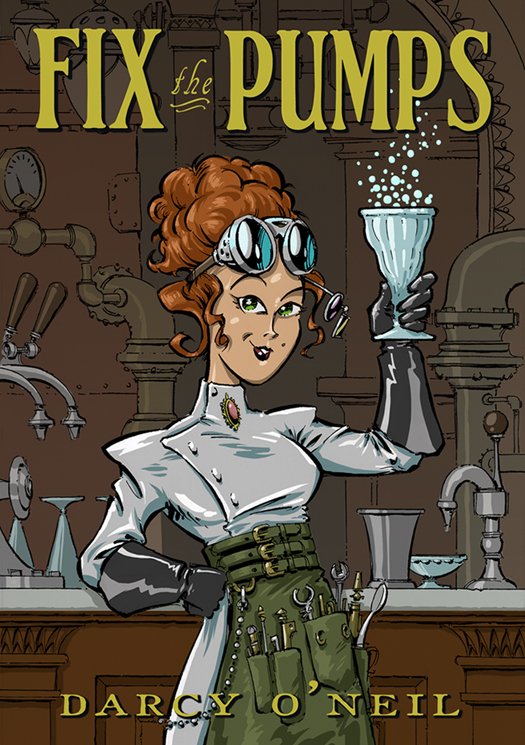
    Another useful resource in my exploration of water in spirits and cocktails is Darcy O'Neil's book Fix the Pumps

    Fix the pumpsThe book focusses on the history and mechanics of the pre-Prohibition soda fountain. Though largely filled with information on sodas, it includes a chapter and some recipes on mineral waters. 

    Before global shipping became easy, soda fountains made their own soda and mineral waters, with the carbonation being the main attraction. 

    Here are a few things I learned from the book:

    • Club Soda is a trademarked brand. Seltzer water was a brand but is now generic. 
    • Carbonation's sensation on the tongue is a chemical sensation rather than a mechanical one. O'Neil likens it to eating peppers, which release endorphins in response to the mild noxious action on the tongue, so the end result is a pleasurable experience. 
    • Bubble formation in carbonated water is affected by CO2 pressure (more pressure gives larger bubbles), temperature (colder allows more CO2 to go into solution), and nucleation points (stuff in the water and imperfections in the serving glass). 
    • Common minerals found in mineral waters are calcium, magnesium, sodium, and potassium. But most minerals waters have a relatively low sodium chloride (table salt) level, compared with sodium carbonate/bicarbonate (baking soda).
    • One should add mineral salts to plain water then carbonate it, as they don't dissolve well in already-carbonated water. 
    • Sometimes it is hard to get all the salts to dissolve. O'Neil provides a chart of the order in which they should be added for best dissolution. 

    There are also recipes for 12 soda waters in the book, which are useful as comparisons more than recipes as they're scaled for batches of 19 to 50 liters. 

    There's a lot more in the book (and you really should buy it for the soda stuff- it's fascinating) but those were a few take-aways for my experiments.

    Now it's back to the lab for me…

    The water project imageThe Water Project on Alcademics is research into water in spirits and in cocktails, from the streams that feed distilleries to the soda water that dilutes your highball. For all posts in the project, visit the project index page


  • Building Better Mineral Water: Deconstructing Mineral Waters

    In the Water Project here on Alcademics, I'm looking at what is in commercial brands of sparkling mineral waters and reconstructing them. 

    To do so, first I looked at how to get all the dissolved solids out of tap water. Then I measured properties of commercial mineral waters – pH and dissolved solids- and compared them with publicly available information. 

    The next step was to examine what each mineral in mineral water tasted like on its own. 

    Again referring to the information on Khymos.org, I could see that the primary minerals in mineral water are Calcium, Sodium, Magnesium, and Potassium. The website also allows you to look at bicarbonate, sulfate, chloride, and nitrate. 

    Photo (1)

    To taste each of these minerals/salts on its own, I looked up the mineral water with the greatest concentration of a particular mineral, then added the ingredient in the proper amount to mineral-free water to give me that water's amount of it. In other words, if Apolinaris water had the most Magnesium (it did), then I started with water with no minerals in it and added the magnesium-containing ingredients in its recipe (epsom salts and magnesium carbonate) without worrying about the other minerals in the recipe.

    I measured the pH and total dissolved solids (TDS) of the new mineral water before carbonation, and the pH again afterward. This was mostly to make sure I wasn't adding anything that would put the mineral water outside of a safe range of pH for drinking. 

    Single-Mineral Mineral Water Chart

    Mineral Brand Added pH TDS pH after carbonation Notes
    Calcium Contrex Plaster of Paris 9.9 244 4.8 Cleared up after carbonation. Nice fizz. Taste: powdery/dry but not flavorful
    Magnesium Apolinaris Epsom salts and Magnesium Carbonate 10 132 5.1 Cloudy until carbonate, creamy, mineraly, soft carbonation though
    Sodium Saint-Yorre Baking soda and Table salt 8.2 2170 5.9 Clear before carbonation, great fizz, tastes very salty
    Potassium   Saint-Yorre Potassium Bicarbonate 8.4 158 4.8 Clear before carbonating, fizzes over with carbonation when charging, flavor is dryness; not much else
    Sufate Contrex Epsom salt and Plaster of Paris 7.4 459 5.1 A little sweet. Really good carbonation. Nice texture. 
    Chloride San Narciso table salt 6.9 876 6.9 Good carbonation but just salty, blech

    It was interesting to see how these salts affected carbonation; not just flavor of the water.

    The next step was to taste these one-mineral-rich waters with alcohol to see what happened. I thought they might bring out different aspects of flavor in booze and I was right. 

    I made an equal-parts Vodka Soda with each of the soda waters above. My tasting notes were:

    Mineral Notes
    Calcium     Bright and flavorful
    Magnesium     Not a lot of character; a little salty
    Sodium Salty, way too salty
    Potassium Chalky but kinda good
    Sulfate Brighter and sweeter, but perhaps too much so
    Chloride Salty

    After this, I made a mineral blend of what I thought might work, using a combination of baking soda, epsom salt, and plaster of paris. This blend did make the flavor in vodka (and whisky) pop, but was too salty tasting. 

    My next experiments will be to build other mineral blends to find one(s) that I like. There is much more work to be done!


    The water project imageThe Water Project on Alcademics is research into water in spirits and in cocktails, from the streams that feed distilleries to the soda water that dilutes your highball. For all posts in the project, visit the project index page


  • Tasting the Regional Waters of Scotland

    In my search for information about water sources used for various spirits as part of the Water Project, I came across Uisge Source, a company that bottles waters from different regions in Scotland.

    Uisgesource1

    The waters from Speyside, Islay, and the Highlands are meant to be representative of the waters used by distillers in those regions to make scotch; for dilution of drinks in the bourbon-and-branch style.

    As I learned in the book Whisky on the Rocks, even distilleries next to each other may have different water sources, so it shouldn't be assumed that all the distilleries in an area use waters just like these in their whisky, but it seems like a good place to start.

    The really cool thing about Uisge Source that it's not just water they sourced from these regions; they actually tell you about the chemistry of the water. 

    Islay’s Ardilistry Spring produces water with higher natural acidity which is created by filtration through peat.

    St Colman’s Well in the Highland region produces a hard water, high in minerals due to filtration through porous and brittle red sandstone and limestone.

    The Cairngorms Well in the Speyside region produces a soft water, low in minerals as a result of being filtered through hard rock such as granite.

    And they give a chart of each water's properties. I love charts! (Click to make it bigger.)

    Chemistry

    As you can see from the chart, the Highland water is full of minerals including calcium and magnesium. Islay water is high in potassium, chloride, and sodium, and has a lower (more acidic) pH. Speyside water is low in nearly all minerals and has a slightly higher (more basic) pH than the other waters.

    So: How do they taste? Happily, they sent me some to experiment with. 

    Uisge Source Taste Test

    Speyside: Tastes quite dry. I notice this in distilled waters without mineral content, though at 125 ppm dissolved solids this still has a lot more minerals in it than my tap water. There is a granite taste to the water as well – not a creamy soft minerality but a hard one. 

    Highland: I measured the total dissolved solids (TDS) in this one at 225 ppm. It tastes softer in body and sweeter than Speyside. It's also more earthy. 

    Islay: At 183 ppm TDS it is halfway in mineral content between the other two, but this water has the most flavor- it's got a pronounced dirt/earthiness to it but I also taste grainy minerality. 

    Then the natural test would be to try different whiskies with the different waters, so that's what I did. The results were surprising!

    Tasting Uisge Source with Scotch

    I tried a 25-year-old Highland single-malt with each water, and a 10 year-old cask-strength Islay with each. I was surprised to find that each whisky tasted best with its regional water! Maybe I just got lucky – I didn't measure quantities down to drops and such, but I really didn't expect these to align.

    The Speyside water made both the Islay and Highland whisky taste sweet. The Highland water brought out honey notes from whiskies, but it was totally in synch with the flavor profile of the Highland scotch where it wasn't a perfect fit for the Islay. The Islay water brought out the creme brulee and smoke of the Highland scotch which was good but not the typical flavor profile I associate with it, while it did the same for the Islay scotch to great effect. 

    This could all be in my head (and down my throat at this point) but I was surprised at how much these waters with subtle differences brought out pronounced differences in the whisky. Awesome. 


    Looking to buy Uisge Source? Unfortunately it's not in the US yet, though they tell me they're in talks with an importer and I'll share the news when it's available. They have a list of retailers on the site for UK customers and you may find it in duty-free shops in some airports. 

    The water project imageThe Water Project on Alcademics is research into water in spirits and in cocktails, from the streams that feed distilleries to the soda water that dilutes your highball.  For all posts in the project, visit the project index page


  • Making Mineral Water: Starting from Scratch

    In the Water Project I'm studying water in spirits in cocktails, from the source water for fermentation through to the sparkling water we use to dilute drinks. As part of the latter research, I'm looking into deconstructing and reconstructing mineral water. 

    Much of the work on this has been done by other people and I'll just be reproducing it here. In short, the mineral content of mineral waters is publicly available, so you can add minerals to your own water to recreate your favorite brand.

    You can either start with your tap water, taking into account its mineral content, and add more minerals to it (as done on the Khymos blog), or you can start with completely mineral-free water and add to that (as done in the Craft Cocktails at Home book). 

    What's in My Water?

    I decided to look at San Francisco tap water to see what it contains. From the annual Water Quality Report we can see the standard minerals that we look at in bottled water  including calcium, magnesium, and sodium. My local water also contains metals like copper, lead, and aluminum. Then it has added chloramine and fluoride for disinfectant and dental health. 

    I know my water tastes good even without filtering it, but is it appropriate for use to make mineral water?  Most of the numbers in the water report are given in ranges, and some of those ranges are pretty wide. They also give average levels of minerals and contaminants. Some averages from the report are:

    Calcium 49 ppm (parts per million)
    Magnesium 4.9 ppm
    Sodium 13.5 ppm

    The average amount of Total Dissolved Solids (TDS) in my water 132 ppm. The TDS is an important number as we use it to measure mineral waters. Water sold as mineral water in the US has to have TDS of 250 at minimum

    Intrigued by the fact that my water seems to be halfway to mineral water, I decided to test the TDS of my tap water. 

    Testing Total Dissolved Solids (TDS)

    TDS is super easy and cheap to test – a TDS meter costs about $15 on Amazon.com, or you can get one for free when you buy a Zero Water pitcher for $33. The pitcher is designed to get reduce the TDS in tap water to zero, so I bought one. 


    • ZeroWater
    • Tds meter
    Tds meter


     Using the enclosed TDS meter, I found that my tap water has super low TDS in the first place – only 32 ppm, compared with the San Francisco average of 132! I then compared it with filtered water:

    San Francisco Tap Water, Average = 132 ppm
    Camper's Tap Water = 32 ppm
    Camper's Tap Water, after filtering with Mavea water pitcher = 28 ppm
    Camper's Tap Water, after filtering with Zero Water pitcher = 0 ppm
    Distilled Water (purchased), no minerals added = 0 ppm

    I also tested Carbonated water, just to see how it reads, as most mineral waters that I'll be looking at later will be sparkling. It turns out that this is harder to read – the meter jumps around quite a bit and then settles around a number range. When I carbonated TDS 0 water it settled to 17 – 22 ppm. Interesting. 

    But what about the rest of the stuff in the water?

    So even if I get the solids down to zero, what about the chloramine and fluoride? Are they still there and can you taste them? It turns out that the Zero Water pitcher gets rid of fluoride and some chloramine. From the FAQ:

    Q. Does the ZeroWater filter remove Fluoride?
    A. ZeroWater filters are not certified for the reduction of fluoride however fluoride is an inorganic compound. The TDS meter is designed to detect inorganic compounds. Fluoride levels in water are usually around 2 to 4 ppm, which will show up on the meter as 002 to 004. So when filtered water reads 000 it is not likely that fluoride is present in water.

    Q. Does the filter remove Chloramine?
    A. We have done internal lab testing that shows our filters can reduce chloramine. However, the presence of chloramine can reduce the expected life of the filter, so if you have chloramine in your water, you may need to change your filter more often than normal.

    I then looked about getting rid of chloramine on the SF Water website

    Chloramine is not a persistent disinfectant and decomposes easily from a chemistry point of view but for water supply purposes chloramine is stable and it takes days to dissipate in the absence of substances exerting chloramine demand. Therefore, it is not practical to remove chloramine by letting an open container of water stand because it may take days for chloramine to dissipate.

    However, chloramine is very easily and almost instantaneously removed by preparing a cup of  tea or coffee, preparing food (e.g., making a soup with a chicken stock). Adding fruit to a water pitcher (e.g., slicing peeled orange into a 1-gal water pitcher) will neutralize chloramine within 30 minutes. If desired, chloramine and ammonia can be completely removed from the water by boiling; however, it will take 20 minutes of gentle boil to do that. Just a short boil of water to prepare tea or coffee removed about 30% of chloramine.

    If desired, both chlorine and chloramine can be removed for drinking water purposes by an activated carbon filter point of use device that can be installed on a kitchen faucet.

    Can you taste chloramine in drinking water? Several sites say that chloramine tastes better than chlorine in drinking water, but can you taste it at all? 

    "Chloramines do not give off any taste or smell and are relatively safe." [link]

    The Water Quality Association, says [pdf]: "While chloramines are not a drinking water health concern to humans generally, their removal improves the taste and odor of drinking water. " They do not mention boiling but activated carbon filtration. 

    (Extra: A note about chlorine and chloramine removal in home brewing.)

    So maybe you can taste chloramine, and better safe than sorry.

    My guess is that if I boil water for 20 minutes to remove chloramine, then cool and filter it in the Zero Water filter, I could get pretty good quality water, with which to begin mineral water experiments. 

    Or, you know, just buy distilled water by the gallon at the store. 

    The water project imageThe Water Project on Alcademics is research into water in spirits and in cocktails, from the streams that feed distilleries to the soda water that dilutes your highball. For all posts in the project, visit the project index page


  • The Geology of Scotland and the book Scotch on the Rocks

    In my studies of water in spirits and cocktails, I picked up the book Whisky on the Rocks: Origins of the 'Water of Life' by Stephen and Julie Cribb. The book is about the geography of Scotland and how that influences the water sources for scotch whisky. 

    It turns out Scotland's geology is pretty varied between very old (2900 million years) and new (60 million years), with large faults that divide the country into different areas, rift valleys, metamorphosed Dalradian rocks, schists, volcanic islands, and more. I don't know what most of those words mean either.  

    Scotch on the rocks book

    Distilleries in Scotland draw their water from streams, rivers, springs, reservoirs, wells, and other sources. Even within a single distilling city like Dufftown, water comes from several different sources. The water used for scotch whisky seems to be just as varied as the whisky produced there.

    One of the most interesting and useful passages in the book (to me), comes from an early page.

    The primary source of water is rain, but what happens to rainwater before its arrival at the distillery affects its chemistry and thus the uniqueness of the resulting malt whisky. The rain may end up as a stream or river, in a loch or a reservoir, coming from the rock as deep or shallow boreholes, or as a spring high on a hillside. 

    If it falls on bare mountains made of crystalline rocks it will flow rapidly downhill as streams. This water has little chance to interact with the underlying rocks and often has a low mineral content. It will be acid and soft. 

    On the other hand if the strata are more permeable, or have many joints and fractures, the rain will percolate into and through the rock, dissolving it and increasing the water's mineral content. Limestones and sandstones, for example, yield water rich in carbonates or sulphates; such waters will be neutral or slightly alkaline and hard. 

    'Soft water, through peat, over granite' was the traditional and still oft-quoted view of the best water for distilling. Remarkably, out of the 100 or so single malt whiskies, less than 20 use water that fits this description. 

    Though the book covers how geography influences the water sources for scotch and the paths it takes to get to the distilleries, it doesn't really get to deep into how that water then influences the distillation and importantly the taste of scotch, noting that it is just one factor along with peat smoke, still shape, and aging that may influence the final product. But of course, that's a big question that I'm researching in my Water Project.

    Some facts about water sources for whiskies from the book (keeping in mind it was published in 1998 so it may be out of date):

    • Water for Laphroaig is acidic due to quartz mountains and peaty lowlands, but the mineral content in the water is low.
    • At Bunnahabhain on the same island, in contrast, spring water is piped from the hills without passing over peat. The spring from which it is sourced is rich in calcium and magnesium so the water contains more minerals.
    • Bowmore's water takes a long path to the distillery passing through quartites, limestones, sandstones, and through peat.  
    • Tamdhu uses well water beneath the distillery and is the only Speyside whisky using water from the River Spey.

     Those are just a few tidbits from the book, which is only 70 pages but rich with diagrams of the geography of the regions being discussed. It is definitely a geography book rather than a whisky book, and can be a little hard for the novice (me) to parse. That said, I have a feeling that the more I learn about water and its effects on fermentation and distillation, the more I'll refer back to this book. 

    The water project imageThe Water Project on Alcademics is research into water in spirits and in cocktails, from the streams that feed distilleries to the soda water that dilutes your highball. For all posts in the project, visit the project index page

  • Transform Tap Water into Magical Alpine Fairy-Water (Book Excerpt)

    Craft cocktails at homeToday's post is an excerpt from the new book Craft Cocktails at Home: Offbeat Techniques, Contemporary Crowd-Pleasers, and Classics Hacked with Science by Kevin Liu. 

    The book is heavy on the science, which is awesome. 

    And you can download the Kindle version for free Thursday, February 28 – Saturday, March 2. 

    Liu gave me permission to reprint a huge section on water, which is below. Thanks Kevin! 


    Transform Tap Water into Magical Alpine Fairy-Water

    STOP. Walk over to your sink, pour yourself a glass of water straight from the tap. Taste it. Does it taste delicious? Like fairies extracted dew out of fresh mountain grasses and carried the droplets in tiny hydrophobic blankets to your glass? Then skip this section. You have no reason to start messing around with your water.

    The U.S. Environmental Protection Agency (EPA) actually maintains more stringent requirements for tap water than the Food and Drug Administration (FDA) imposes for bottled water, so if your tap water ain’t broke, you might do more harm than good trying to fix it. BUT if your tap water—like mine—tastes like you’re licking a cast iron skillet with every sip, read on and I’ll show you how to recreate alpine fairy-water out of normal tap.

    Myth: Water should taste like nothing.
    This shouldn’t really come as a surprise to you, but bottled water manufacturers are lying to you. They promote the myth that bottled water is “pure” and that pure water, free from im“pure”-ities, tastes better.

    Ask anyone who’s spent time in a chemistry lab: distilled water tastes nasty. It suffers from two major problems: (1) when air is removed from water, it tastes “flat” and (2) completely deionized and demineralized water is much more able to react with its environment, so it quickly picks up the taste of whatever it’s touching: typically plastic or the chemicals on paper cups (gross).

    It’s not surprising that the most delicious waters in the world all contain signifi-cant amounts of minerals and oxygen. Consider what happens in nature: rain falls on a fairy-mountain. Let’s assume it’s pure at this point. As the water runs down alpine mountain fairy-streams, it passes over rocks and picks up dissolved minerals like calcium, sodium, potassium, and magnesium. And since oxygen is lighter than carbon dioxide, more oxygen gets dissolved in water than carbon dioxide at high fairy-altitudes.

    These facts are not lost on bottled water manufacturers. Read the fine print on your favorite plastic hydration source, and notice how many of them contain minerals in addition to water. Most natural spring waters contain anywhere from 50 to 300 mg/l of stuff other than water, known in the industry as “total dissolved solids,” or TDS. Any water with TDS over 250 can be marketed as “mineral water” in the United States.

    The United Kingdom even requires bottled water to contain minerals –

    “under the UK Bottled Waters Regulations 2007 any bottled water that has been softened or desalinated must contain a minimum of 60 mg/L cal-cium hardness.” 

    When you start dealing with the mass production of water, consistent quality becomes a concern. It’s often easier for industry types to totally distill water and add minerals back into it rather than design filtration processes to produce a specific water profile. This process is called remineralization (more on this later).

    Myth: All bottled waters taste the same.

     In 2001, ABC’s Good Morning America program conducted a blind taste test of tap versus bottled waters. Of the four waters tasted, 45% (the largest group) preferred New York City tap water over bottled brands.

    But what if ABC just got lucky? Tap water can taste great if it comes from a good source and has been properly treated. But it can also easily pick up off tastes along the way from the reservoir to the faucet. New York tap water might start off great at the treatment facility, but the pipes at your house might be contributing metallic or organic off-flavors. Gross.

    Fast forward ten years. In 2009, the investigative journalism organization Mother Jones ran a piece on Fiji bottled water that examined everything about the product from the socio-economic impact the product has had on the small island of Fiji to the brand’s claims that each plastic bottle actually reduces car-bon footprint.

    As part of the research for the article, editor Jen Quraishi conducted a taste test of popular bottled waters using 10 tasters. The results? Volvic mineral water, Whole Foods Electrolyte Water, and unfiltered San Francisco tap came in 1-2-3, out of ten contenders.

    Then, in 2011, the online current affairs Magazine Slate conducted their own blind taste-test of the four most popular bottled waters in the the United States. In their test, not only could the 11-member tasting panel easily differentiate between bottlings, they all clearly disliked tap water and there was a clear win-ner at the end of the experiment: SmartWater.

    Reverse Engineering the Best-Tasting Waters

     I took a look at how each of the bottled waters that dominated these two taste tests are made and made a startling discovery. Both the Whole Foods and SmartWater brands unabashedly admit they contain nothing more than puri-fied tap water, remineralized with a blend of minerals.

    Luckily for me, inquisitive internet-dwellers had already taken the liberty of contacting both Glaceau (the makers of SmartWater) and Whole Foods to as-certain their mineral formulas. Glaceau happily obliged, as did Whole Foods, though the Whole Foods rep cited a total 3000 ppm mineral content that seemed totally off. So I bought a bottle of each and checked the numbers. Here’s all the available data, combined:
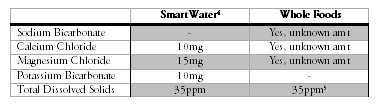
    Chart1

    So in summary, two of the best-tasting brands of bottled water as judged in a blind tasting contained remarkably similar amounts and (probably) ratios of minerals.

    And they’re easy to recreate at home, too. Here are some recipes for water. Ri-diculous? If you think so, you may want to stop this book reading here. It only gets more ridiculous.

    Homemade Electrolyte (Fairy) Water

     1 L Tap Water
    10 g Homemade Electrolyte Concentrate (below)

    Use a reverse osmosis or ZeroWater® filter to produce zero TDS water. Distilled should work too. If in doubt, test your “0 TDS water” with a TDS meter. Add the homemade electrolyte concentrate and shake violently.

    Homemade Electrolyte Concentrate
    1 L Tap Water
    1.50 g Magnesium Chloride
    1.00 g Sodium Bicarbonate
    1.00 g Calcium Chloride

    Use a reverse osmosis or ZeroWater® filter to produce zero TDS water. Com-bine. The mixture will stay cloudy for a while after you add the minerals, though it should clear up in time.

    Notes:
    • Use this concentrate so you don’t have to measure out 10 mg of minerals at a time. That would be annoying.
    • Sodium bicarbonate is nothing more than baking soda. Potassium bicar-bonate can be substituted for people who are sensitive to sodium. Potas-sium bicarbonate is available through beer and wine homebrew stores.
    • Calcium chloride is used both for beer/winemaking and in modernist cooking. Visit retailers who specialize in those ingredients for purchasing options.
    • Magnesium Chloride is available as a dietary supplement. One product I found contained 66.5 mg per 2.5 ml serving, which means you would need 5.7 mL or just over a tsp per liter of water to make Electrolyte Concentrate.
    • Avoid mineral tablets, as these contain binders and anti-caking agents that can affect flavor.


    What Makes Water Taste Good?

     With the exception of magnesium, all of the ions listed in the table above ap-pear in significant amounts in human saliva. However, our saliva’s composition doesn’t at all mirror the ratios presented here. Beyond this simple observation I can only speculate as to why this particular blend of minerals in this concentra-tion tastes especially good.

    One possible explanation may lie in total dissolved solids. I found the following information on a forum post at Home-Barista.com. It quotes the Specialty Coffee Association of America’s (SCAA) Water Quality Handbook:

    The test methodology was blind tasting by six tasters at the SCAA Lab in Long Beach. From page 31:

    “In a tasting conducted by the Technical Standards Committee of the SCAA, coffee was brewed with different levels of TDS to determine if significant flavor differences existed and how much difference actually existed. … The same cof-fee, grind, and brewer were used and the same standard combination of miner-als was used. The only difference was the concentration of the minerals in the brewing water. The first tasting was conducted using three water samples: one contained TDS at a level of 45 mg/L, one at 150 mg/L, and one at 450 mg/L. The coffee that was brewed with 150 mg/L water was chosen as far superior by all who judged the coffee.

    A second tasting was conducted using 125 mg/L, 150 mg/L, and 175 mg/L samples to determine if minor variations in water quality would have an effect on flavor and extraction. The minor changes in the TDS of water were unani-mously discernible by the panel. Acid and body balances were perceived to be off at both 125 mg/L and 175 mg/L TDS, and the 150 mg/L TDS brew was rated superior.”

    So the coffee geeks seem to observe that the level of total dissolved solids is more important than anything else, with no concern as to which solids are actu-ally present. This didn’t make sense to me, so I reached out to a chemical engineer to find out more:

    Joe McDermott on the Taste Chemistry of Water
    Joe is a chemical engineer and a postdoctoral fellow at Harvard University.

    We got in touch because I heard your research area was in water. Tell me about that.

    Sort of—I’m a chemical engineer by trade and my PhD thesis in Chemistry focused on colloidal particles in aqueous systems (the study of tiny stuff dis-persed in liquids). So I know a little bit about water chemistry, but it’s really exciting to be talking about it from the perspective of taste.

    You’ve read through my ideas about making water taste better—what’s your professional opinion?

    What makes water taste good is a really interesting question. From my under-standing of taste receptors, our taste buds are only set up to accept very specific tastes, like sodium chloride for salt or acids for sour.

    I think you’re right that mineral content is important, but I’m not sure why from a taste perspective. My gut instinct is that the cation portion of the min-eral (the positively charged half) has less to do with taste than the anion side. If you look at the periodic table, a lot of the commonly found mineral cations show up really close to each other. There aren’t that many chemical reactions I can think of where Ca+ can’t simply be replaced with Mg+, for example.

    Anions, on the other hand, can vary greatly in structure and complexity. They’re often structured organic molecules. Think about MSG—monosodium glutamate. The anion half is glutamic acid, an important amino acid that serves as a neurotransmitter and has the chemical formula C5H9NO4.

    Why do you think ion concentration is important?

    I work in a world where I need to know how much dissolved ionic material there is in a solution. It matters a lot more than the total dissolve mass because when ions dissolve in water, they change the charge of the water itself, which then changes how particles dispersed in the water behave. In the lab, we deion-ize our water to ensure. But if we get really good deionized water and let it sit out on the counter, it will measure out to 5.6 pH (relatively acidic). That’s be-cause atmospheric CO2 dissolves really readily in water.

    So, does that mean that most water will turn acidic if it’s left out for a long time?

    I haven’t tested this in the lab, but I would think so. In fact, that’s probably one reason why you see sodium bicarbonate (baking soda) or other bicarbonate minerals added to bottle water. Bicarbonates act as a pH buffer—that is, they make it so that it would require more CO2 to dissolve in the water before it actually became acidic. Think of it as insurance for nice-tasting water.

    Here are some rules of thumb for how we perceive acidities found in the normal range for waters.
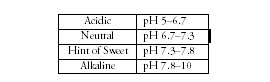
    Chart2

    Resources, Tips, and Tricks
    • You’ll want a digital scale capable of measuring down to 0.01 g (10 mg). Amazon carries many American Weigh models for about $10.
    • My recipe for water is as simple as I could make it and seeks only to make good-tasting water. For many more recipes and resources for reproducing mineral and spring waters with unique taste profiles, see MineralWaters.org, Martin Lersch’s work on mineral water at his blog Khymos, or Darcy O’Neill’s book Fix the Pumps.
    • If you can’t filter your water or create your own magical mineral water, at least let tap water rest for 20 seconds open to air before using. Most tap water is treated with chlorine, but chlorine escapes rapidly into the air, so it’s a good idea to let some of it evaporate off before drinking.
    • Particularly hard water can create unsightly pectin gels or even create a buffering effect that could mess with pH. If in doubt, get a cheap total dis-solved solids meter (about $15 on Amazon) and check your water. When I checked my tap water, it came out to 350 ppm (yikes!).

     

    Craft cocktails at homeBuy Craft Cocktails at Home: Offbeat Techniques, Contemporary Crowd-Pleasers, and Classics Hacked with Science by Kevin Liu on Amazon.com.