Category: whisky

  • Which Whisky Chiller Works Wonders?

    I have a story in the new Fall 2013 issue of Whisky Advocate magazine that's not online. In it I compared a range of devices meant to chill down whisky.

    • Teroforma Whisky Stones [buy]
    • Teroforma Whisky Stones MAX [buy]
    • Balls of Steel [buy]
    • Skybar's Wine Chill Drops [buy]
    • Tilt Spheres [buy]
    • Steel Ice [buy]
    • A glass put in the refrigerator
    • A glass put in the freezer 

    Whisky advocate
    So, which one is best? I guess you'll have to pick up a copy of the magazine to know. 

    If the story goes online, I'll share the link here. 


  • How Different Waters Affect The Flavor of Whisky

    This is some seriously cool stuff!

    A few weeks ago I tasted waters sourced from Scotland's Highlands, Speyside, and Islay regions and noticed how they brought out different flavors in scotch whisky. 

    Bowmore's master blender Rachel Barrie recently performed a similar experiment, though she didn't name the source of the waters. But it turns out they were pretty similar to the waters I tasted, and her results echoed my own. I love not being totally wrong.

    But the truly exciting thing is if we combine the results of her tasting with what I've learned about regional waters of Scotland, we see that the water from certain regions of Scotland, when added to whisky, seems to bring out specific taste qualities in the whisky for which those regions are known.

    In other words, if you dilute a whisky with water from Islay (or in the style of Islay water based on mineral content and pH), it seems to emphasize Islay-ish flavor notes in the whisky, no matter where that whisky is from. 

    Okay, let's get started. First lets see how Barrie's waters compared to the ones I tasted from UisgeSource.


    UisgeSource Water Rachel Barrie's Water
     Highland Water: hard water, high in minerals. 225 parts per million dissolved solids and high in nitrate, calcium, and magnesium. pH around 7.7 (lightly alkaline)  Mineral-rich, with above average concentrations of Calcium and Magnesium minerals, high hardness and an elevated pH of 8.
     Speyside Water: soft water, low in minerals. 125 ppm dissolved solids. pH around 7.8 (lightly alkaline)  Soft water with low conductivity, hardness, minerals and polarity with pH 7.
     Islay Water: higher natural acidity. 183 ppm TDS. pH around 6.3. High in sulphate, potassium, sodium, and chloride.   Acidic water with higher Sodium chloride and Potassium sulphate, lower Calcium and Magnesium and pH 6-7.


    As you can see, the waters we each tasted were pretty similar to each other. The only not-major difference was that the pH of Barrie's low-mineral water was more neutral than the water I tried. So I think it's fair to say that we tasted basically the same style of water. 

    Now lets compare tasting notes, taking into account that Barrie is the Master Blender and the expert at this, while I'm just making stuff up as I go. Barrie noted that she didn't expect the subtle tastes in the water to bring out dramatic tastes in the whisky, but it did. They conducted a blind tasting with equal parts whisky and water. 

    UisgeSource Water- My Tasting Notes Rachel Barrie's Water- Her Tasting Notes with Bowmore 12
     Highland Water: The Highland water brought out honey notes from whiskies.  The mineral-rich water unlocked additional layers of floral, herbal and peaty notes on the nose, and provided a more intense and intriguing textural experience (chalky minerality) on the tongue.
     Speyside Water: The Speyside water made both the Islay and Highland whisky taste sweet.   The soft water brought out more of the sweet honeyed and citrus fruit notes, and delivered a softer, sweeter and smooth rounded taste experience.
     Islay Water: The Islay water brought out the creme brulee and smoke.  The acidic water brought out more peppery peat, iodine and brine with unripe fruits and cereal notes.


    While our notes don't agree entirely, we each found that Speyside water brings out sweetness, while Islay water brings out Islay-specific flavor notes like peat, smoke, iodine, and brine. 

    I've always been skeptical about the bourbon-and-branch concept of pairing a whisky with the water from the same source. In the process of distillation, nearly all of the source water is removed from the spirit, and then it is diluted with purified (usually municipal) water. There is hardly any branch water in a finished whisky, so why bother going through the effort of pairing it? 

    But yet, if we look at the results of the experiment above, Barrie's tasting notes for what the water brings out in the whisky are pretty similar to the generic tasting notes for whiskies from those regions:


    Tasting Notes for Regional Whiskies, from a story I wrote for Imbibe Magazine a few years ago Rachel Barrie's Water- Her Tasting Notes
     Highland Whisky: these whiskies tend to yield a light smoke/peat element and flavors ranging from heathery and spicy to fruity  The mineral-rich water unlocked additional layers of floral, herbal and peaty notes on the nose, and provided a more intense and intriguing textural experience (chalky minerality) on the tongue.
     Speyside Whisky: gentle, elegant and, refined whiskies  The soft water brought out more of the sweet honeyed and citrus fruit notes, and delivered a softer, sweeter and smooth rounded taste experience.
     Islay Whisky: pungent with peat smoke, iodine, and brine flavors  The acidic water brought out more peppery peat, iodine and brine with unripe fruits and cereal notes.


    Isn't that awesome? Turns out there just might be something to all that bourbon-and-branch stuff after all.

    Note that Barrie wasn't trying to gauge the "best" water to pair with Bowmore. She writes, "Which water and Bowmore combination you will prefer is all down to personal taste. If you prefer a sweeter honeyed taste, adding soft water may be preferred. However, if you prefer the drier/briney tastes in Bowmore, a slightly acidic water (such as the water sourced locally on Islay) may be preferred." Read Rachel Barrie's full experiment and thorough tasting notes here.

    This experiment deserves more testing. Here are some projects you and I might try to validate this experiment and take it further:

    • Survey the scotch whisky producers for more information on their waters. As I wrote previously, even distilleries close to each other may have very different water sources. 
    • Try whisky from each region paired with water from each region. In my experiment, I tried both Highland and Islay whisky and found the waters brought out the same notes in each, but it's worth trying all three of these regions. 
    • Try this with waters from the Lowlands of Scotland, and Kentucky and Japan with those whiskies. 
    • Find commercially-available bottled water that has the same or similar properties to the waters from each of these regions. (I'll get on this one right away.) If I can't find them, I may need to make them myself with what I've learned about creating mineral water
    • Then repeat this experiment with those waters to see if it still works. 


    So, yeah, awesome! 

    The water project imageThe Water Project on Alcademics is research into water in spirits and in cocktails, from the streams that feed distilleries to the soda water that dilutes your highball. For all posts in the project, visit the project index page


  • Tasting the Regional Waters of Scotland

    In my search for information about water sources used for various spirits as part of the Water Project, I came across Uisge Source, a company that bottles waters from different regions in Scotland.

    Uisgesource1

    The waters from Speyside, Islay, and the Highlands are meant to be representative of the waters used by distillers in those regions to make scotch; for dilution of drinks in the bourbon-and-branch style.

    As I learned in the book Whisky on the Rocks, even distilleries next to each other may have different water sources, so it shouldn't be assumed that all the distilleries in an area use waters just like these in their whisky, but it seems like a good place to start.

    The really cool thing about Uisge Source that it's not just water they sourced from these regions; they actually tell you about the chemistry of the water. 

    Islay’s Ardilistry Spring produces water with higher natural acidity which is created by filtration through peat.

    St Colman’s Well in the Highland region produces a hard water, high in minerals due to filtration through porous and brittle red sandstone and limestone.

    The Cairngorms Well in the Speyside region produces a soft water, low in minerals as a result of being filtered through hard rock such as granite.

    And they give a chart of each water's properties. I love charts! (Click to make it bigger.)

    Chemistry

    As you can see from the chart, the Highland water is full of minerals including calcium and magnesium. Islay water is high in potassium, chloride, and sodium, and has a lower (more acidic) pH. Speyside water is low in nearly all minerals and has a slightly higher (more basic) pH than the other waters.

    So: How do they taste? Happily, they sent me some to experiment with. 

    Uisge Source Taste Test

    Speyside: Tastes quite dry. I notice this in distilled waters without mineral content, though at 125 ppm dissolved solids this still has a lot more minerals in it than my tap water. There is a granite taste to the water as well – not a creamy soft minerality but a hard one. 

    Highland: I measured the total dissolved solids (TDS) in this one at 225 ppm. It tastes softer in body and sweeter than Speyside. It's also more earthy. 

    Islay: At 183 ppm TDS it is halfway in mineral content between the other two, but this water has the most flavor- it's got a pronounced dirt/earthiness to it but I also taste grainy minerality. 

    Then the natural test would be to try different whiskies with the different waters, so that's what I did. The results were surprising!

    Tasting Uisge Source with Scotch

    I tried a 25-year-old Highland single-malt with each water, and a 10 year-old cask-strength Islay with each. I was surprised to find that each whisky tasted best with its regional water! Maybe I just got lucky – I didn't measure quantities down to drops and such, but I really didn't expect these to align.

    The Speyside water made both the Islay and Highland whisky taste sweet. The Highland water brought out honey notes from whiskies, but it was totally in synch with the flavor profile of the Highland scotch where it wasn't a perfect fit for the Islay. The Islay water brought out the creme brulee and smoke of the Highland scotch which was good but not the typical flavor profile I associate with it, while it did the same for the Islay scotch to great effect. 

    This could all be in my head (and down my throat at this point) but I was surprised at how much these waters with subtle differences brought out pronounced differences in the whisky. Awesome. 


    Looking to buy Uisge Source? Unfortunately it's not in the US yet, though they tell me they're in talks with an importer and I'll share the news when it's available. They have a list of retailers on the site for UK customers and you may find it in duty-free shops in some airports. 

    The water project imageThe Water Project on Alcademics is research into water in spirits and in cocktails, from the streams that feed distilleries to the soda water that dilutes your highball.  For all posts in the project, visit the project index page


  • The Geology of Scotland and the book Scotch on the Rocks

    In my studies of water in spirits and cocktails, I picked up the book Whisky on the Rocks: Origins of the 'Water of Life' by Stephen and Julie Cribb. The book is about the geography of Scotland and how that influences the water sources for scotch whisky. 

    It turns out Scotland's geology is pretty varied between very old (2900 million years) and new (60 million years), with large faults that divide the country into different areas, rift valleys, metamorphosed Dalradian rocks, schists, volcanic islands, and more. I don't know what most of those words mean either.  

    Scotch on the rocks book

    Distilleries in Scotland draw their water from streams, rivers, springs, reservoirs, wells, and other sources. Even within a single distilling city like Dufftown, water comes from several different sources. The water used for scotch whisky seems to be just as varied as the whisky produced there.

    One of the most interesting and useful passages in the book (to me), comes from an early page.

    The primary source of water is rain, but what happens to rainwater before its arrival at the distillery affects its chemistry and thus the uniqueness of the resulting malt whisky. The rain may end up as a stream or river, in a loch or a reservoir, coming from the rock as deep or shallow boreholes, or as a spring high on a hillside. 

    If it falls on bare mountains made of crystalline rocks it will flow rapidly downhill as streams. This water has little chance to interact with the underlying rocks and often has a low mineral content. It will be acid and soft. 

    On the other hand if the strata are more permeable, or have many joints and fractures, the rain will percolate into and through the rock, dissolving it and increasing the water's mineral content. Limestones and sandstones, for example, yield water rich in carbonates or sulphates; such waters will be neutral or slightly alkaline and hard. 

    'Soft water, through peat, over granite' was the traditional and still oft-quoted view of the best water for distilling. Remarkably, out of the 100 or so single malt whiskies, less than 20 use water that fits this description. 

    Though the book covers how geography influences the water sources for scotch and the paths it takes to get to the distilleries, it doesn't really get to deep into how that water then influences the distillation and importantly the taste of scotch, noting that it is just one factor along with peat smoke, still shape, and aging that may influence the final product. But of course, that's a big question that I'm researching in my Water Project.

    Some facts about water sources for whiskies from the book (keeping in mind it was published in 1998 so it may be out of date):

    • Water for Laphroaig is acidic due to quartz mountains and peaty lowlands, but the mineral content in the water is low.
    • At Bunnahabhain on the same island, in contrast, spring water is piped from the hills without passing over peat. The spring from which it is sourced is rich in calcium and magnesium so the water contains more minerals.
    • Bowmore's water takes a long path to the distillery passing through quartites, limestones, sandstones, and through peat.  
    • Tamdhu uses well water beneath the distillery and is the only Speyside whisky using water from the River Spey.

     Those are just a few tidbits from the book, which is only 70 pages but rich with diagrams of the geography of the regions being discussed. It is definitely a geography book rather than a whisky book, and can be a little hard for the novice (me) to parse. That said, I have a feeling that the more I learn about water and its effects on fermentation and distillation, the more I'll refer back to this book. 

    The water project imageThe Water Project on Alcademics is research into water in spirits and in cocktails, from the streams that feed distilleries to the soda water that dilutes your highball. For all posts in the project, visit the project index page

  • I Peated in your Scotch: A Trip to Laphroaig

    In June I took a short trip to Islay, Scotland to see how Laphroaig single-malt scotch whisky is made. Islay is an island off the coast of Scotland known for its smoky, peaty whiskies.
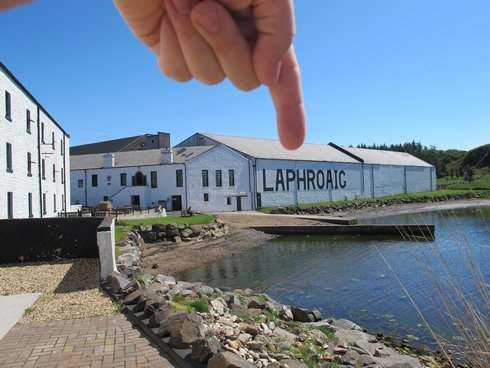
    Pointing Laphroaig Distillery Islay Scotland_tn

    What Laphroaig does differently from other scotch producers, as you'll read, is:

    • Floor maltings
    • Separation of malt flavoring (with peat smoke) and malt drying
    • An uneven number of pot stills
    • Quarter Casks

    Floor Malting

    Laphroaig is one of six scotch makers that floor malts some of its own barley. Floor malting is the historic technique of preparing barley for fermentation. Most of the 100 distilleries in Scotland purchase malted barley from commercial malting plants, and most (all?) of the distilleries that do floor malting also purchase additional malt from commercial malters.

    The other distilleries that malt their own barley are Bowmore and Kilchoman on Islay, Highland Park on Orkney, Springbank in Campbelltown, and The Balvenie in Speyside on the mainland. (Other brands including BenRiach have announced considering it.)

    Malting Floor Laphroaig Distillery Islay Scotland _tn
     In floor malting here at Laphroaig, barley is soaked three times at room temperature (simulating spring rains), then spread out over a floor where it will begin to germinate. During four days in the summer (seven in winter), the malt is turned over with rakes to reduce heat build-up and release Carbon Dioxide that builds up in the piles. Then it is dried to halt germination.

    Laphroaig Distillery Islay Scotland malting barley_tn

    Traditionally, the wet barley was dried over the local fuel source, be that peat (thick blocks of muddy decaying vegetation from bogs, on its way to becoming coal), or actual coal in the case of Highland distillers that had access to coal from the railroads. Now that other sources of energy can be used to blow hot air through the barley to dry it, smoke isn't necessary in the flavor of scotch. From commercial maltings, distillers can specify the level of smokiness they want their malt made.

    Harvesting Peat

    But for distillers with floor maltings who want smoky scotch, that means harvesting the local peat to burn for fuel. We donned Wellington work boots and headed out into the bog.

    The peat for Laphroaig is all harvested by hand. The procedure is to first cut off a top layer of grassy soil that hasn't decayed enough yet and place it on the next row over so it will keep decaying. Then peat is cut in long brick-shaped pieces by pushing down into the muddy peat with a special peat cutting tool, then placing it on the surface grass to dry outdoors.


     Click through the images below to see me harvesting peat.

    • Camper cutting peat Laprhoaig Distillery Islay Scotland3_tn
    • Camper cutting peat Laprhoaig Distillery Islay Scotland_tn
    • Camper cutting peat Laprhoaig Distillery Islay Scotland4_tn
    • Camper cutting peat Laprhoaig Distillery Islay Scotland5_tn
    • Row of peat Laprhoaig Distillery Islay Scotland2_tn
    Row of peat Laprhoaig Distillery Islay Scotland2_tn


    The seaweed and other Islay plant-rich peat harvested here imparts more "peaty" (earthy and medicinal) flavor characteristics to the barley than peat harvested from the mainland (which may be comprised of other vegetation), which imparts more wood smoke flavors.

    After the peat dries outdoors (but before it is too dry, as moist peat gives off lots of the desired smoke), they bring it back to the distillery where it is time to use it to dry the wet barley on the floor of the malting house.

    Dried peat in field Laprhoaig Distillery Islay Scotland2_tn

    I Peated in Your Scotch

    Wet peat is moved into the drying room, which sits a floor above a big boxy fireplace like on a steamship. Down below, peat is shoveled into the fire and the smoke rises to the room above to engulf the wet barley with smoke aroma. I took a turn throwing some peat onto the fire so you could be drinking my handywork in ten or so years.

    Peat fire Laphroaig Distillery Islay Scotland_tn
    Peat fire Laphroaig Distillery Islay Scotland_tn
    Peat fire Laphroaig Distillery Islay Scotland_tn

    Laphroaig is unique in that first they flavor the barley with smoke for 17 hours, and then after that they pump hotter dry air through it for an additional 19 hours to fully dry the barley. Other floor malting distilleries do the flavoring and drying steps together.

    This longer, slower flavoring and drying method changes the flavor profile of the barley, and the finished product – it doesn't just make it smokier. According to Master Distiller John Campbell, when we talk about the phenol profile of a whisky we're talking about 5-7 flavor components. The process of flavoring the barley at Laphroaig particularly brings out 4-ethyl glycol guaiacol and creosole components, present in other whiskies but not to the same extent as in Laphroaig.

    Smoking barley Laphroaig Distillery Islay Scotland_tn

    The malted barley made at the distillery is mixed with malted barley made just down the road at the Port Ellen maltings, along with malted barley from the mainland as well. Now it's time to ferment and distill.

    Fermentation and Distillation

    The water source for Laphroaig is a large reservoir a ways from the distillery, uphill. 

    Water source reservoir Laprhoaig Distillery Islay Scotland_tn

    The dried, malted barley is then ground up and put through the "mashing" process. Hot water is added to the barley and this inspires the enzymes released through the malting process to break the starches into fermentable sugars.

    Next they collect the sugary water and discard the solids, adding yeast to allow the sugar water to ferment over 55 hours into a beer. Then it's ready to be distilled.

    Stills Laphroaig Distillery Islay Scotland2_tn

    At most scotch whisky distilleries, the stills come in pairs. A larger still (wash still) performs the first distillation, and a smaller one (spirit still) paired with it takes on the second distillation.

    Here at Laphroaig, things are weird. There are 3 wash stills and 4 spirit stills. The 3 wash stills are all the same size, but there are 3 small spirit stills and 1 big one with twice the capacity of the small ones.

    One batch of fermented beer fills up 5 wash stills, so what they do is run 3 wash stills to go into 3 small spirit stills, then 2 more wash still runs to go into the one big spirit still. 

    Lynne arms Laphroaig Distillery Islay Scotland_tn

    Campbell says that the large and small spirit stills produce different tasting whiskies, but it's because they run the larger spirit still distillation too fast. (They've been doing it for 40 years that way though, so he's not about to change it.) The big still produces heavier, slightly oilier spirit as opposed to the lighter, sweeter, fruitier spirit that comes off the smaller spirit stills. Regardless, they blend all these together before putting it in barrels.

    Barrel Aging

    The spirit is 136 proof after distillation (68% ABV), but they put it into the barrel at 127 proof, which is common in the industry.

    Warehouse 1 Laphroaig Distillery Islay Scotland_tn

    Nearly all Laphroaig is aged in ex-Maker's Mark barrels. On Islay, they have 8 warehouses holding 50,000 casks. As is now the norm in Islay scotches, they also age some of their stock on the mainland. However, Campbell says that he believes the majority of the whisky used in the single-malt Laphroaig (as opposed to stuff sold to other brands for blending) is aged on the island. He says aging on the island imparts earthier, saltier notes to the whisky.

    The warehouse we visited is four floors tall and is the largest warehouse they use. Campbell says they get great flavor out of the whisky aged in this warehouse, but less color extraction from the wood as in their other warehouses. (The other warehouses are covered with metal and get hotter than the oceanside warehouses with their thick walls.) But putting together the barrels for the final products is the job of the blender.

    Tasting session Laprhoaig Distillery Islay Scotland_tn

     The Range

    10 Year – This is 70% of Laphroaig's single-malt sales. Minimum of 10 years aging in ex-bourbon casks.

    Quarter Cask – After aging 5-11 years in ex-bourbon barrels, a blend is made and then it is further aged in "quarter casks" for 7 months.

    Quarter casks are a quarter the size of a sherry butt, though they are made out of ex-bourbon barrels. They hold 30 gallons as opposed to 55 for bourbon barrels. These smaller casks impart more wood influence into the spirit in a smaller amount of time.

    Triple Wood – This starts with the Quarter Cask liquid, then it is aged for an additional 2 years in ex-oloroso sherry casks.

    I made the point that since quarter casks are actually made out of ex-bourbon casks, this is technically only two woods, not three. Lies! Maybe they should have called it triple barrel instead…

    PX – This is the same product as the Triple Wood (that is actually double wood), except for those additional 2 years it is aged in ex-Pedro Ximenez (PX) sherry barrels instead of oloroso. This bottling is only available at duty-free.

    18 Year Old – A minimum of 18 years in ex-bourbon barrels.

    Cask Strength – This is the 10 Year Old at cask strength. Previously this was a blended product so that each bottle tasted the same (called Original Cask Strength), but now they release this in batches, so it should be a little different with every batch.

    L for Laphroaig Distillery Islay Scotland2_tn

  • Filtration in Spirits: A Primer

    For CLASS Magazine online at DiffordsGuide.com, I wrote an article about filtration in spirits. This was based on the research I did for my talk on the subject at the Manhattan Cocktail Classic earlier this year. 

    Don't Forget the Filtration Factor
    By Camper English 

    Nearly every spirit undergoes some sort of filtration, yet we rarely acknowledge it as part of production. But filtration makes vodka what it is today, practically defines Tennessee whiskey, is the standard in making white rum, and is changing the look of tequila. Filtration is important.

    Generally speaking, filtration refers to the mechanical process of passing a liquid or gas through a medium that keeps out solids of a certain size. But in spirits, we include carbon filtration (sometimes called carbon treatment) as filtration too. Carbon filtration works differently: by absorption, the adhesion of particles to a surface, like flypaper. 

    I researched filtration in spirits for a talk at this year's Manhattan Cocktail Classic. While I can't claim category-wide or hands-on expertise in this matter, I spoke with several industry sources who know their stuff. Consider this an introduction to the subject.

    The article covers filtration in vodka, rum, tequila, whisk(e)y, and cognac. I hope you'll find it interesting. Get the full story here.

    Filtration in Spirits Diffords
    Update: The story came off the site, so here it is in its entirety:


    Filtration in Spirits

    Camper English


    Nearly every spirit undergoes some sort of filtration, yet we rarely acknowledge it as part of production. But filtration makes vodka what it is today, practically defines Tennessee whiskey, is the standard in making white rum, and is changing the look of tequila. Filtration is important.


    Generally speaking, filtration refers to the mechanical process of passing a liquid or gas through a medium that keeps out solids of a certain size. (Think of a screen door.) But in spirits, we include carbon filtration (sometimes called carbon treatment) as filtration too. Carbon filtration works differently: By adsorption, the adhesion of particles to a surface. (Think of flypaper.)


    I researched filtration in spirits for a talk at the Manhattan Cocktail Classic in May 2012. While I can’t claim category-wide or hands-on expertise in this matter, I spoke with several industry sources who know their stuff. Consider this an introduction to the subject.


    Vodka, Charcoal, Tequila, and Rum


    Early vodka was surely very different from the perfectly clear, nearly-neutral spirit we know today. True, distillation was cruder, performed in pot stills rather than in today’s hyper-efficient columns, but filtration helped rid vodka of lots of nastiness. Much early vodka filtration seems to resemble “fining” in wine and beer – a fining agent speeds up precipitation of impurities in the liquid. Fining agents have included egg whites, milk, gelatin, fish bladders, something called “blood powder.” Vodka has also been filtered through sand and other soils (this process is still used in water treatment), felt, and other materials.


    But activated carbon (charcoal) seems to have the largest impact on vodka and other spirits, or at least it is the most commonly used filtration method. In vintage vodka, charcoal derived from trees was used to clean up the liquid, but today charcoal for filtration may come from wood, nut shells (coconut especially), and even bones. (Fun fact: some white table sugar is clarified using bone charcoal, rendering it non-vegetarian.)


    Vodkas today advertise a range of other material to complement the carbon. These include birch charcoal, quartz sand, and algae (Ladoga), Herkimer Diamonds (Crystal Head), freeze filtration, Z-carbon filter, and silver (Stoli Elit), Platinum (Platinka), Gold (Lithuanian), Lava Rock (Hawaiian, Reyka), and marble (Akvinta). Though many of these methods sound like pure marketing, in fact some of these precious materials like platinum and silver do improve filtration efficiency. (For very detailed information on some vodka filtration technologies, this site https://www.vodka-tf.com/ is quite a read.)


    Charcoal filtering is also commonly used in tequila. According to one tequila producer, this is because the law for tequila production (the NOM) specifies amounts of impurities like esters and furfural that may be present in tequila, and these numbers are difficult to consistency hit with distillation alone. Thus, charcoal filtration cleans up the impurities in tequila a little bit – but also removes some flavor with it.


    Charcoal filtration can remove color as well as flavor and impurities. Many ‘white’ rums are aged a year or more in ex-bourbon barrels, and then filtered for clarity. Charcoal filtration (and other new-at-the-time technologies such as aging and column distillation) helped make Bacardi the popular and later global brand of rum that it is today. This lighter, clear style of rum born, in Cuba, is often called the ‘international style’ that won out in popularity over regional production methods.


    All charcoal isn’t created the same, however. Should you take a dark rum and run it through a water filter repeatedly, you may not lose any color. (I tried.) Some parameters that distillers investigate in choosing the right carbon filtration material include the base material (bone, nut charcoal, wood, etc), the “iodine number” and the “molasses number,” the latter a measurement of decolorization. Activated carbon meant for cleaning up water may not be of any use in stripping color from liquids.


    Decolorization has allowed for a new trend in tequila: aged tequila filtered to clarity. Probably the first tequila to do so was Maestro Dobel, a blend of reposado, anejo, and extra-anejo tequila filtered to near-clarity. In recent months, new brands have followed suit, including Casa Dragones (blanco and anejo mixed together and clarified), Milagro Unico (blanco with ‘aged reserves’), and Don Julio 70th Anniversary Anejo Claro (clarified anejo). In the opposite direction, the first tequila that I’ve seen labeled as ‘unfiltered,’ a special cask-strength bottling of Ocho, has also just hit the market.


    Whisky and Cognac


    In both scotch and in bourbon, there is an increasing trend toward unfiltered whiskey, while chill filtration is still very much the norm. Chill filtration prevents cloudiness in spirits (particularly at low temperatures) and precipitation of particulates in the bottle. It is purely an aesthetic choice, not meant to affect the flavor of the spirit. However, many experts argue that it does alter (flatten) the flavor to some extent. (For a very nerdy analysis of chill filtration, we refer you to this information from Bruichladdich https://www.bruichladdich.com/library/bruichladdichs-guide-to-chill-filtration.)


    As far as I have been able to learn, in chill filtration activated carbon is not used. The spirit is chilled to a certain degree, and then a cellulose or other paper filter is used to remove the esters and fatty acids that are less soluble at low temperatures. Whiskies bottled at higher proofs tend not to cloud, so many cask-strength whiskies and many (if not most) whiskies bottled at 46 percent alcohol or higher are non-chill filtered. Outside the bottle, however, when ice or water is added and they dilute, they may get cloudy.


    Tennessee whiskey has its own style of filtration. After the spirit is distilled but before it goes into the barrel for aging, the whiskey is dripped through or soaked in tubs with about ten feet of charcoal made from sugar maple trees. Contrary to popular opinion, this is in no way required by law, but both Jack Daniel’s and George Dickel employ this technique. Gentlemen Jack is unusual in that it undergoes charcoal filtration a second time before bottling.


    One cognac distiller revealed that filtration in cognac is also standard: cognac is run through paper filters of a specific (depending on the product) pore size to filter out undesired molecules. While most cognac is not chill-filtered, one producer said that when bottles are destined for cold-weather countries (cognac is popular in Scandinavia), it is often chill-filtered to prevent cloudiness in the bottle. It might be interesting to taste chill and non-chill filtered versions of the same cognac. The opportunity is rarely, if ever, afforded in scotch.


    So, some form of filtration is used in about every type of spirit, whether that’s to change the color, clean up undesired impurities or clean out off flavors, to prevent cloudiness, or just to keep out chunks of stuff from floating in your bottle. As with the water used in fermentation, the type of still, and the location/condition of aging barrels, filtration is an important part of the process of making spirits and shouldn’t be so often overlooked.

  • Buffalo Trace Distillery Visit

    This spring I visited 8 American whiskey distilleries, including Buffalo Trace. Buffalo Trace is owned by the Sazerac company. They make Buffalo Trace, Blanton's, Elmer T. Lee, Eagle Rare, Van Winkle, and other whiskey brands, plus the make/own/import other spirits including Rain vodka, Puebla Viejo tequila, and Glenfarclass scotch. 

    Unlike most of the other American whiskey distilleries I visited, Buffalo Trace feels like a campus or a mini factory town. Other distilleries have just the central distillery and bottling line, but the aging warehouses are spread further afield. They're closer by at Buffalo Trace.

    Buffalo Trace Distillery4_tn
    Buffalo Trace Distillery4_tn
    Buffalo Trace Distillery4_tn

    The name Buffalo Trace comes from the paths that the buffalo took to this area, where they would cross the river. The distillery is located where several paths intersected. Our guide Freddie said that this site is also probably where the first bourbons were ever shipped down the river to New Orleans in the early days of bourbon. 

    Here at Buffalo Trace, several rickhouses are built of brick on the outside and have many windows, unlike the typical metal-clad warehouses. However, the inside of the brick warehouses are wooden structures that hold the barrels, not connected to the outside framework. 

    Buffalo Trace Distillery7_tn

    Having all of this close together makes for a good tour- you can walk from building to building  (as I did) and see every part of the distilling, aging, and bottling operation. 

    Buffalo Trace launched the first single-barrel bourbon, Blanton's, in 1984. We saw it being bottled. We also saw the vats for chill filtration, which was helpful as I was about to give a talk about filtration in spirits right after my visit. 

    Buffalo Trace Distillery chill filtration_tn

    We were also treated to seeing the bitters room, where they make Peychaud's and Regan's Orange bitters. I got to try those suckers out of the tap! To make them, they add the ingredients to one of 7 little tanks, age them 2 weeks, filter the solids, let them rest a week, and then bottle them. 

      Buffalo Trace Distillery bitters room_tn
    Buffalo Trace Distillery bitters room_tn

    Visiting Buffalo Trace

    Information about visiting the distillery is found at BuffaloTraceDistillery.com. There are regular tours, hard hat tours, tours specializing in the time right after Prohibition, and even a nighttime ghost tour. 

    Buffalo Trace Distillery packing peanut tree2_tn

  • Heaven Hill Distillery Visit

    This spring I visited 8 American whiskey distilleries, including Heaven Hill.

    Heaven Hill Distillery8crop

    Heaven Hill makes whisky brands Evan Williams (the second largest bourbon after Jim Beam), Elijah Craig, Bernheim Wheat Whiskey, Old Fitzgerald, Rittenhouse Rye, and Georgia Moon Corn Whiskey, plus they make and/or own Burnett's vodka, Hypnotiq, Lunazul tequila, and many other brands. They are the only company that makes all of  bourbon, rye, corn whiskey, and wheat whiskey. They have nearly 1 million barrels in storage. 

    Though the visitors' center and many rickhouses are here, the distillery is elsewhere – the distillery and many warehouses burned down in a major fire in 1996. After the fire they purchased the Bernheim distillery in Louisville to do the distillation, along with some rickhouses there. 

    Heaven Hill Distillery visitors center_tn

    For three generations, master distillers at Heaven Hill have been descendants of Jim Beam. 

    Heaven Hill Distillery beam family tree_tn

    We visited one of the warehouses – actually the rickhouse in which several "whisky of the year"s have aged. It is seven floors tall and we walked to the top for the view. Most of those "best whiskies" were aged on the top floor here.

    Heaven Hill Distillery rickhouse_tn

    Our guide pointed out where the distillery was that burned down. 

    Heaven Hill Distillery view from rickhouse_tn

    For all their bourbons, they use a single mashbill. (They didn't give out the specific numbers but said it's about 70% corn and 10% each rye and malted barley. Update: see the comments for specifics.) Between all the brands, age and proof are the only differences; not the recipe. When they distill a spirit and put it into a barrel, it's not designated to be a specific brand – they pull barrels as needed to make specific flavor profiles of their products. 

    Heaven Hill Distillery2_tn

    Visiting Heaven Hill

    The Bourbon Heritage Center opened in 2004, and still looks shiny and new. Inside, you get the typical displays of bourbon history and the history of the company, plus there is a cool round bar tasting room inside.  

    There are several tours available – mini tour inside the visitors' center, an 1.5 hour tour that visits a rickhouse as I did, a trolley tour around downtown Bardstown, and a 3 hour "Behind the Scenes" tour. More information about visiting Heaven Hill is here.


  • Maker’s Mark Distillery Visit 2012

    This spring I visited the Maker's Mark distillery, along with seven other American whiskey distilleries in Kentucky and Tennessee. I had previously been to Maker's Mark and wrote about my visit here. As you'll read, I learned a lot of different stuff on this trip. 

    Makers Mark Distillery8_tn

     Maker's Mark uses a mashbill of 70% corn, 16% soft red winter wheat, and 14% malted barley. Bourbon must be a minimum of 51% corn but 70+ is normal. Malted barley is always used to aid in fermentation, and the remaining percent is usually made of up rye or wheat, more often rye. 

    At Maker's they prepare the grains a little differently than at other distilleries. They use a roller mill to crunch up the grains, rather than a hammer mill. This cracks the husk of the wheat but leaves it intact. The husks do go into the boiler with the other grains, but they boil it at a relatively low temperature so it won't break down and become available to the yeast for fermentation. They also cook their grains (to prepare them for fermentation) in an open-topped cookers, rather than pressure cooking them. 

    The grains are then fermented with yeast for three days. 

    Makers Mark Distillery fermenting grains_tn

    The fermented grains are then distilled, up to 120 proof in the column still, and then up to 130 in the doubler. We smelled the two distillates: The first was very oily and minerally. After the second distillation it smelled fruity and light, like a typical white dog. 

    Makers Mark Distillery column still_tn

    They put the new spirit into barrels at 110 proof. Most of the warehouses for Maker's Mark at six storeys tall. They are the only bourbon distillery that rotates all of their barrels throughout the aging process. Barrels are first racked on the top floors, then moved after two years and then moved lower again after another two. 

    Makers Mark Distillery Rob Samuels_tn

    Maker's 46, a new bourbon from Maker's Mark, begins as the same distillate, aged for the same amount of time. It is then aged an additional 8-11 weeks in barrels with 10 seared French oak staves in the barrels. They do this only in the winter, as that way the liquid sucks flavor out of the staves rather than sucking liquid into the wood of the staves as it would do in the hotter months of summer. I think the final product tastes like wood-spiced Maker's Mark- pretty tasty. 

    Visiting Maker's Mark

    Free tours are available. Check the Maker's Mark website for more information. 

  • Woodford Reserve Distillery Visit

    This spring I visited eight American whiskey distilleries, including Woodford Reserve. 

    Woodford Reserve Distillery building_tn

    Woodford Reserve's distillery is in a charming setting, nestled down next to a stream in a little valley. The distillery is in a grey stone building dating to 1838, though everything inside it is new. Like most American whiskey distilleries, it changed names and owners many times over the years, changing to the Woodford Reserve distillery in 2004.

    Woodford Reserve grounds3_tn
    Woodford Reserve grounds3_tn

    Woodford Reserve is made from a mashbill of 72% corn, 18% rye, and 10% malted barley. They use limestone-filtered well water to ferment the grains in Cyprus wood fermentation vats. They ferment for six days – quite a long time. The fermenting grains taste very sour, kind of like sour green beer. 

    Woodford Reserve Distillery fermenter2_tn

    The sour mash process is where you take leftover grains that have been fermented back into the new batch of grains that are going to be fermented. Here at Woodford Reserve, they "sour in the cook" as opposed to souring in the fermenter. That means they add the last batch's spent grains to the new grains when it is being cooked, previous to when yeast is added for fermentation. Sour mash is known for keeping consistency between batches, but also it is acidic and helps reduce bacteria in the new batch.

    Woodford Reserve is unique in that they make a portion of their whiskey in pot stills. The stills look much as they do in Scotland, but here there are three of them. In Scotland, after the grains have fermented they separate out the grain solids from the sugary beer and only distill the liquids. In bourbon, solids and liquids are put together into the column still. So at Woodford Reserve, they put solids and liquids into the first pot still and distill it only up to 20 percent alcohol. For the most part they are just separating out the solids in this step, taking care not to burn them into the inside of the still.

    Woodford Reserve Distillery 3 stills_tn

    The second and third distillations bring the alcohol up to 55 percent and 78 percent (this is just under the legal limit of 80 percent maximum distillation percent for bourbon), and then it is put into barrels. The spirit goes into the barrels at 55 percent alcohol. 

    The rickhouses for the aging spirits are heated for Woodford Reserve. They put a temperature sensor in a barrel on the ground level. When it reaches 60 degrees Fahrenheit, they heat the warehouse until the spirit reaches 85 degrees and then turn off the heat. This makes for faster cycles of the spirit moving in and out of the barrel wood. 

    Woodford Reserve Distillery rickhouse3_tn

    Woodford Reserve is aged for an average of 7.3 years, and when they take it out of the barrel, they've lost about 50% of the whiskey to evaporation. 

    After aging, the pot distilled spirit is blended with column distilled spirit (distilled elsewhere) to make the final bottling blend. They do not say at which ratio these two spirits are blended for the bottle (and they didn't mention the column spirit at all until it came up in conversation), but say that it changes depending on flavor.  

    Woodford Reserve Distillery barrel_tn
    Woodford Reserve Distillery barrel_tn

    Visiting Woodford Reserve

    Tours of the Woodford Reserve distillery cost $7. It is the most visited distillery on the Kentucky Bourbon Trail, despite the fact that they only sell 165,000 cases of bourbon annually- a tiny fraction of what Jim Beam sells. For more information, visit the Woodford Reserve website.

    Woodford Reserve grounds4_tn
    Camper at Woodford Reserve Distillery_tn