Category: science

  • Science on How Spirits Change or Age in the Bottle, Rather than the Barrel

    At Tales of the Cocktail, I attended a seminar led by Ian McLaren and three scientists, all from Bacardi. It was called Genie in a Bottle: How Spirits Age. 

    Being part of a gargantuan spirits company they were able to call upon the science that had been done in the past and specifically for this seminar about how spirits change in the bottle. I think there is a general acceptance that in opened bottles stored for many years, spirits get a little bit flatter in flavor. In this seminar they took it way further than that. 

    The most important information is on this slide: 

    IMG_4113

    Here are a lot of notes:

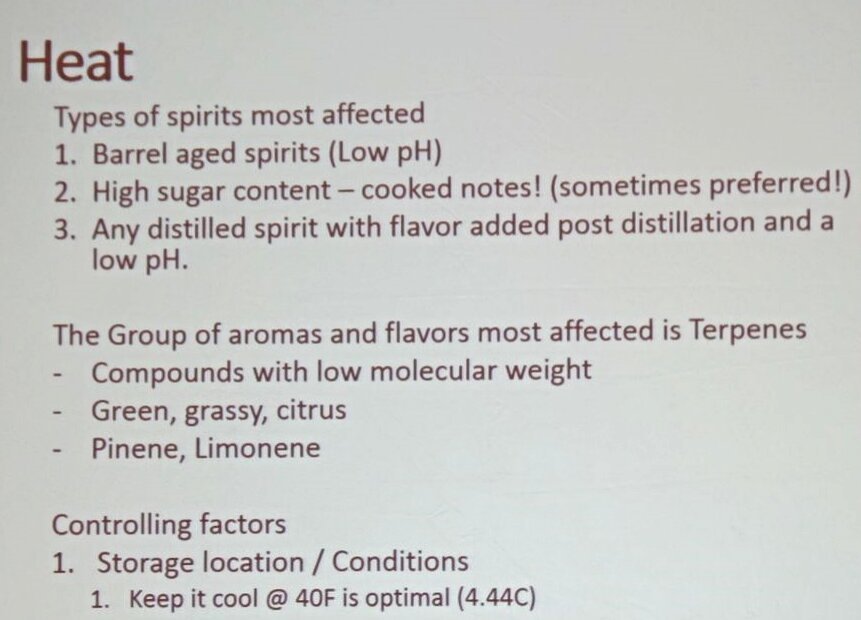
    • IMG_4106Temperature: They found that for heat, degradation really occurs at 100 degrees Fahrenheit (37.8C). They tracked the temperature of bottles as they were shipped around the world to see if they ever reached that in the process of getting from the distillery to the store, and found that when it happened, which was unusual, it was in the process of getting from the truck to the boat – on the docks- so they put in place some systems to prevent that for their most temperature-sensitive products. 
    • Heat accelerates aging processes including oxidation, evaporation, adds cooked fruit notes to high sugar content liqueurs, affects the flavor of flavored spirits with low pH, so that's particularly citrus flavors.
    • 40F (4.44C) is the optimal temperature at which to store spirits
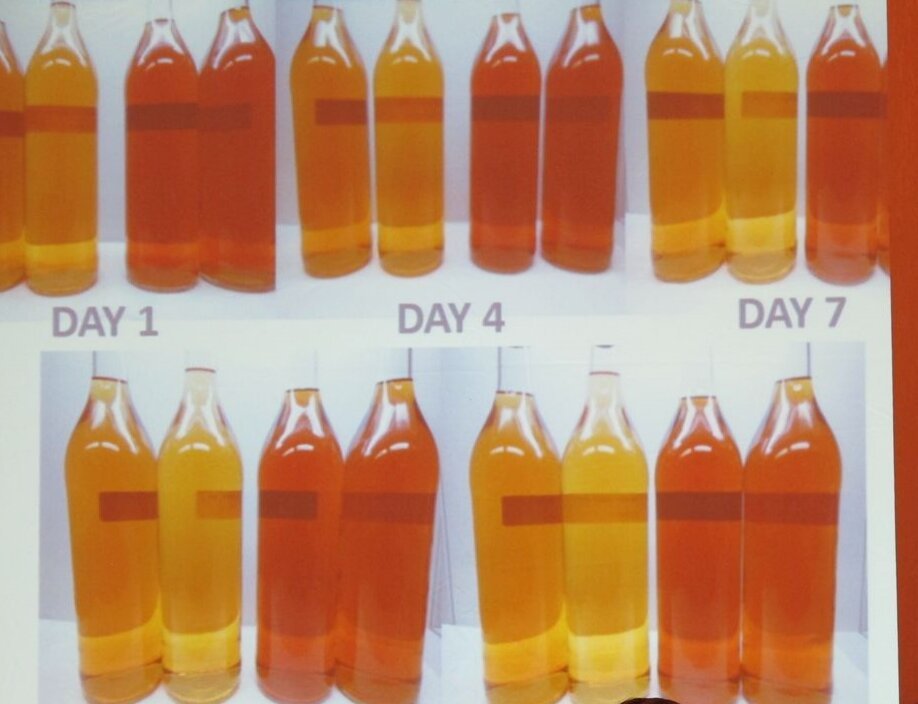
    • IMG_4107Light impacts spirits too, not just by adding heat. Aged spirits like bourbon and scotch can lose a significant amount of their color (which impacts our perception of their flavor). 
    • Light effects are impacted by bottle color (amber will have the least impact), bottles with more glass exposed (so Angostura bitters with its oversized label would be less impacted than a clear, printed bottle), the type of light source (direct sunlight, LED, fluorescent light) though it's not an easy determination of which is the worst (sunlight is really bad though) because it's the combination of the light's frequency and wavelength, and proximity to the light source.
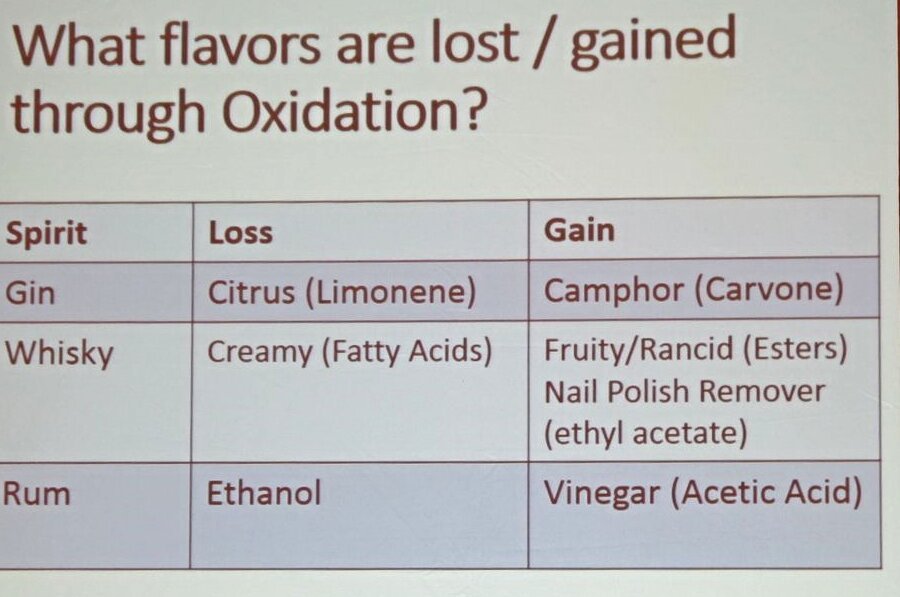
    • IMG_4109Oxidation changes flavor: Acetaldehyde from oxidation reaction can be good in small quantities – adds fruity aromas; but in larger quantities it transforms in acetic acid (vinegar). Gin loses citrus flavor and gains "moth balls" flavor. Whisky loses its creamy fatty acids, gains fruity but then rancid and nail polish remover flavors. Rum gains vinegar aromas. 
    • Oxidation happens not just with heat and light, but also headspace in the bottle (the St. Germain bottle was cited as one particularly badly designed as you get a lot of headspace as soon as you open it), how frequently you open it (as that changes the equilibrium in the bottle- each time the air above the liquid gets exchange with fresh air), the type of closure (corks allow oxidation; screw caps less); and pour spouts can have an effect even if you cap your bottles at the end of the night. 
    • So to reduce oxidation you should keep precious liquids in small brown bottles with screw caps rather than 1/3 empty bottles with corks.

    That was just a fraction of what was shown at the seminar, but I hope it's helpful.

    I cringe every time I see the back bar against the windows (in San Francisco I always think that when I see  Zuni Cafe, Absinthe, my local liquor store's wine selection, and the new Black Sands, but at least it doesn't usually get that hot in SF), but hopefully they move through product quickly so that the effects are not as dramatic.

    McLaren showed a lot of slides of brightly-lit LED and fluorescent-lit back bars, with particularly bad ones being when the spirits sit on a light box as that adds heat as well. 

    So maybe all those candlelit, brick-walled speakeasy-style back bars aren't so bad after all.


  • Carbonation Fun Facts Explained with a New Carbonation Device, Plus Bonus Math!

    I was sent a sample of a new carbonation device called the Bonne O, and in trying it out I had a lot of questions about how it worked. That lead me to learn a bunch of new (or needing repetition) facts about it.

    The Bonne O carbonator is different from a Soda Stream carbonator in two fundamental ways:

    • Instead of a CO2 tank, it takes tablets that work like giant Alka-Seltzer tablets to create CO2
    • You can carbonate more than just water. With Soda Stream (at least the current models), you carbonate only water and then add syrup to it to make soda. With this device you can add other ingredients into the carbonating chamber.

    Bonne-O-home-carbonation-system

    Img_4621_grande


    But I was confused as to how specifically it works. You add  most of the liquid and any solid ingredients to the bottle that will be carbonated, then on the base of the machine the fizzing tablet to one chamber, and the sweetening/flavoring syrup to a separate chamber. That last part particularly confused me. 


    Bonne o diagram
    Bonne o diagram


    So I emailed with Bonne O inventor Darren Hatherell. He explained to me (and also did a good job of it on this blog post, from where I stole most of these images), and now I'll explain to you.

    The Stuff You're Carbonating Must Be Cold, But the Chemical Reaction Should be Warm

    For maximum carbonation, you must have cold liquids, as cold liquids hold more carbon dioxide in solution. However, the particular acid-base Alka-Seltzer-style fizzing reaction in the Bonne O works best when the liquid added to the fizzing tablet is warm. (To verify this, try adding Alka-Seltzer to warm vs cold water and see how much longer it takes to fizz.) 

    They way they got around needing both cold and warm liquid is: The device takes the temperature of the liquids in the bottle (it sucks some into the machine from the top), and if it's too warm for effective carbonation, it just beeps at you and won't even try to carbonate. If it's nice and cold, however, it sucks in that liquid and heats it to an ideal temperature before sucking it into the carbonation chamber with the fizzing tablet. 

    This warm liquid (and dissolved tablet) doesn't go back into the bottle. It stays in the chamber and you dump it out at the end. Keep reading for how and why…


    Sugar Makes Foam And That's Bad

    The main reason you don't put syrup flavors into the Soda Stream is that when you carbonate syrupy water, it foams up and out of the bottle, then will clog up the gas system, perhaps only to explode later. Sugary things make foam.

    The Bonne O gets around this by holding the syrup in a separate flavor chamber (you can add flavors to the bottle, including solid ingredients like strawberries, but the stuff in the bottle ideally shouldn't be super sugary).

    When you hit the button to turn it on, the Bonne O sucks in liquids from the top of the bottle into the carbonation chamber where it fizzes and creates CO2 gas, and pushes out the syrup or other liquid from the flavor chamber (along with the newly-created CO2 gas) into the bottom of the bottle. So the space in the bottle from the stuff that was sucked out is replaced with the syrup or other stuff from the flavor chamber. Thus the flavor chamber always has to be full, even when you're not flavoring your liquid.

    So if you're just carbonating water, you add cold water to the bottle and water to the flavor chamber. (Same if you're carbonating a bottle of tequila, which I did live at Tales of the Cocktail – you put tequila in both the bottle and the flavor chamber.)  

    If you're carbonating a soda or cocktail like a Gin & Tonic using tonic syrup, you add the gin and water to the bottle and the tonic syrup to the flavor chamber. If you were going to carbonate a cocktail with a liqueur like a Margarita, you might want to put the liqueur into the flavor chamber instead of mixing up the full cocktail first. I haven't experimented with adding something syrupy to the bottle to see what happens. 

    The Downside To Both

    The downside to a Soda Stream is that you ultimately add carbonated water to syrup, which will reduce its overall carbonation. 

    The downside to the "keep the syrup separate" model of the Bonne O is that if you're a perfectionist you have to do some math to get your cocktail right: Some of the liquid in the bottle will be sucked out and discarded to be replaced by the syrup, so you have to control for the change in volume.

    The bottle holds 750ml

    The flavor chamber holds 142 ml

    Thus, you need 142 ml extra un-sweetened liquid that will be discarded from the bottle. 

    Let's Do Math!

    For example, if you used Strong Tonic syrup to make a carbonated G&T, the brand recommends 1 part syrup to 2 parts gin to 4 parts water. For the final 750 ml that you will make, that means each "part" is 1/7th of 750 ml:

    107 ml syrup 
    214 ml gin
    428 ml water

    But not all of that goes into the bottle- remember the syrup goes into the flavor chamber. The flavor chamber holds 142 mls, so you can add the full 107 ml of syrup to it, and then top it off gin and water. But how much? We need 35 ml total of non-syrup to get to our 142 ml.

    So the total of non-syrup (that's the gin and water combination) will be 750ml (that's what fits in the bottle) + 35ml extra for the flavor chamber = 785 ml of gin/water.  

    So 785 ml of gin/water in a proper 1:2 ratio is:
    262 ml gin
    524 ml water

    Checking our math on actual quantities used in final drink:

    Flavor Chamber: 107 ml syrup + 35 ml gin/water in 2:1 combo (12 ml gin and 24 ml water)
    Bottle: 750 ml gin/water in 2:1 combo (250 ml gin and 500 ml water)

    But remember that 142 ml of the bottle is discarded. 750 – 142 = 608 ml gin/water combo will actually go into the drink, plus everything in the flavor chamber, which makes our total of each ingredient: 

    Syrup: 107 ml 

    Gin from flavor chamber = 1/3 (35ml) = 12 ml  
    Gin from bottle = 1/3 x (750-142 = 608) = 203 ml
    Gin total = 215

    Water from flavor chamber = 2/3 (35ml) = 24 ml  
    Water from bottle = 2/3 x (750-142 = 608) = 405 ml
    Water total = 429 ml water

    So our final recipe is:

    Mix 262 ml gin and 524 ml water and make sure the combo is very cold. Fill Bonne O bottle to top with this combination. 

    Add: 107 ml Strong tonic syrup to flavor chamber plus rest of gin/water combo (35ml) to flavor chamber. 

    Add carbonating tablet to carbonation chamber and press the button to carbonate the liquid.


    Science is fun!  


  • Cocktail Citratres: What, Why, and Where?

    CitratesAt the Tales of the Cocktail convention, I attended a seminar hosted by Ira Koplowitz and Nick Kosevich of Bittercube Bitters called On Creating Cocktail Citrates & Elixirs. 

    The seminar lead up to the point that if you want to make lasting kegged (and often carbonated) cocktails, you might need to use citrates. 

    One of the presenters smartly called kegged cocktails "the new punch," and interestingly, like vintage punch, citrates start with oleo saccharum then add some science.  

    Citrates are an approximation of sour mix: sugar and citrus combined, but in a form that is predictable, reproducible, and stable. They start with an oleo saccharum (citrus peels and sugar), then add other acids and mouthfeel agents. 

    This is important, they say, because citrus changes dramatically after being juiced/cut (BRIX level falls, pH rises, organic compounds change and degrade) especially after 24 hours. They also noted that for carbonated cocktails, citrates reduce nucleation points that interfere with good carbonation. 

    So the goal of a citrate is to replace or reduce citrus and syrup in a cocktail. They noted that citrates are not identical to sour mix – if you just match the BRIX and pH level, you won't get to where you need to be. And you can't just use citric acid either. 

    Citrates Are Composed Of:

    • Water
    • Sugar
    • Mouthfeel agents (tapioca starch can be used; also pulp)
    • Natural oils
    • Acids (this is their basic formula)
      • Citric acid 95%
      • Sodium citrate 1% (gives a bit of salty mouthfeel)
      • Malic acid 4% (gives sourness)

    Elixirs, by their definition, are compound flavor citrates plus water. 

    You can read more about them in this PDF document on the Bittercube website. It gives a good overview of the what and why of citrates and elixirs. It also includes recipes for several citrates, elixirs, and a kegged cocktail.

    Many bars that use citrus in their kegged cocktails use a citrate by some form (and often by another name), so you might have unknowingly tried one already.

    For more reading on the topic, check out Dave Arnold's book Liquid Intelligence


  • A Few Notes About Cocktail Pharmacology

    LarrianaddictionDuring the Golden State of Cocktails in Los Angeles earlier this year, I attended a talk called The Pharmacology Behind Creating Flavor-Addicting Cocktails. It was given by Larrian Gillespie, MD, who also runs the site AddictionMixology. On the site she sells science-enhanced cocktail ingredients and equipment like ultra-sonic infusers and insta-foam for cocktails. 

    She covered a ton of incredibly interesting material in a short amount of time, so below are just a few notes that I jotted down. I'd highly recommend attending her seminars if you see them pop up in your area. You can sign up for the mailing list on the site to hear about upcoming seminars.

    • Supertasters are not as sensitive to umami and salt. They are sensitive to items in the nightshade family like eggplant, chili, potatoes, and tomatoes.
    • I've tried those supertaster strips previously and only came in at a high normal taster, but this time we tried other strips that test for the dominant and recessive genes and I registered as a supertaster on both of them. 
    • In the last 5 years science has shown we have taste receptors all over our body, not just on the tongue, with all of them tasting the environment in some way. Creepy.
    • Umami signals nourishment to the brain. Breast milk is very high in umami.
    • Flavor pairing, on a molecular level, allows you to increase the effect of flavors when put together. Mushrooms have no connections to any other flavor, while meat and potatoes share around 170 connections. She has a flavor pairing database launching this summer called The Cocktail Matrix. She told me via email, "Unlike any other database, this one has a living matrix that shows you the precise chemical elements that are matched in a Negroni….or any drink you compose…and it will also allow you to play Mr Potato head and swap out an ingredient for another flavor comparable profile….all the while keeping the ABV intact and the ratios."
    • 87% of Bitters comply with Lipinski's Rule of Five, which has something to do with drug development.
    • Customers will pay 30% more for pretty drinks than regular ones.
    • Sound makes you less sensitive to taste, except for umami. (So maybe when the music is too loud in the bar customers taste less. But on the other hand, we know that loud music makes people drink more so perhaps it evens out the effect…)

    Addiction


  • Dunder and Dragons: Making Rum at Lost Spirits Distillery

    Lost Spirits Distillery in Monterey County, California, is a kooky little place, resembling more a back yard miniature golf course than a typical distillery. Most of the equipment is outdoors, including the pot still that's shaped like a dragon, miniature grain-smoking pagoda, and the above-ground pool that serves as the cooling water for the condenser. 

    IMG_1469

    The distillery is run by Bryan Davis and Joanne Haruta. You may remember them from several years back when they ran a distillery in Spain that produced Obsello absinthe and Port of Barcelona gin. Davis is a former art teacher and zoo exhibit designer but he has picked up more than a little bit of chemistry as we'll soon see.

    So, that dragon-shaped pot still: It's powered by an old apartment building steam boiler for heat. The body of the still (300 gallons) looks like a big barbecue grill but it's made out of roofing copper. The shape was built in a way to minimize removing flavors, rather than rectifying much like tall round pot stills. Davis says, "We engineer the fermentation so much that we want to capture more of the flavor in distillation."

    IMG_1424
    IMG_1424

    The dragon tail is the lynne arm, which dips into a horizontal condenser. The water for the condenser comes from the bottom of a swimming pool, which heats up over the day of distilling, sometimes reaching 100 degrees Fahrenheit.

    With their old still, which was built out of wood, they would hop in the warm pool at the end of the day and use it as a hot tub. But chlorine and wood doesn't mix – the still actually got corked and they had to replace it. (For those of you barrel-aging cocktails, never rinse your barrels with chlorinated tap water for this reason.)

    Davis would like you to know that the pool water does not actually go into the whiskey; it stays in the pipes for cooling purposes only. 

    The dragon's head is a steam release, so while distilling steam shoots out its mouth. 

      IMG_1467
    IMG_1467

    Making Rum at Lost Spirits

    At this distillery they make whiskey and rum. The whiskey I wrote about for Whisky Advocate and I'll try to publish some more info here when the story comes out. 

    We watched an incredibly scientific Powerpoint presentation about the rum called, "Engineering Rum: The Fruit Nature Forgot to Make." I'll cover what I think I learned from it. 

    There will probably be some mistakes in the below text, so please don't take it as gospel but as starter info for further exploration. 

    • The goal, in part, as Lost Spirits, is to make high-ester rum 
    • A given rum may have up to 300 unique esters
    • Simple phenol smell is that familiar Band-Aid smell, but phenols as a group are a category
    • To make a high-ester rum, you need to make acids
    • Phenolic acids come from when we burn things. (In scotch whisky we're always talking about the phenol content of smoky whiskies.)
    • Lignin in sugar cane contains phenols you release by heating
    • For their rum, they want to start with a molasses that has high phenolics; has low anisoles (anise flavors); and is free of sulfur compounds. They use Grade-A molasses particularly for the latter reason. 

    Dunder

    • Rum nerds have heard about dunder pits- pits of decaying vegetation (and sometimes things like a rotting goat head) in wood-lined pits, found in old distilleries particularly on Jamaica. 
    • These pits acts as a bacteria starter. To these pits distillers in the olden days added stillage from distillation (the leftover stuff from distilling).
    • Then the dunder pit contents would be added to fermenting molasses to increase the esters in the rum distilled from it. 

    At Lost Spirits, they imitate the dunder pit process in a more… clean way. They mash up bananas and add lab-controlled bacteria to it. Then they add this to the fermenting molasses.  

    In the process of fermentation, there is a battle of yeast versus bacteria. The byproduct of yeast's battle against bacteria is acetic acid and trace carboxylic acid. Yeast under stress bind acids to alcohol and make esters. They accomplish this stress by adding dunder to yeast.

    As the goal is to get funky, stanky (high-esther, high-acid) rum out of the still, their still is a low-rectification model (short and squat). This will allow more of these compounds to pass over in distillation.  

    Aging Rum at Lost Spirits

    RumOne flavor they want to get out of their rum is a honey flavor, which is phenol-ethyl acetate. This comes from ethyl acetate (ester) plus phenol. And the ethyl acetate comes from from acetic acid (that comes from wood, yeast, and bacteria), wood as a catalyst, and ethanol. 

    Got that? Yeah me neither but sorta. 

    To age their rum they use new American oak barrels, smoked and charred to release lots more esters. These barrels are then seasoned with sherry. 

    Another flavor they want to crank up in their rum in rancio, a flavor found in old cognac and other spirits but that usually doesn't turn up until about 30 years of aging. However, Davis notes that it shows up earlier in solera-aged spirits, which are aged in super old barrels.

    Rancio comes from lignin (from long-aged wood barrels) decomposing in liquid. So they have figured out a way to copy this process and are patenting it. So all I know is what they're doing; not how. 

    Rums Coming Out of the Distillery

    Rums coming out of the distillery come in small batches and include Navy-style rum, Cuban-style rum, Colonial American-style rum, and Polynesian-style rum. I'm not sure what the difference is between the various styles, but they're all high-proof.

    I believe that the navy-style rum is the easiest to find. Some of it comes in at a whopping 68% and retails for about $45, which is an absurd bargain. 

    Science is delicious! 


  • Enzymes in Spirits: What Are They and What Do They Do?

    In the process of making many types of alcohol enzymes are used, but I didn't know very much about them. So I decided to do some reading and share what I've learned. Or what I think I've learned anyway. 

    Enzymes are used in spirits production before fermentation. They are used to expose fermentable sugars in base ingredients so that they can be fermented by yeast. For example, a raw potato with yeast added to it won't produce potato beer (or not much of it). But when heated and with enzymes added then it will.

    Let's review spirits production:

    1. The base ingredient is prepared for fermentation. This can be as simple as crushing a grape or stalk of sugar cane, but many other raw ingredients must be prepared by methods such as malting (barley), baking (agave), heating in water (many things, called 'mashing' in whisky), and/or adding enzymes. 
    2. The ingredient now has its fermentable sugars exposed, so yeast can do its job and convert these sugars into alcohol.
    3. The result is a beer/wine with a low percentage of alcohol.
    4. The beer/wine is concentrated through distillation. 

    What Are Enzymes?

    • Catalysts that perform and speed up chemical reactions. They are present in biological cells. They do a lot of work in nature.
    • They convert molecules into other molecules. An example of this is the enzyme lactase, which breaks a lactose down into two glucose molecules. People who are lactose-intolerant do not produce the enzyme lactase so they can't process lactose. 
    • Enzymes aren't fuel for reactions – they're not consumed by the reaction they catalyze.
    • Enzyme activity can be affected by environmental things like temperature, pH, and pressure. (For most fermentable materials, the mash of hot water and raw material is heated to very specific temperatures so that the enzymes will work.)
    Enzyme2

    The enzymes are B,C,and D in this illustration. The material A is broken up. Source.

    Common Uses for Enzymes

    Some easy-to-understand cases where enzymes are used:

    • In meat tenderizers that break down proteins into smaller proteins, making it easier to chew.
    • In stain removers to break down fats or proteins on clothing. 
    • In digestion. From Wikipedia, "An important function of enzymes is in the digestive systems of animals. Enzymes break down large molecules (starch or proteins) into smaller ones, so they can be absorbed by the intestines. Starch molecules, for example, are too large to be absorbed from the intestine, but enzymes hydrolyze the starch chains into smaller molecules, which can then be absorbed."

    Enzymes in Beer Production

    The website HomeBrewTalk.com has a great, detailed chapter on enzymes in fermentation. They lay out how grains for beer are often mashed (heated with water) to two different temperatures.

    Mashing is the process in which the milled grain is mixed with water. This activates enzymes that were already present in the barley seed or have been formed during the malting process. These enzymes work best in particular temperature and pH ranges. By varying the temperature of the mash, the brewer has control over the enzyme activity.

    In barley starch makes up 63% – 65% of the dry weight. Starch is a polysaccharide (very large chains of glucose) which is insoluble in water. Brewer's yeast, however, can only ferment monosaccharides (glucose, fructose), disaccharides (maltose, sucrose) and trisaccharides (matotriose).

    In order for that starch to be converted into water soluble sugars (fermentable and unfermentable), two processes need to happen. First the starch is gelatenized to become water soluble. For starch found in barley and malt this happens above 140ºF (60ºC).  Secondly the activity of the amylase enzymes break the long chained starch molecules into shorter chains.


    Enzymes in Scotch Whiskey

    The malting process in scotch whiskey is a process to expose enzymes. To make malted barley, the dried grains are soaked in water so that the seeds just start to sprout, then the grain is dried to halt the process. Then when the grain is later mashed (has hot water added to it), the enzymes will convert the starches in the grains into fermentable sugars.

    According to Ian Wisniewski in Michael Jackson's Whiskey,

    "Growth hormones released by the grain also trigger the creation and release of enzymes that begin breaking down the cell walls and protein layers, in order to access the starch… The enzymes collectively termed 'diastase,' include alpha-amylase and beta-amylase (the latter is already present in barley). These enzymes are essential for the subsequent conversion of starch into fermentable sugars during the subsequent process of mashing."

    Enzymes Used in Many Spirits

    In other spirits, enzymes are added, which saves the malting step or speeds the natural reaction with enzymes naturally present. This is true in bourbon (from corn), in other spirits from grain (like vodka), and for potato vodka.   

    Most bourbon mashbills (recipes) contain a certain portion of malted barley. This is because the malted barley provides the rest of the batch with enzymes needed to break down the material into simpler sugars. However, in modern times many (if not all) major bourbon producers also add enzymes to the corn, wheat/rye, and malted barley mashbill to speed things up. 

    A good overview of the chemistry of this and list of enzymes available for purchase can be found on this IM biotech company site


    A Word on Karlsson's Vodka 

    KarlssonsBottleI'm doing a research project on potatoes for Karlsson's Vodka, which I visited a few years ago. 

    From the few potato vodka distilleries that I have visited, it seems that adding enzymes is standard in the process of preparing potatoes for fermentation. So I used this project as an excuse to learn more about enzymes.

    If you think about a raw vs. cooked potatoes, they get a bit sweeter after you cook them so we can guess that heat helps break down the starch into sugars- at least partially. Enzymes help with the rest.

    Karlsson's uses "virgin new potatoes" to produce their vodka. These are very small, skinless potatoes that are full of flavor that translates into the final spirit.  


  • My First Centrifuge, and Somewhat-Clarified Tonic Syrup

    I have had a centrifuge sitting on my Amazon.com wish list for a couple years, just waiting for me to get tipsy and reckless enough to hit the one-click button. Well, I finally bought it last week not because I was wet with sauce but because I could no longer contain my curiousity.

    Plus, I had just finished reading the preview copy of Dave Arnold's forthcoming book and wanted to play with some of the techniques. (I'll post a full book review later.)

    The centrifuge I bought is one recommended by Arnold for experiments and travel, the Ample Scientific Champion E-33 centrifuge. The thing is about the size and shape of a rice cooker. It's adorable!


    • Centrifuge2
    • Centrifuge1
    • Centrifuge dial
    • Centrifuge tubes
    Centrifuge tubes


    Note to bartenders: It's not really practical for commercial applications. The total liquid volume (if using all 8 of the 15ml test tubes that it can hold) is only 4 ounces. Enough to play around with; absolutely. Enough to make clarified lime juice for your bar program? No way. 

    But I'm not producing mass volumes and it costs less than a juicer so I picked one up. 


    Semi-Clarified Tonic Syrup

    Centrifuges are used to separate liquids by weight – the heavier stuff spins to the bottom of the tube. 

    If you've ever made tonic water syrup from cinchona tree bark, you know that it usually comes as a silty powder that is very hard to filter out of your solution. (My method for getting as little of the bark into syrup is to put it in the coffee maker with several filters.) Still, filter all you want and there will still be bark floating in the syrup, somewhat settling out of solution in your bottle.

    It was the perfect thing to clarify as I knew there was a good chance for success. Rather than make my own syrup to clarify, I used Small Hand Foods' Yeoman Tonic Syrup, which was specially developed to pair with Beefeater gin.  

    The centrifuge has a 30-minute timer and a good amount of the bark came out of solution after one 30-minute cycle. But I put it back in for several more anyway. 

    What came out was a solution that was sparkly transparent but still colored. It tasted bitter and citrusy (Small Hand Foods tonic syrup is more citrusy that other brands) but much less barky than the original. I'll call that a success.

    In the images below, the syrup on the left is un-centrifuged and on the right is centrifuged syrup. Note at the bottom of the test tube you can see the bark stacked up.  

    • Centrifuge before and after tonic sunlight
    • Centrifuge before and after insta
    Centrifuge before and after insta


    Perhaps next time I'll centrifuge boiled cinchona bark on its own- just in water rather than a syrup- to see what happens. 

    That will surely be one of zillions of future experiments with my new toy. Fun fun fun!


  • Notes on the Science of Flavour

    Last week in Sicily I attended the Disaronno Mixing Star Lab. It was two long talks over the course of two days.

    The first was called The Science of Flavour and it was given by food scientist Dr. Rachel Edwards-Stuart.

    Disaronno Mixing Star Lab tastes

    I took a lot of notes – and here they are:

    By adding color to food (and drink) it changes our perception of its flavor. So a redder drink will appear sweeter. Green on a can of soda will make you think there is more lime in it.

    Sugar and salt enhances flavor, so if you want to have something that you want to enhance the flavor you add that. So too does MSG and acidity.

    Acidity as a flavor enhancer: If a food naturally has acidity in it, you can add more acid to boost flavor.

    There was a study on mint gum – they found that the menthone stayed the same over time but as the sugar went away over time, you lose the perception of the mint. So you can dip mint gum in sugar and it will revive the mintyness.

    pH shows sourness, but if sugar is present the perception of acidity will be lowered no matter what the pH meter says.

    Malic acid brings out green apple ripeness in foods/drinks.

    Tartaric acid you get in wine/grapes.

    We did a tasting of pure taste solutions: sweet, salt, umami, acid, bitter. Then we all compared the intensity of them on a scale. It showed a huge range of perception of intensity of flavor. Also, it has been shown that people perceive intensity of taste differently on different days.

    Lemons and limes – the difference in their flavor is due largely to their aromas.

    Some countries in Asia have salty vanilla products, so they associate vanilla with salty rather than sweet.

    We perceive aromas in the same part of the brain where we perceive memory.

    With liquids, you don’t really get the aromas until you swallow. (That’s why wine tasters do that sucking thing.)

    Trigeminal Stimulation – Everything that isn’t a taste or an aroma but is picked up in a chemical sensation in the mouth. Chile/spice, mint/cooling, carbonation.

    Astringency is not technically a trigeminal stimulus (not in the same nerve/brain pathway), but we can categorize it similarly though it’s more of a mouthfeel. Tannins strip away proteins in your saliva.

    Try ginger with a nose clip – it makes it taste way spicier as it enhances that trigeminal sensation.

    Carbonation – bubbles bursting in the mouth activates mechanoreceptors. And CO2 turns into carbonic acid which activates pain receptors. It changes the balance of sweetness and acidity – that’s why flat Coke is so disgusting.

    Research suggests CO2 increases bitter aftertaste and suppresses sweetness, but there is disagreement in the scientific literature.

    Congruent flavors: sugar increases strawberry perception, but MSG for example doesn’t. So the color green + melon + mint are congruent. If you increase any of those elements it increases the overall perception of all of them. Incongruent flavors don’t enhance overall perception.

    Potato chips are put in noisy packaging to increase the perception of crunch and freshness.

    The color of the plate affects flavor perception. Strawberry mousse on a white plate tastes sweeter and more intense than on a black plate. Serving something in a heavy bowl increases perception of density, likeness, value, and fullness vs a light bowl.

    Under blue lighting people liked a certain wine more, but also tasted fruitier and spicier. Under red lighting, it tasted sweeter.

    Music- When they played German music in a supermarket, people bought more German wine, opposite with French music/wine.

    People served same dish with different names perceived the flavor differently.

    Flavour Chemistry in Mixology

    All 5 tastes are water soluble. (Because water and tastes are both charged.) So sugar is soluble in water but olive oil is not. (Sugar is charged and oil is neutral).

    Aromas are not charged – and are fat-soluble. So aromas are not soluble in water. 

    Alcohol will dissolve fat-soluble things as well as water-soluble things. So you get both taste and aromas trapped into alcohol. Makes it a great carrier of flavor.

    The book Modernist Cuisine has tables of ideal infusion time/temp/substance for many ingredients.

    You can use a centrifuge to separate oils, liquids, solids. Then use the oils for fat-washing into spirits.

    In nitrous infusion in a whipped cream charger, nitrous is a neutral gas. In CO2 you get carbonation, plus the carbonic acid affects flavor.

    Saltiness suppresses perception of bitterness, as does sweetness.

    White chocolate and caviar contain the same aroma chemical – triethlyamine (sp?). They make an interesting food pairing. Use FoodPairing.com to look up interesting pairings based on chemistry. 

    MSG is probably not the cause of migranes; it’s something in refried rice when not prepared properly.

    The Main Flavors of Disaronno (according to a trained flavor panel)

    • Bitter Almonds
    • Vanilla
    • Fruit – overripe apple/cherry
    • Sweetness – Caramelized/brown sugar/honey

    When you dilute Disaronno with water, keep the nutty flavor equal, get more fruity flavors.


    • Disaronno Mixing Star Lab Rachel talk slide9
    • Disaronno Mixing Star Lab Rachel talk slide10
    • Disaronno Mixing Star Lab Rachel talk slide12
    • Disaronno Mixing Star Lab Rachel talk slide13
    • Disaronno Mixing Star Lab Rachel talk slide15
    Disaronno Mixing Star Lab Rachel talk slide15


    A mass spectrometer can only pick up 24 flavors in Disaronno. The human nose can pick up more. Some important ones for flavor pairings:

    • Benzdaldehyde = marzipan note. Almonds cherries, peaches.
    • Furfural – in heated food containing sugar, including toffee, whisky, coffee, cakes, and meat. 
    • Ethyl Benzoate – fruits (not citrus)


    Disaronno Mixing Star Lab Rachel2

  • How Much Pappy Van Winkle is Left After 23 Years in a Barrel?

    Vanwinkel23_1__99283.1358021587.1280.1280The most sought-after bourbon in the world, Pappy Van Winkle 23-year-old, begins life as 53 gallons of new-make whiskey at 114 proof. 

    What's left in the barrel after 23 years is a mere 14 gallons of bourbon at around 135-140 proof. What makes it into the bottle is even less. 

    So I decided to run the numbers on how much Pappy Van Winkle is left in the barrel every year after evaporation (aka the "angel's share").

    According to Harlen Wheately, Master Distiller at Buffalo Trace, the angel's share is 10 percent for the first year (because whiskey is absorbing into the wood of barrel as well as evaporating), then 4 percent for the next 8 years after that, then around 3 percent per year after that. 

    (They store the future Pappy in barrels in the parts of the warehouse with the least evaporation as they know they want it to age for a very long time.)


    Pappy Van Winkle 23 Countdown
    Year Angel's Share (Percent) Math Total
    1 0.1 53 -(.10)*53 47.7
    2 0.04 =D3-(D3*B4) 45.792
    3 0.04 =D4-(D4*B5) 43.96032
    4 0.04 =D5-(D5*B6) 42.2019072
    5 0.04 =D6-(D6*B7) 40.513830912
    6 0.04 =D7-(D7*B8) 38.89327767552
    7 0.04 =D8-(D8*B9) 37.3375465684992
    8 0.04 =D9-(D9*B10) 35.8440447057592
    9 0.04 =D10-(D10*B11) 34.4102829175289
    10 0.03 =D11-(D11*B12) 33.377974430003
    11 0.03 =D12-(D12*B13) 32.3766351971029
    12 0.03 =D13-(D13*B14) 31.4053361411898
    13 0.03 =D14-(D14*B15) 30.4631760569541
    14 0.03 =D15-(D15*B16) 29.5492807752455
    15 0.03 =D16-(D16*B17) 28.6628023519881
    16 0.03 =D17-(D17*B18) 27.8029182814285
    17 0.03 =D18-(D18*B19) 26.9688307329856
    18 0.03 =D19-(D19*B20) 26.1597658109961
    19 0.03 =D20-(D20*B21) 25.3749728366662
    20 0.03 =D21-(D21*B22) 24.6137236515662
    21 0.03 =D22-(D22*B23) 23.8753119420192
    22 0.03 =D23-(D23*B24) 23.1590525837586
    23 0.03 =D24-(D24*B25) 22.4642810062459
           

    According to those calculations, there are 22.4 gallons left in the barrel, but this assumes that the alcohol percentage stays the same as it started. 

    The actual final proof is around 140 (70% ABV), so the 14 gallons that Wheately reports are equivalent to about 17.2 gallons at the original proof of 114 (57% ABV). That's a lot closer to the calculated number. 

    Wheately filled me in on some other practical factors for the math discrepancy.

    “We have done a lot of proprietary work to determine the real proof drop while the barrels are aging so I wouldn’t want to reveal all our info…. (but)

    While processing such small batches you get quite a bit of loss during the bottling process during the filtration process.

    Also, during the course of 23 years there tends to be other factors such as leaks that increase the loss and are difficult to put numbers to.

    A typical/perfect 23 year old barrel of wheated bourbon should yield about 14 wine gallons with about a 1-2 gallon loss during bottling which gets it down to 12-13 wine gallons recovered.”

    So when you're paying for a bottle of Pappy Van Winkle 23 even at non-surge pricing, you're not just paying for the raw materials used to make and the time spent to age what's in that bottle, you're also paying for the raw materials and aging of 39 gallons of bourbon that evaporated before it got to the bottling facility, and a total of nearly 80% of the original juice that didn't make it into the bottle. 


  • High-Tech Bar Equipment on PopSci.com

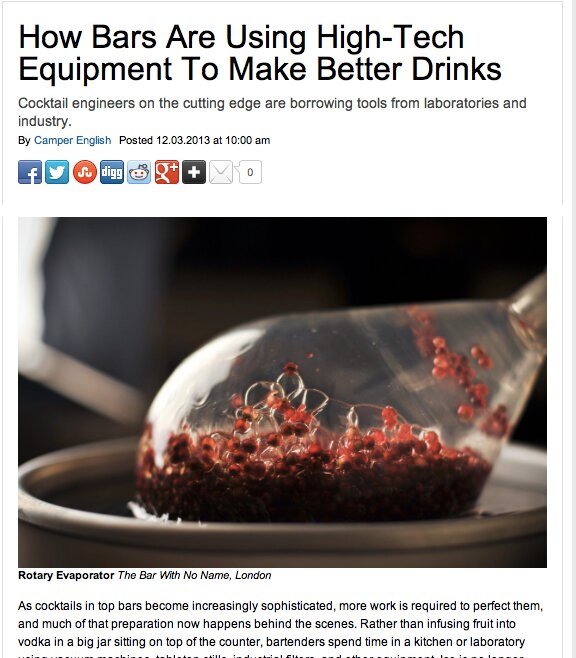
    In a slideshow for Popular Science, I wrote about ten pieces of bar equipment you not know about as they're hidden behind the scenes. 

    Screen Shot 2013-12-03 at 7.57.51 AM

    The story includes equipment used by some of the world's most innovate bartenders and includes equipment including rotovaps, machine-engraved ice, sous-vide cooking, and many others. 

    Check it out on PopSci.com!