And all the information about it is on this page right here.
No recipes, no tasting notes. Just a little history of the bitter highball from 1630 to today.
And all the information about it is on this page right here.
No recipes, no tasting notes. Just a little history of the bitter highball from 1630 to today.
I made cocktails for a code developer event a week ago and was able to get theme approval of "frozen dinosaur incubator laboratory" for it. This post is just some pictures from the event to show off.
The company has a dinosaur in some of its material, and I knew I was going to serve Old Fashioneds on big ice cubes, and part of my schtick for events is that I use chemistry glassware. So I filled in the blanks and that's what I came up with. Sort of like Jurassic Bar.
We used big ferns as line management, dressed as jungle scientists in khaki aprons and safari hats (with safety glasses), and put the drinks and hundreds of plastic dinosaurs in a series of beakers and flasks with bubbling liquids and dry ice. We had melting frozen dinosaurs, glowing ice cubes, the works.
The lighting was really red and it was hard to get good photos, but the professional photographer captured some good shots.

Photo provided by Google, Inc.

Photo provided by Google, Inc.

Photo provided by Google, Inc.

Photo provided by Google, Inc.

Crappy photo by Camper English
So yeah, if you didn't know, I not only write about drinks but now I create drinking spectacles.
You are awesome.
Note: This book is sold out! Some of the material is included in my book Doctors and Distillers, due out in July 2022!
In the meantime, two books on tonic that I love are Just the Tonic [amazon][bookshop] and Something & Tonic [amazon][bookshop]
 The extraordinary and hilarious history of one of the world’s most popular cocktails!
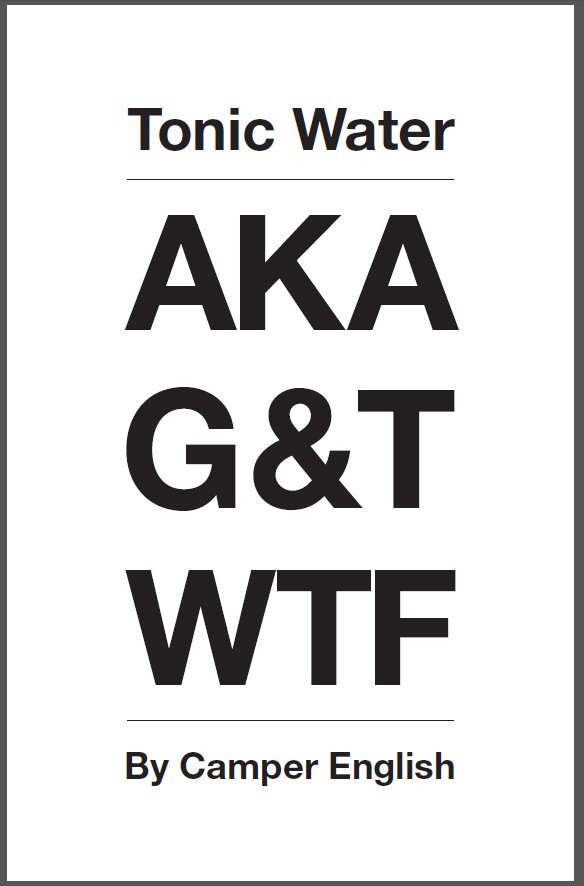
Tonic Water: AKA G&T WTF by Camper English.
This is a deeply researched but lighthearted look at the history of the Gin and Tonic from 1630 to today, including:

The book contains 35 hand-drawn illustrations from one of the great artists of our time. Just kidding! I drew them all so they’re pretty terrible. Click on that page to pull up an illustration of a cat with a parachute.
Tonic Water AKA G&T WTF is a short version of an ultra-epic book of the same history I hope to publish a couple years from now. Support your local tonic water historian!
Purchasing Info

Digital Version:
The book is available as an ebook on Amazon Kindle. It should be available for sale on all international Amazon sites as well. It costs $4.99 US and the equivalent in international currency.
Get it on Amazon USA here, or on these international Amazon sites:
UK Germany Spain Netherlands Japan Brazil
Thank you for your order.
San Francisco restaurant The Perennial has a cocktail program in which none of the drinks on the menu are either shaken or stirred. What's up with that?
The program, lead by Jennifer Colliau (also of The Interval and Small Hand Foods) focusses on reducing waste with a big emphasis on water waste.

Ice Machine Waste
According to Colliau, both Kold Draft and Hoshizaki ice machines (which produce the large clear cubes in most better bars in the US) waste 50% of the water that goes into them. The way these machines make their ice is that water runs over or is sprayed over a cold plate; and apparently the run-off is simply sent down the drain.
The Scotsman pellet ice machine, on the other hand, she says is 95% efficient. Thus the desire was to not use the water-wasteful machines in the program. They use only the Scotsman machine, but they don't use it for everything.
A second point of water waste: The average shaken or stirred cocktail is assembled in a mixing glass or cocktail shaker, shaken or stirred, and then strained and poured onto new ice in the serving glass – and the shaking/stirring glass ice is dumped out (using nearly twice the amount of water). Then the cocktail shaker/mixing glass must also be washed/rinsed out. Colliau sought to eliminate this waste.
Reducing Ice Use
For stirred cocktails on the menu at The Perennial, the drinks a batched in advance and are served in glasses in which a specific amount of water has been frozen to the bottom (glasses are kept in the freezer obviously). Stirred drinks on the menu are also pre-diluted so they don't need to be stirred but rather just poured. The liquids are kept refrigerated until service, then simply poured into the ice-containing glasses. I asked Colliau how she developed the system. She said:
I originally stirred these drinks to various temperatures, depending on their alcohol content, until they tasted the best. I measured the drink going in to the beaker then out to see how much dilution resulted from the ice melt. Then, because all of our freezers are the same, I took that dilution proportion and held the resulting drink in the freezer to make sure it tasted great even at that colder temperature.
Served in rocks glasses with ice frozen into them, approximately every 5 minutes the drink gets about 5 degrees warmer until it hits around 35F. It's important that the drink taste delicious over time.
Ideally we would White Lyan-style this execution and have different freezer temps for different drinks, but we use these freezers to chill glassware and keep sherbet and large ice in them, so we hold them all cold and manipulate the dilutions to work for each drink.
For shaken cocktails, things are even more complicated – the act of shaking is to roughly mix and emulsify ingredients together. To accomplish this, they use 1/3 cup of Scotsman ice, and run the cocktail through a blender in a small mason jar until there is no ice left. Thus the drink is "shaken" and no ice is dumped out at the end. Colliau says she'd definitely prefer a less noisy option, but it's the best they can do so far.

For off-menu cocktails, they have cubes from 2" Tovolo ice cube trays that they can use for rocks or cracked for stirring.
Stirring to Temperature
For off-menu drinks that are not pre-diluted, they stir drinks to temperature; as temperature directly relates to dilution.
The idea is that because ice kept in the well is basically at 32 degrees (F), all dilution of the drink will result in known temperature reductions (and vice versa). Thus to serve a drink the bartender can put in some cracked ice in the glass, stir a bit, prepare other more complicated drinks while it is diluting/melting, then check the temperature and stir more/add more ice if needed, until it reaches the desired final temperature. Any extra ice will be dumped.
Colliau notes, "Cobbled ice has so much surface area that it over-dilutes too quickly to stop when the drink is ready to go."

Temperature of Stirring
For low-alcohol drinks and those served on glasses with ice frozen into the bottom, they stir to 35 degrees. For regular stirred drinks like a Manhattan or Martini, they stir to 32 degrees as there will be no additional dilution from ice in the glass. And for the Gimlet at The Interval, they stir down to 25 degrees because the drink uses high-proof gin and additional dilution is needed.
Colliau says, "These are temps that I like for certain drinks, and they are guidelines rather than hard rules. Above all the drinks should be delicious! Using temps makes consistent execution across staff much, much easier."
Other Eco Savings
I'm sure there are tons more environment-saving considerations and processes in place – and this is just on the drink side of the program. This is definitely a more thoughtful process than pretty much every other bar attempting to reduce waste. Really, really impressive.
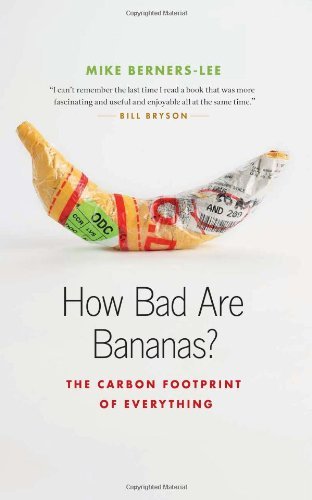 Homework: Colliau says she got a lot of information about carbon footprint of transporting bottles and other ingredients from the book How Bad Are Bananas? I'm planning to read it one of these days.
 While in Jerez for the launch of the Redbreast Lustau Edition, I had the opportunity to speak with Midleton Distillery Head blender Billy Leighton. Since I had a couple extra minutes, I asked him about the effect of sulfur in barrels used for their whiskies.
As some background, the whisky writer Jim Murray, who seems to enjoy generating controversy to increase book sales, said that sulfured casks are ruining scotch whisky. I don’t know much about the topic, so I asked Leighton if it was an issue.
He said, “The use of sulfur to sterilize casks for shipping or storage is a common practice, but it has to be done carefully. In the year 2000 we stopped the cooperage from using sulfur candles when they’re shipping casks to us. There is always a little bit of a risk of infection or secondary fermentation when you do that. Also, we have only shipped barrels typically between Oct and Feb [the lower temperature months in order to avoid that fermentation/spoilage], though it’s expanding because of [increased sales] volume."
 [Irish Distillers has a relationship with the cooperage Antonio Paez to build and prepare their sherry barrels, so they don't buy their casks on the open market. If they did they'd not be able to control/track this.]
He continued, "Historically you would have found a presence of sulfur from time to time. Now we have stopped that for 16 years. We don’t have the same problem certainly in our first fill casks. We could still see some sulfur raising its ugly head again in refill casks [casks purchased before 2000 that aged whisky and then were reused]. And one cask affected with it can ruin a vat. So even now every single sherry casks is personally screened by me."
That’s new info to me, and I thought I’d share.
I received a sample of the forthcoming Rabbit Clear Ice Cube Tray, which will be "only available at Bed Bath & Beyond starting in the fall," though I don't see it on the site yet. I'll link to it when it goes live.
Now it's available here.
The predicted retail price is $19.99, far less expensive than any other clear ice tray on the market.


As you can probably tell from the images, this ice cube tray takes advantage of Directional Freezing, the technique I pioneered here on Alcademics.
What is not visible is that each of the four blue ice cube holders has a hole in the bottom, so you fill the tray with more water than fits in the cube part alone. Directional freezing (from the top to the bottom since the sides are all insulated) will cause trapped air and impurities to push down into the bottom of the chamber, leaving the top (the entire ice cube) very clear.
To remove the ice cubes, you pull the plastic part out of the base cooler, and pop the cubes out of the tray. My first trial with this was quick and painless. Below are pictures from my first trial.


Pros: The price point is great; and it's a good proof-of-concept of a directional freezing tray. It's easy to use, and it will probably be a big gift this holiday season. If you take photos of cocktails at home, you can finally not have the ugly white bits in your cubes.
Cons: It's large; taking up a good chunk of freezer space, and you only get one highball glass worth of ice cubes out of it. The cubes aren't super big, so while you may impress yourself/your guests with your clear ice cubes, you're not going to blow their minds as you might with a 2-inch cube.
 This is a simple point but one I didn’t know before. Often you’ll see that scotch and other whiskies are aged in Spanish oak barrels that previously held sherry. However, I’ve always been told the barrels in the sherry soleras are American oak. What gives?
Thanks to Billy Leighton, Head Blender at Midleton Distillery, I have an answer. He says that yes, the true barrels on the sherry soleras are American oak and as old as possible. They do not want wood influence in sherry so the barrels don’t lend any flavor.
Traditionally, sherry was shipped to the UK in barrels (rather than bottles), and for that they would use the much less expensive/lower quality (at least at the time; I can’t speak for that now) Spanish oak casks, rather than American oak ones.
After being emptied, those casks would have been the ones reused to age scotch and other whiskies.
The Redbreast Lustau Edition is aged in ex-bourbon American oak barrels and sherry conditioned Spanish oak casks.
People are all excited about blue drinks these days, but I first wrote about their return in 2012. Since Details magazine went away and the story is no longer online, I rescued this story from the Internet Archives.
Memories….

After years of worshiping brown spirits and classic drinks, booze fans at this year's Tales of the Cocktail convention in New Orleans turned the spotlight on a new color: blue. In particular, the sometimes-neon liqueur blue curaçao—often reviled as the antithesis of all things vintage and authentic—is back.
Blue drinks have long been a mixologists' in-joke. When bartenders were getting serious about pre-Prohibition cocktails about five years ago, jet-setting New Zealand bartender Jacob Briars invented the Corpse Reviver Number Blue, a piss-take on the sacrosanct classic Corpse Reviver #2 that was enjoying a major comeback.
Since then, he and other bartenders have been practicing "sabluetage"—spiking the drinks of unwitting victims with blue curaçao when no one is looking. The forbidden liqueur can now be found on the menus of a few of the world's best cocktail bars, including Jasper's Corner Tap in San Francisco, PDT in New York City (where it's mixed with other unfashionable ingredients, such as Frangelico and cream), and London's Artesian Bar (winner of the World's Best Hotel Bar award this week), where a new blue drink—called Blue Lagoon—also features Sprite and bubble tea.
What has spawned this artistic blue period? According to a panel discussion on the topic this weekend, blue-curaçao-cocktail recipes date back as far as 1908 (predating the margarita and even the original Corpse Reviver #2), but the reappearance of the ingredient is likely more an elitists' embracing of the down-market and absurd—the mixological equivalent of trucker hats among fashion's hipoisie several years ago.
There is also a consensus that perhaps everyone is taking all this classic-cocktail stuff a bit too seriously. Today's top bartenders may be walking encyclopedias of cocktail knowledge, but they're also aware that no one goes to a bar to hear an encyclopedia reading. Blue drinks are a reminder that drinking is supposed to be fun.
"At the end of the day, people want to have a good time," says Artesian's head barman, Alex Kratena, as he demonstrated making his drink for the Tales of the Cocktail audience. Of course, his cheeky blue bubble-tea drink will run you about $23 back in London. If you're willing to sacrifice the cool factor, you could always join the hordes of partying tourists on Bourbon Street, one block away from the convention, gulping down blue drinks that are served in souvenir plastic cups—for half the price. Irony, as always, costs extra.
—Camper English is an international cocktails and spirits writer and the publisher of alcademics.com.


