Blog

  • My Favorite (Nerdiest) Blog Posts About Cognac

    Cognac has long been a category marketed as a luxury item like jewelry or precision watches: You don't need to know how it's made (they seem to be saying), just trust in the brand. 

    But over the years, particularly in the past couple years, I've been able to learn a bit more about the category. Like whisky and later gin (anyone remember when every brand's botanical mix was a secret?), cognac brands seem to be coming around to transparency. Consumers (nerds and otherwise) want to know where their food comes from, and their booze too. 


    6a00e553b3da20883401b8d19a7019970c


    Long story short, in this post I've pulled together some of my favorite previous cognac writing. 


    All About Cognac. This post, from 2009(!) is an intro to the category. 

    The Complicated Aging Process for Cognac, as Seen at Cognac Hardy. This (2015) was the first time I really got to know about how dynamic aging can be in cognac production. 

    What's the Difference Between Cognac and Armagnac? A charticle.

    A Visit to Merlet Cognac and Liqueurs in France. I've been to a bunch of cognac distilleries (click the cognac tag at the bottom of this post to scroll through all the cognac posts) but this one was interesting because they also make liqueurs. 

    Between the Heart and the Tails, the 'Seconds'. A post dedicated to a narrow cut of cognac- and rum! 

    A Fascinating Interview with Remy Martin Cognac Cellarmaster Baptiste Loiseau. A really interesting (so says me) article that gets to the heart of what interests me about cognac: It is a directed exercise; cognac is crafted, not just blended from random barrels. 

    Ramping up Aromatics in Cognac: How Camus Does it.  Camus cognac showing the numbers on how they try to make their cognac aromatic. 

    Cognac Hine series – A wrote a series of posts (sponsored by Hine importer Hotaling & Co) about how this brand of cognac is produced. I learned so much doing so, particularly around early landed cognac, aging conditions, and additives. 


    I hope my fellow cognac nerds will take time to read through some of these. 


  • Dilution and Additives in Cognac (Hine Series Part 6)

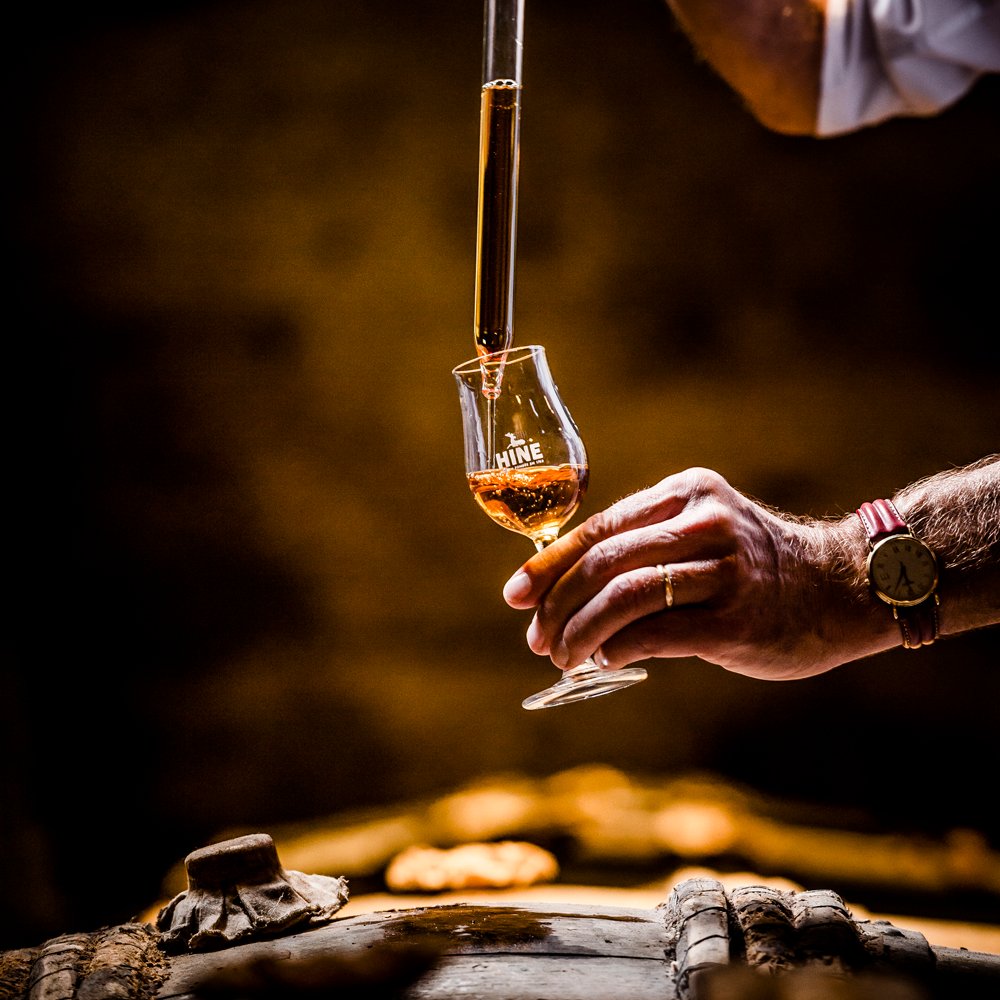
    In a series of posts I've been nerding out about cognac production, after sending a list of 100 questions to Hine cognac's cellar master Eric Forget, and combining that information with what I can pick up in books and elsewhere.

    In this post, I'll talk about diluting and additives used in cognac. There is a lot that happens in between taking cognac out of a barrel and it being sealed up in a bottle.

    The posts in this series are: 

    1. Cognac from grapes to wine

    2. Cognac distillation and the impact of distillation on the lees.

    3. Wood and barrels used for cognac.

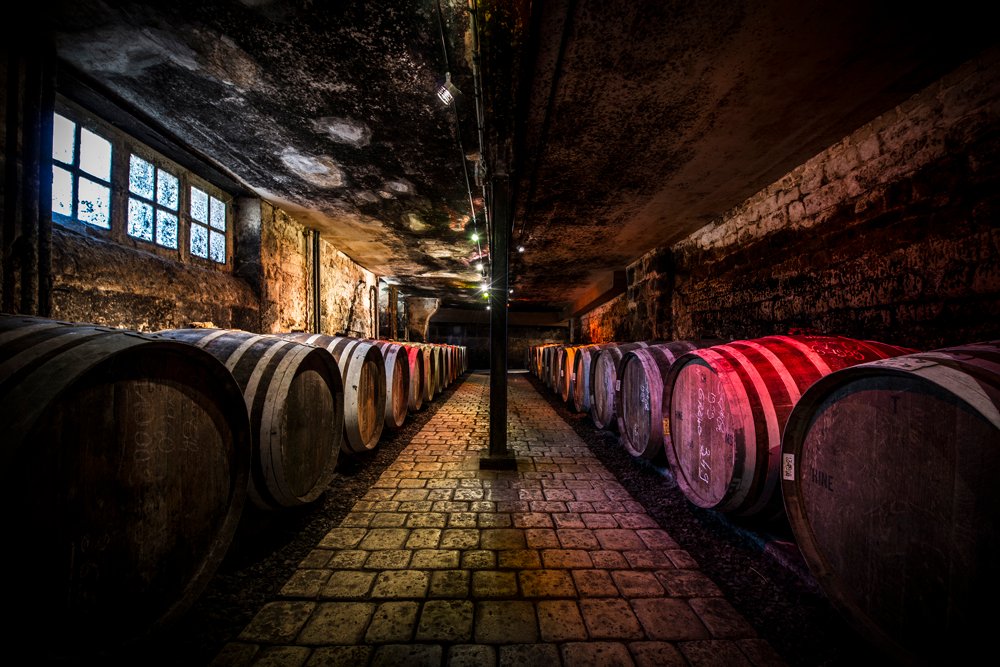
    4. Aging conditions for cognac.

    5. The strange exception of early landed cognac.

    6. Dilution and Additives in Cognac.


    Dilution in Cognac

    As mentioned in an earlier post, dilution in cognac does not necessarily come all at the end just before bottling. Diluting alcohol with water is actually an exothermic reaction – it creates heat. And heat blows off more volatile aromas. Much of what is done in cognac's gentle handling is specifically designed not to blow off volatile aromatics. 

    So cognac is often diluted slowly over the years – a little bit more water is added at certain intervals during aging, and a final amount at the end before bottling (well, most likely while marrying the blend that will rest before bottling). According to Cognac by Nichos Faith, they don't bring it down below 55% ABV while aging though, as it needs to be stronger to interact with the wood in the barrel. (Cognac is distilled to 70% initially and at least at Hine they dilute to 62-65% before putting it in barrels.) 

    The water used for dilution at Hine is reverse osmosis filtered totally neutral water so that there is no flavor impact on the spirit.

    Some producers, however, dilute with petits eaux.  Petits eaux ("small waters") is made by putting water into an old cask. This will pull some of the alcohol out of the wood and end up at around 20% ABV after six months, according to Cognac. This water is used to further slow the rate of dilution. [Note that in most places it is spelled "petites eaux," just not in the Cognac book.]

    Faith's book says petits eaux are used by "reputable" producers, but Hine's Forget says they do not use petits eaux because "There is a negative impact in term of finesse." 

    Another reason to dilute cognac slowly is saponification – if not done correctly, the brandy can take on soapy flavors, as Faith writes, "When brandy is blended with water, molecules of fatty acids clash and the result is the sort of cheap, soapy cognacs found in all too many French supermarkets." 

    I would love some time to compare quick-diluted soapy-cognac with properly-reduced version to see how soapy soapy cognac is.  


    Ck Mariot photography


    Boisé

    Some call boisé cognac's dirty secret. It is woody water made from boiling wood chips down into a thick liquid. This liquid is added to cognacs to make them woodier without the cost of new wood barrels. As Faith writes, "It thus provides a shortcut for those wanting to add a touch of new wood to their cognacs – and an alternative to buying new casks which now cost up to £500 each, which equates to over a pound per bottle of cognac. "

    Forget says that boisé is often used in wine production (I had no idea, but it makes sense), but Hine does not use it in their cognac. Faith writes that there is no limit on boisé used in cognac, unlike other additives. 

    I wonder about making some boisé at home to make "barrel-aged" cocktails without the barrel…. I'll have to think about that next time I get some wood chips. 


    Sugar

    According to Faith, it is permissible to add up to 8 grams of sugar per liter to cognac, and certainly it is very common to add sugar especially to young cognacs. In the case of Hine, Eric Forget says their VSOP and XO expressions do have added sugar, but not the rest of the line. He says, "It is a common habit for all houses to deliver a little sweetness."


    Caramel

    Coloring caramel, which should be flavorless, is a common additive not just in cognac but scotch whisky, rum, tequila, and pretty much all aged beverages except straight bourbon where it is not allowed. 

    Most producers will say that adding caramel is for "consistency only" and not to make the products appear older by being darker, but in cognac some producers are actually honest about it. For Chinese/Japanese markets in particular cognacs are often made darker than the same cognacs sold elsewhere. (Nicholas Faith writes that they are often made "richer" as so they can be diluted with ice as they are frequently consumed.)

    Forget says that Hine does not make their products for other markets extra dark. 


    Medsker_Hine_Day02_125


    Filtration

    Forget says Hine is filtered, "Like all the houses of cognac, at room temperature and then again at cool temperature. Cognac is very rich in oils and if some are [removed] during the filtration, and if the filtration is well conducted, there is no negative impact on the quality. It is also necessary to export in cold regions." 

    Typically spirits below 46% ABV are chill-filtered for just this reason – when the spirits get cold, oils can come out of solution and look cloudy. Consumers, generally speaking, associate this with the spirit being bad or moldy or something; and cognac is nearly always bottled at 40% ABV, so all cognac (that I know about anyway) is chill filtered. Forget says this is only done for visual reasons. 

    If you ever want to see the effect, take a 46% or higher spirit (probably whiskey) and add some cold water to dilute it a bit. Place a glass of this and a glass of full-strength spirit in the freezer and compare after they chill – you can see the cloudy bits in the diluted one. 


    Marriage

    I did not ask Forget specific questions about how long after creating blends does the cognac sit in large vats to "marry," to come into harmony with itself so that it doesn't taste disjointed. (To be fair, I'd already asked him 100 questions at this point.)

    But when I inquired if I'd missed anything or if anything else could impact the blending process, he said two factors I hadn't mentioned were having bad wood (which is a problem I think we're seeing in all the small batch American whiskies – people are so concerned with distilling they forget to pay attention to the barrels); and the other potential problem is not allowing enough time for marrying the blend before bottling. 


    So, this is the last official post in the series sponsored by Hine cognac. I've learned so much, and yet I still have so many questions! But that's the nature of learning -  you're never done, it's always a journey. I hope you were also able to enjoy the ride. 


    IMG_7157


    Note: This series of posts has been sponsored by Hotaling & Co, importers of Hine cognac. 

  • Mocktail Thesaurus – Alternatives for the Word Mocktail

    Many people have an extreme dislike of the word "mocktail," and a thousand and one Facebook discussions later, I've decided to put all the suggested alternatives for the word in one place.

    So if you're looking for a new section heading for your bar menu, or you're a journalist writing the 4000th Dry January story and need some new words to use, this list is for you!


    Non alcoholic menues

    Menus from PrettyUgly (Toronto), North Shore Distillery (Chicago), Zona Mexicana (San Francisco), Zyankali Bar (Berlin), Sushi By Bou (Multiple locations)


    Please let me know if  I missed something! 

        1. 0% ABV
        2. 86 ABV
        3. abstinence drinks
        4. alcohol free
        5. all ages show 
        6. almost cocktails
        7. barely legal
        8. baseless
        9. boozeless
        10. chauffeur's choice
        11. cocktail adjacent
        12. coolers
        13. designated drivers
        14. drinks for your endurance
        15. driver friendly
        16. driver's choice
        17. dry cocktails
        18. dry liquids
        19. even keel
        20. fauxtails
        21. free-spirited cocktails
        22. freetails
        23. gentle spirit
        24. g-rated
        25. immaculate concoctions
        26. jerk soda
        27. junior varsity
        28. kiddie cocktails
        29. lie-bations
        30. liver friendly 
        31. loopholes
        32. low test
        33. maternatinis
        34. minor indulgences
        35. no ABV
        36. nolo
        37. nocktails
        38. no knocktails
        39. non-alcoholic 
        40. nonnies
        41. nontoxicants
        42. no octane
        43. no proof 
        44. not just for kids
        45. not quite cocktails
        46. not-tails
        47. n.w.a. (nothing with alcohol)
        48. on the wagon
        49. pacers
        50. PG
        51. placebos
        52. preggatinis
        53. rated E for Everyone
        54. refrainers
        55. refreshers
        56. safe for work
        57. shallow end
        58. sober drinks
        59. soft cocktails
        60. soft drinks
        61. spirit-free
        62. teetotalers
        63. teetotaler tipples 
        64. temperance drinks
        65. tonics and refreshers
        66. uber juice 
        67. unleaded
        68. virgin
        69. volcano sacrifice
        70. Volstead approved
        71. without alcohol
        72. without proof
        73. zero alcohol
        74. zero-proof


    Got other ideas? Let me know! 


  • The Weird Exception of Early Landed Cognac (Hine Series Part 5)

    I have been writing a series of blog posts about cognac, and I've really been looking forward to this one about "early landed" cognac. 

    This series has been detailed information about cognac production generally, and Hine cognac specifically, as I was able to ask the cellar master Eric Forget a ton of questions. It has been a fun way for me to review what I know, challenge my assumptions, and put together general production information with specifics from one brand. 

    The posts in this series are: 

    1. Cognac from grapes to wine

    2. Cognac distillation and the impact of distillation on the lees.

    3. Wood and barrels used for cognac.

    4. Aging conditions for cognac.

    5. The strange exception of early landed cognac.

    6. Dilution and Additives in Cognac.


    What the Heck is Early Landed Cognac

    Early landed cognac is cognac that ages in Britain rather than in France. WHAT?? Yeah, it's weird because cognac is of course an AOC product, an Appellation d'origine contrôlée, like certain cheeses and rhum agricole and calvados and armagnac. Generally AOC products must be produced within a delimited region with a whole lot of rules for quality, and packaged in that region also. 

    So for there to be an exception in the AOC for cognac to be aged elsewhere and still able to be called cognac is wild.

    The expression comes from the phrase "early landed, late bottled" meaning that they land on British shores early but aren't bottled until later. (In reality all cognac is aged so it's all late-bottled.) 

    To understand how this came to be, consider that a huge audience for cognac has always been Britain – and many of the cognac houses including Hine have British origins. In days before bottles were common, wine and spirits were shipped in barrels to the UK (thus beginning the tradition of scotch whisky being aged in ex-sherry barrels), and bottled there, so probably early landed cognac was once common. Today however not so much! 

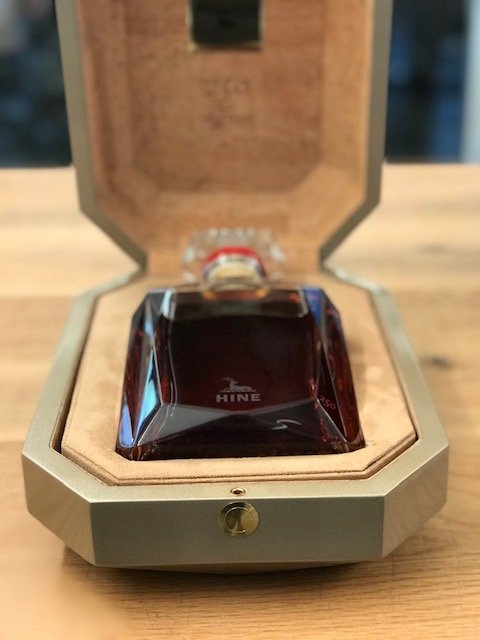
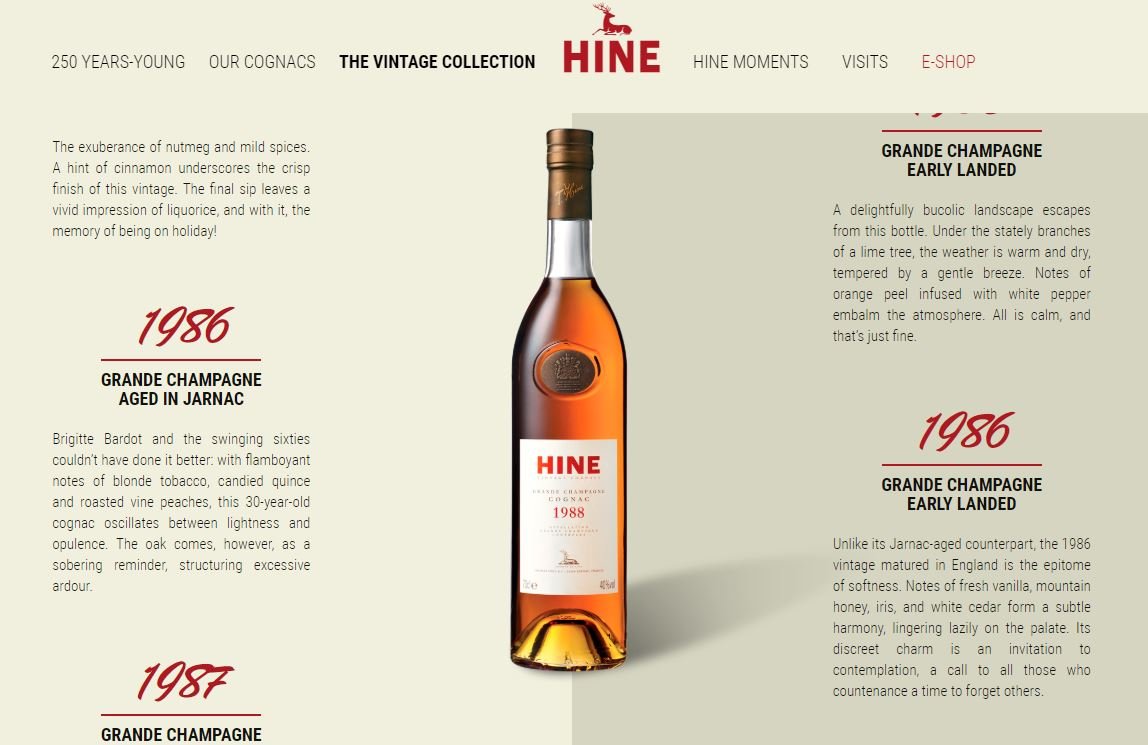
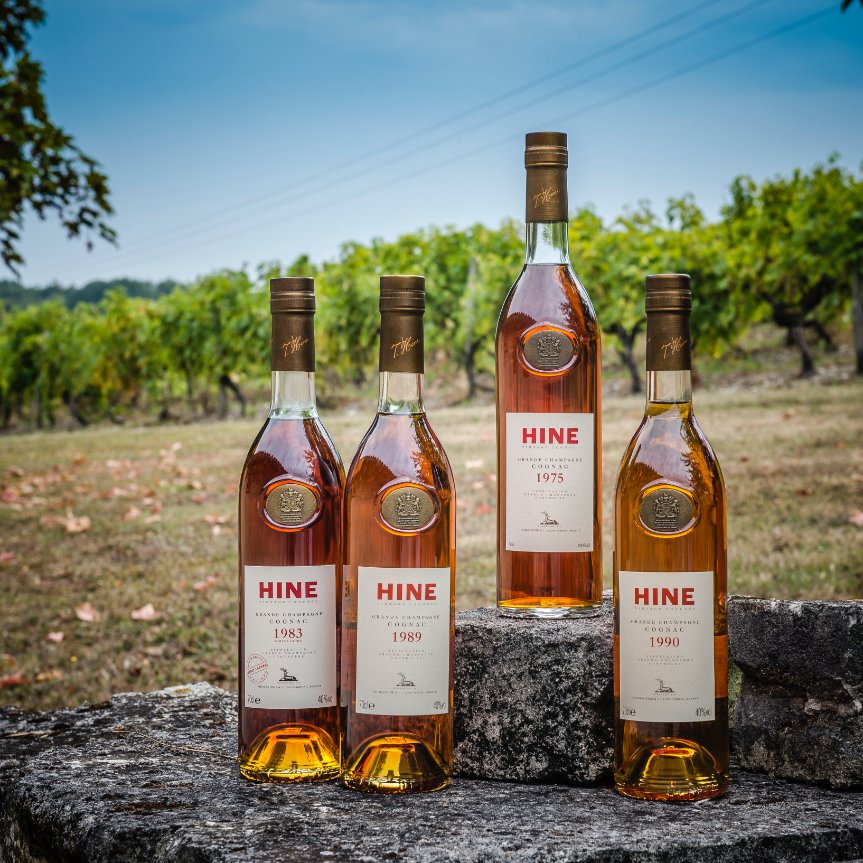
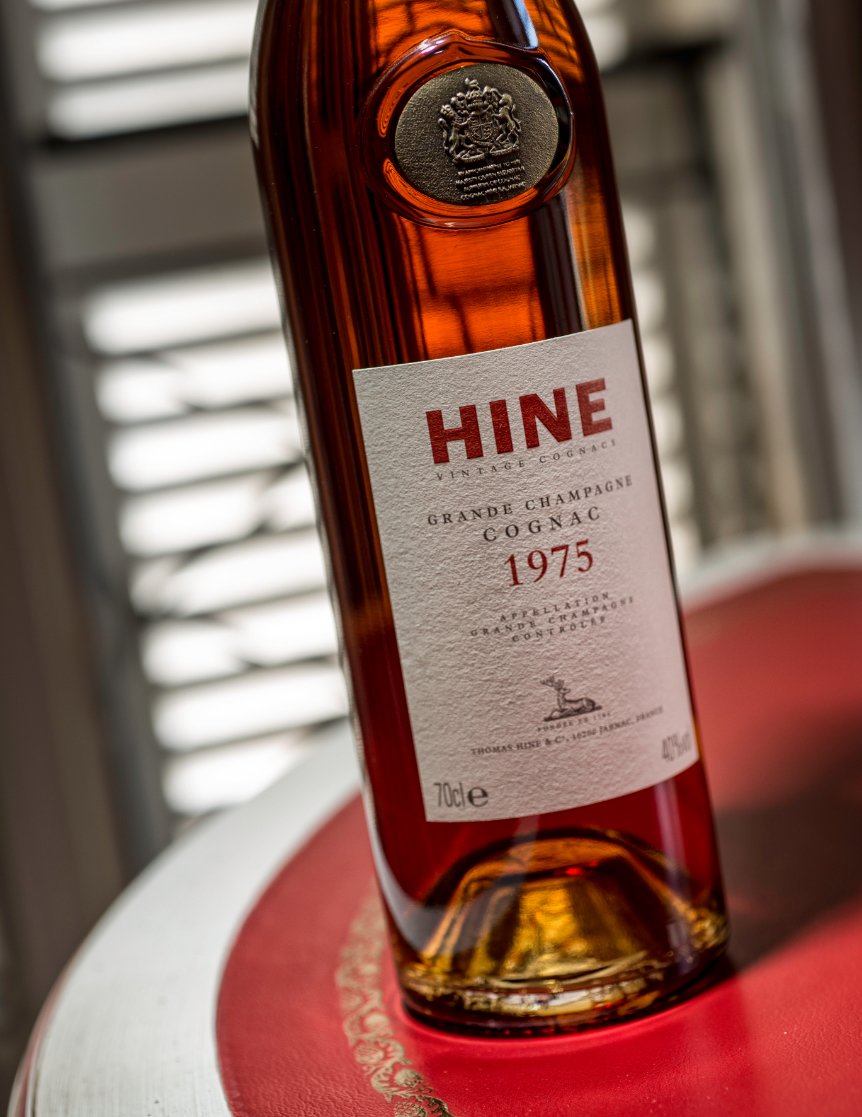
    But early landed cognac is a specialty of Hine – when I looked up some information about it, every single story about early landed cognac is a story about Hine in particular. Currently on the brand's website, they list vintage 1975, 1981, 1983, 1984, 1985, 1986, and 1987 of early landed cognacs available for sale. 

    According to the Berry Brothers & Rudd website, "This custom [or early landed] dates back to the 19th century, when they first shipped selected vintage Grande Champagne Cognacs in cask to Bristol, in England."
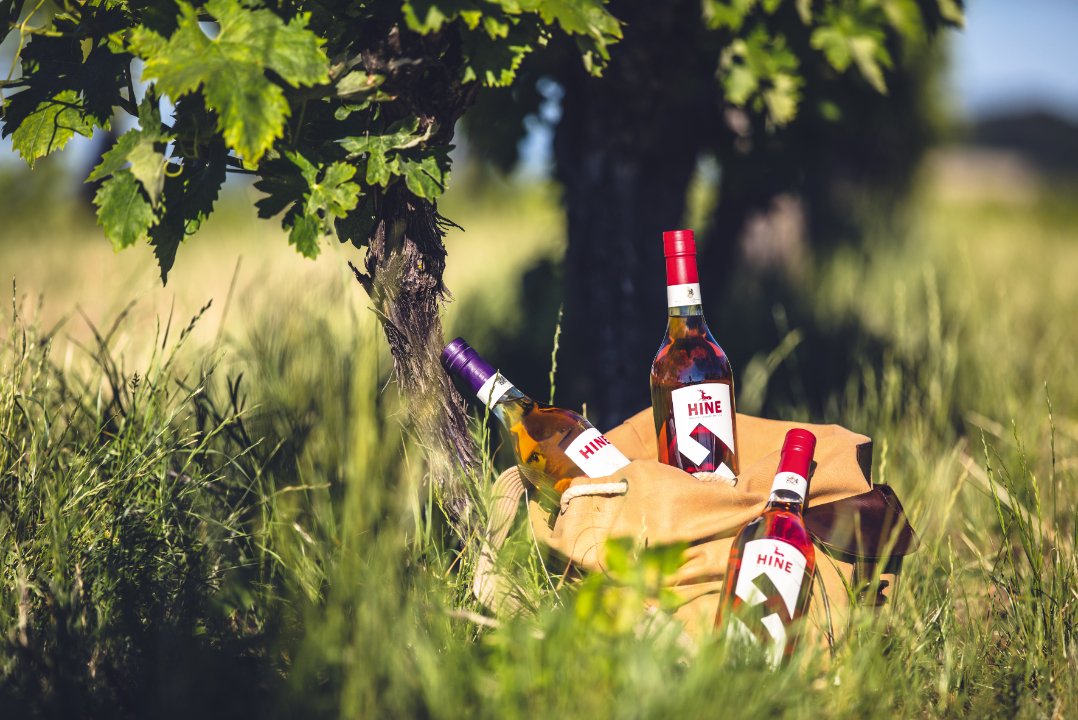
     

    Hby-HINE-pick-nick-©-Olivier-Löser

    photo: Olivier-Löser


    History of Vintage and Early Landed Cognac

    Hine offers vintage cognacs – both regular and early landed versions. Vintage cognac on its own is not very common- most all cognac is a blend of ages. And in fact vintage cognac was not legal to sell for about 25 years, according to this article from 1994 in the LA Times

    According to that LA Times story, early landed cognac was a way to sell vintage-dated cognac before it became legal again. "However, the BNIC [the cognac bureau] ruling only prohibited bottling of vintage-dated Cognac by the Cognac producers themselves. It didn’t stop the long-established practice of sending vintage-dated barrels of Cognac to England, where it was known as “early landed” Cognac. After varying periods of barrel-aging, English wine merchants would bottle this Cognac with a vintage year." 

    According to this post about cognac regulations, "In 1962 single vintage cognacs were banned. A few exceptions were made: early landed cognacs (these were ageing in England) and three cognac houses who held a perfect registration and could prove the provenance regarding year and district of their eau-de-vie. These three were Croizet-Eymard, Delamain and Hine.
    In 1987 this ban was lifted again."

    If true (not all info on the site is accurate so I'm trying to fact-check this), that would be a pretty cool historical factoid for a couple specific brands to get an exception. 

    Anyway – I mentioned that Hine offers both vintage and early landed cognacs but even better – they offer some of them from the same years so you could do taste comparison if you can get hold of them. There are vintages of both early landed and French-aged cognac from 1975, 1983, and 1985-1987. It would be amazing to taste them against each other. 


    Early1


    Early Landed – How Hine Does It

    Early landed cognac is distilled in France and sent to England to age "shortly after distillation." I first asked questions about how Hine ages their early landed cognacs, which made me curious about how other brands do it and what the regulations are. Those are below. 

    In the case of Hine, according to cellar master Eric Forget,  the cognac for early landed is not produced any differently than it is for other vintages. It remains in the UK aging for about 20 years. Hine does not own the UK warehouses – they are "bonded warehouses". ("It is a British bond," Forget says.) The aging cognac is still owned by Hine while it's overseas. 

    I asked Forget if there are cellarmasters on site in England, and he replied, "We are fully in charge. The early landed just sleeps in the UK. There is no work during the time they spend there." So no manipulation is done to the cognac (transfering to different barrels, etc) – this is just a different aging environment, and then the barrels return to France afterward for bottling. 

    After aging in the UK, the cognac is sent back to France where it is bottled by Hine. 


    Early Landed Cognac Rules and Regulations

    “The Bureau National Interprofessionnel du Cognac (BNIC) is a coordination and decision-making body for the Cognac industry." I reached out to them, via their PR agency, with some questions about the legalities of early landed and boy did I learn some new stuff! My impression of how early landed cognac is legal with the AOC was totally wrong. 

    Here is my email interview: 

    1. Can early landed cognacs be bottled in the UK or must they return to France for bottling?
    2. If not, are they still legally cognac if bottled in the UK?

    In respect of Cognac product specification, as homologated by French decree n° 2015-10 of January 07, 2015, there is no mandatory bottling in the delimited area. Therefore, it is possible to bottle Cognac in the UK, as soon as long as it has been aged for a minimum of 2 years in the delimited area.

    3. If they are able to be bottled in the UK are there any special regulations – maybe something on dilution or additives that's different?

    Regardless of the location, bottling has to respect the same rules, inside or outside the delimited area. Any addition not expressly referred to in Cognac product specification is strictly forbidden.

    4. I believe in the past that people could buy a barrel and age/bottle it in England with an independent bottler/merchant like Berry Brothers – so people could have a private barrel. Is this still the case? (the bottom of this story from 2001 mentions doing it but I'm not sure if this has changed. )

    In respect of Cognac product specification, it is possible to age cognac outside the delimited area but only if ageing during the first 2 years takes place in the delimited area.

    5. Or must an approved Cognac brand do the bottling?

    At this stage there is no approbation of bottlers by BNIC.

    6. Are there any regulations on time of aging in the UK? (Min/max time – I see a lot of mentions of 20 years but don't know if this is something official)

    To be directly sold to consumers, the only regulation is that cognacs aged at least 2 years. There is no maximum limit to this ageing, whether inside or outside the delimited area.

    7. Are the cellars in the UK owned by the brands or are they independent? 

    It is up to the brands to decide how they want to organize the process.


    So that's super interesting: 2 years is the minimum aging of cognac for VS, and after a cognac reaches that age it can be aged anywhere and bottled anywhere as long as it follows the rules of bottling for cognac. 

    Also interesting is that most cognacs are aged in a new oak barrel for the first several months of their life (8 months at Hine), which means that the cognacs are already on their second barrel before they get sent to the UK.

    This was so new and interesting to me that I emailed Hine to clarify that it was actually the case that they're aged for 2 years. A contact at Hine (I'm not positive who) responded with the following (slightly edited for clarity):

    Early landed used to be aged in Bristol, they are now aged in Scotland (and have been for a decade).

    In the past, when tradition was that wines, cognacs or port were sent in cask to their final destination for commerce, liquids used to be bottled by the merchant it was sold to (Berry Brothers & Rudd, Corney & Barrow, etc. ).

    This has completely stopped to avoid any possible fraud or problem during bottling that could damage the liquid, and furthermore, the brand.

    Early landed are aged for around 20 years in the UK, after having spent the mandatory 2 years aging in Jarnac to obtain the Cognac appellation. Our cellar masters (Eric Forget and Pierre Boyer) travel to the UK every other year to taste the barrels on site. They last visited Scotland in June 2019.

    After 20 years, barrels are shipped back to Jarnac in their bonded casks to be put in demijohns. They are then bottled at Hine, on demand.

    This helps explain why you don't see a lot of early landed cognac lining shelves – they're such niche products that they're only bottled when needed. (In Sacramento, the Corti Brothers store specializes in this segment.)


    CK Mariot

    photo: CK Mariot


    Impact of Aging Cognac in England

    In the last post in this series we talked about the impact of aging in wet versus dry cellars in Cognac. Well in the case of early landed its the case of wet vs wet-and-chilly. Hine vintages in France are aged in wet cellars. Forget says, "The difference comes from the difference in humidity and a low but stable temperature in UK."

    The always-wonderful Dave Broom wrote about Hine and early landed cognac in 2001. Even the title is great! "Pale beauties that thrive in the dark."

    We exit from the creaking lift into a chilly, crepuscular dungeon. A greenish-grey mould covers the walls like diseased cotton wool, barrels lie apparently smothered in soot, and the floor is slippery. Hell for a homeowner, but paradise for ageing Cognac that thrives in the cold and the humidity already seeping into my bones. These conditions help give early-landed Cognac its signature style…

    He pulls samples from the casks, giving me a quick history lesson on how "early landed" means the spirit arrives here before it is two years old and how, when the style was more common, wine merchants would age it in waterside bonds in London, Bristol, Liverpool and Leith… [note: we see here before the law changed it was moved from France before it was 2 years old]

    The pale colour, he explains, is because the humidity allows the strength of the spirit to fall, but the cold means there is virtually no evaporation.

    The Berry Brothers website continues from the above:

    Nowadays, Hine still ships some of its single vintage cognacs to the UK (and is one of a very rare few estates who continue this tradition) after they have spent several months ageing in new oak barrels in Jarnac.

    Cool, dark cellars house barely a hundred barrels of Early Landed (a barrel is the equivalent volume to around 350 bottles). Here the ageing conditions are quite different from those in Jarnac as the temperature is low and remains constant (between 8 and 12°C) and the high humidity level rarely drops below 95%. These factors ensure that Hine's Early Landed cognacs are particularly light and fruity with very delicate oaky notes, and delightful aromas of fresh flowers and the characteristic orange peel – very close to the cognac’s initial notes.


    Nicholas Faith in his book Cognac describes the British palate as preferring this particular style of cognac. He writes:

    This is why the brandies are lighter and mature more quickly than those which remain at home- indeed they are smooth, elegant, and delicious after a mere twenty years. This was much to the taste of old-style English connoisseurs. One of their breed, Maurice Healy, described such a cognac as 'of almost unearthly pallor and a corresponding ethereal bouquet and flavor'. By contrast they were – and -are- not overly highly rated by many French blenders, who find them flabby.


    The low, stable temperature means there isn't a ton of wood impact on the spirit (as the light color indicates). Forget describes the taste difference of early landed cognacs, "The cognacs keep more freshness and liveliness and get this so typical orange peel nose and taste." 


    Conclusion

    Early landed cognacs could be a marvelous opportunity to make an exact comparison of the aging environment on spirits. Currently they're aging in the UK, and you could compare Hine's vintage cognacs aged in France versus those in the UK.

    And since there's that new 2015 law, cognac could be aged in other parts of the world too. I hope someone is doing so already because I'd like to try it in another decade or two when it's ready. 


    Note: This series of posts has been sponsored by Hotaling & Co, importers of Hine cognac. 
     

    1975-©-CK-Mariot-Photography

    photo: CK Mariot
     

  • Aging Conditions for Cognac (Hine Series Part 4)

    I'm in the middle of a series of posts about how cognac is made generally, with details from Hine cognac cellarmaster Eric Forget  about how Hine is made specifically.

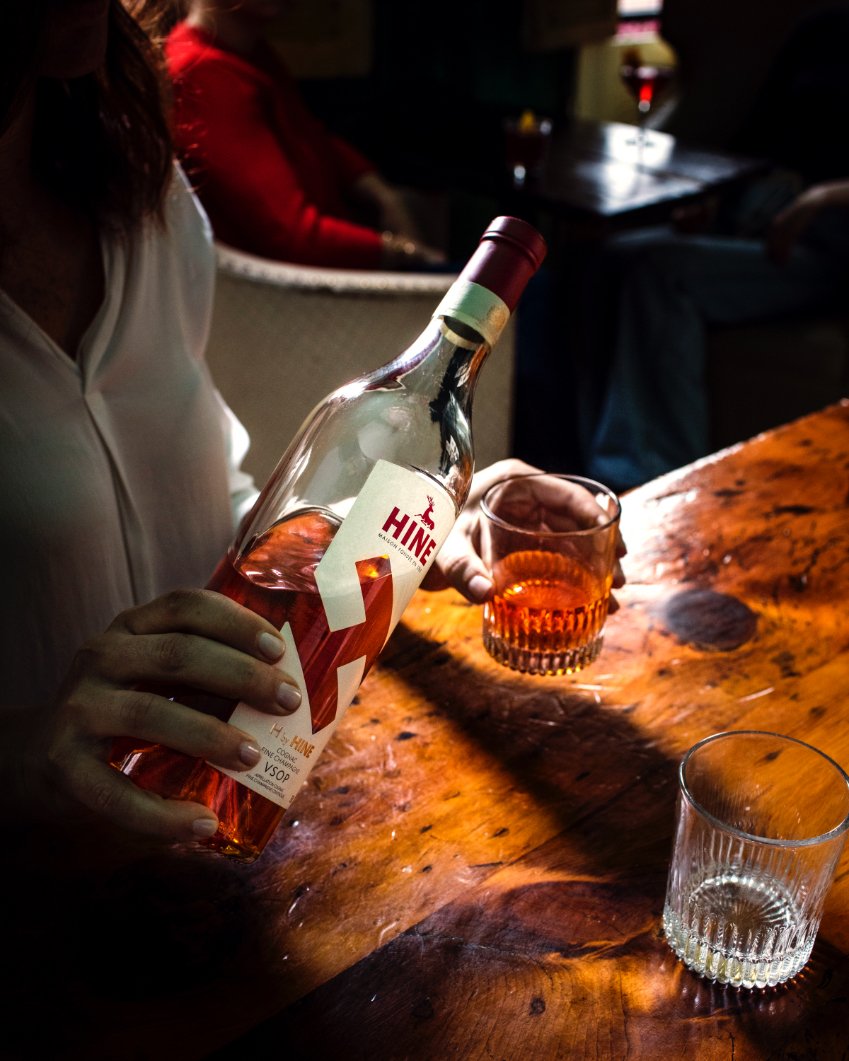
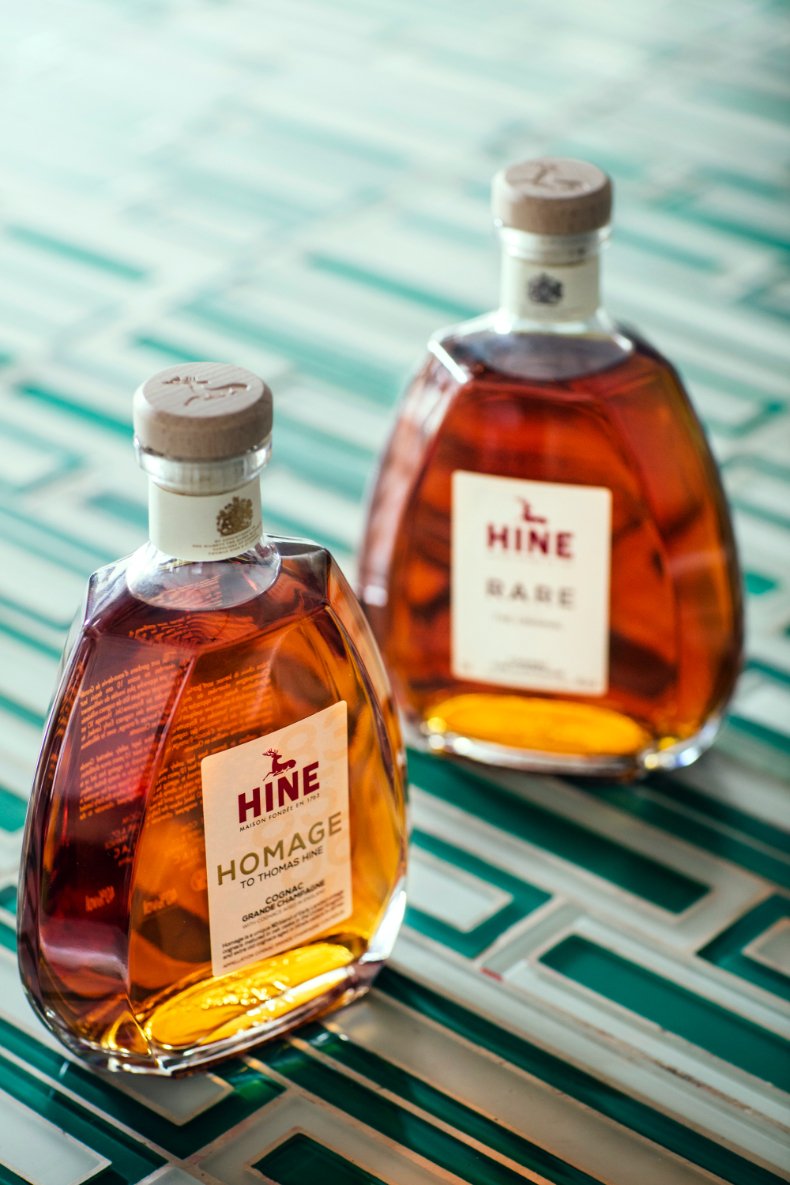
    Hine offers a special blend meant for mixology (H by Hine), other VSOP and XO blends, single vineyard cognacs, and many vintage-dated cognacs. 

    The posts in this series are: 

    1. Cognac from grapes to wine

    2. Cognac distillation and the impact of distillation on the lees.

    3. Wood and barrels used for cognac.

    4. Aging conditions for cognac.

    5. The strange exception of early landed cognac.

    6. Dilution and Additives in Cognac.

    Hine-Cellars-©-CK-Mariot-Photography

    CK Mariot Photography
    Today's post is about aging in those barrels we discussed last time. 

    I think one of the most interesting things about cognac is how its aging is not static. It does not go into a barrel and remain there until its transferred to the blending vat and bottle, unlike many (most?) spirits. 

    Designation

    As I'm trying to make clear with this set of blog posts, cognac is not, as many brands seem to imply, a masterwork of blending starting from a huge supply of random barrels that have been just sitting around aging without manipulation. Cognac is designed; cognac is made

    Right off the still, cognac makers have an idea about what will become of the brandy. Of course they know where the grapes were grown and whether those areas (and those winemakers) produce eau de vie that ages well over a long time or a shorter amount of time. An initial determination is made of the new make distillate if it might go toward a VS, VSOP, XO, or even longer aged product.

    According to Nicholas Faith's book Cognac (that I'll be quoting from a lot) the richness, oiliness, and sheer concentration of the spirit's flavor tells you whether it will open up over a long time or be ready to drink in a few years. 

    With an idea (that will be confirmed with tastings over the years) of where the new-make spirit will end up, decisions are made about in what type of barrel it will age and in what type of warehouse and for how it will age long right off the bat, and they'll keep the liquid moving between different situations as predicted and as needed.


    New Barrels at First

    Cognac is usually put into a new barrel for a certain number of months. New barrels give up a lot of tannin, so the eau de vie is then moved to an older barrel after that.  Note that "new" doesn't necessarily never been used before, but under a certain few years old, usually three years old. 

    At Hine, cellar master Eric Forget says that newly-distilled eau de vie goes into new barrels for about 8 months. He said, "in general" that eau de vie designated for older products doesn't go into older barrels sooner. 

    According to the Faith book Cognac, if the year had been especially wet with a lot of rainfall, the cognacs could come out very flabby so they might age for a bit longer in new barrels; the opposite if it was a very dry year. Though it's rare, some other cognac producers only age in older barrels – that would be for marques that are destined to age a very long time.  

    As cognacs age, they will likely be moved to older and older barrels, and then possibly to a glass demijohn to freeze it in time.


    MRT_0253


    When To Move

    Depending on the brand, every barrel is tasted annually or more often than that. Then it may be redirected into a different barrel or placed in a different cellar to attempt to bring out its best aspects. 

    Aging cognac may be combined and diluted at certain intervals, and then redistributed to barrels. For example, cognac that will become an XO may be taken out the barrel, blended with other barrels in a big vat, diluted to x% ABV after 2 years, then again to a new lower ABV at 5 years, then again at bottling. (I am making these time points up but the point is that cognac can be combined, diluted, and rebarreled multiple times over its life.) 

    This is a good point at which to move a parcel of aging eau de vie from its current barrels to new-to-it ones.

    Barrels give up their tannins and lignins over the years, and at some point they basically become a neutral vessel, allowing the exchange of oxygen but no longer being additive. Still, different cognac houses have limits on how long they'll leave cognac in a barrel at all to prevent it from becoming overly woody. 


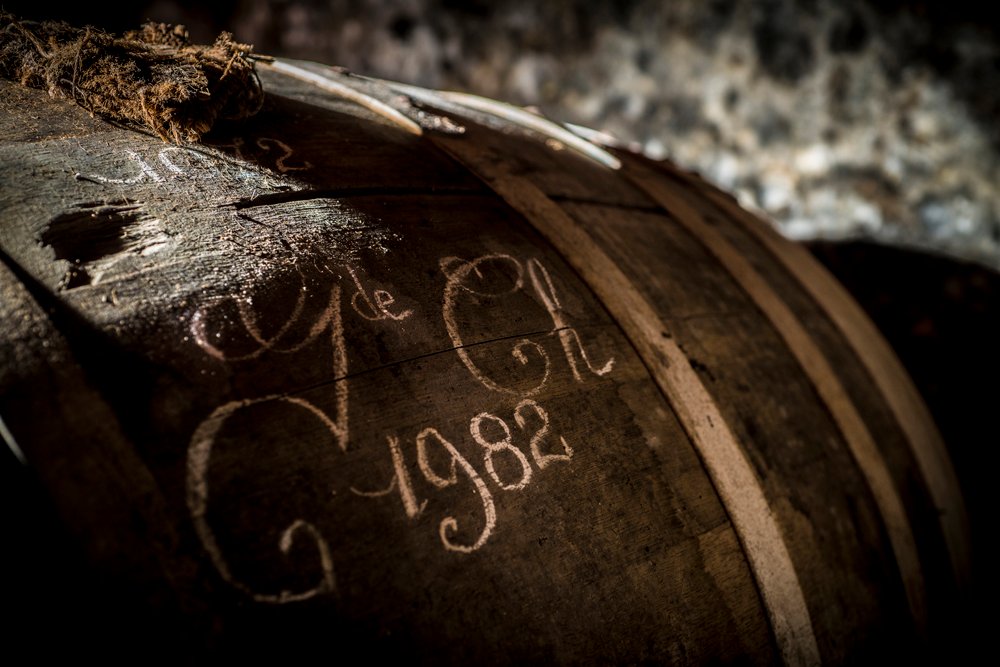
    Barrel1982©-CK-Mariot-Photography-1

    CK Mariot Photography
     

    Different Cellars

    There are different types of cellars for cognac- dry and wet. The rate of water evaporation will be impacted by the humidity of the warehouse. If it's very humid (wet cellars in basements and/or close to the Charente river) then not much water will evaporate from the barrel compared to alcohol. If it's dry, more water will also evaporate compared to alcohol. (The angels' share in cognac is generally about 1% ABV per year for the first ten years, then a slower rate after that.) 

    Also, in Faith's book he writes that super dry cellars also retain a youthfulness of cognac flavor, while super wet ones will taste extra mature. I didn't check with Eric Forget of Hine, but I would assume this means that cognac designated for the premier long-aged products would more often age in the wet cellars, as maturity is highly valued. 

    Forget says, that "wet cellars make rounder cognacs, versus dry, which give more liveliness." I asked him if you could tell just by tasting whether a cognac was aged in a wet or a dry cellar. He replied, " It could be only possible only if they stay a long time." 

    In an extreme case over a long time, a wet-cellared cognac would lose proof in the barrel and eventually could drop below 40% ABV and no longer legally be cognac! (Before this happened it would be moved to rest in glass demijohns to prevent it.) Faith's book says that after 50 years the cognac will still be about 46% ABV, so in order to go below 40 it would really need to be extremely old. 

    The great houses of Cognac are located along the Charente River not for the view, but for the access: barrels of cognac used to be floated down the river out to sea on flat-bottomed boats. For the same reason, the old cognac cellars are also located along the water. Newer ones are located away from the river, tend to be drier without the river air, and may be temperature-controlled.  

    So cognac could also be moved from wet cellars to dry cellars or the reverse depending on how the barrels are aging. I do not know if this is common.  I asked Forget if barrels tend to stay where they are or are moved from one type of cellar to another. He replied there are "no fixed rules." 

    Finally, I asked Forget if certain blends are made from some combination like 30 percent from wet cellars and 70 percent from dry ones, but he dismissed it. "No, tasting is the only element." 

    So, at the end of the day you can choose your vineyard and your distillation parameters and your aging routine to try to make exactly the right brandy for a specific blend in the house style, but ultimately it's still up to the cellar master to redirect the liquid as it changes and to assemble the final blend from the barrels they've nurtured.


    Stay tuned for a few more posts in this series!


    MRT_0913

    CK Mariot Photography
     

    Note: This series of posts has been sponsored by Hotaling & Co, importers of Hine cognac. 


  • Wood and Barrels for Cognac (Hine Series Part 3)

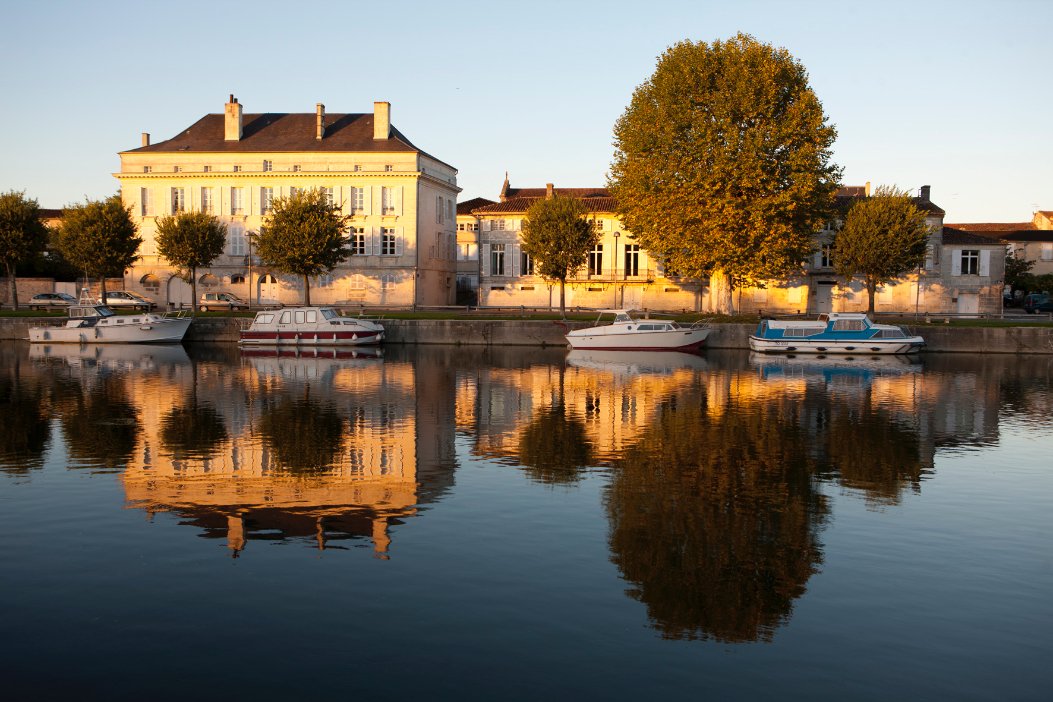
    At the end of 2019, I sent a list of 100 questions to the cellarmaster of Hine cognac, Eric Forget. I'm writing up what I learned over several posts.  Hine is a small (relative to the majors) cognac brand founded a bit over 250 years ago. The main house is located along the Charente River in Jarnac. Pull up your boat and have a sip. 


    Hine025-copyright-Flavio-Pagani-Les-Editions-dAutils

    The Hine House ©Flavio Pagani Les Editions d’Autils


    The posts in this series are: 

    1. Cognac from grapes to wine

    2. Cognac distillation and the impact of distillation on the lees.

    3. Wood and barrels used for cognac.

    4. Aging conditions for cognac.

    5. The strange exception of early landed cognac.

    6. Dilution and Additives in Cognac.


    In this post, we'll cover wood and barrels used for cognac generally and Hine specifically. 

    Hine buys their barrels from coopers in the Cognac region, though cellarmaster Eric Forget didn't specify if they purchase from one or multiple cooperages. (To be fair, I forgot to ask.)  Some cognac brands don't age all their cognac in their own cellars, but Hine does – with the exception of their early landed cognacs that age in England. We'll will discuss these in a future post because they're so unusual. But in any case Hine purchases those barrels as well.


    Trees and Wood

    Hine states they use "fine grain, light toast" French oak barrels. When we talk about American oak barrels for bourbon, producers might talk about the char level for them. It's rare that they speak about air vs. kiln drying and extremely rare for them to talk about oak tree terroir. It's different for cognac. 

    The French cooperages follow specific instructions from each cognac brand they sell to about which type of barrels to make. Some of the parameters are the type of trees/wood used, letting the wood air-dry for a certain amount of time, and the level of toasting of the finished barrels.   

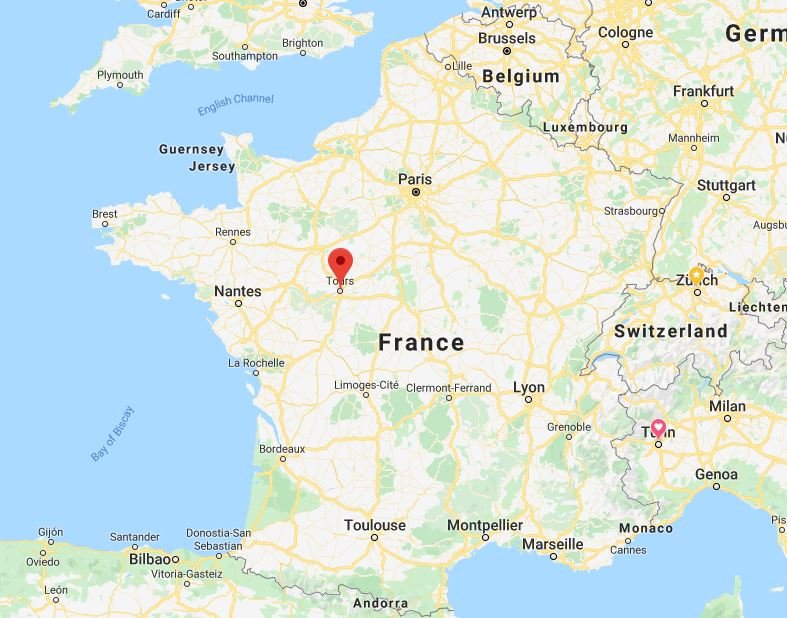
    We always hear about the two french forests when it comes to barrels for wine and cognac: Troncais and Limousin (if my mapping skills are correct, they're close to each other in central France).

    I asked Forget where the trees for the barrels used by Hine come from. He said, "It is a natural element, so you could find a large [parcel of forest from elsewhere] even if these two [forests – Troncais and Limousin] are the most common. But the terroir of the forest is important also. The fine grain [wood] comes from the forest north of the Loire Valley." 


    Loire valley

    The pin is roughly the heart of the Loire Valley.


    According to this article with a map, the main forests for barrel wood in France are "six main French forests known for oak: Limousin, Vosges, Nevers, Bertranges, Allier, and Tronçais (a sub-section of Allier)". Only a couple of these are north of the Loire Valley (not directly north, but in Latitude). I was confused but I think I found how this can be. 

    For those two main forests – Troncais wood is tighter-grained with less tannin and more lignin than that of Limousin, according to the book Cognac by Nicholas Faith. And thus it imparts less woody flavor to cognacs. So if you planned on making cognac that would age a long time, you'd choose Limousin as it still has tannins to draw out from the wood over a longer time; if VS cognac was aged in it it would be too tannic. Faith also asserts that 'Troncais' is now recognized as a style of wood rather than wood from that particular forest. 

    More importantly, Faith also writes, "There are a number of forests providing wood with fine grain along the Loire – forests which have been carefully tended since before 1789 and which therefore have trees more than two hundred years old." Those sound like the forests where Hine is getting its wood.  In any case, as Forget indicated, it's a matter of the type of wood you get rather than where the trees are from. 


    6a00e553b3da20883401b8d0b796f0970c

    Toasting Barrels

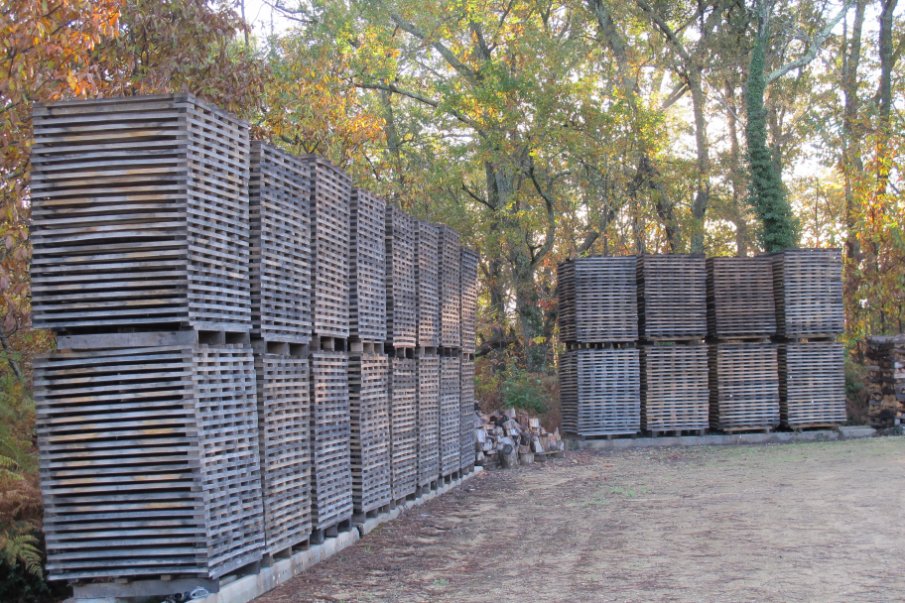
    The first stage of making barrels is to cut the trees into planks, and then let the planks air dry outdoors to remove harsher tannins. The rain washes the tannins out of them, leaving black streaks on the ground beneath the wood. (I've recently learned that tannins are dark and were used to make ink.) Nicholas Faith says that most makers air dry the planks for 5-6 years. 

    In making barrels for French brandy (and most wine as far as I understand, but wine isn't my area of expertise) barrels are not charred as they are for bourbon; they're toasted.  So they don't get that deep black charcoal coating on the inside of the barrels but more of a, well, toast-like browning. Cognac barrels are also larger than those for bourbon – 350 liters for cognac vs 200 for bourbon.

    While bourbon barrels are charred according to certain levels – char #4, etc. That terminology isn't used for cognac barrels. The char levels for bourbon relate to a certain amount of time under the flamethrower, and I'm guessing that's how they'd be designated for cognac/wine barrels as well – number of seconds near a flame but not burned by it. 

    I have visited at least three cooperages – two of them in France. This tiny one that makes 4 barrels per day in the Armagnac region, and Vicard in the Cognac region that makes 60,000 barrels per year. I wrote in the latter post:

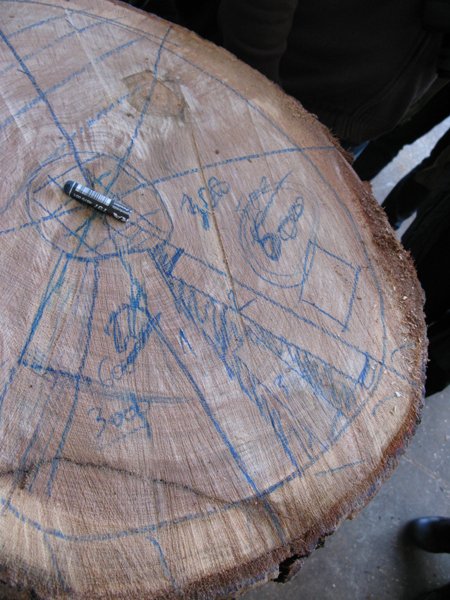
    American oak barrels were described as aromatic and useful in short aging of spirits, whereas French oak barrels have more tannins, add structure to wine and spirits, and are better for long aging. French oak barrels are more expensive, but that's also in part because they're cut differently than American oak barrels. French oak staves are cut so that only 30 percent of the log is used, whereas American oak staves use the opposite- 70 percent.


    6a00e553b3da2088340120a5e1945e970c.jpg


    The staves to make the barrels for Hine are 100% air-dried, according to Forget. While many staves for American oak barrels are kiln-dried, at least in the US. 

    In the next post, I'll write about what happens when the grape spirit is put in the barrels. 

    MRT_0253

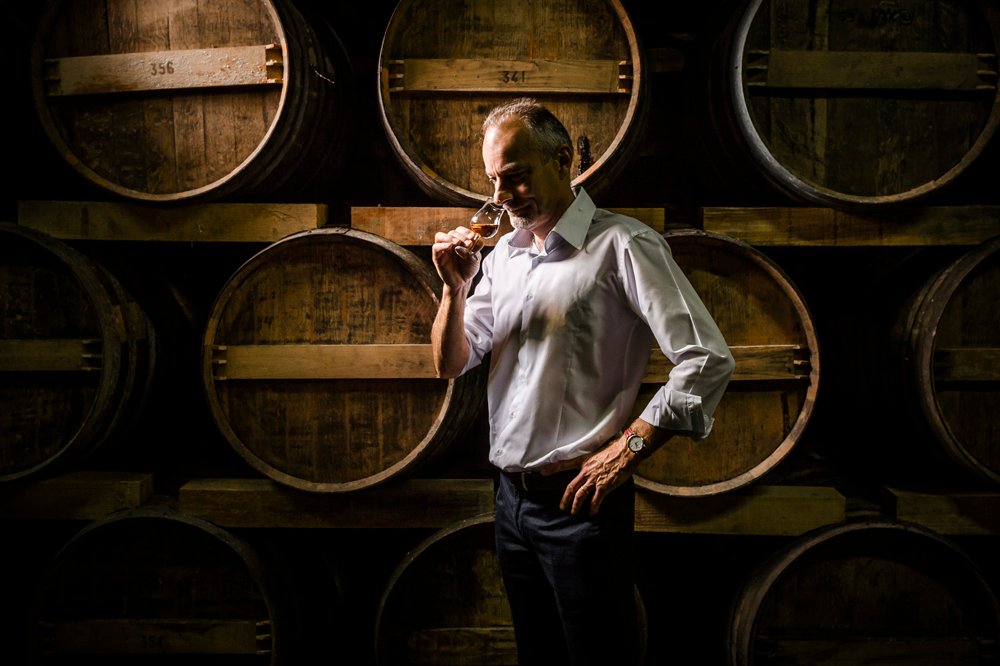
    Hine cellarmaster Eric Forget


    Note: This series of posts has been sponsored by Hotaling & Co, importers of Hine cognac. 

  • Make Clear Ice Balls Using a Thermos

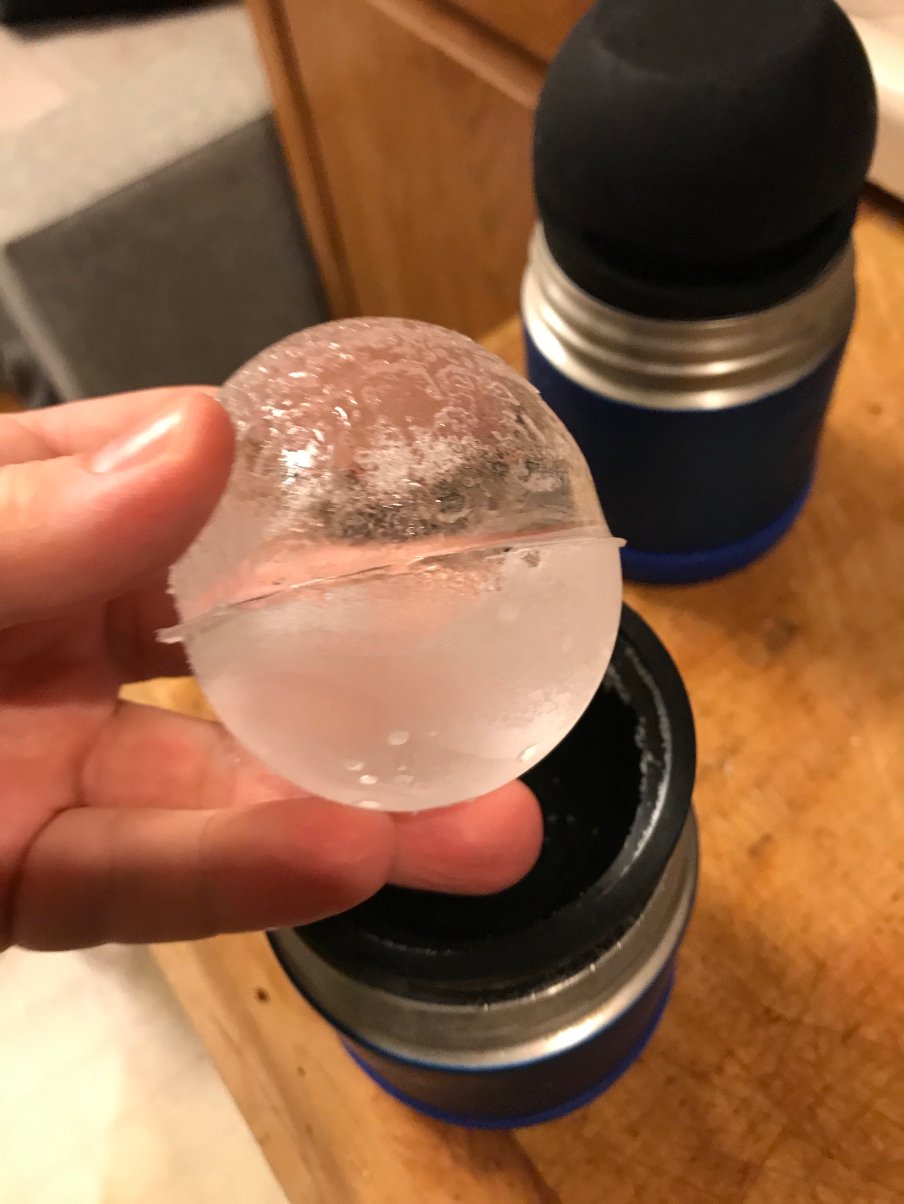
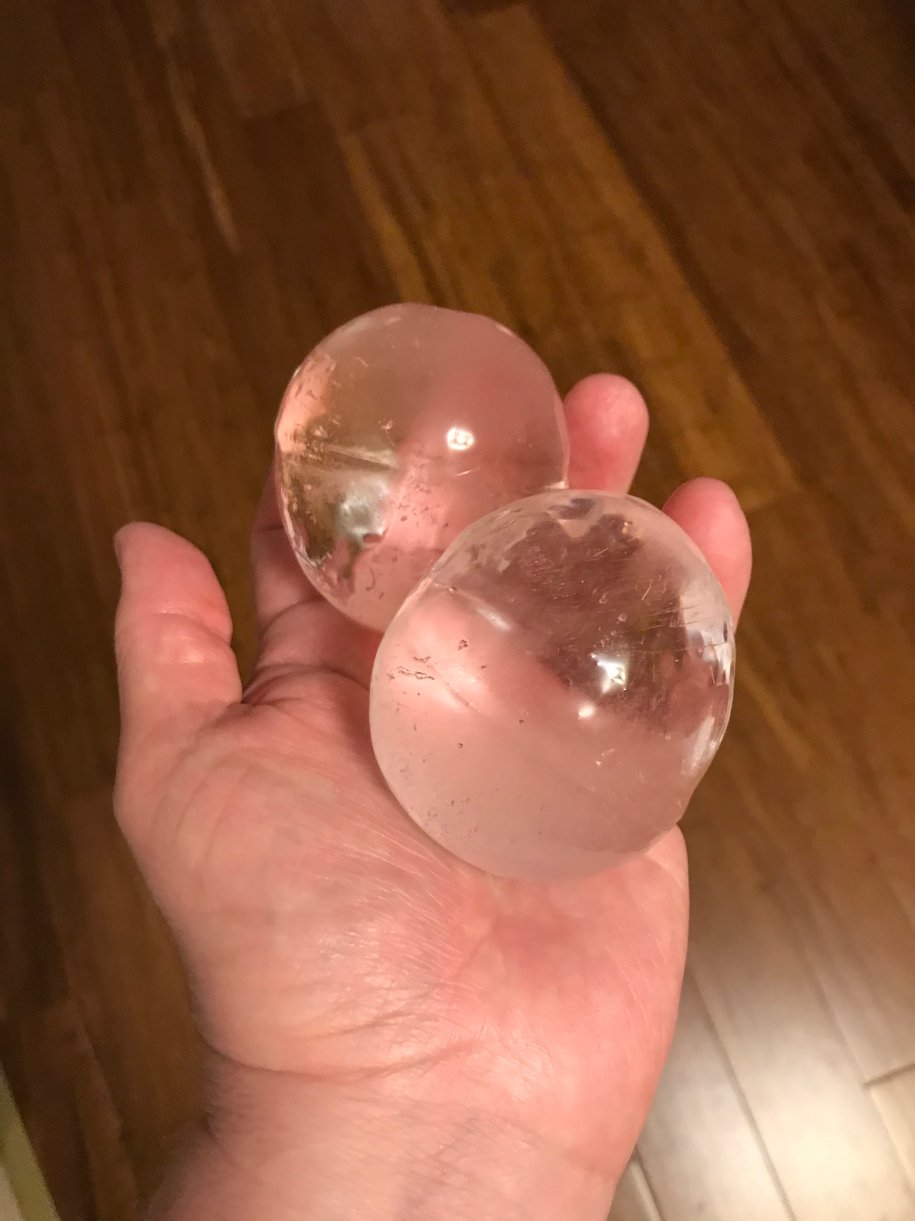
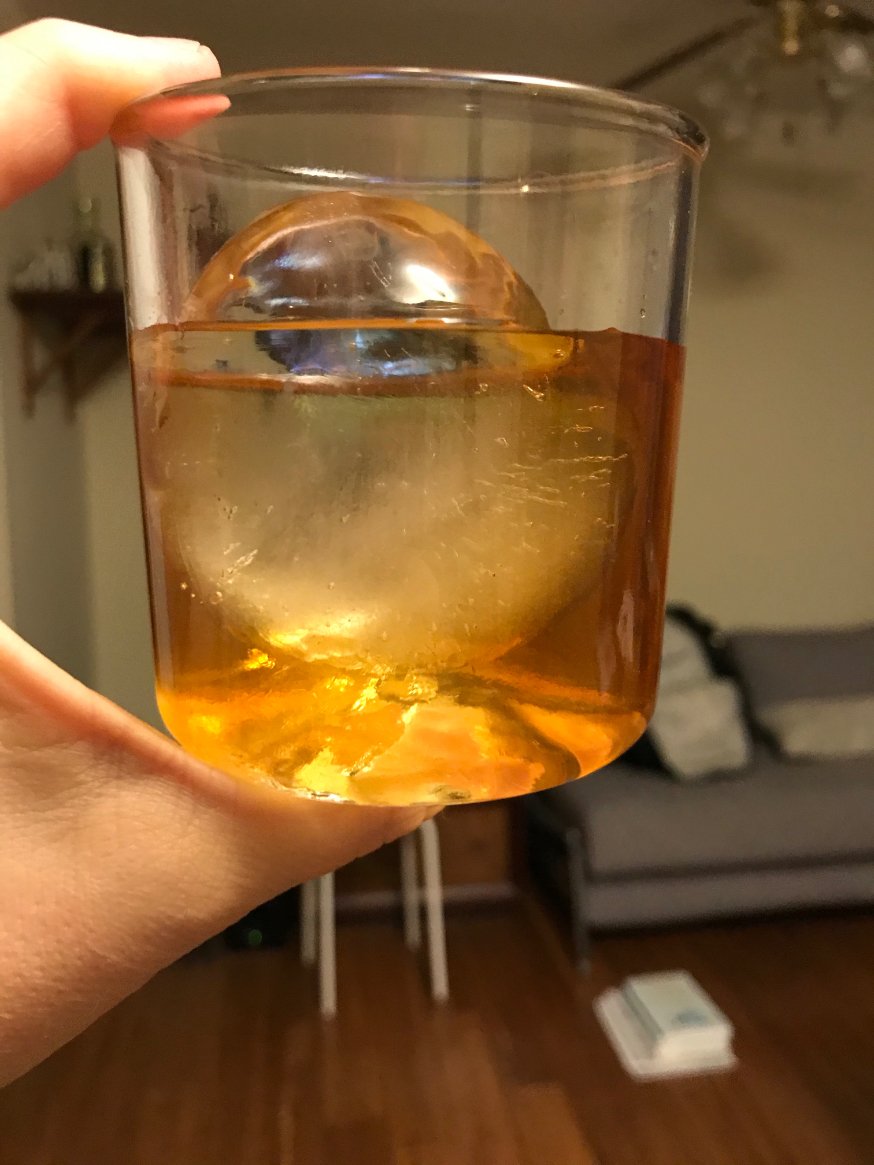
    Most readers of Alcademics are probably familiar with this by now, but I realized that in my many (many, many) ice posts here on Alcademics I don't have a straightforward post listing how I most often make large perfectly clear ice spheres at home. So I made this post to insert into my ice project index. 

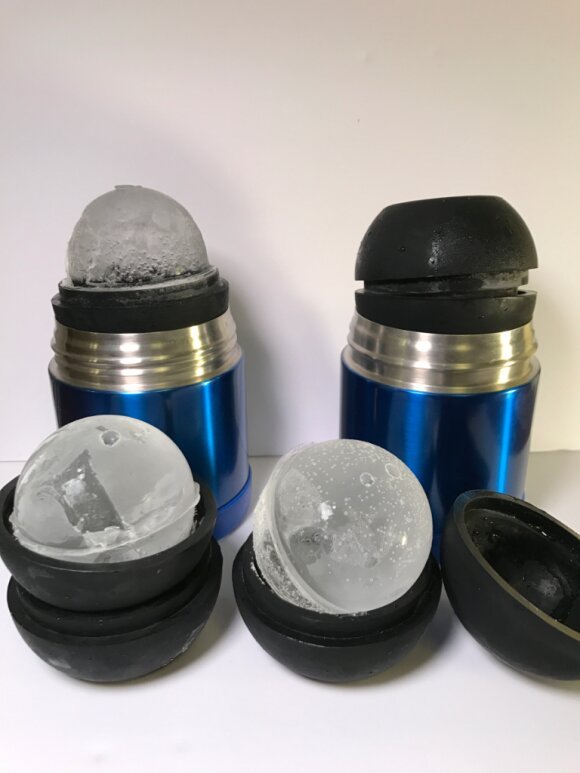
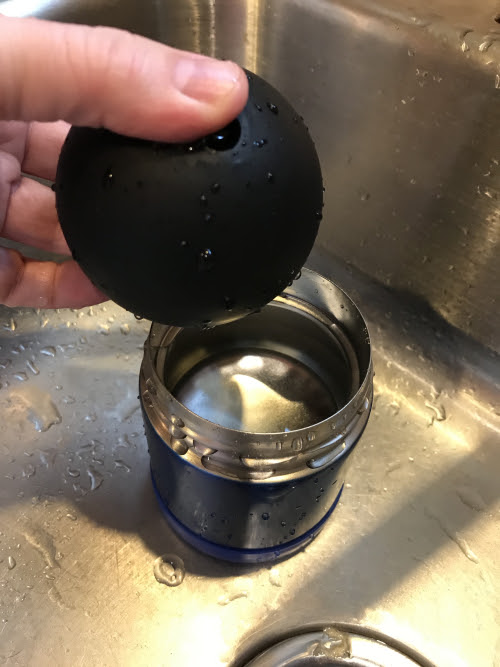
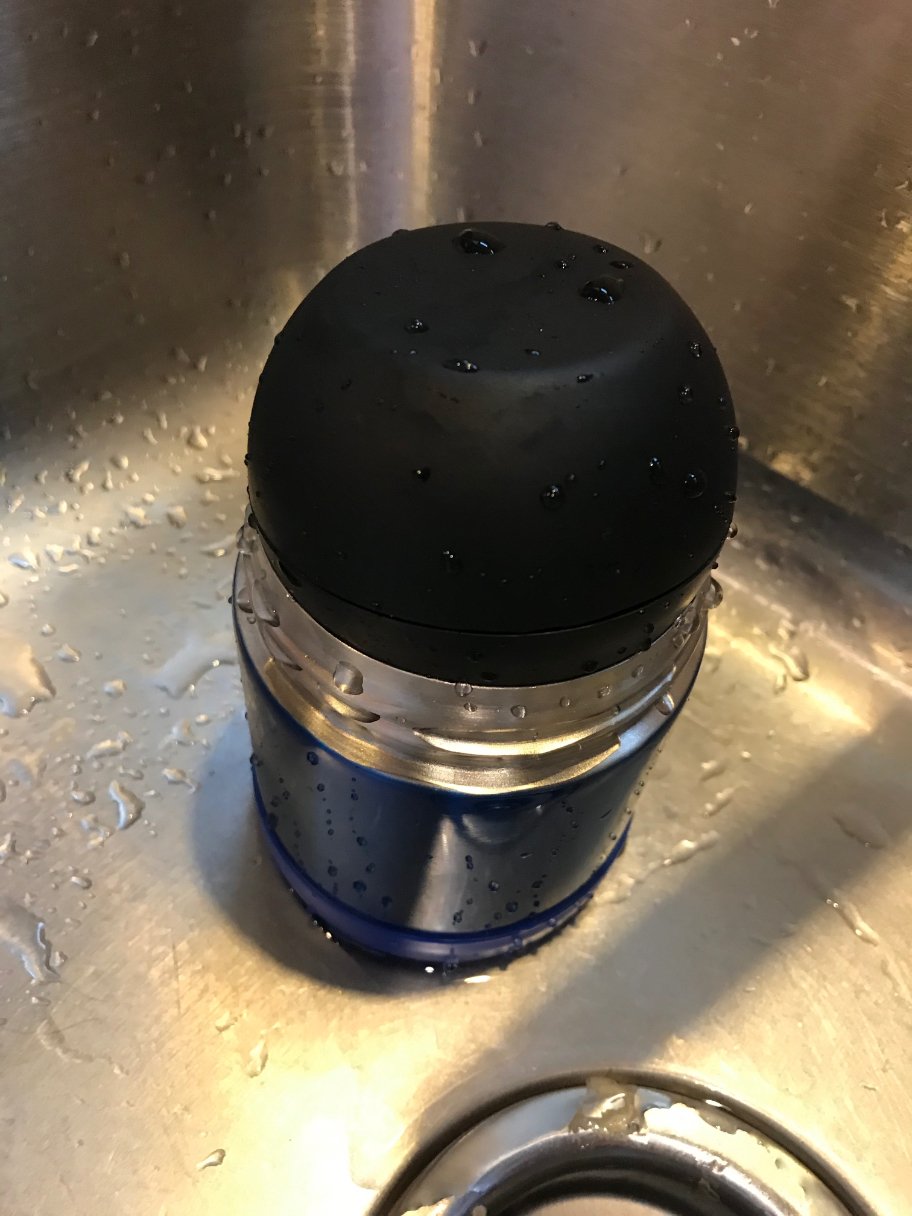
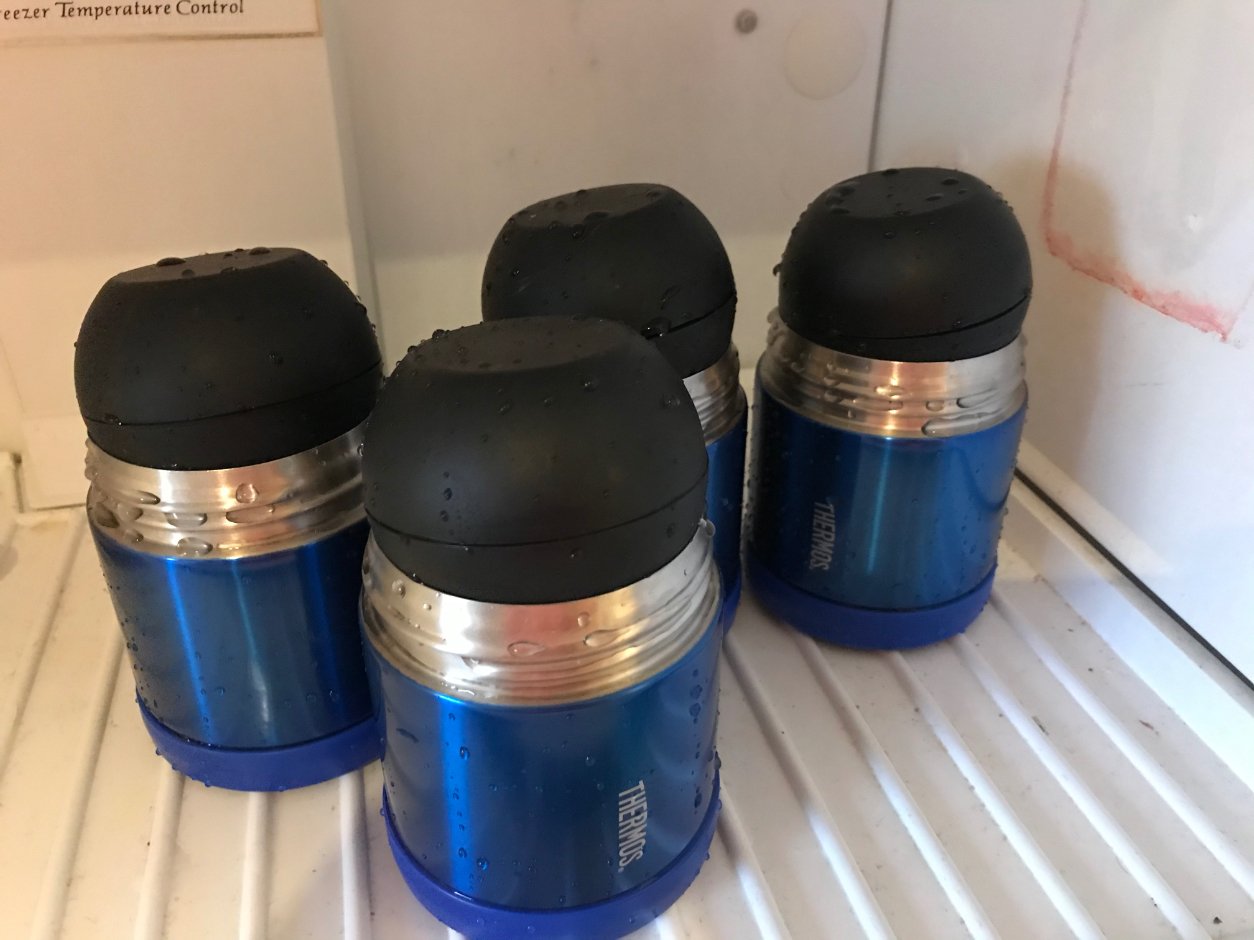
    6a00e553b3da2088340240a501d5c8200bThis method scales up so if you want to make 10 large clear ice balls at a time you can do so without taking up a lot of room or buying more expensive versions of this set-up. 

    The process is based on Directional Freezing (pushing the cloudy part of freezing water in one direction, in this case out the hole in the bottom of the ice ball mold). The particular thermos to use was the suggestion of a reader on Alcademics. You nerds are the best! 

    Equipment:

    Ice balls molds – You'll want the large, 2.5 inch ice ball molds that are circular. 

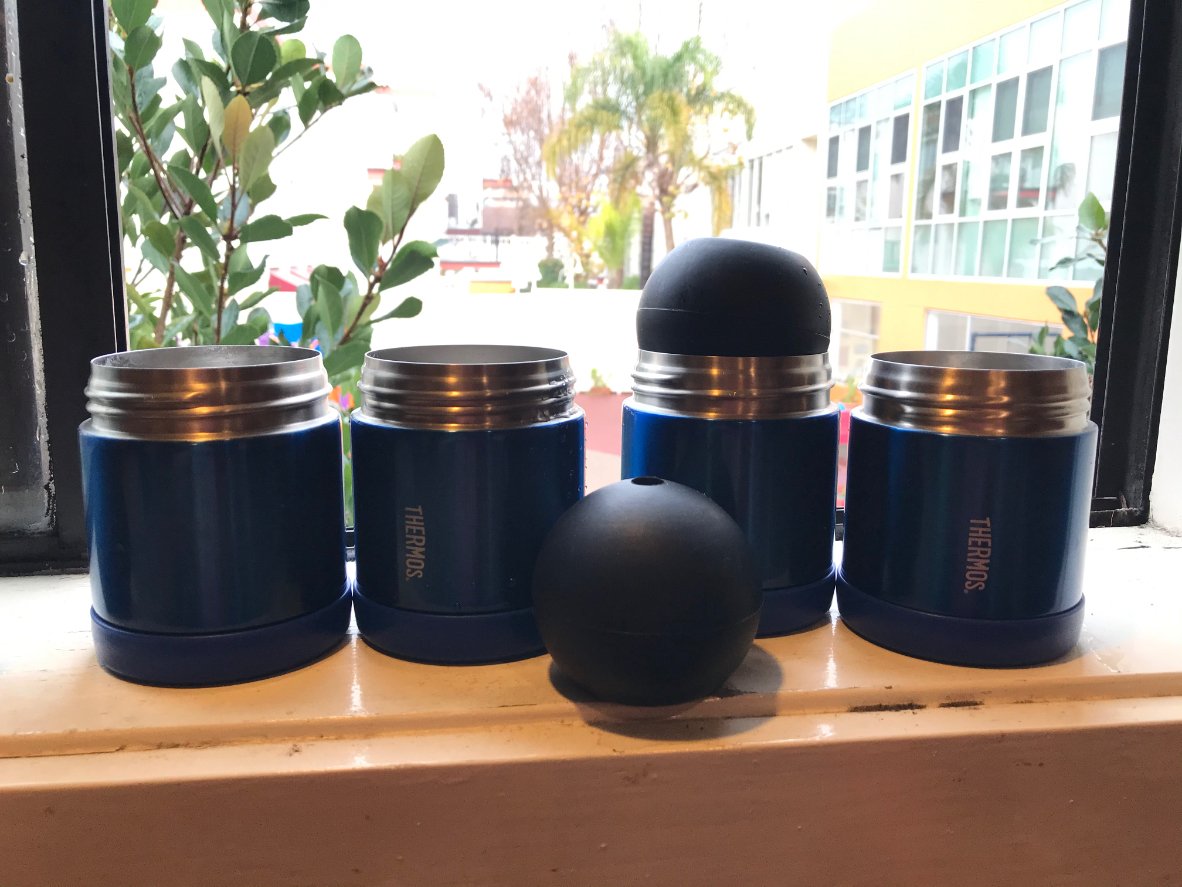
    Thermos – The most compact shape that fits these large ice sphere molds perfectly is these Thermos Funtainers. (You can use an insulated coffee mug or other thermos-style container if you want.)

    Process:

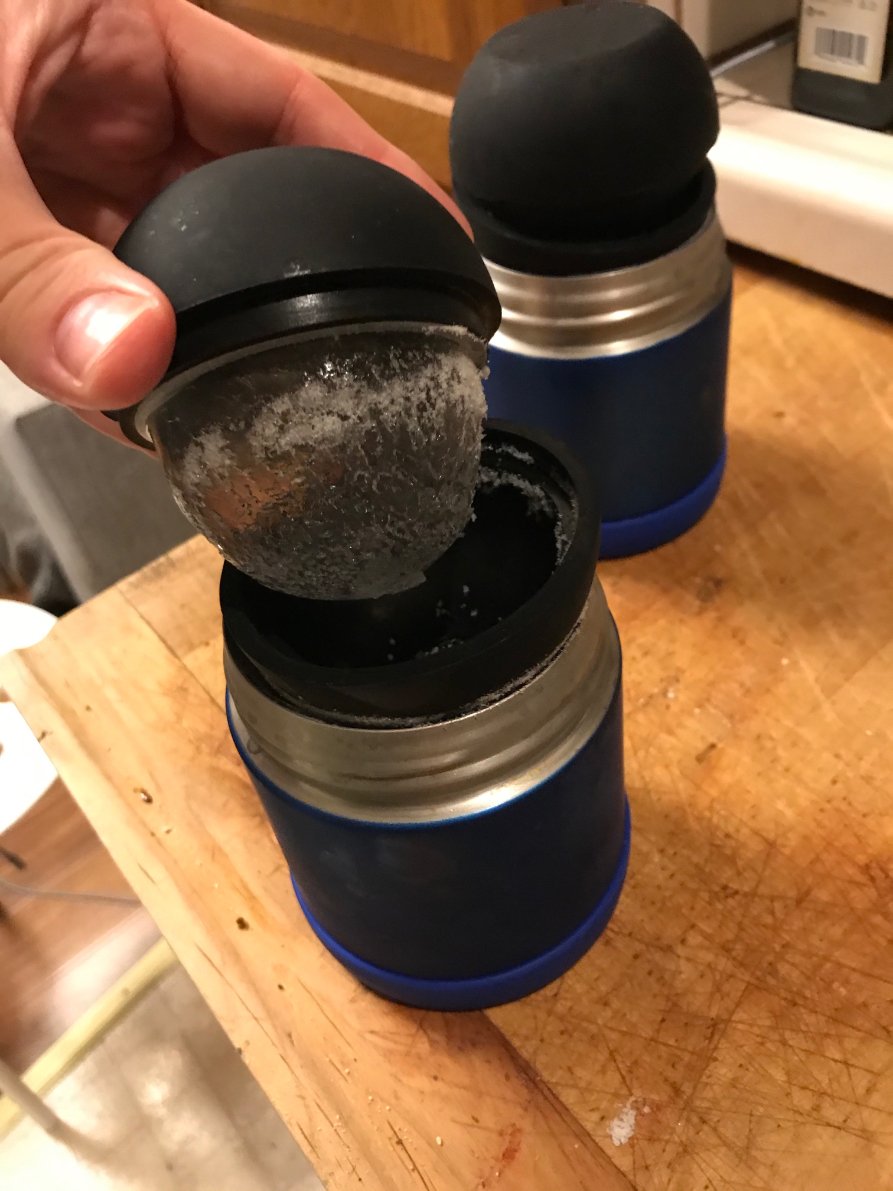
    1. Fill the thermos with water to the top. The water doesn't need to be distilled or boiled or any of that. 
    2. Fill the ice ball mold with water.
    3. Hold your thumb over the hole in the ice ball mold and place it upside-down on the thermos. The water will stay in the mold part as well as the thermos.
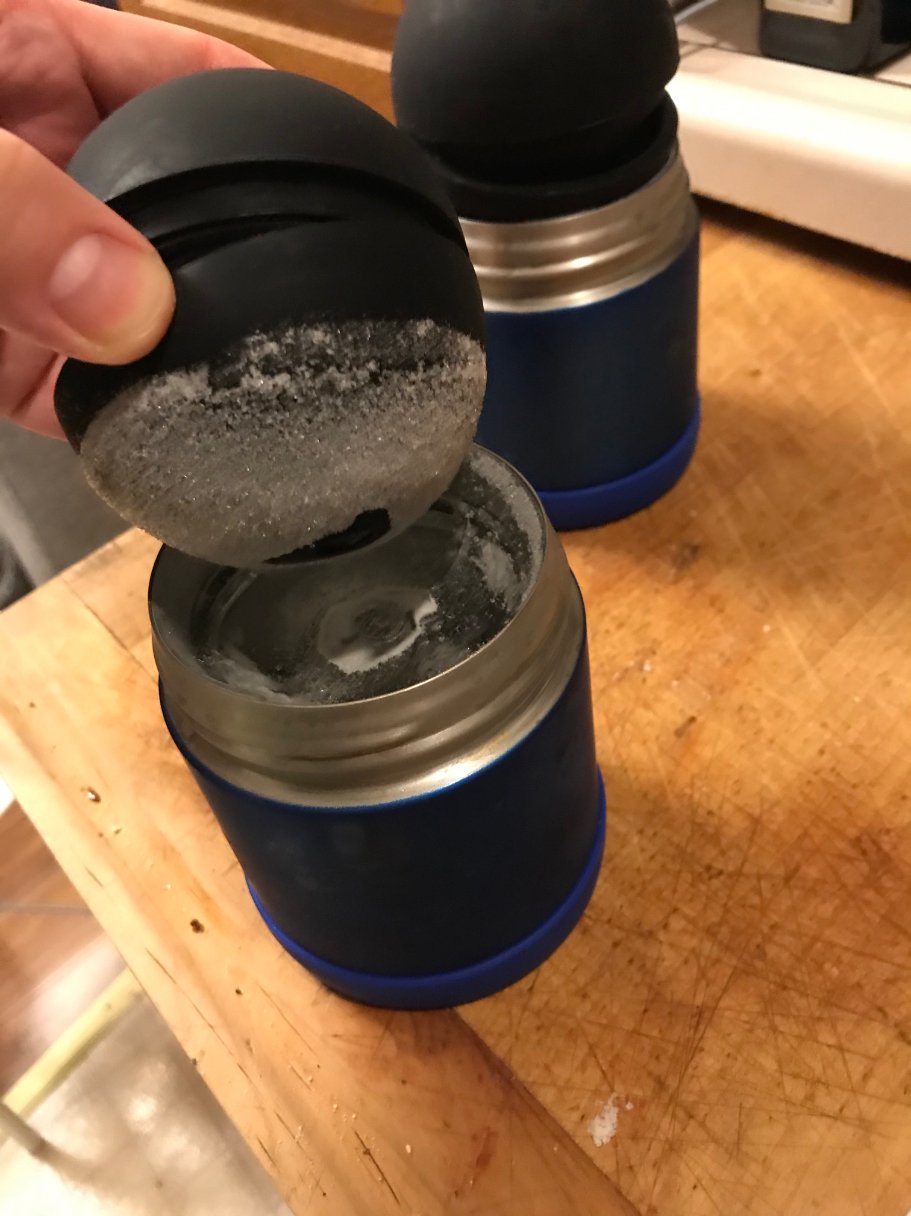
    4. Put it in the freezer. The ice ball mold part will freeze first because it is not insulated. As it freezes, clear ice forms first and it will push the cloudy part of the ice down out the hole in the bottom (because it's partially insulated sitting on top) and into the thermos. The thermos should only just be starting to freeze when the ice ball on top is done freezing. 
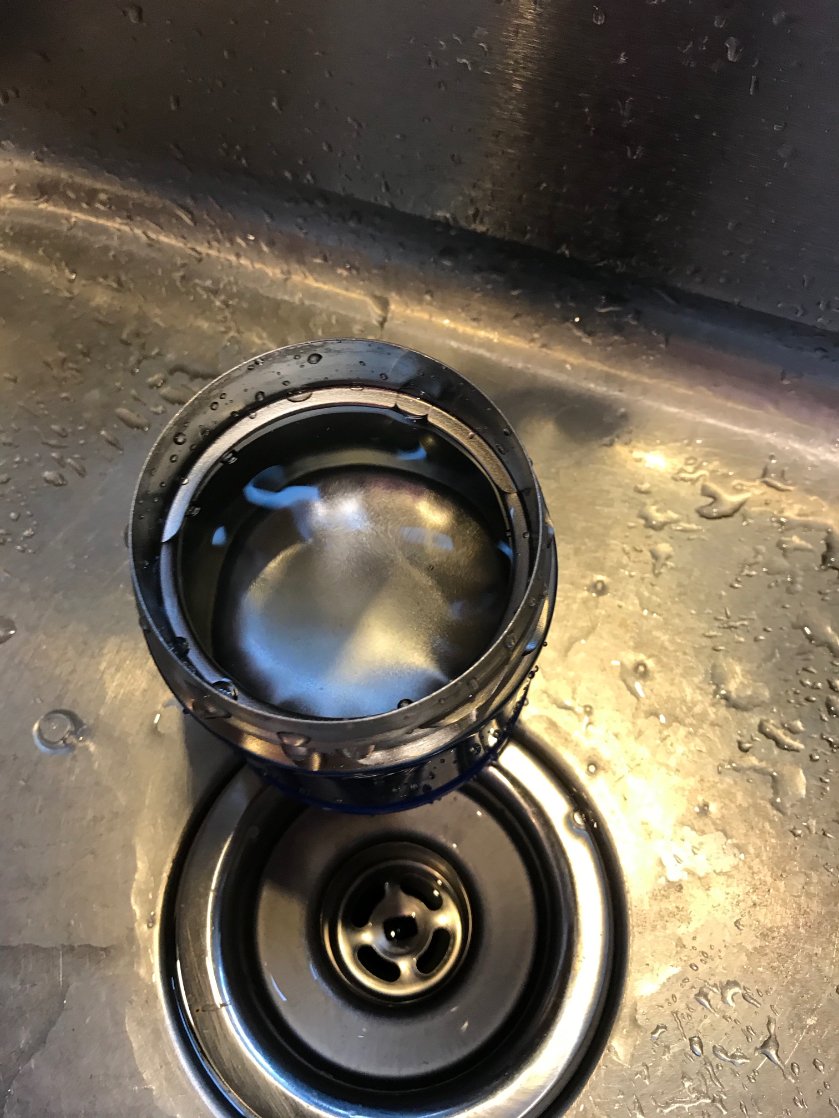
    5. Wait about 24 hours. Try not to let it go for more than a day and half or so, as you don't want the water in the thermos to completely freeze, as it expands and will deform your thermos, or even shatter if it's a glass-insulated thermos. 
    6. The ice ball mold should easily pop off the thermos and be perfectly clear or pretty darn close.

    Ice balls in thermos01
    Ice balls in thermos01Ice balls in thermos01Ice balls in thermos01

    Ice balls in thermos11
    Ice balls in thermos11
    Ice balls in thermos11
    Ice balls in thermos11Ice balls in thermos27
    Ice balls in thermos27

    Tips:

    • If your freezer is set on super duper ridiculously cold it may freeze too fast for this to work (it won't push the cloudy part out the bottom but instead into the center of the sphere). You probably don't need your freezer quite that cold!
    • If you're getting more of an egg shape from your ice sphere, try leaving a little space in the mold and/or thermos. 
    • You can also "polish" your egg-shaped ice sphere into a better sphere just using a clean dish cloth, or even just rubbing it in your hands.
    • If you're opening and closing your freezer and generally jostling the set-up, it tends to be cloudier. 

    Alternatives:

    Be sure to check out the many many other things you can do with ice at the Index of Ice Experiments on Alcademics


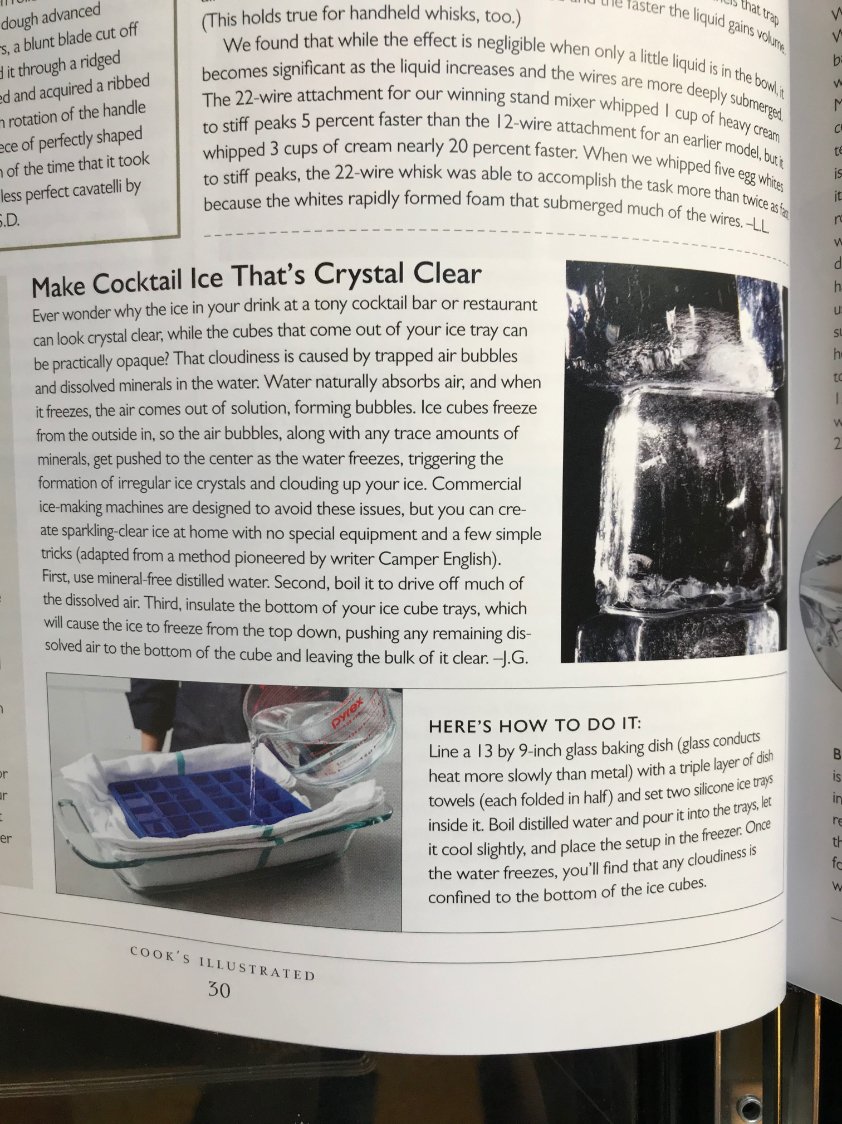
  • Clear Ice in Cook’s Illustrated

    Hopefully if you're a regular reader of Alcademics you know all about how to make crystal clear ice in a variety of ways, so you're not going to learn anything from this post!

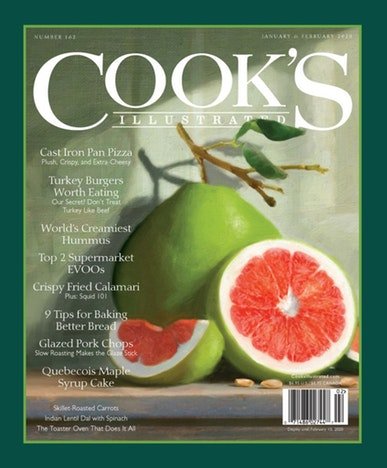
    I just wanted to denote and share for posterity a mention of my clear ice process was in Cook's Illustrated in the January/February 2020 issue.

    The section is online at this link.  

    Cook-s-illustrated-Cover-2020-January-1-Issue IMG-7511


    Interestingly, they also reposted the Clarified Milk Punch article that I wrote with Cook's Illustrated editor-in-chief Dan Souza. The story originally went up in 2016 on Cook's Science (RIP). However, they also recently produced a video about the process that you can view below.


  • Cognac Distillation On the Lees (Hine Series Part 2)

    I sent a list of 100 questions to the cellarmaster of Hine cognac, and am sorting through the answers in a series of posts. In the first post, we looked at cognac from grapes to wine. In this post, we'll take the wine through distillation. 

    The posts in this series are: 

    1. Cognac from grapes to wine

    2. Cognac distillation and the impact of distillation on the lees.

    3. Wood and barrels used for cognac.

    4. Aging conditions for cognac.

    5. The strange exception of early landed cognac.

    6. Dilution and Additives in Cognac.


    Hine cognac is located on the banks of the Charente River in Jarnac, one of the three principle cities of cognac production along with Cognac and Segonzac. Even before cognac was produced in the region (Hine dates to 1763), the river was used to ship salt. Now the river isn't used commercially as far as I know, but the moist air the pervades the cognac aging cellars near the river bank and plays a part in developing the character of cognac. Hine is also unique in that they sell "early landed" cognacs that aren't aged in the Cognac region, but in England. We'll talk about aging in a later post. 

    As we covered in the last post, it is common for cognac makers to own some of their own vineyards and purchase wine from other growers. Similarly with distillation, some brands distill more or less of their wine or leave it to the winegrowers to distill. 

    In the case of Hine, as I learned when I visited in 2014, nearly all of their wine is distilled at a distillery called St. Denis. This distillery works with a lot of brands – they estimated that Hine is only 10 percent of their output. 

    Cognac Distillation

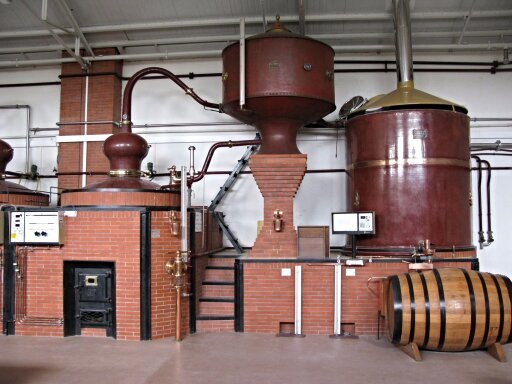
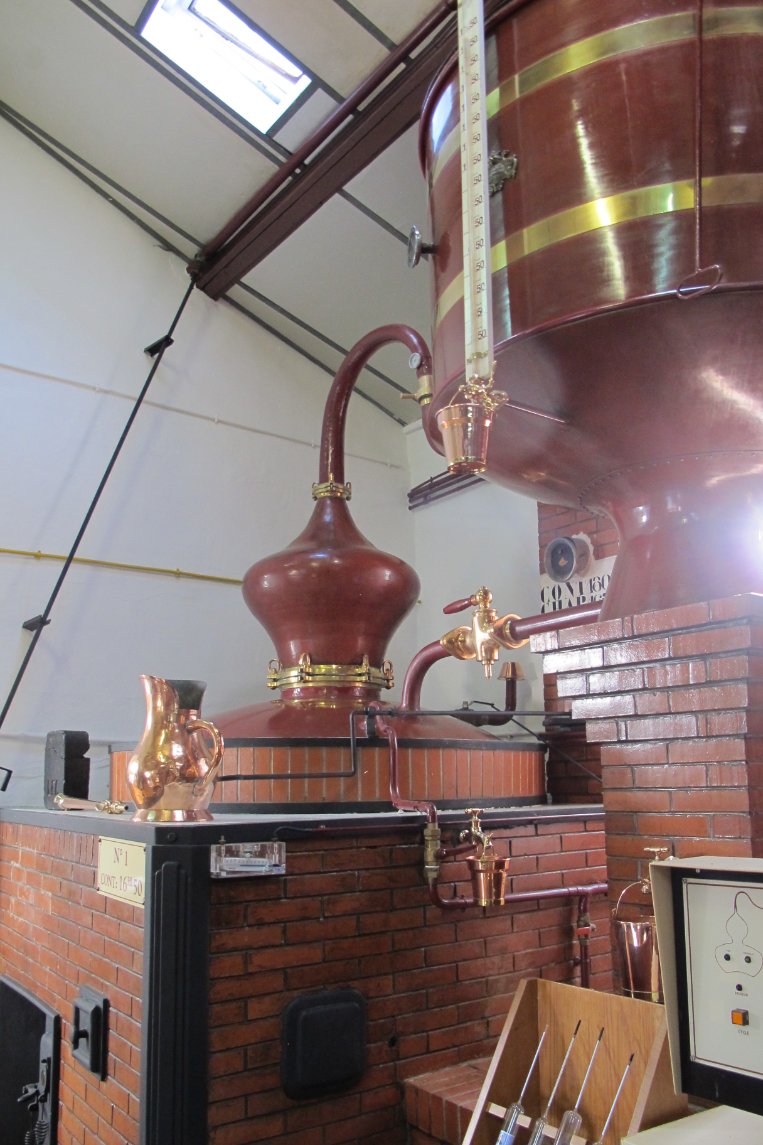
    Legally cognac must be twice distilled in direct-fired Charentais pot stills, and distillation of the wine (which is stored without sulfur preservative) must be completed by March 31. 

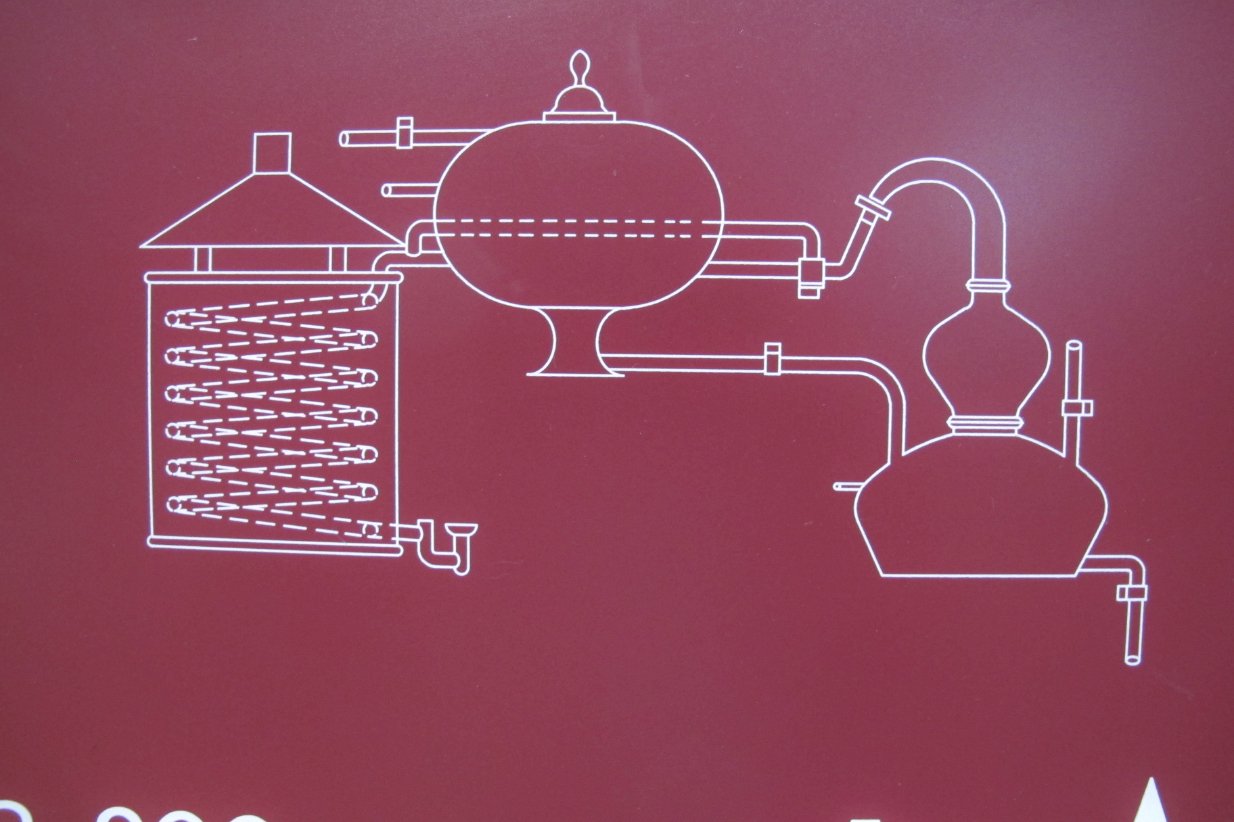
    A diagram of the Charentais still is below. You'll recognize the pot still with it's bulb cap on the right, and the coil for the condenser that cools vapor to liquid on the left. But what's that thing in the middle?


    6a00e553b3da20883401b7c72ad558970b

    That's the wine warmer, an efficiency enhancement fairly particular to cognac production. Before distillation, wine is stored in there, and during the previous distillation run (wine in the still), a tube runs through the wine warmer on the way to the condenser. This heats up the wine so that when it is put into the still for the next distillation run they'll have to expend less heat/energy to do so. Smart! 

    The wine that comes into the distillery (at about 9% ABV) is distilled up to 30% ABV after the first distillation. They make a heads and tails cut after the first as well as the second distillation. The second distillation brings the spirit up to 70-72% ABV.

    Each distillation takes about 12 hours, so it's a full day for each still's worth of wine to be processed into eau de vie. You can see why they need from the end of harvest in the fall until March 31 to complete distilling all the wine for cognac. 

    Now, as cognac brands working with winegrowers pre-specify the strain of yeast to be used, they also specify distillation parameters such as the number of liters collected (the size of the heart cut), the speed of distillation, and whether or not to distill on the lees. I asked Hine Cellarmaster Eric Forget if they specify this all in advance or if it changes along the way. He wrote, "Everything is fixed by tasting, and could be changed every week." 

    Everything except for distilling on the lees that is. 


    6a00e553b3da20883401b7c72ad569970b


    Distilling with the Lees

    Lees are the dead yeast cells left over from fermentation. Some brands distill "on the lees" and others filter them out first. As lees are solids, there is always the danger of them sticking to the bottom/sides of the still and burning, creating off-flavors. Forget says this is a "crucial point" about distilling on the lees and the care that must be taken. 

    I wanted more information about distilling on the lees, so I went to the definitive source, Nicholas Faith's Cognac (2004 edition). Some quotes from that section (p24):

    Moreover the lees need protecting from the air before the wines are distilled and cannot safely be used late in the distillation season, once the external temperature has risen much about 10C. 

    And, as one distiller pointed out, "lees means that you need time for the brandies to mature and provide their additional complexity." 

    The yeast lees contain a number of esters, including three fatty acids, which turn out to be absolutely critical in giving the cognac its much prized rancio (a particular rich, cheesy flavour) quality when it is in cask.

    … virtually all the producers in the Grande Champagne I have come across distill on at least some of the lees, if only because they are producing brandies destined to mature long enough to absorb the resulting richness in the brandy. 


    I decided to look up which brands distill on the lees and which do not. I had heard of the "Big Four" brands (Hennessy, Remy-Martin, Martell, Courvoisier) that only Remy distills on the lees, but when I went to confirm that I ran into inconsistent information. 

    Distill always on the lees: Hine, Remy [source], Camus, Frapin [source], Louis XIII [source]

    Does not distill on the lees: Martell 

    Some with and some without: Courvoisier and Otard/D’ussé [source], though Courvoisier's website says it does distill on the lees but doesn't specify if it always does [source]. Hennessy distills on "fine lees" [source]. But overall I wouldn't count on the accuracy of this information – my guess is that some of their eau de vie may be distilled on the lees but generally not. As we learned from the Nicholas Faith book quotes, VS cognac (only lightly aged) wouldn't be a good fit for brandy distilled on the lees and we know in the case of Hennessy for example that VS is something like 80 percent of their sales. 

    In any case, back to Hine: I was wondering if there is such thing as "reduced lees" or "partial lees" or something like that to impact flavor to a lesser extent. Forget said (speaking about Hine specifically), "We distill all lees but filtered to avoid big impurities. There is never too much lees."

    So what the impact of lees? Usually we hear that they add a nutty taste and more creamy body/texture to the resultant eau de vie; that distillation with lees allows for a "more complex" spirit versus a "cleaner" spirit without. 


    6a00e553b3da20883401bb07cef1df970d


    Flavor Impact of Distillation on the Lees

    I asked cellarmaster Eric Forget what are the production parameters that he felt make the most impact on determining Hine's house style – what makes Hine Hine? He noted that distillation on the lees was the second most important factor in Hine's flavor profile: 

    He said:  "Terroir has the most impact. Only (grapes from Grande and some Petite) Champagne region." Second, "Distillation with lees." Third, "Aging in fine, medium-grain oak barrels that are lightly charred." and fourth, "The differentiation is made with these three key points together, and a balance between the elements of the raw material (wine) and the wood." 

    We'll cover those third and fourth factors, among others, in the next several posts after the new year. 

    And if you haven't read it yet, check out the first post, "Cognac from Grapes to Wine."


    Note: This series of posts has been sponsored by Hotaling & Co, importers of Hine cognac. 


    Medsker_Hine_Day01_197

    © Eric Medsker


  • Cognac from Grapes to Wine (Hine Series Part 1)

    This is the first in a series of posts I'm doing with Hine cognac. I sent Hine cellarmaster Eric Forget a list of one hundred questions (really) about Hine's production a few weeks back, and am sorting through the answers over several posts. 


    The posts in this series are: 

    1. Cognac from grapes to wine

    2. Cognac distillation and the impact of distillation on the lees.

    3. Wood and barrels used for cognac.

    4. Aging conditions for cognac.

    5. The strange exception of early landed cognac.

    6. Dilution and Additives in Cognac.


    For those unfamiliar with Hine, it's a brand founded over a quarter century ago in 1763. Beyond offering VSOP and XO blends, they have a whole series of vintage-dated cognacs and "early landed" cognacs that I'll write about in a future post. 

    We'll first talk about making the wine for cognac, and later cover things like distillation, aging, bottling and filtering. 

    The Vineyards

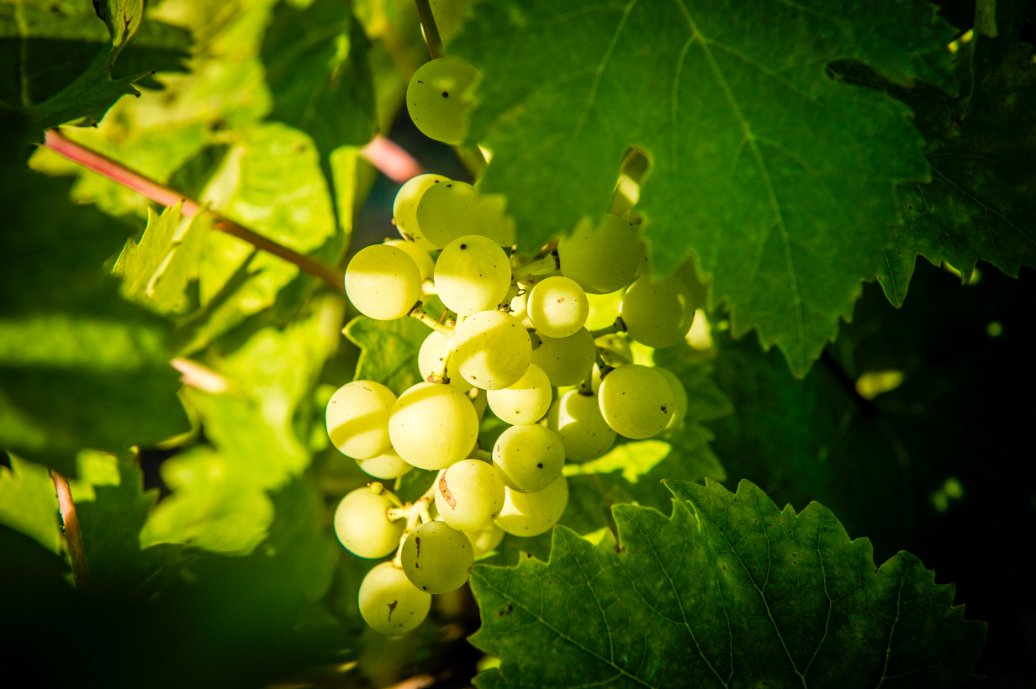
    MRT_0537Grapes for cognac must come from the Cognac region, which is split into six crus. Grande Champagne is the central and most important cru, followed by Petite Champagne, Borderies, Fins Bois, Bons Bois, and the Bois Ordinaires/Bois a Terroirs. The latter includes an island! 

    Grapes grown in Grande Champagne are considered best for long-aged cognacs with floral notes dominant, according to the website of the BNIC, the "coordination and decision-making body for the Cognac industry." Petite Champagne has similar soil type but according to the BNIC's website, there is more influence from the ocean climate in the region; and it produces grapes with more predominant vine flower and fruity notes.

    I asked Eric Forget if there were really large differences in grapes from the two regions and he replied, "It could be very subtle in accordance with the location and terroir," which I think means "not really." I followed up by asking if you could tell by eating a grape which cru it came from? The answer was a solid "no." 

    The other crus are known for bringing out notes of violet (Borderies), pressed grapes (Fins Bois and Bons Bois), or general fruit (Bois Ordinaires) when distilled.

    Hine uses only grapes from Grande Champagne for most of their older bottlings – the XO Homage and Antique, and other bottlings including Triomphe, plus the vintages we'll get into on a later post. For the XO Cigar Reserve, they use Grande Champagne, Petite Champagne and Fins Bois distillates.

    For Hine's VSOP products (H by Hine and Rare) they use Fine Champagne – which is the technical term for cognac with grapes from both Grande and Petite Champagne. 


    33.-fermeture-de-la-grappe-©CK-Mariot-Photography_0016

    Photo: CK-Mariot-Photography courtesy of Hine


    Growing Grapes 

    As seems typical, Hine owns some of their own vineyards but purchases most of their wine from winegrowers. Hine owns 70 hectares (173 acres) of vines in the Grande Champagne region, and this supplies about 30% of the total wine they need. This seems like a lot relative to the larger brands. 

    I asked Forget why not skip the hassle and just buy all the wine rather than make your own? He said, "The first reason is to secure the supply, and of course to make super wines." And do they consider their wine superior to that of the winegrowers from who they purchase wine? "We try to do our best but we select also the suppliers for their professionalism." 

    I asked what specific instructions Hine gives to winegrowers – how the grapes are treated, when to be harvested, etc? Forget said, "We give them a quality chart for production and keep in touch all along the year. For the cultivation, the appellation itself is very strongly involved in these topics." 

    That's pretty interesting and makes sense – it's not only the growers or the cognac makers/brands that get input as to the treatment and quality of the raw material for cognac, it's the region's administration that will have a say to ensure quality standards. I bet those meetings get… tense as conditions change every year. 

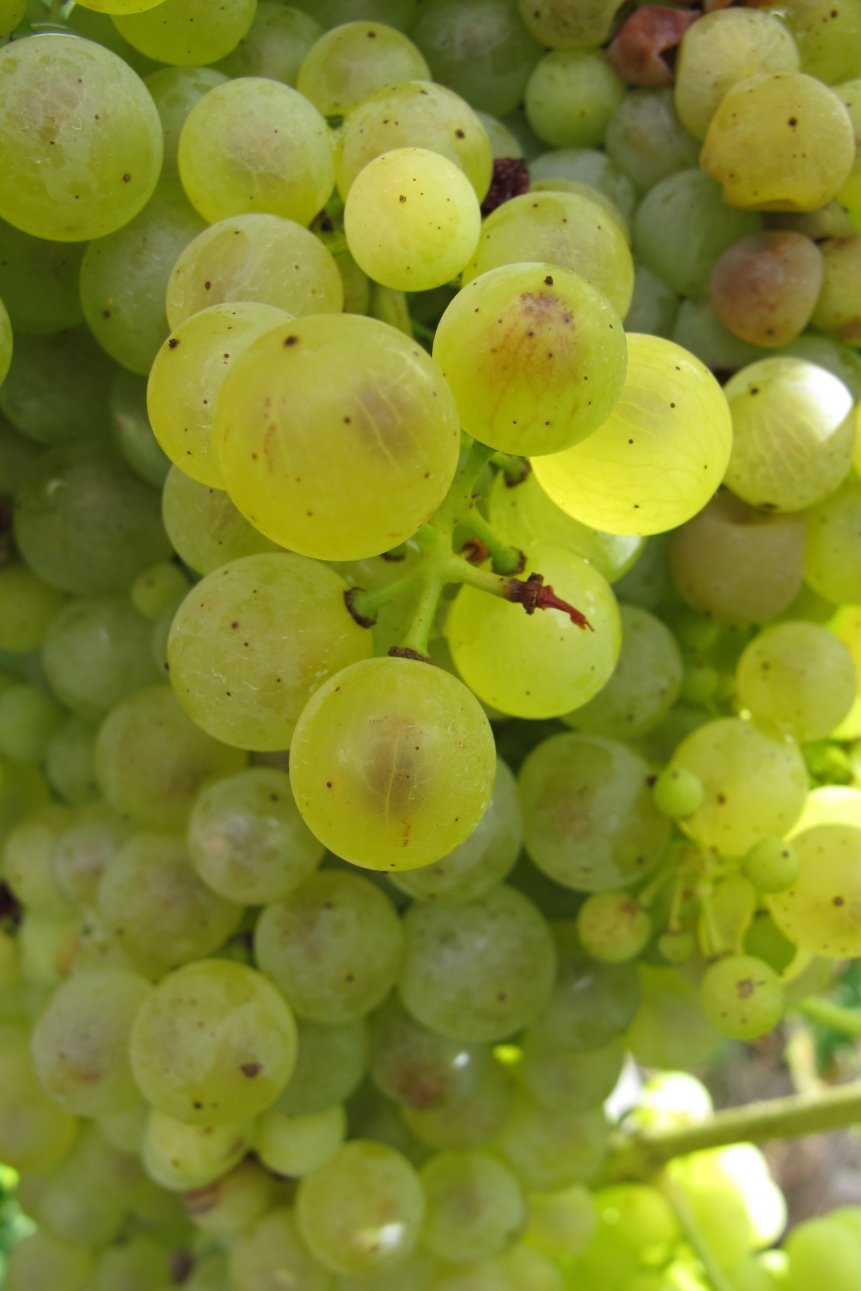
    By the way, 98% of the grapes are ugni blanc in Cognac. 


    Making Wine

    Forget says they use dry commercial yeast, and start fermentation at 17 C (63F). Fermentation continues until it completes naturally, so it will generally undergo some malolactic fermentation. 

    I don't know a lot about malolactic fermentation and its impact on distilled spirits – perhaps that's the subject for a future post! But for now here is some malolactic fermentation information stolen and condensed from Wikipedia:

    Malolactic fermentation is a process in winemaking in which tart-tasting malic acid, naturally present in grape must, is converted to softer-tasting lactic acid. Malolactic fermentation is most often performed as a secondary fermentation shortly after the end of the primary fermentation. The process is standard for most red wine production and common for some white grape varieties such as Chardonnay, where it can impart a "buttery" flavor.

    The fermentation reaction is undertaken by the family of lactic acid bacteria. Malolactic fermentation tends to create a rounder, fuller mouthfeel. Malic acid is typically associated with the taste of green apples, while lactic acid is richer and more buttery tasting. Grapes produced in cool regions tend to be high in acidity, much of which comes from the contribution of malic acid. Malolactic fermentation generally enhances the body and flavor persistence of wine, producing wines of greater palate softness. 

    38.-maturité-©CK-Mariot-Photography_0476

    Photo: CK-Mariot-Photography courtesy of Hine


    On my previous visit to Hine (I wrote about it in this blog post), Forget predicted that he expected to harvest grapes that would make 9.5% alcohol wine at about 3.4 pH that year. 

    I asked him what is the usual range for ABV and pH in wines for cognac, and he said 9 to 11% ABV and 3.2 to 3.5 pH. [Note that this is pretty acidic – while limes and vinegar both hover in the 2-3 pH range]. In addition to the pH and potential ABV (based on the sugar content of the grapes), then temperature must also be taken into account for fermentation.

    Harvest usually runs September and October, and grapes are pressed right after harvest and made into wine. No sugar is allowed to be added in this process, and the wine is not preserved with sulfites as it would really mess up distillation later. 

    Distillation, which we'll get to in another post, is done in pot stills which are slow and inefficient, so this means that all the wine made after harvest has to be stored and kept fresh until it can be distilled. With no sulfites to preserve it, the BNIC has set a legal cut-off date: all the wine for cognac must be distilled before March 31.


    Stay tuned for another cognac post next week. 


    Note: This series of posts has been sponsored by Hotaling & Co, importers of Hine cognac. 


agave alcademics Angostura bartenders bitters bodega bourbon bowmore Campari Camper English chartreuse clear clear ice cocktail cocktail powder cocktails cognac curacao dehydrated dehydrated liqueurs dehydration directional freezing distillery distillery tour distillery visit france freezing objects in ice hakushu harvest history how to make clear ice ice ice balls ice carving ice cubes ice experiments isle of jura jerez liqueur makepage making clear ice mexico midori molasses orange orange liqueur penthouse pisco potato powder production recipe Recipes rum san francisco scotch scotch whisky sherry spain spirits sugar sugarcane sweden tales of the cocktail tequila tour triple sec visit vodka whiskey whisky