Alcademics reader and ice nerd Mike Palmer has come up with an easy if not space-efficient way of making clear ice cubes using a silicone tray and a cooler.
The short answer is: poke holes in the tray and set it on a riser at the bottom of an insulated cooler.
The long answer? Palmer wrote it himself below.
How to easily make perfect clear ice cubes, repeatably, from a tray
By Mike Palmer
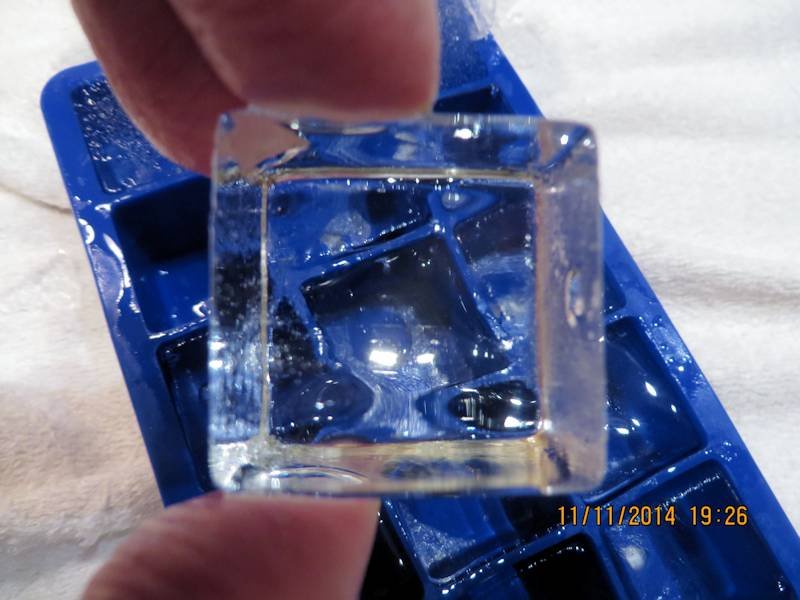
Here’s an easy way to make clear ice cubes in your freezer using an ice cube tray, obviating the need to carve individual cubes out of a block of clear ice.
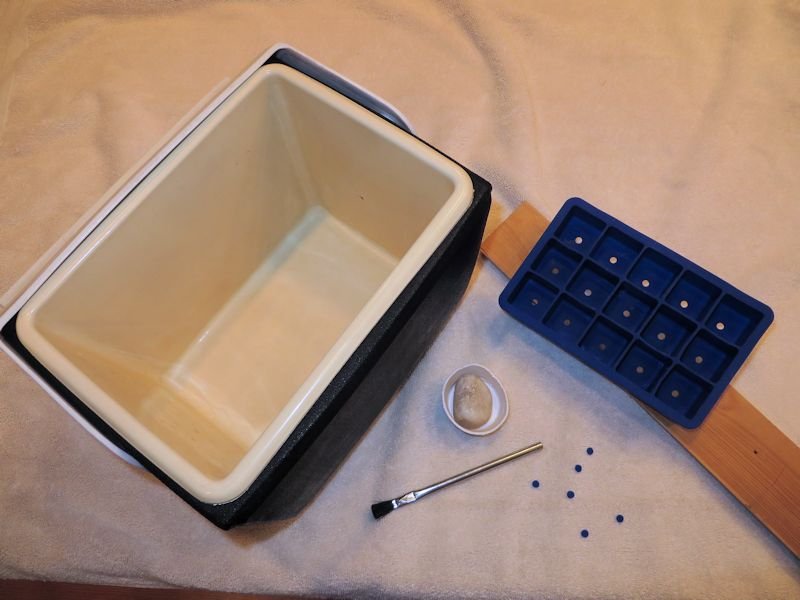
What you'll need: A small "Igloo" type cooler that fits in your freezer. A flexible, silicon ice cube tray with holes punched through the bottom. Something to make those holes, perhaps along with a piece of soft wood. A paper or Styrofoam cup. A rock. And of course, a freezer.
If TLTR, skip down to “How to do it.”
Background
I became obsessed with trying to make clear ice cubes at home (and later, clear ice spheres) after watching David Rees' How to Make an Ice Cube in his "Going Deep" series on the National Geographic TV channel. How hard could it be? (Ha!)
BTW, after finally succeeding at making clear ice cubes, I found that there are tangible benefits from using them in your drinks. (Even if drinking water.) In addition to lasting longer (because they’re pure ice and not ice/air), clear ice cubes also taste better because they’re pure ice. That is, they don’t have yucky tasting freezer air in them. Also, women like the aesthetics of clear ice and they notice—and like—the sound clear ice cubes make clinking in a glass. (Sure to please.) Freezer cubes don’t clink. They clunk. And now you’ll notice every time you hear a sound track in a movie or on TV.
In Theory
In David Rees’ TV program, he showed how clear ice forms in nature when a body of water slowly freezes from the top down with a substantial mass of warmer, unfrozen water underneath. (Alcademics readers knew this back in 2009. See https://www.alcademics.com/2009/11/another-clue-to-ice-clarity-slow-freezing-like-a-japanese-pond.html.)
And he suggested on his website that you could make a block of clear ice by kinda imitating nature, by letting a pan of water cool in a freezer. Although that’s not really imitating nature since the water in the tray freezes from the outside in on all sides.
So freezing a pan of water does not make a clear block of ice, as even Mr. Rees concedes. Air still gets trapped in the middle, so you have to cut the “outer edges of your ice block” to harvest clear ice.
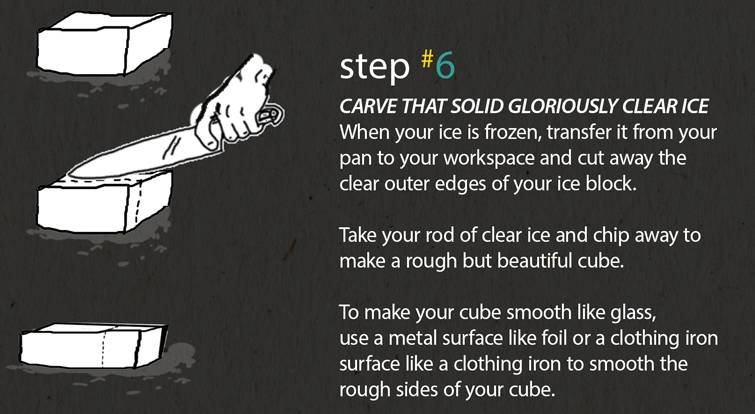
And even if the block were totally clear, you would still have to carve away at it to make individual cubes. And then you’d have to smooth six edges of each cube. that’s very time consuming, not to mention dangerous, working with sharp edged instruments on slippery ice.
Rees’ suggestion for making clear ice works better if you use the slow freezing method, using a dorm style fridge set to 30 degrees, as Mr. Kevin Liu has suggested. https://sciencefare.org/2012/07/12/weird-science-ice-premium-ice-home/
[note: the above link redirects to spam, try the Internet Archive version instead: https://web.archive.org/web/20150316061948/https://sciencefare.org/2012/07/12/weird-science-ice-premium-ice-home/]
But you still get air in your cubes that way. Here’s a photo of an ice cube made that way. Air is still trapped in the last part of the cube to freeze. In this experiment, with only the center trays filled, that’s the bottom middle.
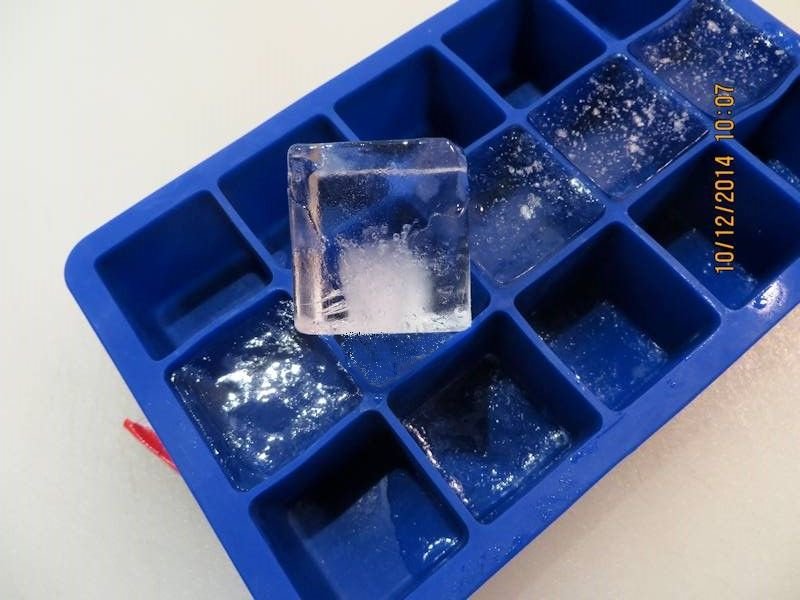
(I hypothesize that air is sucked into the cube when the last bit of water expands as it freezes. It lifts the cube up and pulls a vacuum underneath. Interestingly, air gets trapped in different places in the different cubes depending on whether a cube has a sister cube (or cubes) next to it. You can tell what position in the tray the cube had come from based on the distribution of air trapped inside it. In one experiment, I filled the tray in a checkerboard fashion, so that no cube shared a side with another cube. Only their centers were cloudy.)
In Practice
What to do? I tried the slow freezing method, which was supposed to do the trick. But it didn’t.
Fortunately we have the Internet. After searching around on youtube and seeing people consistently recommend “directional freezing,” I found Camper English’s Index of Ice Experiments on Alcademics. Camper was years ahead of everyone else.
In Camper’s landmark experiment, he found that freezing water in molds in a cooler (that is, from the top down) gave clear ice.
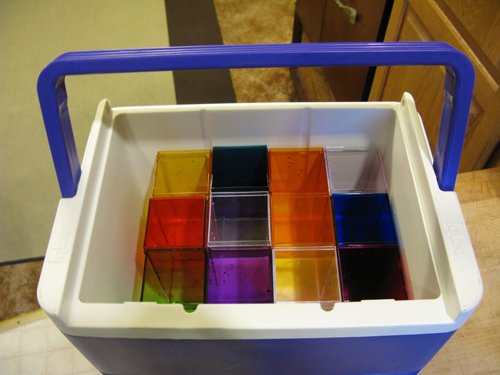
Except that air got trapped in the very bottom of the ice.
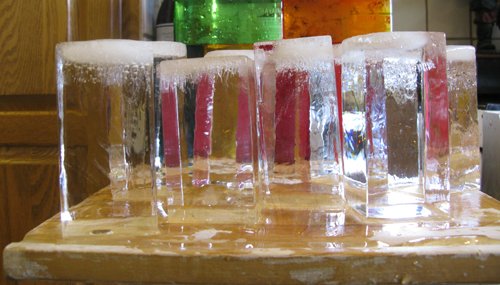
Why was that? Although Camper’s technique imitated the directional freezing aspect of nature, there was at least one other aspect missing: the large thermal mass of liquid water underneath the ice.
So, building on Camper’s experiment, I placed a silicon ice cube tray on top of a large Styrofoam cup (as a stand) in a cooler. I filled the cup and I filled the cooler to the top of the ice cube tray. (That brought the water level halfway up the cooler. More on the optimal water level later.)
I put the cooler in a high-end prosumer freezer, which was set at 0 degrees F, the government’s recommendation for food safety. (I checked the temperature in two places simultaneously using two digital thermometers in different locations in the freezer.)
The result of this experiment was much better, but I still got a little bit of air trapped in the bottom of the cubes.
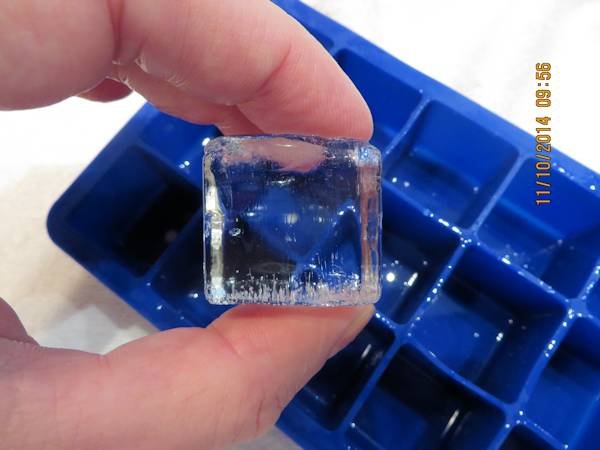
If you look at a close up Mr. Liu’s ice cube https://craftcocktailsathome.com/wp-content/uploads/2012/07/IMG_6874.jpg, his is not perfectly clear either.
I hypothesized that there was still one more aspect of nature missing from this experiment, and that was that, unlike a Japanese ice pond, the water in the ice cube tray could not interact with the unfrozen water below it. One needed holes in the bottom of the ice cube tray for trapped air to escape.
At the same time I came to this “Eureka!” moment, I found that a reader on the Alcademics blog had made the same observation. Furthermore, this idea was consistent with a suggestion on the blog of suspending a spherical ice ball mold upside down, above a pot of water, with the mold’s fill hole in the water to make a clear ice sphere. (Or similarly, the suggestion to put a spherical ice ball mold upside down (hole down) in a mug of water so that the water in the mold could interact with the unfrozen water below in the mug.)
So here’s what I did.
How to do it
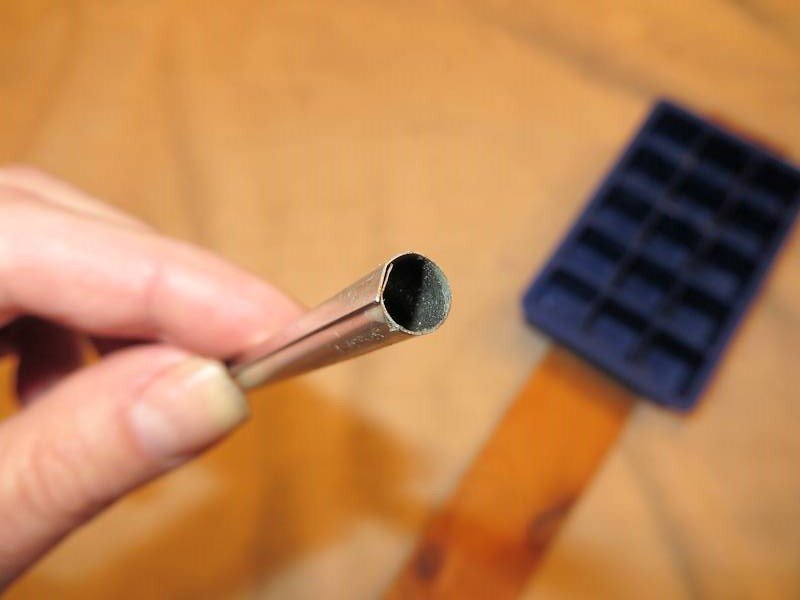
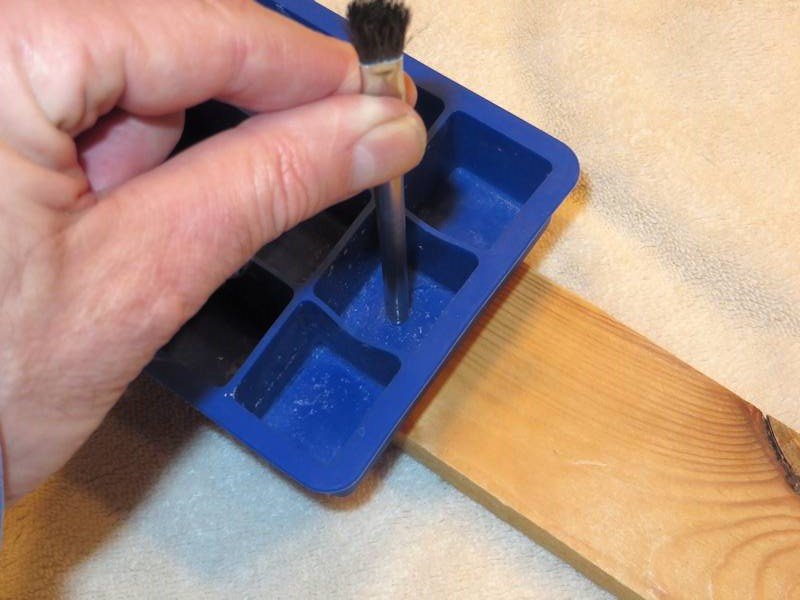
I took an acid brush and used the tube end as an auger to bore holes in the bottom of a silicon ice cube tray. Any similar tube will work. A 9mm shell casing would probably work too. (A .38 caliber casing is too large but works well on spherical ice molds.)
I got my trays from Amazon, if you look closely at the photos of the ice cubes on the Amazon product page, you can see air trapped inside them.
I used a Dremel tool with a cone-shaped cutter to grind a knife edge on the end of the tube. I put the ice cube tray on a piece of soft wood (to act as backing for the work) and pushed the tube into the bottom of the tray while rotating the tube. (If you use the end of an acid brush, you need to rotate it CCW so that the tube doesn’t unwind and open. If you use a shell casing, you can hammer on the casing (on the soft wood) to punch your holes through.)
Take a Styrofoam cup and cut it down to about an inch as a stand for the ice cube tray. (I started with a full size Styrofoam cup, but you’re just wasting water if you fill the cooler half full of water. And by using a one inch cup, the tray is lower in the cooler, resulting in better directional freezing.)
Put’s a rock in the cup to weigh down the cup. Else, the stand floats off the bottom of the cooler.
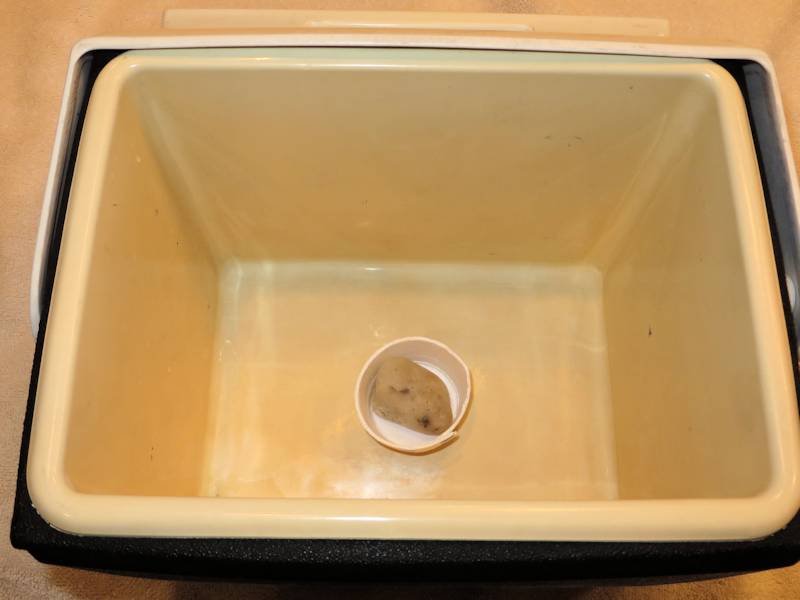
Put the tray in the cup that had the rock in it and filled the cooler with water to the top of the tray.
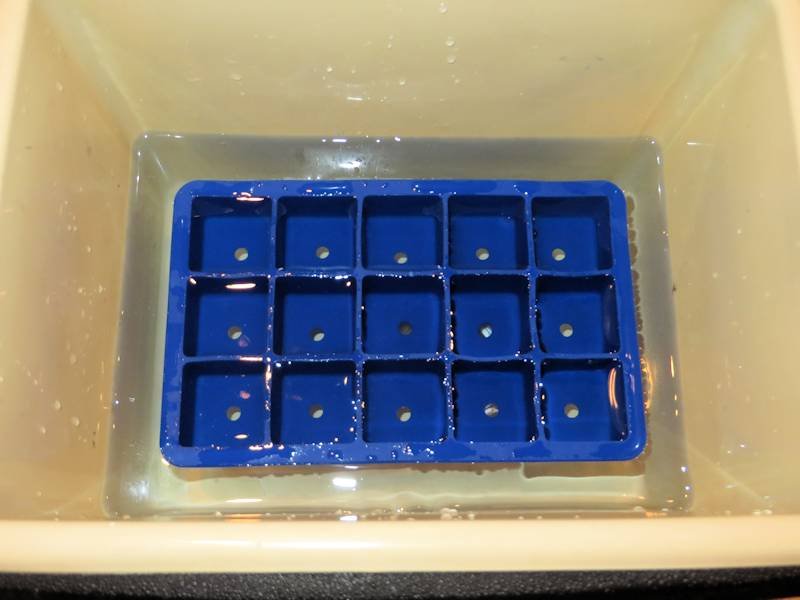
You might want to jiggle the tray a bit after you put it in the freezer, to knock air bubbles out that might be trapped underneath the tray.
Wait about 18 hours. Timing is somewhat critical. You want to catch the freezing process just as ice has formed below the tray. If you wait too long, all the water below the tray will have frozen and you might get air in your cubes. Remember, in the Japanese pond, there is always unfrozen water below the clear ice.
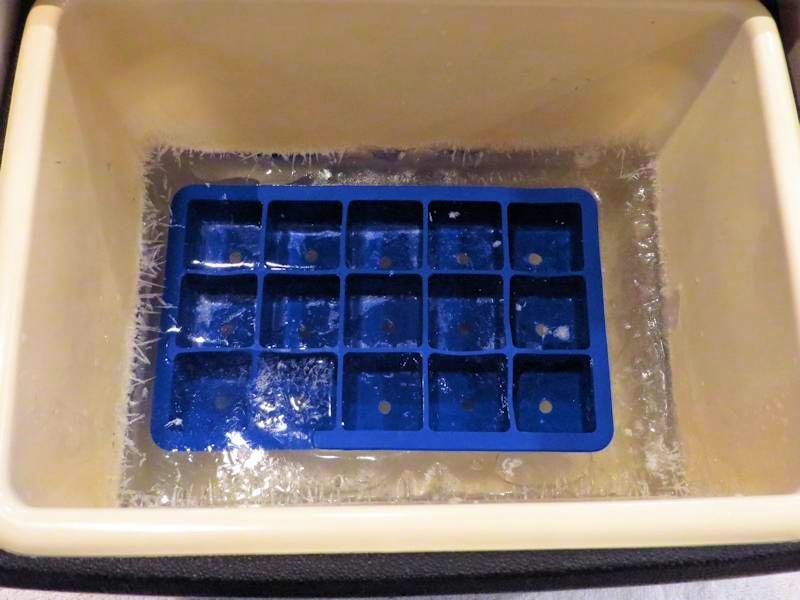
After the water under the tray has frozen, take the cooler out of the freezer, place it upside down in a sink and set a timer for about 10 to 20 minutes in case you forget to baby sit it. In about 10 or 20 minutes, you will hear a thunk as the ice block releases from inside the cooler. If you timed it right, a lot of water will eventually drain out of the cooler. (A cooler with the drain plug might be interesting. We could use compressed air to blow the ice block out.)
You will be greeted by a strange formation of ice crystals and a cavern of sorts from where unfrozen water drained. (Apparently the cooler isn’t as well insulated on its bottom as we would like, since ice forms there. Since cold air descends, shouldn’t coolers be twice as thick on their bottoms as they are on their sides? Maybe we should put a cooler in a cooler?)
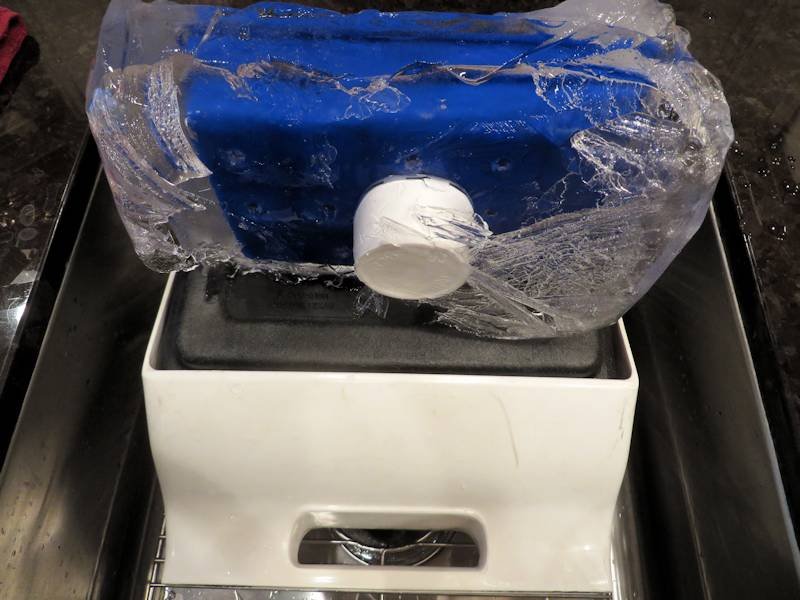
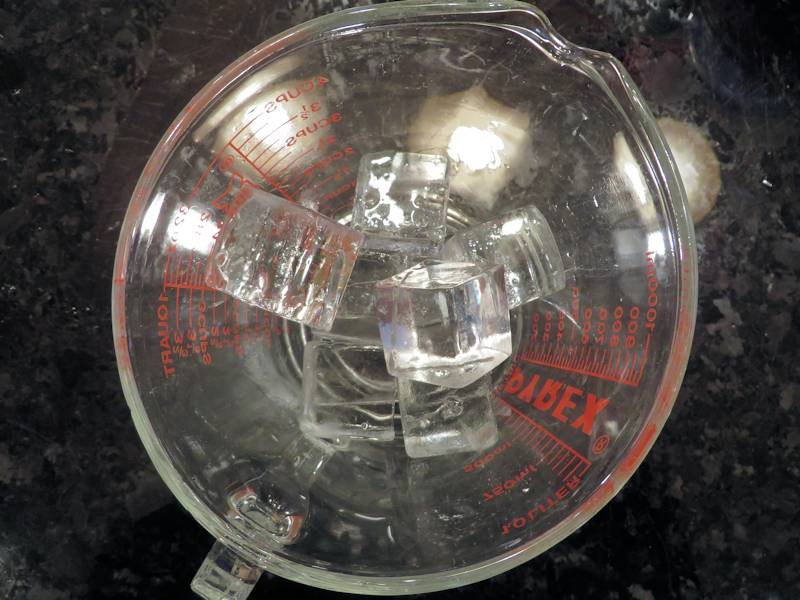
Break the clumped ice away from the ice cube tray, push the cubes out of the tray from behind, and viola! Perfect, clear ice cubes.
Allow your cubes to temper for one minute before using them in your drinks to avoid cracking.
Now you’re ready to do it all over again and make another batch!
High Strangeness
When I first tried these experiments, I started with the minimal amount of water, not knowing what the right amount of water underneath the tray should be.
I made a spacer that was only a half inch high.
When I did that, something strange happened. I got an extrusion of cloudy ice during the freezing process!
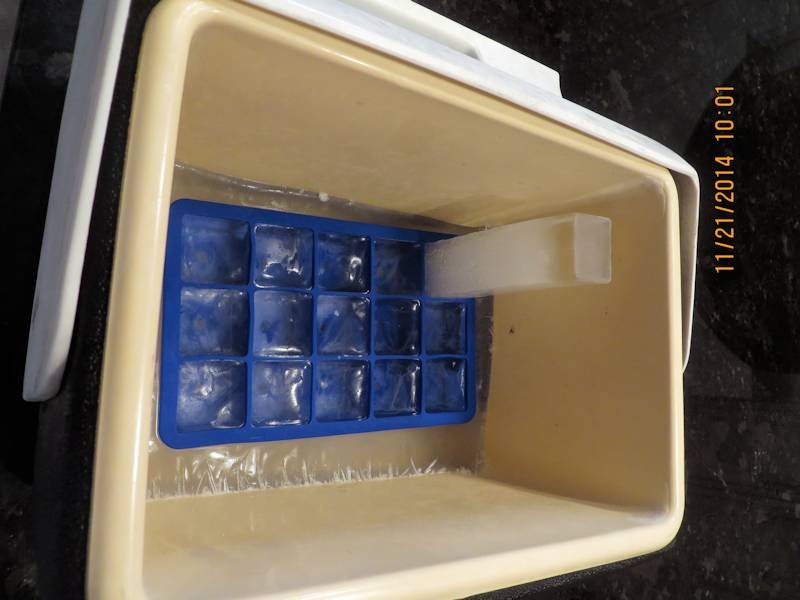
It has always been a corner cube that extrudes in all my runs. All the other cubes are clear. That’s gotta be telling me something.
So then I went the other way, putting more water in the mix by using a plastic beverage cup as a stand for the ice cube tray. I let the water freeze almost completely and didn’t get any extrusions. Let’s hear your thoughts about what’s causing the extrusions.
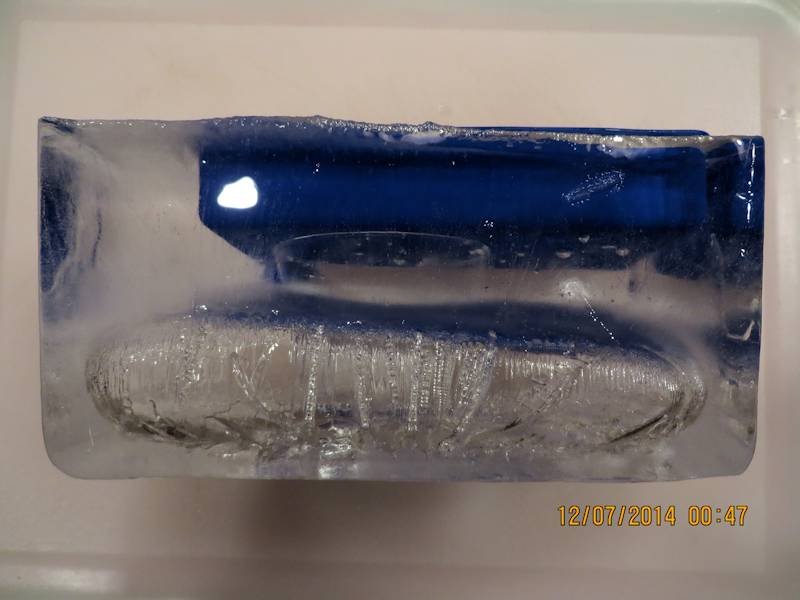
You can see how the water has frozen at the bottom of the cooler, again demonstrating that the bottom of the cooler is not as insulated as it should be. In any event, there’s enough clear ice below the tray to give us clear ice cubes. (Notice some air bubbles just below the tray.)
Ever being an engineer, I wondered what the “optimal” (minimal) amount of water was for this process. I kept shortening the cup until I got to one inch. Since I knew a half inch was too little, it seems that one inch is optimal. One inch seems to be about the same distance in the photo above too.
I can now make perfect clear ice cubes repeatably in less than 24 hours without a lot of waste.
—-
Thanks Mike!
Read about all the ice experients on Alcademics by following this link.