I have had a centrifuge sitting on my Amazon.com wish list for a couple years, just waiting for me to get tipsy and reckless enough to hit the one-click button. Well, I finally bought it last week not because I was wet with sauce but because I could no longer contain my curiousity.
Plus, I had just finished reading the preview copy of Dave Arnold's forthcoming book and wanted to play with some of the techniques. (I'll post a full book review later.)
The centrifuge I bought is one recommended by Arnold for experiments and travel, the Ample Scientific Champion E-33 centrifuge. The thing is about the size and shape of a rice cooker. It's adorable!
Note to bartenders: It's not really practical for commercial applications. The total liquid volume (if using all 8 of the 15ml test tubes that it can hold) is only 4 ounces. Enough to play around with; absolutely. Enough to make clarified lime juice for your bar program? No way.
But I'm not producing mass volumes and it costs less than a juicer so I picked one up.
Centrifuges are used to separate liquids by weight – the heavier stuff spins to the bottom of the tube.
If you've ever made tonic water syrup from cinchona tree bark, you know that it usually comes as a silty powder that is very hard to filter out of your solution. (My method for getting as little of the bark into syrup is to put it in the coffee maker with several filters.) Still, filter all you want and there will still be bark floating in the syrup, somewhat settling out of solution in your bottle.
It was the perfect thing to clarify as I knew there was a good chance for success. Rather than make my own syrup to clarify, I used Small Hand Foods' Yeoman Tonic Syrup, which was specially developed to pair with Beefeater gin.
The centrifuge has a 30-minute timer and a good amount of the bark came out of solution after one 30-minute cycle. But I put it back in for several more anyway.
What came out was a solution that was sparkly transparent but still colored. It tasted bitter and citrusy (Small Hand Foods tonic syrup is more citrusy that other brands) but much less barky than the original. I'll call that a success.
In the images below, the syrup on the left is un-centrifuged and on the right is centrifuged syrup. Note at the bottom of the test tube you can see the bark stacked up.
Perhaps next time I'll centrifuge boiled cinchona bark on its own- just in water rather than a syrup- to see what happens.
That will surely be one of zillions of future experiments with my new toy. Fun fun fun!
You can use the Cooler/Directional Freezing method to make blocks of perfectly clear ice. But those are big blocks and many people want to make clear ice balls.
Typical ice ball molds make ice that is cloudy in the middle. One reader developed a method to take advantage of directional freezing but it involves using a big pot of water so it's not space-efficient.
The natural next step was to use directional freezing in a small container with an ice ball mold sitting on top.
Thus, the water in the ice ball freezes first, then the cloudy parts are pushed into the water in the insulated container below it, which continues to freeze from the top down. All the water in the ice ball should remain clear.
I attempted this, ordering insulated mugs and coozies online, but never found one that was the right size. Thankfully, two Alcademics readers were able to find insulated containers that are just right- and send me pictures and answer all my questions. Awesomeness.
The hole in the mold must be pointed down at an angle. With the hole straight down, you end up with a clear ice "egg" instead.
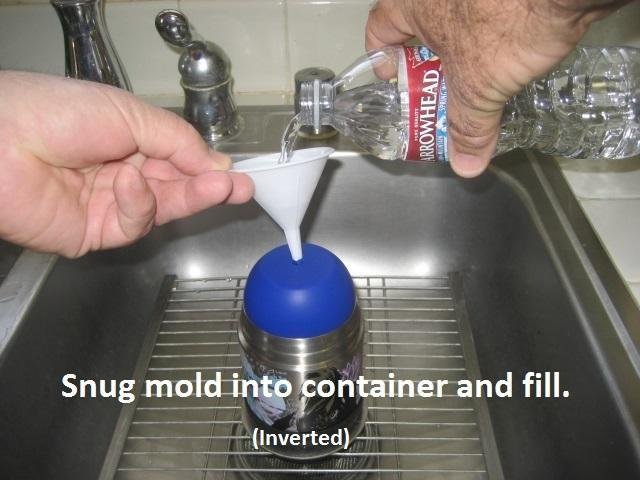
I fill the cups to the brim and gently wedge the molds into the cup with a finger over the hole until the hole is under the water. Do this over the sink and the overflow runs down the drain. I keep as much water in the cup as possible, so there is water visible around the edge of the mold.
There is no problem getting the mold out of the cup. I usually give it 24 hours to freeze and there will be an inch or two usable puck of clear ice under the mold. I'll run a little tap water on the outside of the cup and around the inside edge to loosen up the belt of ice holding the mold in the cup. This doesn't crack the balls.
At 12 or 13 hours the sphere is only 80% frozen, but probably more clear than at the 24 hour point.
Update: In this post, I attempted and was successful at replicating this method. It works great!
Update: Mike Laine (see in comments below) found a smaller insulated mug to use: the Funtainer. This takes up less space in the freezer than the full-sized mug. He also poked a hole in the bottom of the ice ball mold for easier filling. See his post here.
Plastic Mug with a Stand
Reader James Carroll found another way that works. He found a plastic coffee mug. The ice ball mold sits on a smaller container inside the mug.
He found the plastic, 16-ounce mug at Walmart, but it is also here on the manufacturers website. The smaller container is a small Rubbermaid container that fits inside it.
Instructions:
Put container in mug. Fill mug and container with water up to the brim of mug.
Fill silicone sphere mold completely with water. Put your index finger on the fill hole of the mold, turn upside down, and plunge into the mug. Do this in the sink since the water in the mug will overflow.
So now you have the filled sphere mold sitting upside down on the filled container, inside the filled mug. If you freeze it like this, you will wind up with a clear egg. Because the freezing water around the sides of the mold will squeeze the mold out of shape.
To get an ice sphere, use a straw to suck out the water in the mug until the water level in the mug is just below the rim of the container.
Takes about 20-24 hours to fully freeze. You also get a cloudy big ice cube from the container.
Thank you so much Alcademics readers James Carroll and Doug Elder for being more diligent in solving the clear ice ball problem than I was!
An index of all the ice experiments including best successes and many failures is here.
I'm researching potatoes in a little project for Karlsson's Vodka. I've been interested in potatoes for a long time so this was the perfect excuse to learn more.
The potato is native to the Andes mountains in Peru, and was the most important crop of the Incas.
There are about 5,000 potato varieties worldwide. Three thousand of them are found in the Andes alone, and all potatoes came from this single place of origin.
What Is A Potato?
A potato is classified as a tuber. A sweet potato, on the other hand, is a root. The plants seem to have a lot in common (and the first few hundred years after they were discovered by Europeans there was a lot of confusion as to which potato was being discussed), but botanically they are quite different.
Potatoes are propagated vegetatitvely – growers don't plant seeds (that grow on poisonous cherry-tomato-like fruits above the surface in some varieties, if allowed to grow that long) but pieces of the plant itself.
According to Potato by John Reader, "A potato is a grotesquely swollen piece of stem and buds, broken off from a part of the plant's underground stems." The function of this is a back-up method of propagating, and growers take advantage of it, as replanting potato pieces produces clones of known species rather than genetically-mutatable new plants if the flowers are pollinated by insects.
Potato Nutrition
Nutritionally, a potato is nearly 80 percent water, then carbohydrates (mostly starch) and protein. It has a lower protein content compared with grains, though. In distillation of grains, distillers choose grains that are high in starch and low in protein, so this sounds like an advantage when it comes to making vodka from potatoes.
Potatoes are rich in Vitamin C and B complex vitamins, with "useful quantities" of calcium, iron, phosphorous, and potassium. You can look up the nutritional value of a potato using the USDA Nutrient Database.
Potatoes have a distinct top and bottom. Who knew?
Potatoes Used to be Poisonous
Wild potatoes are good at growing at high elevations (like the Andes) with not great weather, where grains wouldn't be successful. But their use as a food crop was not at all obvious. Potato plants evolved in regions with long dry seasons so the underground tuber was an energy storage unit to make it though the season. They even grow in regions where no perennial grasses can survive.
The tubers of wild varieties are small and bitter and can be poisonous, so nobody knows how and why they were first cultivated. This bitter, poisonous quality in potatoes comes from glycoalkaloids. It is believed this quality was reduced (something like 15-fold) by purposeful breeding of the plants.
One study found that one in region where the plants still had high levels of glycoalkaloids, natives would mix the potatoes with clay when eating them. A modern analysis of that clay showed it contained something that binds with glycoalkaloids to neutralize their effect, and because of that people could eat potatoes without getting sick.
First known illustration of the potato from 1597. This was drawn from potatoes in Poland. [source]
Potatoes Today
Potatoes are surprisingly adaptable: Today they are grown in 149 countries around the world, from latitudes 65 degrees north to 50 degrees south, from sea level to over 4000 meters.
The potato is the world's fourth-largest food crop, following rice, wheat, and corn (as of 2012. In 2008 it went corn, wheat, rice, potato.).
Karlsson's Vodka Fun Fact
This post is part of a series sponsored by Karlsson's Vodka, which is made from seven types of Swedish "new" potatoes grown in the sandy soils of Cape Bjare. I visited Cape Bjare a few years ago and wrote about how Karlsson's is made here.
The first time I ever heard of such a thing (besides around the rim of a Margarita glass) was from Duggan McDonnell of Cantina. That was probably four years ago.
Now it seems that everybody is in on the secret and is using salt in their cocktails – whether they tell you about it or not.
Check out the story on Details.com about how and why and where bartenders are using salt in their drinks.
In my latest story for Details.com, I asked bartenders which new gins they love to drink.
I only included ones with multiple recommendations, and here is a list of 13 that rose to the top. I tried to limit them to gins launched in the last two years, though there may be an exception or two.
Coronavirus update March 28, 2020: Many people are coming to this page seeking advice on using cinchona bark to make their own medicine.
You are not qualified to make your own medicine. The bark available for purchase online is not labelled as to its potency. And if you read the article below or this one, you'll also find that an overdose of cinchona bark can be dangerous or fatal.
DO NOT ATTEMPT TO MAKE YOUR OWN MEDICINE USING CINCHONA BARK. RESPECT SCIENCE, LISTEN TO DOCTORS.
A few weeks ago, Avery and Janet Glasser drank some homemade tonic syrup in a Gin and Tonic at a bar and came down with the symptons of cinchonism, a condition caused by a buildup of quinine.
Tonic water contains quinine as its active, bittering ingredient. Quinine comes from cinchona tree bark. Homemade tonic waters begin with this tree bark either in chunk or powdered form. The powdered form is particularly hard to strain out of the final beverage, and this could lead to an accidental overdose.
Symptoms of mild cinchonism (which may occur from standard therapeutic doses of quinine) include flushed and sweaty skin, ringing of the ears (tinnitus), blurred vision, impaired hearing, confusion, reversible high-frequency hearing loss, headache, abdominal pain, rashes, drug-induced lichenoid reaction (lichenoid photosensitivity),[1] vertigo, dizziness, dysphoria, nausea, vomiting and diarrhea.
A scientific paper published in 2007 reported a case of a patient self-medicating for leg cramps with quinine and it turns out he gave himself cinchonism. His systems were intermittent fevers, chills, and tremors for approximately 12 days; general malaise that would begin with a bitter taste in his mouth that wouldn't go away. (On PubMed the article is at PMID: 18004031)
Glasser wrote about his incident on his Facebook page, and I asked if I could reprint it. The Glassers are the founders of Bittermens, makers of bitters, spirits, liqueurs, and other products. Thus they are very familiar with quinine. He wrote:
How did it happen? Well, we work with cinchona all of the time, which means that our bodies already have a small buildup of quinine. During Tales of the Cocktail, we had a gin and tonic at a restaurant where they made their own tonic syrup. By the amount of the suspended cinchona dust floating in the drink and the distinctive earthy tannins that mark incomplete filtration, we should have stopped drinking it at the first sip. But we didn't, and spent the next two days dealing with the very uncomfortable symptoms of cinchonism.
Safe Amounts of Quinine in Tonic Water
The below information all comes from Avery Glasser.
There's a federal standard for the use of quinine in carbonated beverages, specifically that it cannot exceed 83 parts per million in the final tonic water (21 CFR 172.575). Now, if you're working with commercial quinine sulphate or quinine hydrochloride, it's easy to calculate. Basically, that ends up being 2.48 mg of commercial quinine per ounce of tonic water.
So, let's expand this out: a typical gin and tonic is 1.5 oz of gin and 4.5 oz of tonic, 6 ounces total. That means we can expect 11.16mg of quinine in that beverage.
However, most producers of tonic syrups don't use quinine hydrochloride/quinine sulphate… and there's the rub.
Cinchona bark is approximately 5% quinine.
The Most Popular Tonic Water Syrup Recipe Has Too Much Quinine
Let's take one of the most popular tonic syrup recipes, published by Jeffrey Morgenthaler: Basically, it's 6 cups of liquid to 1/4 cup of powdered cinchona bark, which is about 35 grams of cinchona. Extrapolate from that and we're talking about 35 grams of cinchona per 1.4 liters of end syrup, which is 25 grams per liter, and if it extracts fully, contributes 1.25 grams of quinine per liter, which equates to 1251 parts per million. That's 15 times the CFR standard.
If you use 3/4 of an ounce of that syrup in a Gin and Tonic, you're adding in 27.5 mg of quinine – more than double the amount of quinine in a commercial gin and tonic.
Note: Does a syrup extract quinine fully from the cinchona? No – but it extracts faster from powdered cinchona versus cinchona chips or quills.
Note: Does a syrup that is sieved through a french press or a coffee filter have a high percentage of solids still in suspension? Yes – and any of the solids you swallow contribute the full amount of the quinine as your body digests the powder.
Quinine in Bittermens Bitters and Liqueurs
Glaslser says, "We work with small amounts of cinchona in many of our bitters. At our concentration, there's only about 1.1 grams of cinchona per liter in the maceration, and all of the solids are removed down to 5 microns, which means there's barely any cinchona left in the mix. If we say that we get a full extraction of quinine from the cinchona before we filter it out, then we're talking about contributing about 57 mg of quinine per liter of bitters, or assuming a half ml of bitters per cocktail, we add no more than 0.0283 mg of quinine to a cocktail, or raise the total amount of quinine by 0.19 parts per million. Again, that's assuming that we left all of the cinchona bark in the final product, which we do not as we don't use powdered cinchona (we use larger pieces of bark). Most likely, we're contributing less than a tenth of that amount.
"Just for full disclosure, our liqueur division (Bittermens Spirits) makes a tonic liqueur – but we had that tested before releasing it to ensure that our liqueur was below 83 ppm, meaning that any beverage use would still be well below the federal limits."
Avery Glasser's Conclusion
All I'm saying this this: be careful. Bitters and tonic syrups can be fun to make, but they can be dangerous if you don't know what you're doing. I'm not saying that you need to be a food scientist or a compounding pharmacist to do things safely, but you have to understand that you're working with potentially harmful substances! Indian Calamus root, Virginia Snakeroot or tobacco – even in small amounts can have horrible and irreversible effects. Just last week, I was told about a bar that was soaking stone fruit pits in neutral grain and had no idea about cyanide toxicity.
For us, it's now five days later and the symptoms are basically gone, but it also means we have to be careful about having cinchona for another week or so.
That's it. No rant. Just a plea for my health and the health of all of our friends and customers: think carefully before making your own tinctures, extracts, bitters and syrups.
Thanks to Avery Glasser for sharing his story – and the math – with us.
This July I visted the town of Saronno, Italy, and the blending and bottling house where they make Disaronno liqueur (formerly known as Disaronno Amaretto).
So The Legend Goes
Disaronno, as with many brands, is based on a legend involving a beautiful woman and a secret manuscript. We visited the chapel where the story begins.
In the 1400s, the Sanctuary of Our Lady of the Miracles was founded in Saronno. For a later addition to the chapel in 1525, a painter named Bernardino Luini found a model for the Virgin Mary in a local widowed innkeeper, and used her face in the paintings in the chapel.
As a reward for this honor, the innkeeper gave the painter a present of a flask of liqueur, which was what would become Disaronno. The brand claims that this was the first amaretto liqueur, “amaretto” meaning “a little bit bitter.”
In the 1600s, a member of the Reina family supposedly rediscovered the old recipe, and it was commercialized in the early 1900s. The Reina family still owns the company.
The Company Today
Today Disaronno is one brand from a big company named ILLVA. A big part of the company is a flavor company called Real Aromi. This part makes the flavors that go into the liqueurs. Other spirits made in the facility include Zucca, Tia Maria, and an amaro called 18.
How Disaronno Makes Bitter Almond Oil
Probably the most important ingredient in Disaronno is the essential oil made from bitter almonds.
Bitter almonds are illegal to sell as a food product in the US, because they contain a chemical that converts to the poison cyanide. Sweet almonds is what we crunch on. Neither type of almond is a true nut; they are pits of fruits.
As I understand it, there are many varieties of both sweet and bitter almonds, and both share the same botanical genus as the peach. While sweet almonds (as well as the tree) are just called almonds , bitter almonds can be either a particular almond tree/nut, or (as is the case at Disaronno) the pits of related stone fruits. The folks at Disaronno seemed to say that no matter if the pit comes from cherries, peaches, or apricots, it's still a bitter almond.
According to Wikipedia, "The fruits from Prunus dulcis var. amara are always bitter as are the kernels from other Prunus species like apricot, peach and cherry (to a lesser extent)."
For Disaronno they purchase 300 tons of bitter almonds (apricot pits) annually. They only use their oil for their product; they don’t sell it to other companies.
So, bitter almonds, which here are the kernels of apricots, are first crushed in a machine that grinds them into a flour. This flour is then soaked in hot water, which separates the flavor components from the sugars in the pits.
This is similar to making scotch whisky, in which ground malted barley is heated with hot water to separate the sugars from the solids. The sugary water is used and they leave the solids behind. For Disaronno, though, they don’t want the sugars and they do want the flavors.
The sugar and heated almond flour mix is then distilled under pressure (which allows you do to it a lower temperature), so that they don’t cook the bitter almonds. The run the still at a max of 50 degrees Celsius. Note that this is a water distillation, not an alcoholic one.
As is typical in distillation, the lighter components boil over and leave the heavy ones behind. This includes not only the almond solids (which are sold to make biscuits and other Italian treats), but also the poisonous arsenic that is contained in pits. (At ArtOfDrink, Darcy O’Neill studies the problem of cyanide in pits.)
The result of the distillation after condensation is oils and water. These are kept in a tank and left to naturally separate. They then pull off the bitter almond essential oil to use to make Disaronno, and save the water to use in the next distillation.
We smelled the raw essential oil – it has those high orange/cherry notes, sweet nuts, and marzipan notes typical of Disaronno, but also a bit of a marker smell that thankfully doesn't show in the final product. The essential oil is not bitter from the bitter almonds, as those aromas are heavier and don't pass through their distillation.
The Blending and Bottling Facility
The production and administrative offices for Disaronno, Real Aromi, and the ILLVA are in an industrial office park of sorts in Saronno. We were the first group of press ever allowed into the facility, but alas, no pictures were allowed of the production part.
While the office building is decked out in modern style with gray and white backgrounds with red accents and modern art on the walls, the rest of the facility seems to hold anonymous buildings in which all the magic happens. We visited a chemical analysis lab, the bottling room, blending room, and the areas where they make the almond essential oils and other flavors.
We started in the herb storage room, which was full of big sacks of things like Chinese rhubarb (which smells like smoky curry and I later tasted as a note in Campari), ginseng roots and vanilla beans, along with things like Glucinex, propylene glycol, and dextrose monohydrate.
The extraction room was filled with all different sorts of stainless steel vats and tubs, with a few older machines scattered about. (The flavoring part of the company only relocated to this spot a year ago – before that it was in southern Italy.)
Some of the vats were soaking vats, where water and/or alcohol is combined with a flavor to extract it. In front of one row of vats was a centrifuge that runs sideways, like the one I’d seen at Cointreau.
Other tubs rotate slowly sideways to keep liquids and solids mixing.
A set of cool-looking stills that basically hang from the ceiling perform distillation under pressure for the purpose of concentrating ingredients. So while in a typical alcohol distillation we distill over the parts we want and throw out what’s left in the bottom of the still, here they keep the reminders and discard or recycle what comes out of the still. They were making ginger and guarana concentrates when we were there.
Another room was filled with a single giant machine for making powdered flavors. The flavor components are combined with starches and the liquids are flicked around the inside of a big diamond shaped box. When the liquids hit the sides of the box (I think it is heated), the liquids evaporate and the starches and flavors remain together. The solids then fall to the bottom of the diamond and into a collection bag below.
Putting It all Together: How Disaronno Is Made
Bitter almond essential oil is one of the two main flavoring components of the liqueur. The other is vanilla. These flavors (and probably others, the recipe is a secret) are combined with water, sugar, alcohol, and coloring.
First water and sugar are combined to make a weak syrup. Alcohol and the flavorings are combined and added together. Then the coloring comes after the mixture has rested for 2 hours. The flavored oils are added with alcohol, as aroma molecules are soluble in alcohol (we learned more about this at that Mixing Star Lab), and with this method the water won't blow off the aromas.
Disaronno is then bottled. In most parts of the world it is bottled at 28% ABV but in Spain and Australia it is bottled at 20% (because apparently you can only advertise alcohols under a certain percent), and it is bottled at that same lower ABV for Ohio and Alaska due to bigger tax rates at higher strengths in those states.
The alcohol base is dervied from either sugar beets or sugar cane (they say it's the same once it's distilled up super high), and the sugar used to sweeten it comes from sugar beets.
Thanks to Disaronno for a peek inside the process.