Blog

  • Drink Books Published in 2013 in Consideration for Gifting or Reading

    I have a to-read backlog of more than 40 cocktails and spirits books in my house, and that's just the print ones.  So while I haven't read the majority of these books released in 2013 yet, I want to list them all together in case you want to buy something for yourself or a liquor fan by the end of the year.

    Notable Cocktail and Spirits Books Published in 2013:

    • 6a00e553b3da2088340192aa8dcf0b970d.jpgThe Drunken Botanist: The Plants That Create the World's Great Drinks [link] [Alcademics review]
    • The Art of the Shim: Low-Alcohol Cocktails to Keep You Level [link]

    • American Whiskey, Bourbon & Rye: A Guide to the Nation’s Favorite Spirit [link]
    • Under the Table: A Dorothy Parker Cocktail Guide [link]

    • Shake: A New Perspective On Cocktails [link]

    • Reasons Mommy Drinks [link]

    • diffordsguide Cocktails: The Bartender's Bible, 11th Edition [link]

    • Architecture of the Cocktail: Building the Perfect Cocktail from the Bottom Up [link]
    • Handcrafted Cocktails: The Mixologist's Guide to Classic Drinks for Morning, Noon & Night [link]

    • Tequila Mockingbird: Cocktails with a Literary Twist [link]

    • Cocktails for a Crowd: More than 40 Recipes for Making Popular Drinks in Party-Pleasing Batches [link]

    • Cocktail Culture: Recipes & Techniques from Behind the Bar [link]

    • The Cocktail Lab: Unraveling the Mysteries of Flavor and Aroma in Drink, with Recipes [link]

    • Winter Cocktails: Mulled Ciders, Hot Toddies, Punches, Pitchers, and Cocktail Party Snacks [link]

    • Whiskey: Instant Expert [link]

    • Drink More Whiskey!: Everything You Need to Know About Your New Favorite Drink [link]

    • Aphrodisiacs with a Twist [link]

    • Shake 'Em Up!: A Practical Handbook of Polite Drinking [link]

    • Drinking with Men: A Memoir [link]

    • The Wet and the Dry: A Drinker's Journey [link]

    • Apothecary Cocktails: Restorative Drinks from Yesterday and Today [link]
    • True Brews: How to Craft Fermented Cider, Beer, Wine, Sake, Soda, Mead, Kefir, and Kombucha at Home [link]

    • Happy Hour at Home: Libations and Small Plates for Easy Get-Togethers [link]

    • The Curious Bartender: The Artistry and Alchemy of Creating the Perfect Cocktail [link]

    • Sherry, Manzanilla, and Montilla [link]

    • Kentucky Bourbon Whiskey: An American Heritage [link]

    • World's Best Ciders: Taste, Tradition, and Terroir [link]

    • The Deans of Drink [link]

    • Down the Hatch: One Man's One Year Odyssey Through Classic Cocktail Recipes and Lore [ebook] [link]

    • Professor Cocktail's Zombie Horde: Recipes for the World's Most Lethal Drink [ebook] [link]
    • Raise the Bar: An Action-Based Method for Maximum Customer Reactions [link]

    • Adult Milkshakes [link]

    • Planet of the Grapes Vol 3: Wine Cocktails (ebook) [link]
    • Beachbum Berry's Potions of the Caribbean [link]

    Screen Shot 2013-11-29 at 6.23.04 PM


    If you know of any I missed or want to promote your own, please do put them in the comments! 


  • High-Tech Bar Equipment on PopSci.com

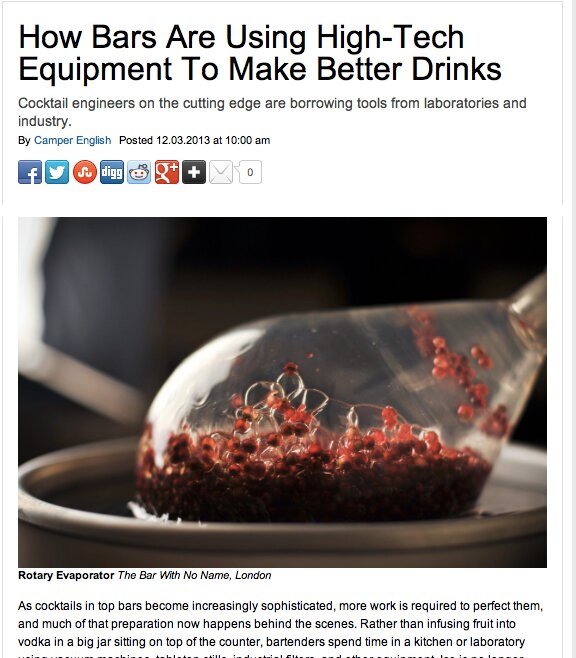
    In a slideshow for Popular Science, I wrote about ten pieces of bar equipment you not know about as they're hidden behind the scenes. 

    Screen Shot 2013-12-03 at 7.57.51 AM

    The story includes equipment used by some of the world's most innovate bartenders and includes equipment including rotovaps, machine-engraved ice, sous-vide cooking, and many others. 

    Check it out on PopSci.com!

  • Liquid Gift Guide on Details.com

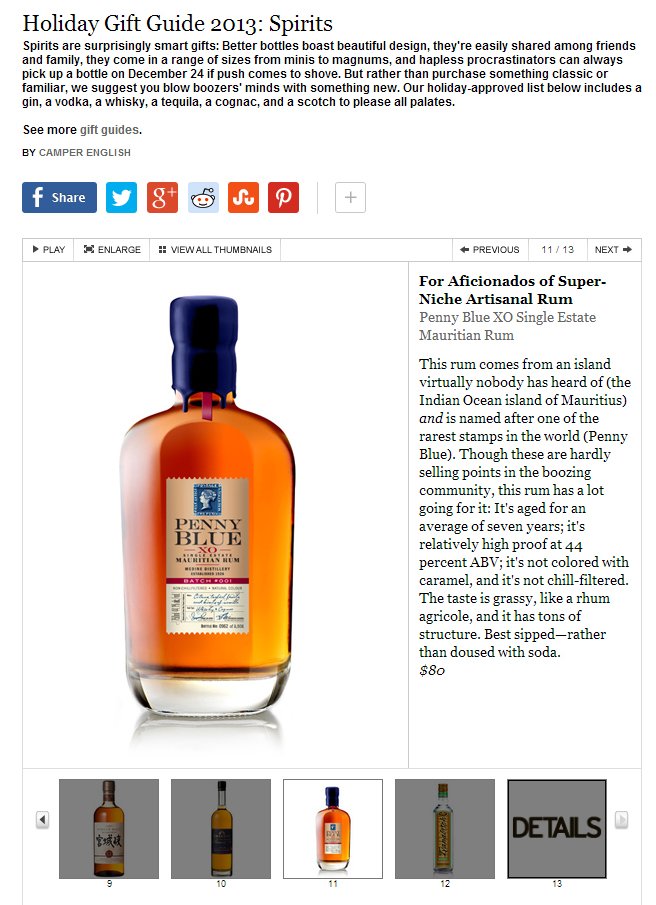
    Hey, I wrote up a gift guide of spirits for Details.com. 

    Details gift guide

    It includes rum, tequila, gin, vodka, scotch and other whiskies, brandy, and a liqueur. Go get it

  • Breakfast Cereal in Cocktails is as Pretty Big Thing

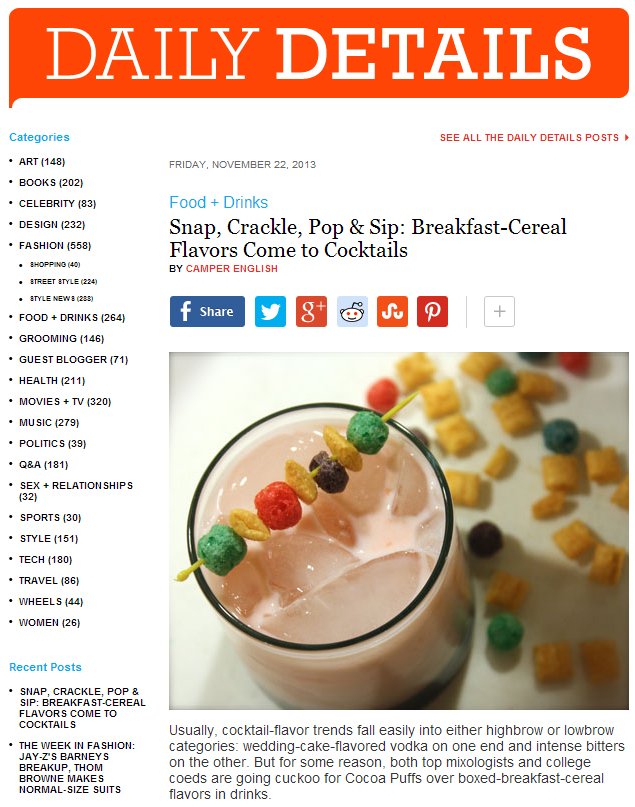
    In my latest post for Details.com, I took a look at the multitude of ways that people are using breakfast cereal in cocktails. 

    Initially I thought I'd only find it in a few places but I think there are more than a dozen mentioned in the story and they're located everwhere from London to Bordeaux to Miami to San Diego. Some folks are serving them up in bowls with a spoon, while others are infusing cereal into milk or directly into liquor. 

    Cereal details

    Check it out over at Details.com

    Loopy Fruits Cereal Shooter Photo

  • All About Absolut Elyx and “Sacrificial Copper”

    Absolut Elyx is the newish, high-end expression of Absolut vodka. On a trip this past winter to Ahus, Sweden, where Absolut is made, we took a day to learn about Elyx. 

    ABSOLUT ELYX 1L Bottle Shot lo

    Elyx is a single-estate vodka made in Absolut's old distillery (the new one is only 5 years old), in amazing copper column stills dating to 1921. I wish I had more pictures to share but they weren't allowed on our tour. 

    The winter wheat for Absolut Elyx is grown on an estate named Rabelof. Rabelof is located near Ahus, and everything for the vodka comes from within a 25km radius of the town. Here's a picture of a wheat field.

    Wheat_full_page_cmc_cmyk

    Like regular Absolut, the water comes from the large aquifer beneath Ahus. 

    The first distillation of the wheat is actually done at Absolut's newer distillery in Nobbelov. There, they use the same yeast and the same two first columns to distill Elyx. 


    AbsolutElyxDistillery

    The old distillery, scanned from a brand book they gave us.


    Sacrificial Copper

    In the tops of the column stills, they add "sacrificial copper." I recently learned and shared how in column distillation, copper is very important, but only needs to be present in certain parts of the distilation process in a column still.

    From my understanding, the first stage of distillation is stripping out the liquids from the solids, and then the alcoholic vapors are refined often within the same column. This happens at the top of the column in a bourbon still, where you'd find "bubble caps". Bubble caps are a method of adding more copper into the process, and copper combines with sulphurous compounds so that they don't make it into the final spirit. 

    Beyond bubble caps, some distillers use a version of Brillo pads (shredded copper) in their stills. At Absolut they use small segments of copper pipe that are further punctured increase surface area exposed to the alcohol. They use this sacrificial copper in regular Absolut, but apparently for Elyx they use new ones for every distillation run. 

    After the first distillation (in the first two columns) at Nobbelov, the 85% alcohol spirit then travels to the old distillery at Ahus. There it is rectified in column stills dating to 1921. This part of the distillery is rather gorgeous, with huge tall copper columns with wooden insulator jackets surrounding them. The building is filled pre-computer analogue dials, gauges, old pumps, leather belts, and big piston engines. 

    Here, the spirit is distilled in one extraction column, two rectification columns, and in two methanol columns. As at the new distillery, there is also a recovery column that recycles waste products. 

    Absolut Elyx is bottled at 42.3% ABV. 

    Ahus satelite map

  • The Wide Variety of Irish Whiskey Made at Midleton

    RedbreastJameson, Redbreast, Green Spot, Midleton Very Rare, Powers John Lane, Paddy: These Irish whiskeys and more are all made at one distillery: Midleton in County Cork, Ireland. 

    On a recent trip the distillery for a big celebration (I wrote about that here), I learned more about the differences between various products, and gained some perspective on where Irish whiskey sits in with other products. 

    To hugely oversimplify what are the constants and what changes in different types of whiskey:

    • Single-malt scotch whisky is made from 100% malted barley and distilled in pot stills. They typically make one distillate, and the single malts that come from a single distillery are differentiated by how long they're aged and in what type of barrels they're aged (ex-bourbon, sherry, etc.)
    • Many bourbon distilleries focus on a single mash bill (blend of grains) that they distill in column stills into a single distillate. Since it's all aged in new American oak casks, the various bourbons that come out of a single distillery are differentiated by their length of aging and final proof of the spirit. 
    • For Japanese whisky, they use many different shapes of still as well as many different types of barrels and often buy grain at different peating levels. They have a lot of different whiskies aging that they blend to make both blended and single-malt products. 

    There are big exceptions to all of the above. 

     For Irish whiskey, there are three main distilleries. Midleton makes triple-distilled malted/unmalted pot still whiskey (called "pot still" on its own and "single pot still" when it comes from one distillery) as well as column distilled grain whiskey. Bushmills makes triple-pot-distilled malt whiskey ("single malt") that they sometimes blend with Midleton's column still whiskey. And Cooley makes double-pot-distilled malt whiskey ("single-malt") and column still grain whiskey. [See this blog post for a handy chart.]

    But just looking within Midleton, they don't make just one triple-distilled pot still whiskey; they make four. I believe these are designated internally as light, two different medium ("mod pot"), and a heavy. These are made by different variations on the mash bills (ratio of malted to unmalted barley), how high they distill to, and where they cut heads and tails in the distillation. 

    They use these distillates in different ratios in the final products. That's why the Single Pot Still Irish Whiskeys made at Midleton can have such distinct personalities, despite all sharing certain characteristics such as apple and butter notes. They're made from any of four malt/unmalted pot still whiskies, aged for a different number of years in different types of barrels, and bottled at different proofs. 

    From one distillery comes many options. 

    Midleton single pot still whiskies

    Blends: 

    • Jameson
    • Jameson 12 Year Old
    • Jameson 18 Year Old
    • Jameson Gold Reserve
    • Jameson Signature Reserve
    • Jameson Select Reserve
    • Jameson Rarest Vintage Reserve
    • Paddy
    • Midleton Very Rare

    Single Pot Still

    • Redbreast 12 Year Old
    • Redbreast 15 Year Old
    • Redbreast 12 Year Old Cask Strength
    • Green Spot
    • Yellow Spot
    • Powers John's Lane Release
    • Midleton Barry Crockett Legacy


  • A Doubled Jameson – A Return Visit to the Midleton Distillery in Ireland

    A couple of months ago I returned to the Midleton distillery in Cork, Ireland, for a party they were throwing to celebrate the newly-expanded facility. 

    Jameson tasting panelI wrote a one-page story about it for November's issue of Tasting Panel magazine, which you can read here (digital magazine, go to page 149), but I have more to say than just that. 

     I last visited the Midleton distillery in early 2011 (as well a a stop into the former distillery and current visitor's experience in Dublin). A write-up on that visit is here on Alcademics

    The Midleton Distillery looks like it did a few years ago with the exception of gleaming new column stills and the new Garden Stillhouse. These are the new column stills:


     (On all pictures on this post, click the thumbnails on top for a larger picture below)

    • JamesonMidletonDistillery colunm stills2
    • JamesonMidletonDistillery Column Stills
    JamesonMidletonDistillery Column Stills


    The existing stillhouse (where the pot stills are based) holds four pot stills, which are used to make all the triple-distilled pot still products, as well as the pot still part of the Jameson blended whiskies. 

    The brand new Garden Stillhouse, enclosed in glass, holds three new pot stills so that they can nearly double capacity- and it has room for three more to be installed within a few years. (That's how fast Jameson is growing, folks.) 


    • JamesonMidletonDistillery Garden Stillhouse1
    • JamesonMidletonDistillery Garden Stillhouse4
    • JamesonMidletonDistillery Garden Stillhouse11
    • JamesonMidletonDistillery Garden Stillhouse5
    JamesonMidletonDistillery Garden Stillhouse5


    Each of the copper pot stills holds 80,000 liters. As you should be able to tell from the pictures, they're pretty huge. The stills are used for the same thing each time: there is a Wash still, a Feints still, and a Spirit still for the first, second, and third distillation.

    I was curious as to how they're all the same size, since they're cutting heads and tails during each distillation. It turns out that they collect the result of each distillation in holding tanks before moving it to the next still, so they could add the results of 1.5 runs from the first still into the second distillation, for example.

    In addition to the distillery expansion, they added an archives and a Whiskey Academy. We didn't get a chance to do an in-depth training but the Academy was really cool – there are a wall of mini-stills so students can actually distill whiskey there. 


    • Midleton Whiskey Academy1
    • Midleton Whiskey Academy2
    • Midleton Whiskey Academy3
    • Midleton Whiskey Academy4
    • Midleton Whiskey Academy5
    Midleton Whiskey Academy5


    A second major reason for the celebration was that it was Master Distiller Barry Crockett's last official function. After 32 years with the company, he was retiring and handing the reigns to Brian Nation. Crockett was instrumental in moving the distillery operations from Dublin to Cork in the 1970s, as well as developing the Single Pot Still range that includes Redbreast, Green/Yellow Spot, Midleton Very Rare, and others. 

    To honor his career, they renamed the older stillhouse the Barry Crockett Stillhouse. 

    Barry Crockett Stillhouse
    During the day of the celebration, they had guided whiskey tastings, food carts by local purveyors, inspirational talks by the likes of David Wondrich and Nick Strangeway. At night, they threw a hell of a party inside a barrel warehouse with food and music including The Chieftans. 


    • JamesonMidletonDistilleryHousewarming
    • JamesonMidletonDistillery4
    • JamesonMidletonDistillery Housewarming crowd
    • Barrelmans Feast Chieftans
    • Barrelmans Feast1
    • Barrelhouse3
    Barrelhouse3


    So yeah, that was one heck of a party and a great return trip to the Midleton distillery. In a future post, I'll write a little more about the process of making Irish whiskey. 


  • The Difference Between a Shrub and a Switchel

    I received the new cocktail menu from Brandon Wise of Imperial in Portland, Oregon and noticed that it has the following drink on it:

    Slings and Arrows: Dewars blended scotch, Lemonhart Demerara rum, Lemon, Mulled pinot noir syrup, Tony's homemade switchel.

    The last ingredient was described as, "House-made switchel, also known as swizzle or haymaker’s punch. A long forgotten ingredient, Wise’s nostalgic resurrection of this carbonated cross between sweet tea and apple cider is an appreciated addition to Imperial’s ingredient list."

    So, a switchel sounds a lot like a shrub, a (usually) fruit-and-vinegar syrup. I followed up with Wise to ask him:

    What's the difference between a switchel and a shrub?

    His response:

    There are many commonalities between switchel and shrub. The main difference is the role of fruit(s and veggies): shrubs, speaking in a general sense, are a way to preserve fruits of the season with vinegar. The switchel we make also incorporates vinegar, apple cider vinegar specifically, but does not rely on fruit for its flavor. Molasses, cider vinegar, and ginger are the key flavor agents in our switchel whereas in a 'strawberry shrub' (for example) the strawberry is the primary flavoring agent which is then effected by the vinegar. Switchel is a little closer to a root beer, ginger beer, or traditional ale.

    Another fundamental difference is that our switchel is itself a drink, not an ingredient in a drink. Shrubs are delicious when you add water or soda but operate more as a syrup or sweetening agent; our switchel is meant to be consumable on its own. We bottle condition with yeast much like we make our tonic water for natural carbonation. The goal was to make something like a sarsaparilla rather than a syrup. Switchel, like tonic, can be carbonated or uncarbonated, we simply choose to do it this way.

    We're very excited about this product and are pleased to see folks trying it for the first time and loving it. The cocktail on our menu that features switchel was an immediate hit and has become one of our best sellers. To my knowledge we are the only ones using it for cocktails and that is pretty exciting. It was something we stumbled upon when doing research for the Portland Penny Diner and its soda fountain component and have long desired to incorporate it into our beverage program. We've sat on the concept for almost a year until the season was right, and now we're seeing that our patience paid off. Resurrecting a quintessentially American beverage was our aim and our patrons are very much enjoying the fruits of that labor.

    I'm no historian or scientist so my answer may still be lacking, but hopefully a bit of the back story and its application can at least clarify its intent and its differentiation from a shrub. 

    That's a pretty thorough answer. Thanks Brandon!


    Switchel1

    Switchel in the bottle and the Slings and Arrows cocktail


  • Robot Bartender Report on Popular Science

    My first story for PopularScience.com is a report on the bartenders from BarBot, held this past weekend in San Franicso. 

    PopSciScreenShot

    Go here to read the story!

    It's mostly a slideshow with videos as well. 


  • Caring for Mini Barrels – Beware of Chlorine!

    2,4,6-Trichloroanisole.svg

    image from wikipedia

    If you're using barrels or wood chips to make barrel-aged cocktails, be aware that they can develop 246-TCA, better known as "cork taint." 

    Cork taint doesn't only come from corks, it turns out; it can come from barrels. One way that it forms (in part) is when chlorine bleach is used to clean corks (or barrels). 

    Wikipedia says, "Chlorinated phenols can form chemically when hypochlorous acid (HOCl-, one of the active forms of chlorine) or chlorine radicals come in contact with wood (untreated, such as barrels or pallets.) The use of chlorine or other halogen-based sanitizing agents is being phased out of the wine industry in favor of peroxide or peracetic acid preparations."

    Much tap water contains chlorine or chloramine, so don't clean out your barrels with untreated tap water. 

    Depending on whether your water is treated with chlorine or chloramine you may take a different approach to getting rid of that in the water (as opposed to buying gallons and gallons of distilled water). Chlorine and chloramine require different filters or amount of time boiling the water or time to leave it to fizz off. 

    A little bit of research gives widely different answers as to how long you'd have to boil water to eliminate chloramine (that's what's in San Francisco's drinking water). The answers are everywhere from 20 minutes to 2 hours to 2 days of boiling. Carbon filters also remove chloramine, but they have to be really good/fresh filters. Some detailed information from a brewing perspective is here.

    This was first brought to my attention by Carl Sutton of Sutton Cellars. I asked him what a good cleaner for barrels would be and he recommended Proxycarb. Some research tells me that has the same active ingredient (Sodium Percarbonate) as OxyClean (though I don't know if OxyClean is food-safe so you should probably buy it from a wine/beer store).

    Have fun with your barrel aged cocktails, and remember to avoid chlorine when cleaning them out. 


agave alcademics Angostura bartenders bitters bodega bourbon bowmore Campari Camper English chartreuse clear clear ice cocktail cocktail powder cocktails cognac curacao dehydrated dehydrated liqueurs dehydration directional freezing distillery distillery tour distillery visit france freezing objects in ice hakushu harvest history how to make clear ice ice ice balls ice carving ice cubes ice experiments isle of jura jerez liqueur makepage making clear ice mexico midori molasses orange orange liqueur penthouse pisco potato powder production recipe Recipes rum san francisco scotch scotch whisky sherry spain spirits sugar sugarcane sweden tales of the cocktail tequila tour triple sec visit vodka whiskey whisky