My most recent story for Details.com is about flips: drinks made with whole eggs.
In the piece I talk about silver and golden fizzes, noggs, and a few places to find flips around the country.

My most recent story for Details.com is about flips: drinks made with whole eggs.
In the piece I talk about silver and golden fizzes, noggs, and a few places to find flips around the country.

While I was in Cognac with Grey Goose, I made a quick trip to the Chateau de Cognac where they make cognac Baron Otard in addition to the new product for the US market, D'USSE.
I previously visited this chateau to learn about Baron Otard, which was then just called Otard. Baron Otard is the sixth largest cognac brand.
D'USSE is also made here, so I wanted to learn what makes it different. I met with Philippe Jouhaud, Sales and Marketing Director of Chateau de Cognac.
Production
Jouhaud described the ways that the cognacs here are different from other brands. Firstly, they use grapes grown in four of the legal regions: Grande Champagne, Petit Chamagne, Fins Bois, and Borderies regions.
They distill the brandy on the lees, which means the grape skins are put into the still along with the grape juice.
They also redistill the segund (sp) with the result of the first distillation. Or, in English: Cognac is distilled twice. In distillation, you take out the heads and tails, but keep the heart. The segund is the spirit that's between the heart and the tails. Distillers have the option of recycling this segund by throwing it back with the wine for the first distillation, or as they do here, put it with the spirit from the first distillation. Thus, the segunds are only redistilled once rather than twice.
They insist their brandies are distilled before the end of January, though legally eau de vie for cognac can be distilled until the end of March. This ensures the grapes are fresh.
Aging
They also use casks made from different regions – Limousin, Trancais, and other regions. Limousin oak is loose grained, and thus allows for more extraction/interaction with the wood and spirit. The other woods are tighter grain.
In aging, they put the newly made spirit into Limousin oak barrels for 4-6 months then later transfer it to older barrels so it won't extract so much tannins. Limousin oak barrels are typically used for younger cognacs so it gets more wood influence in a shorter amount of time.
They give their barrels a medium toast.
The chateau is unique in Cognac. Not only are barrels of brandy aging in what is essentially a castle, it is a mere 50 meters from the Charante river. This makes for cellars that are the most humid in Cognac, along with some dry cellars as well. The humidity of the aging cellars make a big difference in the flavor profile of cognac.
Otard vs. D'USSE
The goal with D'USSE was to make a boldly flavored cognac that would stand out in mixed drinks. To do that, the blenders used cognacs from certain cellars.
Otard and D'USSE are made from the same barrel stock, just with different blends.
In humid cellars the barrels lose alcohol faster, and this creates cognac that Jouhaud describes as round and smooth. In dry cellars, the alcohol evaporates at a slower rate and the cognac tastes woodier, spicier, drier, and with more of a bite.
Thus, to give D'USSE its desired flavor, they used a greater proportion of cognac from dry cellars.
This September I visited Cognac, France to judge a competition for Grey Goose vodka. While there, I learned about the production process. I'm sorry I don't have pictures of all this to share- you like reading, right?
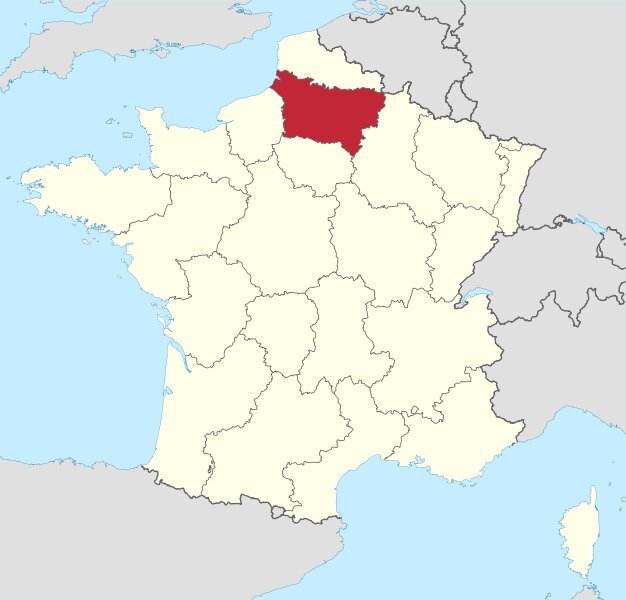
Grey Goose is made in two parts: in Picardy, in the north of France, where the wheat is grown and distilled; and Cognac, France, where the wheat spirit and water are filtered and bottled.
The Wheat
Grey Goose is made from soft winter wheat grown in Picardy. In that region they grow tons of wheat for France (and you know how the French like baguettes). The temperature never goes below -5 degrees Celsius and in the summer not hotter than 25 or 35 degrees. Winter wheat is sewn in October and harvested in August, giving it 10 months to grow strong, as opposed to summer wheat that grows in 6 months and is more fragile.
The wheat is grown by many farms, then sold to and classified by a co-op. They use only that classified as "superior bread-making wheat" for Grey Goose. Soft wheat, as opposed to hard wheat, is better for distilling according to Maitre de Chai Francois Thibault. I takes about 1 kilo of wheat to make 1 bottle of vodka.
Milling and Fermentation
Interestingly, Grey Goose doesn't own their distillery, yet they have an exclusive contract with the distillery and they produce only Grey Goose there. The distillery is also located in Picardy, and it sounds like quite the huge operation. The entire distilling process is one continuous operation – wheat goes in and spirit comes out with the whole thing in motion.
The wheat, purchased from three different co-ops, enters the distillery, where it is cleaned and then milled. It is milled four times over the course of 24 hours. The husks, which won't ferment, are sold as cattle field. The flour goes through to fermentation.
To break the carbohydrates in the flour down into fermentable sugars, enzymes are added. They add one enzyme that cuts the starch into random sized pieces, then cool it, then add another enzyme that cuts those pieces into evenly sized fermentable sugars.
Why use enzymes? I asked Francois Thibault that question. He said that unlike barley, which can be prepared to transform into fermentable sugars by the malting process, wheat doesn't germinate (see geeky explanation by Ben in the comments). However, as with bourbon, malted barley could be added to the corn/wheat to help transform its starches into fermentable sugars. Thibault says though they could use malted barely, using enzymes is more stable, efficient, and cleaner; and no undesired microorganisms will be added during the process.
Now the wheat is ready for fermentation. They use a commercial (non-proprietary) yeast strain that is prepared elsewhere.
Fermentation takes place in a continuous manner – this is something I've not seen at other distilleries, though I think this technology is used elsewhere. Typically, the wheat/corn/whatever that is being fermented goes into a big vat, ferments completely, then the vat is emptied out. This is a batch process.
For Grey Goose, they use a continuous fermentation process over a series of six cascading tanks. Wheat and yeast goes in the first tank, then pours into each successive tank operating at a different phase in the fermentation process. At the end, the liquid is fully fermented in the form of a beer at 10% alcohol by volume. This takes about 30 hours. New wheat and yeast is constantly added to the first tank and beer is constantly pulled out of the last one.
Distilling
Then the beer is distilled into spirit. They use a five column distillation process. Despite the names given to each of thecolumn stills, they're more or less the same stills, just fine tuned with number of plates, pressure and temperature settings, etc., to do a certain job.
The waste products of distillation are redistilled and sold off as industrial alcohol.
The entire process from when the wheat enters the distillery until it leaves takes four and a half to five days.
Filtration, Water, and Bottling
I didn't have the opportunity to visit the wheat fields and distillery in Picardy, but I did get to visit the bottling facility near Cognac.
The water used to bottle Grey Goose comes from a well 500 feet deep beneath the bottling plant. As the soil is full of limestone (just like in Kentucky), the resulting water is full of calcium.
The water is filtered to remove the minerals using double reverse osmosis. Thibault emphasized that the machine can't make great water out of bad water, so they have to start with good stuff like they have. Furthermore Thibault says they don't filter it to 100% pure H20 – they do it to their specifications and leave in the rest for character.
The water is mixed with vodka to bottling proof and then filtered again, this time through pads of cellulose and carbon.
I was curious as to why they don't just bottle the vodka up in Picardy. Thibault says they didn't really consider it – he was based in Cognac (he was a cognac and other spirit maker) when Sidney Frank asked him to develop Grey Goose, and he knew the water in the region was good. He says it was a practical decision to grow the wheat and distill in Picardy and transport it Cognac rather than ship the water of Cognac to Picardy or to try to grow wheat in the Cognac region.
Finally, the bottles are also produced in France. At the bottling facility they only bottle Grey Goose, no other products.
The Glycerin Question
Grey Goose has long been the victim of rumors that it has something added to it to make it smoother. Darcy O'Neil tested Grey Goose for glycerol and found none. But other additives are allowed by US law (sugar, and I think citric acid, for example). So I asked Thibault directly if anything was added to Grey Goose after distillation besides water. He said "Absolutely nothing," and I believe him.
On my recent trip with the Tahona Society, we visited took ATVs into the agave fields and "helped" harvest some agave.
There, Olmeca Altos tequila Master Distiller Jesus Hernandez filled me in on some details about agave I didn't know, so I thought I'd share them:
I also learned something from Guillermo Sauza, distiller/owner of Fortaleza Tequila.
Today on the Tahona Society trip to the tequila regions of Mexico we visited the distillery of Sauza. Yesterday’s visit to La Fortaleza was an example of the most primitive/traditional production methods for tequila. Today at Sauza we say the most high-tech.
I last visited Sauza about a year ago, and that post on Alcademics is here, and probably a bit more thorough than this one. Unfortunately we weren’t allowed to take pictures in most of the distillery, so mostly text will have to do.
Sauza uses what they call “soft extraction” of the sugars from agave plants. While almost every tequila maker bakes agave plant hearts (pinas) then crushes the baked plants to extract the fermentable sugars from the plants, at Sauza first they crush the plants then they cook the liquid.
The agave is first run through a big roller mill, and then a diffuser, a huge machine that specializes in getting the most of the sugars out of agave. Then this liquid is cooked at 120 degrees Celsius for 4-5 hours.
This sugary liquid is then fermented super fast- 24 to 26 hours- then it is distilled.
Distillation for Sauza products takes place first in a column still, where they distill up to anywhere from 24 to 35 percent alcohol depending on the product, and then in a copper-lined stainless steel still up to 56-65%.
An interesting fact I learned on this trip is about their mixto tequila – tequila distilled from the fermented sugars of at least 51% agave and 49% other sugars, usually sugar cane. However at Sauza, where they do use the minimum 51/49 percent ratio, the sugar used is corn syrup, not sugar syrup.
Yesterday I visited the La Fortaleza distillery. This tiny distillery makes 100% tahona tequila, in the heart of the city of Tequila in the Lowlands.
The distillery was rebuilt in a 100 year old distillery site by Guillermo Sauza, 5th-generation Sauza family. His grandfather sold Sauza to the company who sold it to Jim Beam. Guillermo decided to return to distilling the traditional way.
The tahona is a volcanic stone wheel that is rolled in a pit to crush baked agave. Most distilleries use a diffuser, rollermill, or a combination of rollermill and tahona.
The fibers are removed and the sugary water and pulp remain. These are fermented in wooden fermenters.
Then they are distilled in the tiniest little pot stills.
The aging room is about as big as a two-bedroom apartment.
The view from the hill behind the distillery is amazing- they own 80 acres right in the city of Tequila.
There are caves underneath this hill. In the caves they’ve put a bar. We were in there for a good two hours.
Short blog post, but an amazing distillery and a great night!
Today we visited the distillery Pedro Domecq, where they make Tezon, Olmeca Altos, and Olmeca tequilas. I wrote about this distillery before on Alcademics. The post is here.
Tezon is made from 100 percent tahona-milled agave. It is no longer on the US market. Olmeca Altos is a blend of tahona-milled agave and rollermill agave. Olmeca is a mixto and that’s not on the US market.
Yesterday we visited the agave fields to see the harvest. The fields here in the Highland area around Arandas are about 2300 feet above sea level. The agaves are harvested and then brought to the distillery. they then go into either steam ovens (for the 100% agave products) or cooked in an autoclave for mixto.
The agave is cooked for 48 hours, then it is shredded, either by a tahona or by a rollermill. This exposes the sugars in the agave so that they can be fermented.
The tahona is a big stone wheel traditionally used to crush agave. Here they use a mechanized version, which spins the wheel in a circle, while a man follows the wheel raking up the fibers to expose them to further crushing. Then they transfer the wet fibers to the fermentation vats.
The rollermill is a shredding machine that is a bit rougher in its handling of the agave fibers, shredding them into smaller bits so they can get more of the sugars out of the agave. The sugary water from the washed agave fibers from the rollermill is then fermented, as opposed to the tahona agave where the fibers and liquid ferment (and are distilled) together.
The sugary agave water is then fermented, then distilled. The tahona-processed fermented liquid/solids is distilled on one type of still, and the liquids-only rollermill agave is distilled in a more traditional pot still.
For Tezon, the tahona tequila is filtered and bottled. For Olmeca Altos they blend together rollermill and tahona tequila before bottling.
Then it was time for the cocktail contest. We’ll cover that in the next post.
agave alcademics Angostura bartenders bitters bodega bourbon bowmore Campari Camper English chartreuse clear clear ice cocktail cocktail powder cocktails cognac curacao dehydrated dehydrated liqueurs dehydration directional freezing distillery distillery tour distillery visit france freezing objects in ice hakushu harvest history how to make clear ice ice ice balls ice carving ice cubes ice experiments isle of jura jerez liqueur makepage making clear ice mexico midori molasses orange orange liqueur penthouse pisco potato powder production recipe Recipes rum san francisco scotch scotch whisky sherry spain spirits sugar sugarcane sweden tales of the cocktail tequila tour triple sec visit vodka whiskey whisky