Blog

  • Bartenders Looking Very GQ

    Cover-jay-zHey, I'm in GQ magazine in the December issue. Surprisingly not as their Man of the Year, but in the Bombay Sapphire advertorial looking somewhat constipated.


    CamperInGQMagazine

    The four-page spread is about the Most Inspired Bartender contest 2011, for which I was one of the judges. We all carved our names into that ice block in the background.

    Most of the pictures are of bartenders outfitted in Ted Baker clothing, looking good. I've scanned and pasted the pages below the jump.

    (more…)

  • Bars in Japan: Observations

    Here are some observations about bars in Japan from my trip with Suntory whiskies. 

    • You can smoke in bars in Japan. Bars were all a little bit smoky, but none of them I visited were smoky that your eyes hurt. 
    • When you enter a cocktail bar and most other types of bars, they give you a hot wet towel to wipe your hands. Even the low-end bars give you a wet-nap version of this. This is lovely and I'd like to see some bars in the US do it. 
    • For many bars it's seated customers only. You pop your head in and ask if there is room before entering. 
    • A lot of cocktail menus don't list the drink ingredients, only the name, even for original creations. What good is that?  
    • When barhopping at home, I can have just one drink at each bar. In Japan I noticed that my hosts always steered me toward a second drink. I think that it's impolite to leave after just one. 
    • Understanding Japanese gets easier after the third drink. However, it gets really hard again after the tenth. 
    • Japanese people can drink a lot. I have a healthy layer of fat and yet all of my skinny Japanese hosts kept up or surpassed me nightly.
    • Bars have a cover charge.
    • Almost every bar offers some food. A snack is often included in the cover charge, but they offer much more. Thus you can go barhopping without eating first -you're going to be eating at every place you go. 

    Thanks Japan, you are awesome!

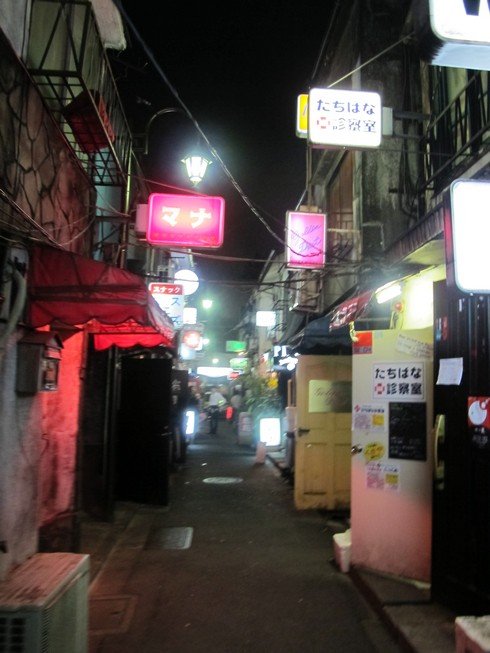
    Karaoke bar shinjuko tokyo_tn

  • Bars in Japan: Miscellany

     On my five-day visit to Japan with Suntory whiskies I hit 21 bars by my count. I am talking about them in groups. Next up: The Rest of Them.

    The difference between the various styles of bars is subtle and I'm defining them as I see them. I'll be describing whisky bars, cocktail bars, highball and standing bars, and pubs/clubs/dives. This is that last section.

    Rippongi Nouen is actually a restaurant but it's notable because they serve highballs with flavors like ginger and rosemary.

    The restaurant has big glass cubes in the back that have (or used to have, can't tell) herbs and vegetables growing in them. 

    Roppongi nouen rosemary highball_tn

    The tasting menu had some great food. I think they picked this place not just for the drinks but for its vegetarian tasting menu.

    Roppongi nouen personal grill_tn
    (Everyone gets their personal smoking grill in one dish.)

    One Shot Bar The Door (I'm not sure if it's called The Door or One Shot Bar) is located in Kyoto. I didn't see much of the bar downstairs as we were in a private room upstairs with our shoes off on with tatami mats having a great conversation. It has a short cocktail menu, mostly of classics. I ordered a Martini. 

    One shot bar kyoto japan_tn

    One shot bar kyoto japan martini_tn

    Three Martini Bar in Yokohama is full of good. The walls are lined with vintage whisky decanters and ice buckets and they were playing a soundtrack of yacht rock. Good vibes all around.

    Three martini bar yokohama_tn

    Three martini bar yokohama2_tn

    Three martini bar yokohama menu_tn
    (Mmm, tequira.)

    Our hosts gave us a few reasons why it's called Three Martini, but I only remember one of them. "Three" in German is spelled "dreit" as in "dry." In exchange, I told them that in America it might refer to the three-martini lunch or Dorothy Parker's "two at the most" rhyme.

    Anyway, we ordered Moscow Mules and the three Martinis.

    Three martini bar yokohama moscow mule mugs_tn

    Three martinis at three martini bar yokohama_tn

    For bar snacks they had several options including fried sugar(!*!*!*!).

    Three martini bar yokohama fried sugar_tn

    Eagle Bar in Shinjuku area of Tokyo looks like a speakeasy gentleman's club with patterned wallpaper, wooden walls, and carpeting. To enter you walk down a flight of stairs to find a room with the main bar. Walk down another flight of stairs (two storeys below the street) and there is another small bar room where we sat. 

    Eagle bar upstairs shinjuko tokyo2_tn

    We sat at the bar. It has low barstools so your feet are touching the floor. While a couple to our right were working their way through the cocktail list, we stuck to highballs. 

    Eagle bar shinjuko tokyo2_tn

    Bigri Bar is located in Golden Gai, the neighborhood of tiny bars I mentioned previously. 

    Street Golden Gai Tokyo Japan_tn

    You enter in a set of incredibly steep stairs into a room that looks like a kitchen in a studio apartment.

    Steep stairs Bigri Bar Golden Gai Tokyo Japan_tn

    I think this is what is called a "mama-san bar" as the owner is an older lady who serves drinks and also cooks you (not exactly good-looking) food from behind the same bar counter. 

    Coaster Bigri Bar Golden Gai Tokyo Japan_tn
    (Hand-knit cocktail coasters. Adorable.)

    Cooking Bigri Bar Golden Gai Tokyo Japan_tn

    Track Bar is an uber-hipster bar that wasn't filled with hipsters at the time we visited. They have a wall of 33" records and a DJ spinning them. There were mason jars full of help-yourself snacks. But it still operated like a cocktail bar – you ask when you walk in the door if there is enough seating before entering. 

    Bar track  ebisu tokyo3_tn

    Bar snacks bar track  ebisu tokyo_tn

    It seems like a whisky bar but I saw cocktails being made as well. I ordered a highball, and their house style at this bar is to serve it in a frosted glass without ice. 

    Highball without ice bar track  ebisu tokyo_tn

  • Bars in Japan: Standing and Highball Bars

    On my five-day visit to Japan with Suntory whiskies I hit 21 bars by my count. I am talking about them in groups. Next up: Standing and Highball Bars.

    The difference between the various styles of bars is subtle and I'm defining them as I see them. I'll be describing whisky bars, cocktail bars, highball and standing bars, and pubs/clubs/dives. As far as I can tell, highball bars are all standing bars but I'd imagine there are standing bars that don't specialize in highballs. 

    As you can guess, standing/highball bars are bars in which everyone is standing up drinking at tall tables rather than seated. They are popular after-work bars. Perhaps they're Japanese happy hour bars. 

    Anyway, in Kyoto we went to a bar called Getto, which is a pretty great name. The bar is as big as a hallway, with lots of traditional Japanese beverages. You stand up the whole time but are essentially leaning against the wall behind you. 

    Getto bar Kyoto Japan_tn

    There I tried aged awarami, a beverage from Okinawa that is aged in ceramic containers. It tastes like shochu for the most part. A little gamey but nothing special. 
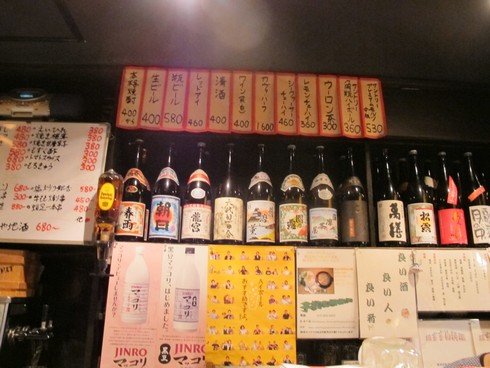
    Getto bar Kyoto Japan2_tn

    I also tried kokutojochu, which is sugar cane schochu fermented with rice mold. Basically, it's Batavia arrack and I wanted to see if it tasted the same. More or less! It was, as expected, completely disgusting, like fermented sweatsocks

    However, the cucumber was awesome.

    Getto bar Kyoto Japan cucumber_tn

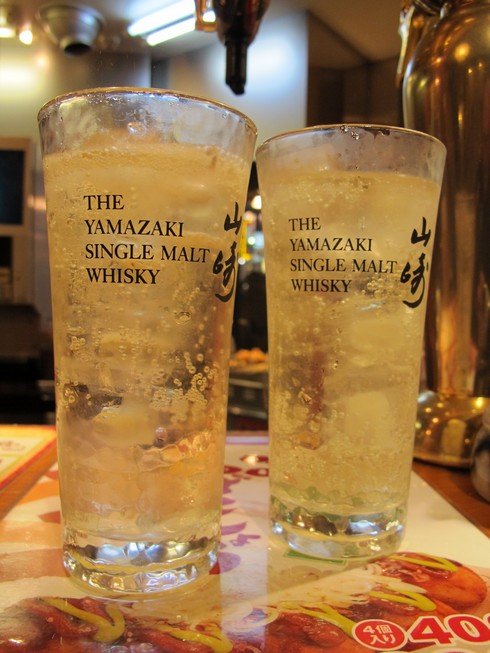
    Gindaka is a highball bar in the Shinjuku area of Tokyo. It's  basically a take-out restaurant with one window facing the street and another into a tiny room for standing customers. They have a tap that serves highballs of Yamazaki 10 and Suntory Whisky (a blended whisky sometimes called "koku" which means "box" as the bottle is short and squareish.)
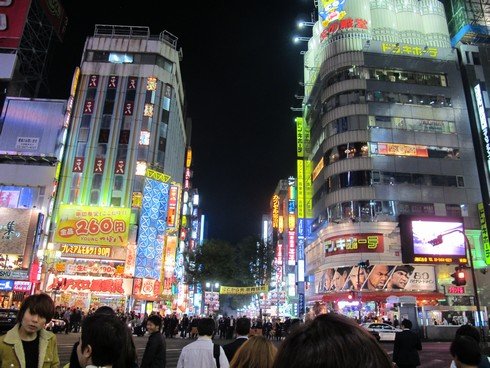
    Shinjuko tokyo2_tn
    (This is the neighborhood where Gindaka is located. Busy, to say the least.)

    Gindaka highball bar shinjuko tokyo on tap_tn
    (Highballs on tap, with Suntory Premium Malts beer also on tap in the middle.)

    Sign at gindaka highball bar shinjuko tokyo_tn
    (Koku bottle in ad.)

     When they served us the Koku, it came with a lemon slice, served in a plastic mug. For the Yamazaki 10, they put it in a highball glass. And when we ordered a highball with Hakushu 10 they put it in the same glass with a tiny piece of mint on top. A nice little indicator that you've moved up in your drinking choice.
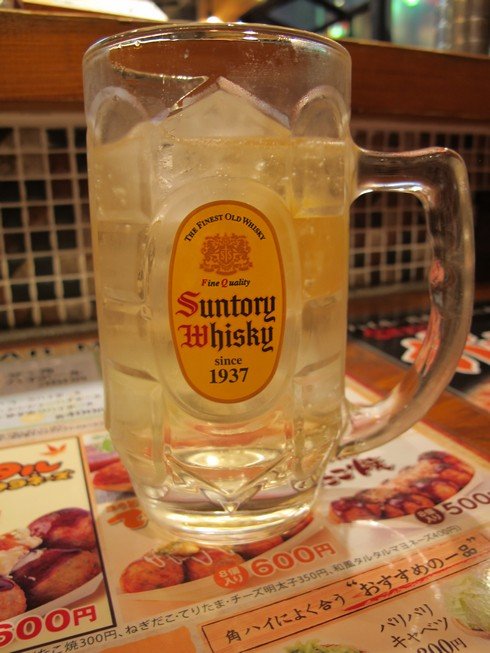
    Highball of suntory at gindaka highball bar shinjuko tokyo_tn
    (First drink with Suntory Whisky.)

    Highball of yamazaki 10 gindaka highball bar shinjuko tokyo_tn
    (Second highball, Yamazaki 10 in highball glass.)
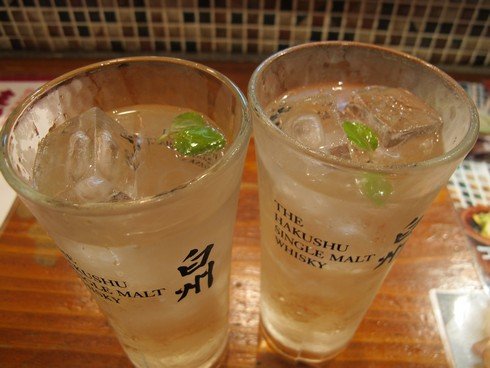
    Hakushu 10 mint garnish gindaka highball bar shinjuko tokyo_tn
    (Hakushu 10 highball, with tiny mint garnish.)

    Marugine, my hosts tell me, is the most famous highball bar in Japan. It's what I would call 'regular bar' sized, but with all tall communal tables for standing and eating or drinking. 

    Marugine highball bar tokyo_tn

     As this was my sixth bar of the evening, I am a little hazy about any other details. 

    Marugine highball bar tokyo2_tn

  • Bars in Japan: Cocktail Bars

    On my five-day visit to Japan with Suntory whiskies I hit 21 bars by my count. I am talking about them in groups. Next up: Cocktail Bars.

    The difference between the various styles of bars is subtle and I'm defining them as I see them. I'll be describing whisky bars, cocktail bars, highball and standing bars, and pubs/clubs/dives. Many cocktail bars look pretty much like whisky bars, since so many bars carry a massive amount of scotch. 

    Bar High Five is run by Japan's most famous bartender, Hidetsugu Ueno (Ueno-san). It was voted one of the world's 50 best bars. It's a tiny little place located in a building full of bars.

    Bar high five tokyo sign2_tn

    It only seats about a dozen people at the bar, plus there is an additional booth that can hold about eight more people. The mood inside was great – people complain about the formality of Japanese bartenders but I've found that when you're sitting at the bar it's fine to chat and laugh and have a good time with them. 

    Unfortunately we were only here for one drink as we were a large group at that point and didn't feel like we should hog the whole place. Someday I will be back for longer! 

    Bar high five tokyo camper and uena san_tn
    (At least Ueno-san looks good in this picture.)

    Tender Bar is owned by Japan's other most famous bartender, Kazuo Uyeda (Uyeda-san). This bar is classy and weighty and feels expensive; the Pegu Club to High Five's PDT. 

    Tender bar tokyo sign_tn

    Though I was tempted to order Uyeda's famous Gimlet, I opted for a Jack Rose that came out dry, as opposed to my bar-mate's surprisingly delicious bitters-free Manhattan. 

    Tender bar tokyo drink2_tn

    Uyeda-san's wife was our host for the evening and her English was quite good. I had met them both in New York for a 2-day seminar on Japanese bartending. 

    Bar Orange, near Shibuya in Tokyo, is a nearly-hidden downstairs cocktail bar. It's dedicated to the movie Clockwork Orange though you'd not call it a theme bar. It's very sleek and dark and I'd imagine attracts a stylish young crowd. The cocktails are served in gorgeous vintage-looking glasses. 

    Bar orange tokyo_tn

    Bar orange tokyo cocktail_tn

    Ishi no hana was the most progressive bar we visited in Japan. It's run by bartender Shinobu Ishigaki, who won the Bacardi Grand Prix competition a few years ago with this drink:

     
    Ishinohana bar roppongi tokyo cocktail2_tn
    (That is some serious garnish.)

    I had an Apple Vinegar Martini, while my bar companion had a Yellow Chartreuse Mojito. Other ingredients on the menu include rhubarb confit, jasmine, saffron syrup, and earl grey tea. 

    Ishinohana bar roppongi tokyo garnish_tn

     The bartender Shinobu Ishigaki even has his face on a can of a green tea beverage called calpis sour.

    Beverage by bartender shinobu ishigaki_tn

    While the Ginza bars of Tender Bar, High Five, and Star Bar get all the glory, visitors to Tokyo should definitely put this one on their list. 


  • Bars in Japan: Whisky Bars

    On my five-day visit to Japan with Suntory whiskies I hit over 20 bars. I think the best way to talk about them will be in groups. First up: Whisky Bars.

    The difference between the various styles of bars is subtle and I'm defining them as I see them. I'll be describing whisky bars, cocktail bars, highball and standing bars, and pubs/clubs/dives. I only hit one or two izakaya places. 

    Whisky bars specialize in whisky, of course. Most of them have a huge range of single-malt scotch whisky (100 different bottles is a start) and also serve whisky highballs. Many have a cocktail list too, but typically these list just a few classic drinks like Martinis, Manhattans, and Gimlets. The focus is on whisky rocks and whisky highballs. 

    Whisky bars I didn't visit include ones with names like Bar Argyll, Bar Caol Ila, Bar Main Malt, Cask, Kask, and Malt House Islay. Many are associated with either Yamazaki or Nikka whisky and will serve a better selection of those whiskies than of the other brand. It's sort of like how fast food restaurants usually serve either Coke or Pepsi but not both. 

    Highlander, one of the bars in the fabulous Hotel Okura Tokyo, has red plaid carpet and a clubby, old-world look. I tried a few interesting whiskies there, including the stunning Hibiki 21 year old blended Japanese whisky. 

    Highlander bar
    (Image from the hotel's website.)

    K6, in Kyoto near the Yamazaki whisky, is an upstairs bar with shelves around three sides that stocks 600 single malts! We had a nice chat with the bartender and a few unusual drams. And then we ordered haggis pizza, because if offered Scottish food in Italian format in a bar in Japan you just say yes. 

    Bar K6 kyoto japan_tn

    Oil is in a special place in Tokyo called Shinjuku Golden Gai. It is full of tiny bars stacked on top of each other, many the size of a bedroom. Some welcome regulars only; others are open to tourists. Some of them you're practically climbing a latter to get into.

    Golden Gai Tokyo Japan bar directory_tn
    (Bar directory of Golden Gai.)

    I got a feeling my hosts were not all that interested in taking me there, but there I went. We went to two bars, Oil and Bigri Bar (that I'll talk about later).

    Oil bar Golden Gai Tokyo Japan2_tn

    Oil serves two things for the most part: Jack Daniels and Triangle Shochu. You can buy a bottle and have it there waiting for you on your next visit. The bartender, who appears to be the main owner as his picture is all over the place, is a heavily-tattooed, long haired rock and roll type. The rest of the decor is dedicated to actor Yusaku Matsuda, who was in the 1989 movie Black Rain

    Bartender from oil bar Golden Gai Tokyo Japan_tn
    (Cartoon of the bartender.)

    When I ordered a whisky on the rocks expecting scorn and derision from too-cool-for-school guy, he took a large, perfectly clear piece of ice, put it into a tumbler glass, carefully stirred it with a barspoon a full minute or so to cool the glass, and poured the whisky. Nicely done. 

    Jack on the rock oil bar Golden Gai Tokyo Japan_tn

    There are several bars called Yamazaki Bar so I'm not sure how to identify this one by address, but it was staffed with all women bartenders wearing suits. So it's not really a "hostess bar" where you are paying for female company.

    Bar yamazaki2 tornado style_tn

    Anyway, they do a very nice presentation for whisky on the rocks. They call it "tornado" style when they serve it with a few big pieces of ice in an oversized Bordeaux wine glass. Then you can have it "pierced"- they bring out a box of garnishes and you can choose from them. They include simple miniature roses,  raspberries, lime/orange slices, mint, and you can dip any of the above in a little caramel or honey. 

    Bar yamazaki garnish2_tn

    It was a classy, easy, and affordable way to make a drink on the rocks a little more special. 

    Next post: Cocktail bars!

  • A Visit to the Yamazaki Distillery in Japan

    Yesterday I wrote about visiting the Hakushu distillery in Japan. Today I'll write about Suntory's other single-malt distillery, Yamazaki. It is located between Kyoto and Osaka, at the convergence of several rivers. I believe they said the distillery welcomes 100,000 visitors each year. 

    Mount fuji from train_tn
    (Mount Fuji as seen from the train to Kyoto.)

    The Yamazaki distillery was built in 1923 and launched its first whisky, the White Label, in 1929. That whisky is still made today.

    The distillery location was chosen because of its water (as are most distilleries), also sought out by Sen no Rikyo, the inventor of the Japanese tea ceremony. One of his tea houses from the 1500s still stands nearby.

     Yamazaki Distillery Kyoto behind warehouse_tn

    Like at Hakushu they import malted barley from Scotland, then grind it, mash it, ferment it, distill it, and age it on site. At Yamazaki they use a combination of wooden and stainless steel washbacks (fermentation vessels). They use the same yeasts as at Hakushu, but sometimes in different proportions. 

    Yamazaki Distillery Kyoto washback_tn

    They have six differently-shaped pairs of stills to make whiskies with many different flavor characteristics, further enhanced by aging in five different types of barrels. 

    Yamazaki Distillery Kyoto stills4_tn

    Hogsheads (reassembled ex-bourbon barrels at a larger size), puncheons (large barrels made of new American oak), and Mizunara (Japanese oak) barrels are made at the cooperage in Japan at their grain distillery.

    Spanish oak sherry butts are made for them in Spain, and ex-bourbon barrels are what they are. 

    Yamazaki Distillery Kyoto barrels and trees_tn

    Mizunara oak grows in the north of Japan, and sometimes in Hokkaido. I used to describe its flavor as similar to sandalwood incense, but on this visit I was tasting it more as a combination of sticky pine tree and cedar. Either way, it's got spice. 

    Yamazaki Distillery Kyoto whisky cask species_tn

    They still have a cask from 1924 in the warehouse (though they've swapped out the whisky) and you can see the Cadiz sherry stamp beneath the Yamazaki one. 

    Yamazaki Distillery Kyoto oldest barrel 1923_tn

    We tasted whiskies aged in three types of oak: Mizunara, Spanish ex-sherry, and new American oak puncheons. 

    Yamazaki Distillery Kyoto tasting_tn

    From the Yamazaki website, "White oak adds vanilla and coconut flavours during the aging process. Tannins and other polyphenols contained in Spanish oak casks leach into the whisky, imbuing it with a deeper reddish hue compared with white oak casks. Whiskies aged in Spanish oak casks typically have fruity, chocolate notes. Over long periods of aging the Japanese oak casks add a distinctively Eastern touch to the whisky, endowing it with sweet fragrances reminiscent of incense with a hint of citrus. This unique flavour has been gaining the Yamazaki brand new adherents around the world." 

    At Yamazaki they have six different still shapes, use five types of barrels, and barley at two peating levels. This adds up to 6x5x2 = 60 different whiskies produced at this distillery to be used in single malt and in blends.

    Yamazaki Distillery Kyoto clear cask2_tn

    Speaking of blends, the Hibiki blend is assembled at this distillery as well. (I think the lower-end blended whiskies that we don't get in the States are put together here too.) The blends have aged grain, column-distilled whiskies along with the single malts from the Hakushu and Yamazaki distilleries. 

    At the distillery, there is a tasting room where you can try a variety of distillery-only products like 100% sherry cask Yamazaki the 1980s and white dog.

    Yamazaki Distillery Kyoto visitor area_tn

    They also have a library of their whisky experiments.

    Yamazaki Distillery Kyoto whisky library_tn

    And an advertising museum. I wish they'd bring back Uncle Torys.

      Yamazaki Distillery Kyoto unle torys ad cropped

    Now that we've talking about how they make Hakushu, Yamazaki, and Hibiki, I'll get into where and how to drink them in Japan over the next few posts.


  • A Visit to the Hakushu Distillery in Japan

    I visited the Hakushu distillery owned by Suntory, located in the Yamanashi prefecture, about two hours by train from Tokyo in Japan. There is a new Hakushu single malt whisky on the US market. 

    Hakushu Distillery camper english_tn

    As I mentioned in a previous post, Hakushu was built in 1973 and is located at a high elevation – 700 meters above sea level. (Scotland's highest distilleries are Dalwhinnie and Braeval, both about 355 meters.) On the train ride there, your ears are continually clogging as you change elevation. The distillery is on a large site to protect its water source, and doubles as a bird sanctuary. 

    The Yamazaki  distillery used to grow at least some of its own grain up until around 1970, but now they import all their barley. It is grown and malted in Scotland and shipped to Japan. Suntory buys malted barley at two different peating levels; basically unpeated and at highly peated at at 25 ppm phenol content. 

    Hakushu Distillery mashing_tn

    They grind the malted barley on site, then put it in the mash tun with hot water to expose the fermentable sugars and transfer it to the wooden washbacks for fermentation.  They ferment it using both brewers' and distillers' yeast.

    Hakushu Distillery washbacks2_tn

    They have six pairs of stills at Hakushu;  two of them the same shape and one not currently used. Thus they have four active still shapes producing different whiskies. As there is another whisky boom, they're currently distilling 24/7. 

    Hakushu Distillery still3_tn

    As Hakushu is at a very high elevation, the whisky ages more slowly with less wood influence on the spirit. Though they use five types of barrels at the other single malt distillery Yamakazi, at Hakushu they focus on two: ex-bourbon and hogshead. (Hogshead barrels are reconstructed bourbon barrels made a little larger, holding 230 liters rather than 180.) They do, however, age ex-sherry butts (Spanish oak, 480 liters), and puncheons (new American white oak, 480 liter). 

    Hakushu Distillery barrel info_tn

    They rechar some barrels after using them to age whisky about four times, but after they rechar they only use them one more time. Distillery General Manager Mike Miyamoto says that the whisky aged in rechar barrels is more astringent than with regular ex-bourbon barrels. 

    Hakushu Distillery barrel rechar8_tn

    The smell of a recharred barrel is amazing! It's like campfire wood and sugars, even marshmallowish. 

    At Hakushu they use only racked warehouses, in earthquake-safe metal racks that go about 13 levels high. 

    Hakushu Distillery warehouse_tn

    Here they use peated and unpeated barley, four still shapes, and five types of casks (though they focus on two.) They say that between them (2x4x5) they make 40 different types of whisky at Hakushu. 

    Hakushu Distillery whisky procedures_tn

    Regardless, to make up the Hakushu single malt they primarily include three whiskies distilled on-site:  unpeated malt distillate aged in hogshead barrels, unpeated malt distillate aged in  sherry butts, and peated malt distillate aged in  ex-bourbon barrels. 

    Hakushu Distillery three principle malts_tn

    We sampled each component separately and then the Hakushu 12 and 18 year old blends. With three widely different distillates, Hakushu is almost more of a blended malt (vatted malt) than a single malt.  

  • A Kim Kardashian Shrinky Dink Sun Catcher Painted in Dehydrated Midori

    SolidLiquidsProjectSquareLogoI found a new use for the dehydrated Midori I made in the Solid Liquids project

    I made a sun catcher in the shape of Kim Kardashian from her Midori ad, and painted it with dehydrated (and rehydrated) Midori for her dress and X-Rated Fusion liqueur for her hair. Because why not? 

    I started with her Midori ad:

    MIDOMECH0305NoLegal cropped_tn

    And had my graphic designer friend reduce Kim's profile to a line drawing.

    Kim kardashian shrinky dink outline_tn

    Printable shrink film_tnI then printed this onto printable 8.5 x 11 inch shrink film. You know, the stuff used to make Shrinky Dinks, except blank. 

    Then I cut out the shape on the film and baked it in the oven according to the instructions. 

    Kim kardashian shrinky dink finished_tn

    It came out awesome! I am an arts & crafts master! It's about 4.5 inches tall.

    So then I took some of my dehydrated Midori (see dehydration experiments here) and added a few drops of hot water to reconstitute it. 

    Kim kardashian shrinky dink ready for paint_tn

    And I painted her dress. Then I painted her hair using dehydrated/rehydrated X-Rated Fusion Liqueur. Naturally, the Midori drink matches the dress.

    Kim kardashian shrinky dink wet_tn

    And now she makes a lovely sun catcher. 

    Kim kardashian shrinky dink sun catcher_tn

    Until it rains anyway. The thing about painting with dehydrated liqueur is that it washes off with water.

    So I guess this Kim Kardashian sun catcher is also lickable.


    If you enjoyed this post, you might also like Campari Fruit Roll-Ups.

    The Solid Liquids Project index is at this link.

  • Solid Liquids: The Missing Link Aviation

    SolidLiquidsProjectSquareLogoI haven't created cocktails yet with the dehydrated liqueurs I've been making for the Solid Liquids project, mostly because I figure y'all are don't lack imagination and will find good uses for them.

    But here's a drink I've been hankering to create since the beginning. 

    Missing link aviation3_tn

    The Aviation cocktail was originally made with gin, maraschino liqueur, lemon juice, and creme de violette liqueur, but at some point in one cocktail book copying from another, they left off that last ingredient. 

    For something like 60 years, the recipe was written incorrectly as the first three ingredients only, even through the beginning of the current classic cocktail revival. Then someone figured out they were missing the creme de violette that turned the drink sky blue and gave the cocktail its name. 

    I wrote about that here

    I decided a fun drink would be to create the drink that is the missing link between the wrong and correct recipes, leaving the drinker the option to have it either way. The cocktail has dehydrated creme de violette sugar around the rim, and what's in the glass is the other three ingredients.

    Missing link aviation2_tn

    Missing Link Aviation
    By Camper English 

    2 oz. Gin
    .75 oz. Maraschino Liqueur
    .75 oz. Lemon Juice

    Shake and strain all ingredients into a glass rimmed with Dehydrated Creme de Violette.  

    Missing link aviation6_tn

    It tastes delicious.

     Learn how to dehydrate liqueurs here.


    The Solid Liquids Project index is at this link.


agave alcademics Angostura bartenders bitters bodega bourbon bowmore Campari Camper English chartreuse clear clear ice cocktail cocktail powder cocktails cognac curacao dehydrated dehydrated liqueurs dehydration directional freezing distillery distillery tour distillery visit france freezing objects in ice hakushu harvest history how to make clear ice ice ice balls ice carving ice cubes ice experiments isle of jura jerez liqueur makepage making clear ice mexico midori molasses orange orange liqueur penthouse pisco potato powder production recipe Recipes rum san francisco scotch scotch whisky sherry spain spirits sugar sugarcane sweden tales of the cocktail tequila tour triple sec visit vodka whiskey whisky