Blog

  • Dehydrating Liqueurs: Stovetop Crystallization Method

    SolidLiquidsProjectSquareLogoSo far in the Solid Liquids project, I experimented with using the food dehydrator, oven, and microwave to dehydrate liqueurs into flavored sugars. The project index is here.  

    Well, thanks to a Facebook friend, I now have a much more efficient way than all the others I've tried. Lauren Mote, co-owner of Kale & Nori Culinary Arts, wrote me to tell me the way she's made liqueur sugars. She wrote:

    So I have found the easiest way to do this is actually culinary and through "almost" candy making.

    If you cook down the spirit, and remove the water molecules, the liquids eventually crystallize…. the trick is "agitation". When you're trying NOT to crystallize, which is making candy, brushing the edges of a pot with water constantly prevents crystals from forming in the sugar. However, when you agitate the liquid and sugar, the crystals form. Continue to agitate, on low heat past the candy making stage, do not burn it. You will concentrate all of the flavour, without a microwave. Once the crystallization starts, it's really really really fast! Remove from the heat, keep mixing until the mixture turns light and powdery. Let cool on a SilPat non-stick baking sheet. Once cool, blitz in a food processor and sift through a tea strainer. What you're left with is completely concentrated, amazing powdered spirit. I did this with Cointreau and it was really amazing.

    I wasn't sure I was doing it right but I tried it out with Campari, and it works! In short, add the liqueur to a metal pot,

    Boiling campari

    Heat it so that the alcohol burns off, then it starts going into the candy phases as the water burns off. 

    Bubbling campari stovetop

    First it boils, then it gets thicker, then it starts to froth. Eventually the frothiness gets really big, like it's going to overboil.

    Heating campari stovetop
    Thick campari stovetop

    Stir it with a metal spoon (perhaps you have a barspoon around). Not long after this point the frothiness dies down a little. You'll notice sugar crystals on the bottom of the pan as you stir it and the volume of the liquid seems to shrink a lot. Though it still looks quite liquid, it's ready.

    Pull it out and as fast as you can, scrape it onto a silicone Silpat or other non-stick pan. You'll see that it is sugary and full of crystals. This dries really quickly.

    Scraped campari stovetop
    Dried campari stovetop2

    Then you can stick it into a spice grinder and get your powdered liqueur.

    Coffee grinder
    Campari sugar in coffee grinder
    Ground campari sugar in coffee grinder
    Pile of ground campari

    The process takes less than two hours, and it seems to work with larger quantities of liqueur just as fast. Sweet.

    In future posts, we'll finally start dehydrating liqueurs other than Campari.

    The Solid Liquids Project index is at this link


  • Solid Liquids: Bulk Liqueur Dehydration in the Oven

    SolidLiquidsProjectSquareLogoThis is just a quick post in the Solid Liquids Project (project index here) to note that you can dehydrate liqueurs in the oven in containers other than the silicone cupcake holders that I've been using.

    Many people have SilPat non-stick baking mats. These are great but have the problem of being flat so liquids run off them.

    However you can also get other silicone containers. I bought a breadpan-sized silicone pan from Amazon. It works just fine for dehydrating larger quantities of liqueurs.

    As you dehydrate a liqueur in the oven, a surface crust will form trapping some still-liquid liqueur beneath it, so it's important to break it up as it gets near the end of baking. I just squeeze the silicone pan to crunch the innards.

    Baking pan solid_tn
    Baking pan finished_tn
    Baking pan crushed_tn


    The Solid Liquids Project index is at this link.


  • The Sugar Spirit Project: Enter the Sugar Beet

    SugarSpiritLogoSquare1

    In studying sugar and sugarcane (go here for the project index) we need to study the sugar beet; sugarcane's competitor. 

    Here we'll look at the sugar beet's early history. 

    Sugar beets were not economically important as a source of sucrose until the mid-1800s. 

    In 1774 a German scientist discovered the sugar from beets was the same as from cane. 

    Napoleon, due to the economic and real war with England, bet big on sugar beets. In 1811 he supported vast increase in sugar beet production. Within 2 years they built 334 factories and produced 35,000 tons of sugar.

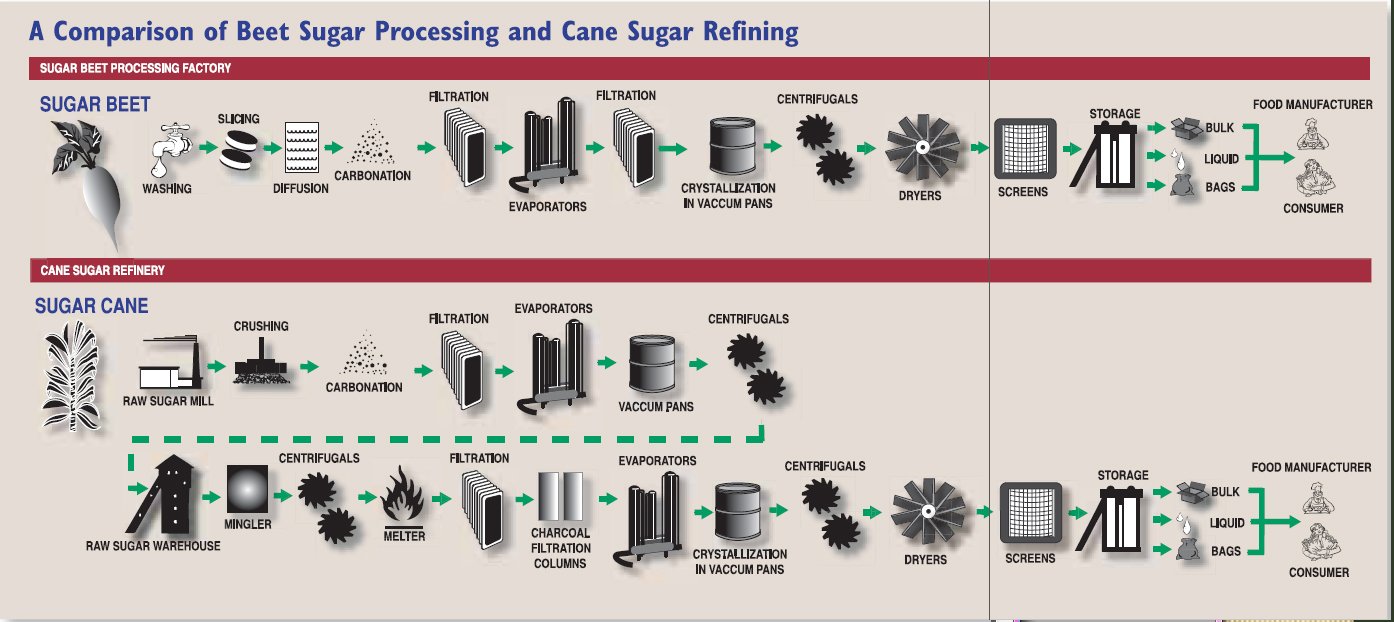
    To process sugar beets, they are sliced, dried, drenched with alcohol (I know the feeling some nights),  heated to boiling, and filtered. Then crystals formed after several weeks. But this technology was later refined.  

    By the end of 1800s sugar beets were planted in North America. Sugar beets best regions to grow in the US are part of California extending east to Michigan, and in Canada from British Columbia to Ontario. 

    The Mormons tried to grow sugar beets as part of their independence movement, but they failed to produce any crystallized sugar with it.  There were many other successes and failures trying to grow sugar beet in US.

    By 1902 41 factories produced over 2 million tons of sugar from beets. by 1915, there 79 factories in operation, partly due to high war prices. 

    The first American farm workers’ union strike was over sugar beets in 1903 at the American Beet Company in Oxnard, California. It employed 1000 Mexicans and Japanese, who went on strike basically against the white workers who formed organizations to keep the wages of the others low. 

    During the Great Depression, sugar beet harvesting provided lots of jobs. 

    After Pearl Harbor, thousands of Japanese and Japanese Americans were sent to internment camps: actually sugar beet farms in Oregon, Utah, Idaho, Montana, Alberta, and Manitoba, to work the fields. 


    Later we'll look at sugar beet production in recent times. 


    The Sugar Spirit Project is sponsored by Bacardi Rum. Content created and owned by Camper English for Alcademics. For the project index, click on the logo above or follow this link

  • Solid Liquids: Campari Syrup

    SolidLiquidsProjectSquareLogoIn the last post in the Solid Liquids project, I used dehydrated Campari to make a non-alcoholic Campari & Soda. 

    Then it occurred to me that for that purpose there was no need to dehydrate the liqueur completely. I could just burn off the alcohol and have a non-alcoholic syrup. 

    So that's what I did. I filled a pot with Campari and took its temperature with a candy thermometer when heating it. Alcohol boils at 172F as opposed to 212F for water, so I tried to keep the temperature between the two. 

    IMG_0142_tn

    It started to bubble around 175 and I could smell alcohol vapor. It began boiling around 183F. When it got to 189F it began to look thicker, as plenty had boiled off.

    IMG_0144_tn

    After an hour total I cooled the liquid to check the volume and found it to be reduced by 50 percent. And since the alcohol content of Campari is 24 percent  alcohol hopefully all the booze and some of the water burned off as well. 

    IMG_0148_tn

    After cooling and storing it, I made another non-alcoholic Campari & Soda. I added about an ounce of Campari syrup to about 3 ounces of soda water. 

    It's good, probably better than the powdered liqueur version. But campared with regular Campari & soda, real Campari still tastes better. Again the real deal has more of an orangey flavor, so the non-alcoholic version can use an expressed orange peel added to it. 

    IMG_0966_tn

    I'm guessing that the volatile citrus orange (oil?) in Campari burns off in the cooking and that's why it's not present in the syrup/solid version. 

    So: What else should I use this Campari syrup for? 

    Update: I just remembered that I saw Campari syrup on the menu at Nightjar in London. I'm not sure if their syrup is the same thing or something else, but it's in two drinks from the summer menu (forgive the funky formatting, it's their font):

    bRick lane cocktail
    g’vine floRaison gin
    campaRi syRup
    dolin dRy veRmouth
    fResh squeeZed mandaRin
    chambeRyZette jelly

    baRnaRd’s bRew
    nut-infused chaiRman’s ReseRve Rum
    nightjaR faleRnum
    caRibbean bitteRs
    campaRi syRup
    fResh squeeZed lime


    The Solid Liquids Project index is at this link


  • Sugar in Early American History

    SugarSpiritLogoSquare1

    In studying sugarcane and sugar, we've looked at its biology, origins, spread to the West, association with forced labor, how it was processed in the olden days, and how the English developed a taste for it. (Go here for the project index.)

    Now we'll look at sugar in America. Again I have used these resources for my facts and understanding of history, as I'm certainly no expert and I welcome your comments.

    Jamestown, Virginia was founded in 1607. Sugarcane was brought there by 1619, but the colonists couldn't make it grow. 

    As it was a new country, the United States started their sugar production late in the game versus the forces of England, France, and Portugal. However they had their own sugar islands in Puerto Rico, Cuba, Hawaii, and The Philippines. 

    Around the time of the US Civil War, we got half our sugar from Cuba and half from Louisianna. After the American Civil War (that ended slavery), Cuban slave owners wanted to end slavery but wanted to be compensated from Spain for each slave freed. Spain refused, and this lead to the Ten Years War. This didn’t end up freeing Cuba (that was 1898) from Spain but it did end slavery in Cuba in 1886. 

    After this, the US imported 82 percent of all Cuban sugar, so sugar interests in Cuba became controlled by American interests. Eventually 2/3 of Cuban sugar was controlled by American interests. 

    In the US, it was sugar producers fleeing the Haitian revolution who made Louisiana’s sugar plantations profitable.  

    In Hawaii as land leases were granted to grow sugarcane,  native Hawaiians were displaced.  Irrigation for sugarcane cultivation diverted streams from their land, so many younger Hawaiians immigrated to California. 

    The US marines, acting for the sugar interests, deposed Queen Lili’uokalani. Hawaii was annexed to the US mostly so that the sugar planters could have free access to the US market. 

    At the 1904 St. Louis World’s Fair, Miss Louisiana was carved from a five-foot sugar lump. Jell-O created new fans. Fairy Floss, aka cotton candy, was also introduced.

    In the 1800s in the US, grocery stores had portable mills to grind lumps of muscovado sugar into granules.

    In 1858 the Mason Jar was invented and canning took off. Canning required white sugar, increasing the demand for it.

    The ice cream craze also increased demand for sugar through mid-1800s.

    Milton Hershey, the chocolate guy, built a factory town named for himself. Then in 1916 he duplicated it in Cuba and bought more than 100,000 acres of sugarcane and built the world’s largest refinery. 

    Now sugar is challenged by high-fructose corn syrup, which is cheaper to produce and transport. In the US (as of the writing of my source book) it takes only 1.4 minutes of work to buy a pound of sugar. 


    The Sugar Spirit Project is sponsored by Bacardi Rum. Content created and owned by Camper English for Alcademics. For the project index, click on the logo above or follow this link

  • Solid Liquids: Cane Sugar, Fruit Sugar, and Honey

    SolidLiquidsProjectSquareLogoI hit a snag in the Solid Liquids Project (project index here) as I can get some liqueurs to dehydrate into a powdered sugar, but not others.

    In the last two posts, I think I've identified a commonality in the liqueurs that did not crystallize: they are probably sweetened with something other than (or possibly in addition to) cane/beet sugar.

    I believe (but am not certain) that X Rated Fusion, Hypnotiq, and Courvoisier Rose are sweetened with fruit juice. Wild Turkey American Honey and Irish Mist are sweetened at least partially with honey. None of these crystallize when heated in the various methods used to make other liqueur powders.

    So I decided that I had better learn about these various sweeteners.

    Cane Sugar, Fruit Sugar, and Honey vs. Sucrose, Fructose, Glucose

    I looked up these different types of sweeteners to see if they could provide insight into why it appears that cane sugar-sweetened liqueurs crystallize while fruit and honey-sweetened liqueurs have not.

    Table sugar, which comes from either cane or from sugar beets, is sucrose. Fruit sugar is fructose. Honey gets its sweetness from the fructose and glucose. My first thought was that perhaps sucrose crystallizes readily and fructose does not.

    However, sucrose (cane sugar) is also made up of glucose and fructose. And when you heat sucrose, it partially breaks down into glucose and fructose. A syrup of just glucose and fructose is called invert syrup.

    Does that mean that there isn't much difference between cane sugar in its hot syrup form and honey or fruit-sugar sugar in its hot syrup form? Or perhaps it is the remaining sucrose in cane sugar syrup that allows for crystallization, while the other syrups have no sucrose so they don't crystallize?

    Fructose, or fruit sugar, according to WikiPedia: "Pure, dry fructose is a very sweet, white, odorless, crystalline solid and is the most water-soluble of all the sugars. From plant sources, fructose is found in honey, tree and vine fruits, flowers, berries and most root vegetables… Commercially, fructose is usually derived from sugar cane, sugar beets and corn." Thus, there is definitely a way to get fructose to crystallize- can it be done with conventional oven methods? I need to research this further. 

    Glucose is sometimes called grape sugar. If what I understand is true, you don't find it just laying around. Wikipedia says, "Glucose is produced commercially via the enzymatic hydrolysis of starch. Many crops can be used as the source of starch. Maize, rice, wheat, cassava, corn husk and sago are all used in various parts of the world. In the United States, cornstarch (from maize) is used almost exclusively. Most commercial glucose occurs as a component of invert sugar, an approximately 1:1 mixture of glucose and fructose." I'm not sure that helps at all. 

    Crystallizing Honey

    Returning to honey, we know it can crystallize as we see it around the neck of the jar. To find out how, I again turn to Wikipedia.

    Fresh honey is a supersaturated liquid, containing more sugar than the water can typically dissolve at ambient temperatures. At room temperature, honey is a supercooled liquid, in which the glucose will precipitate into solid granules. This forms a semisolid solution of precipitated sugars in a solution of sugars and other ingredients. Since honey normally exists below its melting point, it is a supercooled liquid. At very low temperatures, honey will not freeze solid. Instead, as the temperatures become colder, the viscosity of honey increases. Like most viscous liquids, the honey will become thick and sluggish with decreasing temperature. While appearing or even feeling solid, it will continue to flow at very slow rates.

    When sugar syrup is supersaturated, the crystals soon fall out of sollution. Why should honey act differently?

    The melting point of crystallized honey is between 40 and 50 °C (104 and 122 °F), depending on its composition. Below this temperature, honey can be either in a metastable state, meaning that it will not crystallize until a seed crystal is added, or, more often, it is in a "labile" state, being saturated with enough sugars to crystallize spontaneously. The rate of crystallization is affected by the ratio of the main sugars, fructose to glucose, as well as the dextrin content. Temperature also affects the rate of crystallization, which is fastest between 13 and 17 °C (55 and 63 °F). Below 5 °C, the honey will not crystallize.

    From this I am guessing that in order to make honey crystallize I can either add some seed crystals to it (table sugar), or try to affect the fructose/glucose balance. Possible ways to do this could be:

    • Add table sugar (sucrose), which when heated will break down into sucrose and glucose, or
    • Add more glucose, or
    • Add more fructose

    Since I didn't have any glucose or fructose sitting around, I decided to try adding some table sugar. I did this previously using Wild Turkey American Honey and the oven dehydration technique. It did not work. 

    This time I decided to try the stovetop crystallization technique, adding extra table sugar to Wild Turkey American Honey. I added some as it was boiling, and then as it hit the candy stage at which a liqueur would normally crystalize, I added more.

    IMG_1804_tn

    I kept adding more and more in the hopes that it would crystallize in some way. Eventually I had probably added more sugar than there was liqueur in the first place but it never precipitated out of solution. 

    When it hardened it was hard but still sticky; kind of like peanut brittle. This type of dehydrated liqueur won't make a dry sugar when crushed, unfortunately. 

    IMG_1809_tn
    IMG_1814_tn

    So I need to think of some new ideas. Any suggestions? 


    The Solid Liquids Project index is at this link.


  • Primitive Sugar Production

    SugarSpiritLogoSquare1

    In studying sugarcane and sugar, we've looked at its biology, origins, spread to the West, and its previous nefarious association with forced labor. (Go here for the project index.)

    In today's post we'll look at how sugarcane was processed in the olden days to make cyrstallized sugar. Most of this information comes from the sources cited here.

    Sugarcane is first harvested. This was (and still is in many parts of the world) done by hand. First the cane fields are burned to remove excess vegetation and to kill off things like rodents and snakes, then it is cut. I believe that when using modern machines to harvest cane they don't need to burn the fields first. 

    Then the watery juice must be extracted from the cane. A while back I purchased a stick of cane and tried to get the juice out myself. It was a pretty massive failure. 

    Sugar cane cut

    Sugar cane is chopped, pressed, pounded, or soaked to remove the liquid from it. I don't know how the soaking method might work though – anybody have an idea? I am guessing the fibers are shredded and it is washed with lots of water to get the sugar to separate from the fibers. Tequila (post-baking) is shredded and washed to release its sugars so perhaps that's what my book meant by 'soaking.'

    Anyway, then the sugary liquid is heated. This removes water and concentrates the sucrose that eventually becomes supersaturated in the solution. (This is the opposite of adding sugar to water. At first the crystals dissappear into solution until it can't hold any more, then crystals will no longer go into solution. In sugar production, they take an un-saturated sugar/water liquid and remove the water until it becomes saturated.) Crystals then begin to appear in the liquid and then must be separated out.

    The hot crystal-containing liquid was then poured into conical containers with a hole at the pointy part on the bottom. As it cooled, the solid sugar would stick to the sides and the liquid molasses would drip out the bottom.  What was left was a solid cone of sugar. 

    White sugar was preferred to (and more expensive than) the brown stuff that forms naturally. One method to create a whiter product was to put wet clay on top of the cone. Water would drip from the clay through the cone and wash it. This was called "clayed" sugar and was one of many categories used to describe the quality of the sugar, along with muscovado, refined, and double-refined. Sugars from different regions were considered superior to others: Brazilian sugar was once considered inferior to sugar from Jamaica and Barbados, for example. 

    The liquid that remains at the end of the process is molasses. It still contains sucrose but not enough to crystalize. But as we know, it can still be fermented and distilled into rum…  

    The Sugar Spirit Project is sponsored by Bacardi Rum. Content created and owned by Camper English for Alcademics. For the project index, click on the logo above or follow this link

  • Solid Liquids: Dehydrating Liqueurs in the Microwave

    SolidLiquidsProjectSquareLogoIn the process of making powdered liqueurs for future use, I've been trying to figure out the best method to get liquids into solids. I'll be comparing the microwave to the oven to the food dehydrator, using Campari as my first liqueur in all of them.

    In today's post we'll look at using the microwave. As I learned the hard way, what you don't want to do is stick a liqueur in the microwave and turn it on high. It fizzes, splatters, and burns.

    Microwave_tn

    So I attempted to dehydrate liqueur using a low-power setting. In the process I learned something about microwaves, or at least the microwave that I own: Lowering the power doesn't actually lower the strength of the microwave energy, it only changes the length of time it blasts that energy into your food.

    Oven timing chart

    So at the lowest power setting (10 on my microwave), it blasts the liqueur with microwave energy for 10 percent of the time, or for 3 or 4 out of every 30 seconds. The rest of the time it's just turning on the plate. The "defrost" setting is level 30, which should tell you how low the setting is.

    Liquid campari in microwave_tn

    The One-Shot Method

    Because I don't want to stand around the microwave pressing stop and start, I tried to find the setting that would allow me to cook down a liqueur to a solid. 

    After several tries and lots of hot boiled Campari I determined that I couldn't microwave on any power setting higher than the lowest setting of 10. After just a few seconds the liqueur would start to boil rapidly, then it settles down in the remaining 27 seconds. However, after it cooks down nearer to the end (all the alcohol should be boiled off, but the water is still trapped in the syrup) it seems to boil faster, and overflows and splatters after only the 3-4 second heat interval. 

    Thus it seems that my microwave is too powerful to effectively reduce the last part of the liquid liqueur to a solid. 

    Big splatter closeup_tn

    The closest I've come (so far) to making this effective is cooking it on the lowest power setting for 60 minutes (which reduces the volume by half, close to the final volume of syrup) then finishing the drying in the oven at 170 degrees Fahrenheit as this is low enough that the syrup doesn't boil over.

    However, at least in initial experiments, it takes a very long time to bake off the final water – more than 5 hours. And in this case, I may as well just stick it in the oven at 170 degrees Fahreinheit over night. 

    Splatter close3_tn

    The Babysitter Method

    As the 'set it and forget it' method of programming the microwave proved ineffective, I thought I'd try the hard way. I put the same 2 ounces of Campari in the microwave and heated it for short bursts until it boiled. Then I'd stop, wait for it to settle, and hit it again. The point was to prevent overboiling and burning. 

    Don Lee reported success with this method, using short bursts at the beginning and end of cooking, and longer cooking in the middle. 

    I begun with 20 minutes cooking time on the clock, then kept pausing the heating as the boil became violent. Initially I'd do it standing there babysitting the thing, but then as it was taking forever I'd send emails and such in between heating bursts, allowing it to cool more. 

    Unfortunately, this method allowed me no long bursts of cooking – it kept boiling over at 10 seconds maximum. More than 85 short bursts over several hours later, it finally chrystalized, though there wasn't all that much of it left. 

    In conclusion, with my microwave and using Campari anyway, this method is a pain in the butt and not worth the effort compared with setting the oven on a low temperature and letting it cook down overnight. 


    The Solid Liquids Project index is at this link.

  • Sugarcane and Slavery

    SugarSpiritLogoSquare1

    Boy is this ever a topic I'd rather avoid! However there is no denying the historic link between sugarcane production.

    We were tracing the spread of sugarcane and the sugar industry from the Old World to the new. But slave labor used to harvest and process sugarcane began long before sugarcane was brought to the Caribbean.  

    Before sugarcane made its way to the Atlantic islands off the coast of Spain and Portugal, slave labor was used in Crete, Cyprus, and Morocco. Warfare and plague had diminished the local labor force so slaves were 'needed' to harvest it.

    Slavery and sugar remained tied for a very long time, most notably so in the New World. 11 million African slaves were exported from their homelands. Six million of them went to work making sugar- the most of any profession. When the Haitian Revolution occurred near 1800, ending slavery there, it cut off 43 percent of Europe’s sugar supply.

    One cool note: female slaves were often the distillers of rum in the islands. 

    Abolition

    Gillray_Anti-Saccharites-or-John-Bull-and-his-Family-leaving-off-the-use-of-Sugar
    (Anti-Saccharites parody cartoon.)

    The abolition movement in England linked sugar to slavery, and encouraged people to boycott sugar. The movement was largely lead by women, who purchased the sugar for the home. They were known as anti-saccharites. 

    1807 the British House of Commons made the slave trade- but not slavery- illegal.  It wasn't until the 1830s before it was by British law. 

    The Emancipation Proclamation that finally freed the American slaves took effect in 1865.

    After the abolition of slavery in Cuba in 1884, all Caribbean sugar was made by non-forced labor.

    Sugar After Slavery

    After slavery ended, new labor was needed to harvest sugar cane, as many former slaves weren't about to take it up again.

    Laborers came from many places, but especially from China and India. They worked as  indentured servants, paying off their ride to the new island for several years. Indentured workers were called coolies.

    This and other policies kept former slaves from buying land and becoming economically equal to whites.  

    After 1869, Trinidad granted small parcels of land to people who completed their indenturship. They bought up 23,000 acres between 1885 and 1895.

    On Mauritius, nearly half a million Indian workers imported between 1834 and 1910. At one point they produced 9.4 percent of the worlds sugar supply, mostly providing it to Britain.

    Though it was far from smooth sailing, eventually things worked out. According to Sugar: A Bittersweet History by Elizabeth Abbott:

     “Mauritius is an anomaly in the colonized sugar world. Its minorities, Creole and white, have accepted its Indianness- at 68 percent of the population, it has the largest concentration of Indian outside India- and a succession of Indo-Mauritian leaders have governed. An elite minority speaks English, the country’s official language, while everyone else speaks French-derived Creole. Hindu and Muslim holidays are observed, and since 1877, the Mauitian currency has been its rupee. Mauritius’s unique circumstances and the dynamics of its society have enabled its people to unite in racial harmony. Ironically, they have embraced sugar as their common denominator.” 

    In Hawaii, the indentured laborers were Chinese, Japanese, Korean and Filipino. Chinese workers were later banned from immigrating because the powers that be felt there were too many who stuck around after their indenture time expired. 

    What fascinates me about the post-slavery indentured servant era of sugar production is the racial and cultural makeup of Caribbean islands that results from it. There are interesting mixes of whites, blacks, and Asian/Indian populations that vary depending on the island. The cross-cultural pollination over many years has lead to some fascinating local customs, celebrations, and cuisines that we think of as unique local island traditions when we visit on vacation. You go to Martinique and it's all very French and people drink champagne on the beach. You go to Trinidad and eat roti and other Indian food for every meal. As it turns out, those traditions developed due to the unique mix of people from diverse parts of the world, united under a shared history of sugarcane.  


    The Sugar Spirit Project is sponsored by Bacardi Rum. Content created and owned by Camper English for Alcademics. For the project index, click on the logo above or follow this link


  • The Spread of Sugarcane in the New World

    SugarSpiritLogoSquare1

    When we last left off looking at sugarcane's spread from India/Indonesia to the rest of the world, the sugar industry had shifted from the Mediterranean to the Atlantic islands of Spain and Portugal, including Madeira and the Canary islands. 

    During this time, the powers in Europe were developing a taste for sugar. 

    Sugar was only known in Europe after the 8th century. This is about the time that references to growing cane in the Mediterranean appear. Molasses reached England by late 1200s, coming from Sicily. 

    King Henry III (in the 13th century) ordered three pounds of sugar “if so much is to be had,” as it was rare luxury item.

    But by 1319 one Venetian trader carried 100,000 pounds of it to London. The sweet tooth for sugar developed fast. 

    Starting in 1470, European countries radically changed how sugar was produced. They imported crude sugar and refined it locally. This changed the power dynamic – refineries had power and profits – and plays into how the sugar colonies in the New World were treated.

    Sugar's Voyage to the New World

    Columbus carried sugarcane from the Canary islands to New World on his second voyage to Hispaniola (Dominican Republic and Haiti) in 1493. However they were more concerned with finding gold than farming, so the sugarcane failed.

    Later they brought in experts from the Canary Islands to help get it established. It was first grown in the new world in Santo Domingo (though it failed a few times first) and was first shipped back to Europe in 1516.

    Portugal soon got into the sugarcane farming business as well. Brazil was shipping sugar to Lisbon Portugal by 1526 in large quantities. The Portuguese ruled the 1500s in terms of sugarcane dominance.  

    In early 1500s, Spain conquered the Mexican mainland, and used the Caribbean islands more as protected harbors along shipping routes than as sugar growing islands. From 1580 to 1650 (when the English and French got into the game on smaller islands) the Caribbean didn’t produce all that much sugar for export. 

    In 1625 Brazil was still supplying nearly all of Europe with sugar, but when English colonies got into full swing they drove Portugal out of the Northern European trade areas.

    Until the mid-1600s, the British navy drink was "beer sometimes supplanted by brandy." Then the British started making rum. Barbados was settled in 1627 and sugar was grown there. Then after the 1655 British conquest of Jamaica, they started replacing the  brandy ration with Jamaican rum. (Rum is distilled from molasses, the byproduct of sugar production.)

    In 1731 rum became part of the official ration all the way up until Black Tot Day in 1970. Navy rum didn't just provide tasty nutrients, it killed bacteria in the drinking water. 

    Though the Portuguese, Spanish, and British were growing sugarcane, French prices were the best in Europe. Unable to compete, England just supplied its own needs from its islands, keeping pace with increasing demands. 

    As we touched on before sugarcane was even grown in the New World, England  eventually forbade colonies from refining their own sugar. This kept the sugar colonies“infantilized and dependent.” Europe kept all the control, kept wealthy landowners in power in the colonies. The sugar colonies were to be used, not respected. 

    In the early 1600s, the British, Dutch and French all established Caribbean plantations. Years later in the 1800s, Cuba and Brazil were the major producers. Between these eras, sugar production increased as people got a taste for it. The technology to grow and refine sugar didn't change much in this era, but consumer demand did. 

    In the next post we'll look at sugar production and the labor used to do the work. 

    *Bonus fun fact* The West India Docks in Jamaica had gang members with the best names: The River Pirates, Night Plunderers, Heavy Horsemen, Scuffle-Hunters, and Mud Larks.


    The Sugar Spirit Project is sponsored by Bacardi Rum. Content created and owned by Camper English for Alcademics. For the project index, click on the logo above or follow this link


agave alcademics Angostura bartenders bitters bodega bourbon bowmore Campari Camper English chartreuse clear clear ice cocktail cocktail powder cocktails cognac curacao dehydrated dehydrated liqueurs dehydration directional freezing distillery distillery tour distillery visit france freezing objects in ice hakushu harvest history how to make clear ice ice ice balls ice carving ice cubes ice experiments isle of jura jerez liqueur makepage making clear ice mexico midori molasses orange orange liqueur penthouse pisco potato powder production recipe Recipes rum san francisco scotch scotch whisky sherry spain spirits sugar sugarcane sweden tales of the cocktail tequila tour triple sec visit vodka whiskey whisky