Blog

  • Hotel Wine MacGuyver

    Say you find yourself in a hotel room on a cold London night, caught in a bout of sleep-free jetlag, but prepared to take the edge off with a bottle of wine. Unfortunately, you forget to bring a corkscrew. You don't have any cash to tip room service for bringing one up. What do you do? WHAT DO YOU DO?

    I can tell you what I did tonight. First, I paid the 20 dollar wi-fi fee (note to Cumberland Hotel- screw you!) and looked up a solution. The suggestions included banging it on a tree and using a hammer/screw. Having neither a tree nor a screw loose, I  gathered materials from around the room.

    I tried the banging method in several ways- held in my knees with a shoe, against the wall with a pillow, against the floor, an unturned chair, using the hotel bible. None of them worked. Then I moved on to stabbing at it. The cork was synthetic, and seemed designed specifically to thwart me. I did get a paper clip through the cork, but that didn't accomplish much. Various methods of bending it and trying to create a hook were failures as well. Then I tried to make a two-pronged wine key out of… two keys, but I couldn't get them into the sides of the cork at all. Neither could I get the handle of the coffee spoon into the side of the cork.

    I looked around the room for another time (this was an hour long process) and found something that I'd overlooked- the coat hangers! Without a moment to spare (I was really thirsty) I grabbed a hanger and bent it at the neck, so that the spiral part separated- a natural corkscrew! I plunged it into the cork, but was having  a difficult time getting it all through. But in doing so, I must have loosed it up, because the cork began to slip into the bottle. I removed the hanger, grabbed the spoon, and banged in the cork using the hotel bible. The cork plunged into the wine, spraying only enough of it out of the bottle to make it dramatic.

    The victory was delicious! If I only I could say that for the wine.

    So all you need to open wine without a corkscrew is a hanger, a spoon, and a bible. If this information helps just one person get his or her drink on in equally dire circumstances, it will all have been worth it.

  • Clearly a Failure

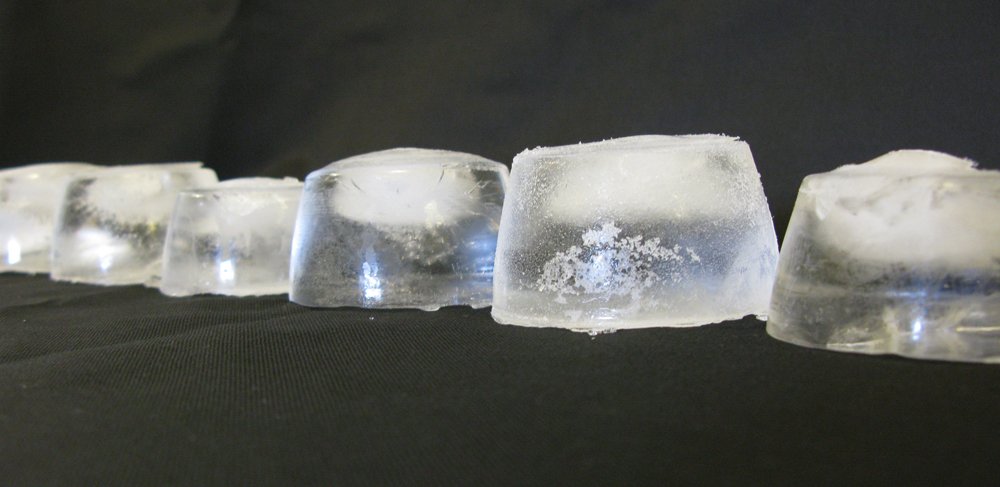
    There are various methods people use to make the clearer ice. To remove the air bubbles that make ice cloudy, people suggest boiling or refreezing the water. I decided to give a few options a try to see what worked best. But as we'll see, my results are less than conclusive.

    Ice1

    Using individual sized apple sauce cups (these are great large cubes for drinking whisky, as you don't want the ice to melt too rapidly and water it down) I froze the following into ice:

    • Control ice- regular ice poured from the Britta filter, probably two days old
    • Re-frozen- above style ice cubes, melted and refrozen
    • Boiled in pot for about 10 minutes
    • Microwaved for about three minutes of boiling

    Then I lined up all the ice in order of most clear to least. I had two of each style of ice, and my results were: Control, Control, Boiled, Microwaved, Refrozen, Microwaved, Refrozen, Boiled. None of the ice was totally clear. And the control should have been the least clear, not the most.

    So… that didn't work at all. I will need to repeat this experiment. Any ideas on what I did wrong? the cups in the picture are upside down, so the most air/cloudiness was on the bottom of the container. Perhaps I need to pour it slowly into the tray to avoid adding air at that point? Drip it through a filter? Use a colder temperature? Suggestions gladly welcomed.

    An index of all of the ice experiments on Alcademics can be found here.

  • A day with Charbay

    The other week I sat down on the patio behind Swirl on Castro with Marko Karakasevic and Jenni soon-to-be Karakasevic of Charbay and tasted through their line of products. Charbay2

    Charbay is a family-run winery and distillery in Napa Valley. And boy do these people like to play with the still- in addition to wine, they make flavored vodka, rum, whiskey, walnut liqueur, grappa, pastis, port, and now some aperitifs. It's hard to keep up with them.

    The aperitifs are neither eau de vie nor typical liqueurs, but flavored fortified wines. Currently they produce a pomegranate and a green tea flavor, which they like to think of as cocktails-in-a-glass. Importantly for retailers, these can be served at beer and wine-only venues.

    We then tasted through the vodka line. When they make vodka at Charbay, really they're making extractions that are added to plain vodka to flavor it. (Most flavored vodkas are vodka plus flavors purchased from flavor companies.) Not only is this unique, they make their extractions using whole fruit- not just the peel or juice. They throw the entire fruit (okay, not the pomegranate, but the citrus) into a leaf shredder and into the tanks, then distill the mixture to extract the flavor components they're looking for. Marko told me he was able to get the Meyer lemon flavor less bitter than before (emphasizing the pith less and peel more). The grapefruit flavor is as bitter as it should be.

    Charbay3
    The Tahitian vanilla rum is triple pot distilled and made from concentrated sugar cane juice (not molasses) from Hawaii. All rums are made from sugar cane products. Rhum agricole and cachaca are made from sugar cane juice. Most rums are made from molasses (the leftovers after sugar is extracted from sugar cane juice). Ron Zacapa is made from a form of concentrated sugar cane juice without the sugar taken out. The sugar cane juice used by Charbay is flash dehydrated under a vaccuum to remove the water and concentrate the liquid. I want to research how this is different from what Zacapa uses. Project!

    I think they should just call their whiskey "weed-lovers-whiskey", because it really tastes like marijuana. This is the second release of the product that was pot distilled from pilsner beer with three kinds of hops (this is probably where the weed aromas come in) and aged six years in new barrels. The first release was after three years in barrels.

    Finally, they're going to release a pomegranate dessert wine (they really like the pomegranate over there) that smells like it's going to be ultra-syrupy, but is just pleasantly sweet. A nice way to end a meal, or a tasting session.

    To sample the products in person, check out the early happy hour at Tra Vigna in Napa Valley, during the weekly Charbay tasting. Hopefully Jenni and Marko will be there, because they're really fun people with whom to share a drink. Or ten.

  • Icefusions

    Gourmet.com has a story about a bartender making ice infused with herbs and spices like dried cherry, cardamom, and clove, which open up in cocktails and add new flavors to the drink as they melt.

    I've had ice made from coconut water and bitters-infused ice before, but this is a new idea to me. Think of the possibilities!

    No seriously, bartenders- go think of the possibilities and I'll be happy to sample your experiments.

  • Look at me, err, at what I wrote

    Maltadvocatetales2008loldrink
    I have a story in the latest issue of Malt Advocate– my first one for them. Hooray!

    It's a round-up of whisky events at Tales of the Cocktail and the increased presence of whisky at the event in general. Run screaming to your local newsstand and read it.

    You'll find my story right beneath the picture of Lew Bryson.

  • The Gentleman’s Companion’s Companion

    Baker
    The Gentleman's Companion
    by Charles H. Baker is one of the most entertaining historical cocktail books, if not always the most useful. It contains cocktail recipes gathered from Baker's travels around the world, but the best parts are the drink introductions and settings. Like this one:

    THE JAMAICAN BLACK STRIPE, another Heartener from that Tropical Paradise, that May Be Served either Hot or Cold
    If served cold: work 2 tsp strained honey into 1 tbsp boiling water until well dissolved. Add 1 jigger Jamaica rum, shake with cracked ice, pour into stemmed cocktail glass and dust with nutmeg. Furnished us by Emerson Low, Esq., gentleman, student, Rhodes Scholar, author and delightful dilettante, who, now that he is married and possessed of child and responsibility, is not nearly so diverting, it pains us to say.

    It's a cocktail recipe, and a total diss.

    Anyway, my pal St. John Frizell has been studying the life of Charles H. Baker. He gave an awesome talk at Tales of the Cocktail this year, and published a long biography in the Oxford American this summer. Now he's posted the story on his website. It's a must-read for all Baker fans.

  • Maker’s Mark Distillery Visit

    Makers1
    As part of a visit to the Kentucky Bourbon Festival, I visited the Jim Beam and Maker's Mark distilleries in September. Today I'll talk about visiting Maker's Mark.

    The distillery has been around since 1805, but was purchased by Mr. Samuels, founder of Maker's Mark, in the early 1950's. This distillery will receive 70,000 visitors this year, and not just because they're fans of the product- this is one of the most beautiful distilleries I've ever seen. With its little bridges, common color theme, trees, and lawns it's more like a college campus. In fact when I was there in September the tours going through almost looked like summer tours for prospective students.

    Maker's is different than other bourbons as it is 70% corn (all non-GMO) plus malted barley and "soft red winter wheat" instead of the rye in most other brands. Also pretty unique is that at this distillery they make only one bourbon- only one product at all. Makers2

    Also at the distillery, they use an "anaerobic processor" to capture methane biogass
    from their waste, which allows them to reduce their natural gas use by
    15-30 percent. They also sell off their spent grains for animal feed,
    but I'm not sure at what point that happens.

    One thing I learned about Kentucky bourbon is that the products produced here are tied to the distiller who produced them (or popularized them), rather than the company. When people talk about a bourbon, they're talking about a distiller, and not usually the current one. When you talk about Jim Beam and the Small Batch Bourbon collection, people think about Booker Noe, who recently died, not so much Fred Noe who is the current voice of the company. When Fred Noe talks about the line, he talks about his father, not himself.
     
    That was also the case at Maker's Mark- Master Distiller Kevin Smith said that his job is to keep Maker's Mark the same as Bill Samuels Sr. created it, and if they created a new product then it wouldn't be a brand extension, it would probably be something new. When they do special editions of Maker's with a different color of wax on the bottle, it's still the same whisky inside.

    Anyway, I think it's interesting how different companies with a history are loyal to the company philosophy or the founder or the product itself.Makers3

    Maker's rotates their barrels in the warehouse, and is the only bourbon distillery to still rotate all of the inventory. The barrels are first put at the top of the warehouse for three years, then spend another three at the bottom.

    Beyond its flavor, Maker's is known for its branding- the iconic bottle with the red dripping wax unique to each bottle. The bottle design, wax seal, and the "maker's mark" itself were created by Mrs. Samuels, Bill Samuels' wife. The dripping wax is actually trademarked, which is why you don't see other brands doing it.

    Those are all of my fun facts for now. More pictures from my Maker's Mark distillery visit are here.

  • Oh, Sherry!

    Sherrysmallpage1I haven't seen the print edition yet, but the digital edition of my story in Men's Book (by San Francisco Magazine) is viewable online here.

    The story is about sherry in cocktails. The story mentions drinks on the menu at 15 Romolo, NOPA, and the forthcoming Gitane, but since I wrote it, sherry drinks have been turning up everywhere.

    One of my favorite drinks in San Francisco right now is Joel Baker's "Drink Without a Name #3". It contains Fino or Manzanilla sherry, Chartreuse, and a basil garnish, and was originally created with fresh pears but is on the menu now at Bourbon & Branch with stone fruit instead. (Or at least it was- they recently changed the menu for fall.)

    The print is too small to read these screen shots, so follow the link about to read the story online. It's on Pages 90-91. Sherrysmallpage2

  • A visit to the Jim Beam distillery

    Beam1In September I visited the Jim Beam and Maker's Mark distilleries as part of the Kentucky Bourbon Festival. For all the distilleries I've been to in 10 different countries, I'd never seen a bourbon distillery.

    The Claremont Jim Beam distillery is a huge facility, and one of two where the product is distilled. They receive tons of grain daily, and distill whiskey 24 hours a day, 6 days each week. The annual output is around 6 million cases of bourbon each year. (I believe they also distill the small batch bourbon collection here- Booker's, Baker's, Knob Creek, and Basil Hayden.) Beam uses 70 warehouses to store their 1.7-1.8 million barrels of bourbon that are aging.
    Beam2
    Beam is made from corn, rye, and barley. Interestingly, we get GMO corn in the US bourbon, but they distill, age, and bottle non-GMO spirit separately for export to Europe where they have restrictions against GMO products. (I definitely want to learn more about this so if anyone has a non-hysterical GMO book/video they can recommend let me know.)

    The bourbon is first column distilled in the "beer still" that's about six stories high. It is then distilled a second time in the "doubler" which they say looks like a pot still but is continuous. (We didn't see it.)

    Beam3The barrel warehouses are not only enormous, they're very tall- nine stories, with each story holding three tiers of barrels. At the top of the warehouse where it's hot, the barrels gain proof over time  as more water evaporates out of the barrel (through the wood) than spirit. At the bottom of the warehouse, the whiskey loses proof as more alcohol evaporates than water. 

    When selecting barrels to use for Beam, they take barrels from each level of the warehouse to make up the final blend. For the Booker's bottling, which is cask-strength and unfiltered, they only take barrels from one middle floor.

    After aging, the barrels are emptied, diluted, and bottled. You can find more pictures on my Flickr page here. In tomorrow's post, I'll talk about the bottling facility- with videos!

  • Here’s that story I wrote about bartenders

    Bay Area's best mixologists leaving bars for brandsSanter

    Friday, September 19, 2008

    While you're still likely to run into many of San Francisco's best
    mixologists in the usual cocktail hot spots, increasingly they'll be
    standing on the other side of the bar.

    That's because many local bartenders have accepted full- or part-time
    positions as spirits brand ambassadors, bar consultants and sales
    representatives. David Nepove, Jon Santer, Jacques Bezuidenhout and
    Todd Smith are some of the top talent who are working behind the stick
    one night per week, if that. Even more are bartending three nights or
    fewer.  Smith

    Venegas

    (read the rest of the story here)

agave alcademics Angostura bartenders bitters bodega bourbon bowmore Campari Camper English chartreuse clear clear ice cocktail cocktail powder cocktails cognac curacao dehydrated dehydrated liqueurs dehydration directional freezing distillery distillery tour distillery visit france freezing objects in ice hakushu harvest history how to make clear ice ice ice balls ice carving ice cubes ice experiments isle of jura jerez liqueur makepage making clear ice mexico midori molasses orange orange liqueur penthouse pisco potato powder production recipe Recipes rum san francisco scotch scotch whisky sherry spain spirits sugar sugarcane sweden tales of the cocktail tequila tour triple sec visit vodka whiskey whisky