Blog

  • Robot Bartenders in the News

    While robots will eventually make all our jobs obsolete, they seem to be coming for bartenders first. Three robot bartender happenings have popped up on my radar recently. 


    Battling Cocktail Robots

    San Francisco's DNA Lounge is hosting their annual Cocktail Robotics Grand Challenge. Actually it just happened on July 16th.

    18198366_10154270716536086_6678239138453139814_n

    image from Cocktail Robotics

    I wasn't able to attend but it promised judging based on:

    • Style and Grace: How clever, how dapper is that robot of yours?

    • Efficiency of Intoxication: Are the drinks it makes good?

    • Full-Assery: The opposite of halfassery. Does the infernal device actually work, or do you have to stand there tweaking it constantly?

    • This Will End Badly: Extra consideration will be given for terrible ideas and Mad Science.

    Check their Facebook page for more info and future events. 


    Robot-Staffed Bar Opens in Vegas

    Tipsy Robot is a new bar in Las Vegas where the robots make the drinks for you. 

    Tipsy Robot Opening 1

    The press release promises:

    A one-of-a-kind destination attraction that merges craftsmanship and high-tech innovation, Tipsy Robot features two cocktail-shaking robots that interact with customers in a social, digital environment. Customers can order one of Tipsy Robot’s 18 signature cocktails — or create a custom cocktail — through one of the bar’s 33 tablets.

    The robots mirror the actions of human bartenders. They mix, shake, pour, slice fruit and even dance to the latest Top 40 and EDM hits. Each beverage takes 60-90 seconds (or less) from order to completion.


    Robot-Made Gin Coming Soon

    At the annual Tales of the Cocktail convention in New Orleans on July 21, there is a seminar called, "Bartending Robots: Friend or Foe?"

    19417465_721285801383695_643559742647716208_o

    The seminar will talk about the future of cocktail robotics, as well as introduce a forthcoming robot-made gin that will be blended a la minute at The Long Now Foundation's bar The Interval. Can't wait to try it. 

    The seminar description promises:

    What of a bartender’s skill can a machine replace? And what is it likely to replace? While people are (usually) much nicer than robots, our mechanical counterparts have been growing in speed, accuracy and number. Before you deride robotics as technology that denigrates the noble bartender’s position, let’s explore the ongoing evolution of bartending machines and how we can use them to further the craft. Taking a cue from European flavor houses that make bespoke gin for brands and bars, Jennifer Colliau, Beverage Director of The Interval in San Francisco, worked with St. George Spirits to make single-aromatic distillations that are combined via robotics to whatever specifications a guest would like. Jennifer is joined by Dave Smith, Head Distiller of St. George Spirits and the manufacturer of the single-aromatic distillates, Pierre Michael, owner of Party Robotics and the builder of The Interval's Gin Robot, and Alexander Rose, futurist and Executive Director of The Interval at Long Now. Join them for a discussion of the future of robotics and automation and how they can impact the bar, for better and for worse. During this seminar, you will taste finished St. George gins, investigate styles and recipes, then use the individual aromatic distillations to mix your own gin.


  • Campari is Made Differently Around the World: Cochineal, Coloring, ABV, & Eggs

    15541338_1840521116237235_1944647162307011240_nI was researching a few different topics and stumbled upon an interesting observation: Not only is Campari sold at a wide-ranging variation of alcohol percentage in different countries, the coloring used to make its signature red is different depending on the country. 

    As many people know, Campari was traditionally colored with cochineal, a scale insect native to South America that grows on the prickly pear cactus. (Cochineal is still used in many products today, as it is a natural coloring and doesn't need to be labelled as the unsightly 'artificial coloring'.)

    In 2006 cochineal was discontinued – but as it turns out, not everywhere. In the United States and it seems most countries, Campari now uses artificial coloring. Depending on which country one is located in, that coloring must be declared in different ways, so what is merely "artificially colored" in the US is labelled as three specific coloring agents in one country, and none at all in others.  

    But in at least one country, cochineal is still used. 

    In the United States, Campari is sold at 24% ABV and the coloring is listed as "artificially colored."

    Campari usa


    In France, the ABV is 25% and the colorings are listed as E122, E102, and E133. 

    Campari france 3 colors


    Next door in Spain, no special colors are labelled, but it's also sold at 25% ABV.

    Spain Campari 25 percent


     It appears it is the same in Argentina (with INS instead of E numbers), but the proof is 28.5%.

    Campari argentina

     In Brazil it is the same, and labelled gluten-free. 

    Brazilian Campari bottle


    In Toronto, it is sold at 25% and the color is merely misspelled (kidding!) as "colour."

    Toronto colour


    In Australia, it is sold at 25% with no special color labelling. 

    Australia campari


    In Malaysia it is the same – 25%, no color labelling. 

    Malaysia campari

    In Japan, it appears to be sold at 25%. Anyone ready Japanese and can tell me if it says anything about coloring or eggs? 

    (One reader responds: "Red #102, Yellow #5, Blue #1. Don't see any mention of eggs.")

    Campari Tokyo2
    Campari Tokyo2
     

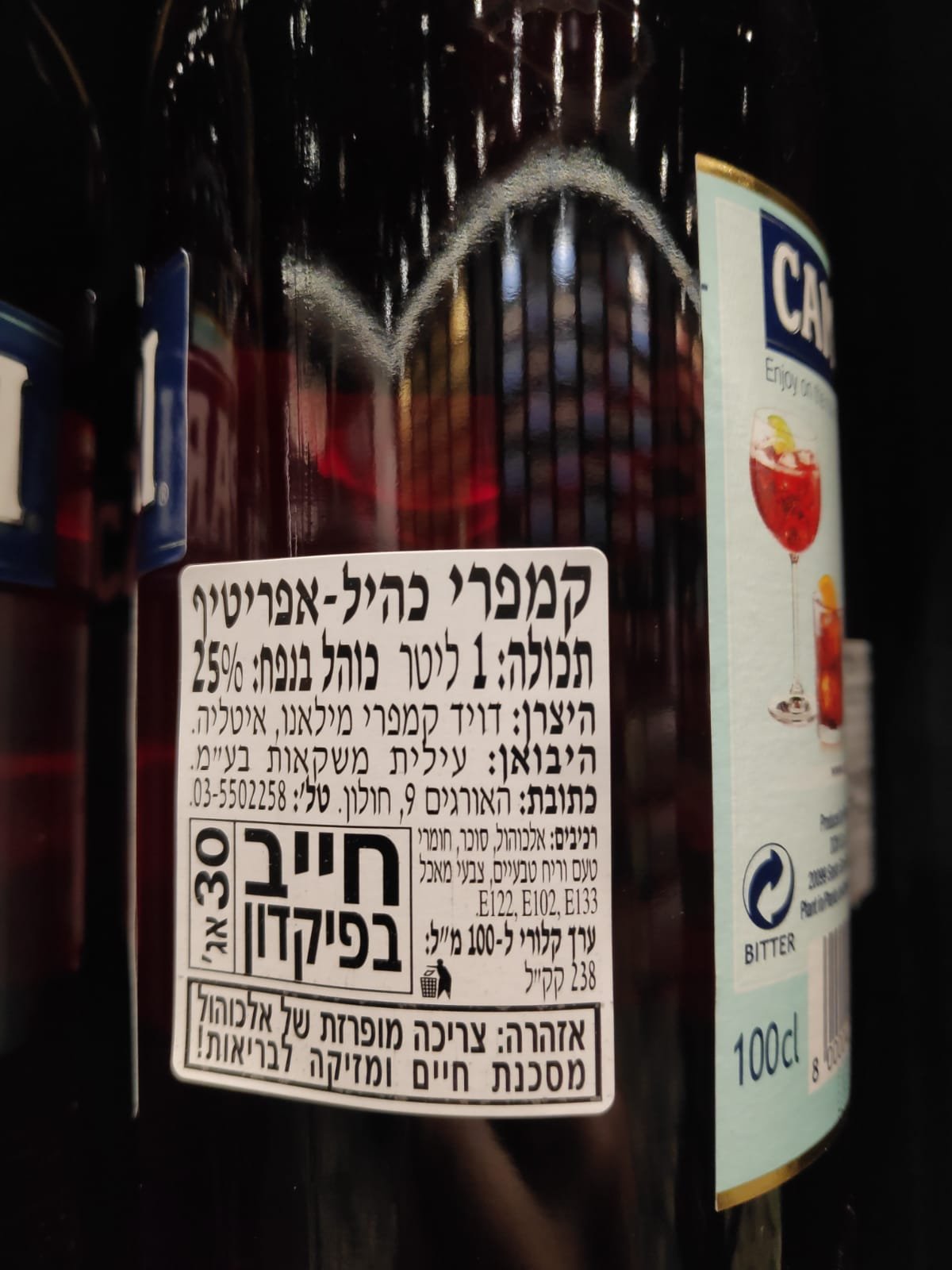
    In Israel, it's sold at 25% ABV with E122, E102, and E133 listed as colorants.

    Campari_Israel


    In Iceland, it's sold at 21% ABV with no special color labelling. 

    Campari Iceland


    Now here's where it gets really interesting.

    I was wondering if the Swedish government website was merely out of date as it lists the coloring as E120 – that's cochineal(!), but a friend just picked up a bottle recently and cochineal is still in Campari in Sweden. Additionally, it is sold at 21% ABV. 


    Campari sweden cochineal still


    Update: A twitterer sent me a pic of bottles from Mexico – they also have cochineal! See the E120:

    Campari in Mexico E120 coloring


    And even more interesting is this bottle of Campari from Jamaica. Hold onto your butts:

    1. "Blended and bottled in Jamaica… by J Wray & Nephew" [Campari now owns JW&N]
    2. 28.5% ABV
    3. "Contains Egg"


    Jamaican campari contains egg

    CONTAINS EGG. Folks, that is some interesting news right there. Typically when eggs are used in wine, beer, and spirits (that aren't egg-based liqueurs), the eggs have been used in the fining process that helps filter the products to clarity. I think it's fair to assume this is how eggs are used in Campari. 

    My guess would be that because Jamaica has a Rastafarian community, many of which are vegans, products fined with eggs are required to be labelled. 

    What this means though, is that even though they took out the cochineal insect coloring (except in Sweden and Mexico apparently), Campari, at least in Jamaica, is still not vegan. 

    The question remains what it is in the rest of the world – I would bet that Campari is still not vegan


    Keep in mind that much cane sugar is whitened using bone charcoal, so any liqueur or sweetened alcohol has an okay chance of being non-vegan. 


    Thank you to my Facebook and Twitter friends from around the world who shared their bottle images. If you live in another country not mentioned here, please send me your bottle image to add to this discussion. Thanks! 


  • The Impact of Phylloxera on Absinthe

    PhylloxI'm giving a talk at Tales of the Cocktail on "Bugs and Booze," and in reading up on the vine-killing aphid phylloxera, I came across a point of history I didn't understand.

    Phylloxera devastated the French (and eventually the world's) wine industry from the 1860s to around 1900. Most absinthe was made with a base of brandy- distilled wine- so it too should have been affected by phylloxera and been less available.  

    But if that was the case, then why did absinthe sales supposedly soar during phylloxera, and why did the wine industry feel the need to launch a negative PR campaign against drinking absinthe when it recovered? (This PR campaign was successful in getting absinthe banned in France and other countries for nearly 100 years.)

    So I posted a question to my smart friends on Facebook:

    Absinthe nerds: We always hear that post-phylloxera the recovering wine industry did a negative PR campaign on absinthe so that wine could resume its place on the throne. But wasn't most absinthe originally made with a wine/brandy base? When did it switch to a grain base (if it really did) – during or previous to phylloxera? Does anyone have historical data on this?

    Well, many, many comments later, I have some ideas about the impact on absinthe, thanks to experts including Anna Louise Marquis, Joshua Lucas, Brandon Cummins, Gwydion Stone, Jack Crispin Cane, Fernando Castellon, Stephen Gould, Francois Monti, Ted Breaux, Heather Greene, Brian Robinson, Alan Moss, and others! 

    I'll break down my understanding of it. You'll note that I'm not citing any sources here so it's up to you to fact-check, but this is what I got from listening to absinthe history experts: 

    The Base Spirit of Absinthe Changed Due to Phylloxera

    Absinthe can be made with any base spirit. Legal regulations were proposed in France that certain quality marques of absinthe (such as "Absinthe Superieure") need to contain grape distillate as the base, but these were never put into law as far as I know. (One source said the wine lobby actually worked to block any quality markers for absinthe.)

    Not all absinthes were made with a grape-based distillate (but marc/grape was considered the best); and absinthe in general had a problem with low-quality (or even poisonous) brands with additives masquerading as the good stuff. 

    Sugar beet spirit became a predominant base spirit not only in absinthe, but in most French liqueurs. This is due only in part to the absence of grape spirit during phylloxera: Napoleon had launched a massive campaign to plant sugar beets in France to be more self-reliant. From a post I wrote in my project studying sugar: "Napoleon, due to the economic and real war with England, bet big on sugar beets. In 1811 he supported vast increase in sugar beet production. Within 2 years they built 334 factories and produced 35,000 tons of sugar."

    Additionally, column distillation came along in the 1830s, which made it easier to get a high-proof, nearly-neutral spirit from most any base material. So in addition to sugar beets, things like potatoes and grain were used as a base for absinthe. 

    So there were many reasons that the base of most absinthes changed to sugar beet or grain during phylloxera. Pernod Absinthe's quality selling point was that it never changed its base. 


    Sales of Absinthe Soared in the Age of Phylloxera 

    True, from pretty much all accounts. Sales of absinthe were increasing before phylloxera, but absinthe's low price and wide availability during the crisis further helped sales. Then after absinthe was banned, sales obviously dropped a bit. So the 30 year period of phylloxera in France coincided with the glory days of absinthe. This is the heart of the Belle Epoque 1871-1914. 


    Absinthe was Banned Due to the Wine Industry Running a Negative PR Campaign

    Anti-absinthe propaganda began before phylloxera did, promoted by a Temperance movement. Much like in the US, distilled spirits were considered the problem with drinking, while beer and wine were considered healthy. (Francois Monti says that beer/wine were considered 'natural' while spirits were 'artificial'.) So the anti-absinthe movement was already in motion pre-phylloxera.

    But certainly the low-quality (and low-priced) absinthes on the market, which surely became of even lower quality during phylloxera when there was less wine to go around, were a problem, and gave anyone who was opposed to absinthe a target. As some people commented, now even the lower classes were drinking absinthe, for shame!

    When the wine industry recovered fully or in part, they wanted all their sales back so they engaged in/funded negative PR campaigns about how dangerous absinthe was. These campaigns helped get absinthe banned after 1900 in many parts of the world. 


    Well, that's a short version of a very long and interesting discussion. I hope I've done it justice. 


  • Make Amazing Frozen Liquor Bottle Displays using Directional Freezing

    Using just a cooler, a makeshift stand, and a bottle you can make cool-looking displays for home, parties, or the bar. 

    If you're just getting started into ice nerditry, you'll want to check out the Index of Ice Experiments, where you can get a definition of Directional Freezing and see other fun projects. 


    IMG_5943

    I previously shared how to do this on this post.

    In short: inside an insulated cooler, lay a bottle atop a small riser of some sort (I used a plastic box lid) so that the bottle is raised up a few inches off the bottom. 


    Photo Apr 22  1 55 57 PM

    Fill the cooler with water (tap water is fine) so that it covers the bottle. Leave the top off the cooler and let it freeze. In my home freezer, that takes 3-4 days. Thanks to Directional Freezing, the top part of the cooler (so the front part of the bottle) will be clear, while the bottom (back of the bottle) will have all the cloudiness in it. 

    You can see from this back view that the plastic riser is still stuck in the back. From the side view, you can see that thanks to directional freezing the top part of the block is super clear (so you can see the front of the bottle), while the back is cloudy. It turns out the cloudy part actually makes a nice backdrop.


    IMG_5850
    IMG_5850

    Remove it from the cooler than your display is ready to go. I've done this at parties (putting some LED candles in the ice beneath the standing block) and it was a huge hit. 

    IMG_6071
    IMG_6071

    6a00e553b3da20883401b7c7cf9f56970b.jpg


    Check out all the ice experiments on Alcademics at this link.


  • Freeze Liquor Bottles Inside an Ice Tube for Better Bottle Service

    Using just a cooler, a tube, and a bottle you can a super funky display for your party or for bottle service at your bar. 

    If you're just getting started into ice nerd stuff, you'll want to check out the Index of Ice Experiments, where you can get a definition of Directional Freezing to see why this works, and see other fun projects. 


    Photo Jun 11  12 15 47 PM (1)

    I originally developed this technique for the bar Whitechapel, which was looking to do a unique Martini cart with frozen bottles. 

    Simply put a bottle inside a tube of some sort (this is a metal utensil holder like you'd see at a salad bar) and fill both the tube and the rest of the cooler with water. Directional Freezing will take care of making the top part of the ice clear. The cloudy part is all around the bottom of the bottle. If you wanted it 100% clear around the bottle, you'd simply put it on a short riser inside the tube.

    Then freeze it (with the top off the cooler) and pull it out.

    IMG_7390
    IMG_7390
    IMG_7390
     

    I did this again with a bottle Zucca as I'm using it for a talk. I no longer had the metal utensil container so I put in a plastic pitcher. I wouldn't say it is the ideal container given that is has irregular sides, but it did the trick for proof of concept. 

    The bottle is a bit problematically tall for my freezer – I almost couldn't get the cooler out! 


    Photo Jun 11  10 55 15 AM
    Photo Jun 11  10 55 15 AM
    Photo Jun 11  10 55 15 AM
    Photo Jun 11  10 55 15 AM
    Photo Jun 11  10 55 15 AM

    Cheers!


    Check out all the ice experiments on Alcademics at this link.


  • Freezing Mini Bottles Inside Collins Ice Cube Spears

    Party Trick! Using an insulated cooler and some gift boxes, you can make super clear tall collins glass ice spears with mini bottles frozen inside them.  

    If you're new to Directional Freezing, check out the Index of Ice Experiments where it is explained. 

    Disaronno minis in ice (26)

    I bought plastic gift boxes from The Container Store to make tall ice spears a while back. Check out that post here. Note that for commercial purposes, these gift boxes aren't certified food safe, so I wouldn't go trying to scale up a bar program with them. (They're also hard plastic and crack easily.)

    More recently, I decided to freeze some Disaronno minis inside of them for an event. They came out adorably awesome.

    Simply fill the cooler with gift boxes and the gift boxes with minis. Fill the cooler (both inside the gift boxes and outside around it) with water. Let it freeze into a block. 

    Disaronno minis in ice (9)
    Disaronno minis in ice (9)
    Disaronno minis in ice (9)


    Then with a great deal of patience, separate out each of the boxes and turn them over so that the cubes slide out. Fun times. 

    Disaronno minis in ice (8)
    Disaronno minis in ice (8)
    Disaronno minis in ice (8)
    Disaronno minis in ice (8)


    Maybe I should have actually put one inside a collins glass so you could see how it looks. 

    Check out all the ice experiments on Alcademics at this link.


  • Fire Inside Ice (Okay, Fireball inside an Ice Ball)

    For years, bars including Chicago's Aviary have been serving drinks inside hollow ice balls. The procedure to make one is easy, at least in theory.

    Photo Jun 11  1 35 49 PM (1)


    Freeze a balloon or an ice ball mold filled with water for a few hours. An ice shell will form on the outside. 


    Photo Jun 11  1 26 15 PM


    Poke a hole in the ice ball and dump out the water. Refill with a (very well chilled) cocktail.  Some bars do with a syringe so that you don't have to open a real hole in the ice ball.


    Photo Jun 11  1 29 22 PM


    Then serve it. I did this at home and thought it would be fun/funny to create Fire Inside Ice – so I filled by ice ball with Fireball cinnamon whiskey.

    Photo Jun 11  1 36 06 PM (1)Photo Jun 11  1 36 06 PM (1)


    Then for a bit of a show I filmed dropping it in slow motion. Enjoy.


  • Phylloxera, Gin, and Scotch Whisky

    I'm continually researching topics related to bugs and booze, and went looking for some better information on how scotch whisky sales were affected by the phylloxera plague that took down most of Europe's vines in the late 1800s. 

    Many sources cite that scotch whisky sales really took off in the same time period as phylloxera killed the wine biz as people switched to spirits, and I was looking for more solid information on that: sales numbers, etc.

    I've found that it's true there was a huge scotch boom in this period (30+ new distilleries opened between 1880-1900), but I was seeking more information.

    Anyway, my office is located above the spectacular Mechanics Institute Library, a membership library dating back to 1854. I have plenty of whisky books in my office, but the library itself has some unique books I've not seen elsewhere. I went to see what I could learn. 

    I happened across a book called The Whiskies of Scotland by RJS Mc Dowall from 1967. It didn't have any information on phylloxera except for this one fun fact about the Gilbey's wine/gin company: they saw phylloxera happening so invested in scotch whisky. Smart. 

    Today Gilbey's is owned by Beam Suntory


    Unnamed

    Anyway, just thought I'd share. 


  • Using Isolated Acids in Cocktails: A Report and Recipes

    In my latest article for CooksScience.com, I wrote about bartenders using isolated acids like citric, malic, tartaric, and succinic to amplify flavors and acidity in cocktails.


    Acid3


    They're doing this for a number of reasons – to make batched cocktails with non-spoiling citrus flavors, to add a generic citrus flavor to cocktails without specific lemon/lime notes to get in the way, to re-acidify cocktail ingredients that have been centrifuged-clarified, and to make use of tons of leftover orange juice created because uber-popular Old Fashioneds only need orange peels. 


    Acids2


    My part of the story is the investigation into how and why bartenders are playing with isolated acids; then the team from America's Test Kitchen played around with the actual acids, and creating a couple of cocktails with added acids you can try at home. 

    Give it a read!


agave alcademics Angostura bartenders bitters bodega bourbon bowmore Campari Camper English chartreuse clear clear ice cocktail cocktail powder cocktails cognac curacao dehydrated dehydrated liqueurs dehydration directional freezing distillery distillery tour distillery visit france freezing objects in ice hakushu harvest history how to make clear ice ice ice balls ice carving ice cubes ice experiments isle of jura jerez liqueur makepage making clear ice mexico midori molasses orange orange liqueur penthouse pisco potato powder production recipe Recipes rum san francisco scotch scotch whisky sherry spain spirits sugar sugarcane sweden tales of the cocktail tequila tour triple sec visit vodka whiskey whisky