Blog

  • Cocktails in Sydney’s Downtown District

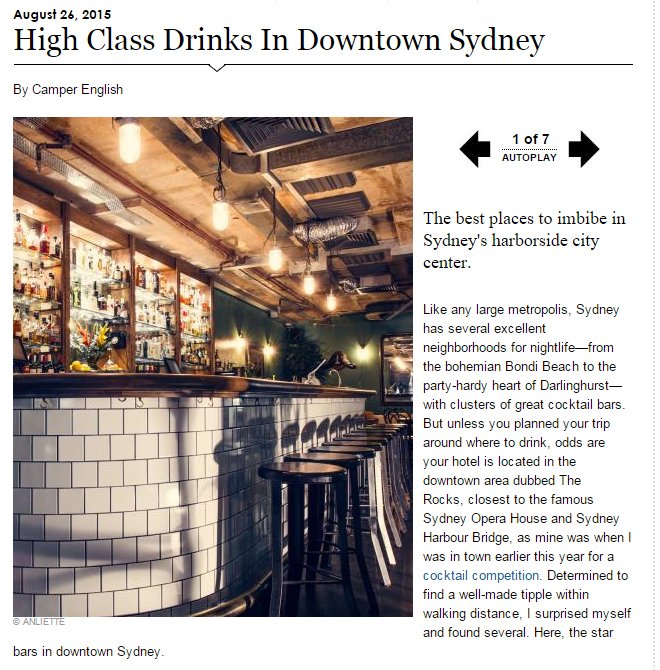
    While I was in Sydney for the Bacardi Legacy global cocktail competition earlier this year, I checked out a bunch of the bars.

    Here is a write-up I wrote for Departures.com of several of them more or less in the Downtown areas closest to the Opera House.


    Sydney bars


  • Science on How Spirits Change or Age in the Bottle, Rather than the Barrel

    At Tales of the Cocktail, I attended a seminar led by Ian McLaren and three scientists, all from Bacardi. It was called Genie in a Bottle: How Spirits Age. 

    Being part of a gargantuan spirits company they were able to call upon the science that had been done in the past and specifically for this seminar about how spirits change in the bottle. I think there is a general acceptance that in opened bottles stored for many years, spirits get a little bit flatter in flavor. In this seminar they took it way further than that. 

    The most important information is on this slide: 

    IMG_4113

    Here are a lot of notes:

    • IMG_4106Temperature: They found that for heat, degradation really occurs at 100 degrees Fahrenheit (37.8C). They tracked the temperature of bottles as they were shipped around the world to see if they ever reached that in the process of getting from the distillery to the store, and found that when it happened, which was unusual, it was in the process of getting from the truck to the boat – on the docks- so they put in place some systems to prevent that for their most temperature-sensitive products. 
    • Heat accelerates aging processes including oxidation, evaporation, adds cooked fruit notes to high sugar content liqueurs, affects the flavor of flavored spirits with low pH, so that's particularly citrus flavors.
    • 40F (4.44C) is the optimal temperature at which to store spirits
    • IMG_4107Light impacts spirits too, not just by adding heat. Aged spirits like bourbon and scotch can lose a significant amount of their color (which impacts our perception of their flavor). 
    • Light effects are impacted by bottle color (amber will have the least impact), bottles with more glass exposed (so Angostura bitters with its oversized label would be less impacted than a clear, printed bottle), the type of light source (direct sunlight, LED, fluorescent light) though it's not an easy determination of which is the worst (sunlight is really bad though) because it's the combination of the light's frequency and wavelength, and proximity to the light source.
    • IMG_4109Oxidation changes flavor: Acetaldehyde from oxidation reaction can be good in small quantities – adds fruity aromas; but in larger quantities it transforms in acetic acid (vinegar). Gin loses citrus flavor and gains "moth balls" flavor. Whisky loses its creamy fatty acids, gains fruity but then rancid and nail polish remover flavors. Rum gains vinegar aromas. 
    • Oxidation happens not just with heat and light, but also headspace in the bottle (the St. Germain bottle was cited as one particularly badly designed as you get a lot of headspace as soon as you open it), how frequently you open it (as that changes the equilibrium in the bottle- each time the air above the liquid gets exchange with fresh air), the type of closure (corks allow oxidation; screw caps less); and pour spouts can have an effect even if you cap your bottles at the end of the night. 
    • So to reduce oxidation you should keep precious liquids in small brown bottles with screw caps rather than 1/3 empty bottles with corks.

    That was just a fraction of what was shown at the seminar, but I hope it's helpful.

    I cringe every time I see the back bar against the windows (in San Francisco I always think that when I see  Zuni Cafe, Absinthe, my local liquor store's wine selection, and the new Black Sands, but at least it doesn't usually get that hot in SF), but hopefully they move through product quickly so that the effects are not as dramatic.

    McLaren showed a lot of slides of brightly-lit LED and fluorescent-lit back bars, with particularly bad ones being when the spirits sit on a light box as that adds heat as well. 

    So maybe all those candlelit, brick-walled speakeasy-style back bars aren't so bad after all.


  • Carbonation Fun Facts Explained with a New Carbonation Device, Plus Bonus Math!

    I was sent a sample of a new carbonation device called the Bonne O, and in trying it out I had a lot of questions about how it worked. That lead me to learn a bunch of new (or needing repetition) facts about it.

    The Bonne O carbonator is different from a Soda Stream carbonator in two fundamental ways:

    • Instead of a CO2 tank, it takes tablets that work like giant Alka-Seltzer tablets to create CO2
    • You can carbonate more than just water. With Soda Stream (at least the current models), you carbonate only water and then add syrup to it to make soda. With this device you can add other ingredients into the carbonating chamber.

    Bonne-O-home-carbonation-system

    Img_4621_grande


    But I was confused as to how specifically it works. You add  most of the liquid and any solid ingredients to the bottle that will be carbonated, then on the base of the machine the fizzing tablet to one chamber, and the sweetening/flavoring syrup to a separate chamber. That last part particularly confused me. 


    Bonne o diagram
    Bonne o diagram


    So I emailed with Bonne O inventor Darren Hatherell. He explained to me (and also did a good job of it on this blog post, from where I stole most of these images), and now I'll explain to you.

    The Stuff You're Carbonating Must Be Cold, But the Chemical Reaction Should be Warm

    For maximum carbonation, you must have cold liquids, as cold liquids hold more carbon dioxide in solution. However, the particular acid-base Alka-Seltzer-style fizzing reaction in the Bonne O works best when the liquid added to the fizzing tablet is warm. (To verify this, try adding Alka-Seltzer to warm vs cold water and see how much longer it takes to fizz.) 

    They way they got around needing both cold and warm liquid is: The device takes the temperature of the liquids in the bottle (it sucks some into the machine from the top), and if it's too warm for effective carbonation, it just beeps at you and won't even try to carbonate. If it's nice and cold, however, it sucks in that liquid and heats it to an ideal temperature before sucking it into the carbonation chamber with the fizzing tablet. 

    This warm liquid (and dissolved tablet) doesn't go back into the bottle. It stays in the chamber and you dump it out at the end. Keep reading for how and why…


    Sugar Makes Foam And That's Bad

    The main reason you don't put syrup flavors into the Soda Stream is that when you carbonate syrupy water, it foams up and out of the bottle, then will clog up the gas system, perhaps only to explode later. Sugary things make foam.

    The Bonne O gets around this by holding the syrup in a separate flavor chamber (you can add flavors to the bottle, including solid ingredients like strawberries, but the stuff in the bottle ideally shouldn't be super sugary).

    When you hit the button to turn it on, the Bonne O sucks in liquids from the top of the bottle into the carbonation chamber where it fizzes and creates CO2 gas, and pushes out the syrup or other liquid from the flavor chamber (along with the newly-created CO2 gas) into the bottom of the bottle. So the space in the bottle from the stuff that was sucked out is replaced with the syrup or other stuff from the flavor chamber. Thus the flavor chamber always has to be full, even when you're not flavoring your liquid.

    So if you're just carbonating water, you add cold water to the bottle and water to the flavor chamber. (Same if you're carbonating a bottle of tequila, which I did live at Tales of the Cocktail – you put tequila in both the bottle and the flavor chamber.)  

    If you're carbonating a soda or cocktail like a Gin & Tonic using tonic syrup, you add the gin and water to the bottle and the tonic syrup to the flavor chamber. If you were going to carbonate a cocktail with a liqueur like a Margarita, you might want to put the liqueur into the flavor chamber instead of mixing up the full cocktail first. I haven't experimented with adding something syrupy to the bottle to see what happens. 

    The Downside To Both

    The downside to a Soda Stream is that you ultimately add carbonated water to syrup, which will reduce its overall carbonation. 

    The downside to the "keep the syrup separate" model of the Bonne O is that if you're a perfectionist you have to do some math to get your cocktail right: Some of the liquid in the bottle will be sucked out and discarded to be replaced by the syrup, so you have to control for the change in volume.

    The bottle holds 750ml

    The flavor chamber holds 142 ml

    Thus, you need 142 ml extra un-sweetened liquid that will be discarded from the bottle. 

    Let's Do Math!

    For example, if you used Strong Tonic syrup to make a carbonated G&T, the brand recommends 1 part syrup to 2 parts gin to 4 parts water. For the final 750 ml that you will make, that means each "part" is 1/7th of 750 ml:

    107 ml syrup 
    214 ml gin
    428 ml water

    But not all of that goes into the bottle- remember the syrup goes into the flavor chamber. The flavor chamber holds 142 mls, so you can add the full 107 ml of syrup to it, and then top it off gin and water. But how much? We need 35 ml total of non-syrup to get to our 142 ml.

    So the total of non-syrup (that's the gin and water combination) will be 750ml (that's what fits in the bottle) + 35ml extra for the flavor chamber = 785 ml of gin/water.  

    So 785 ml of gin/water in a proper 1:2 ratio is:
    262 ml gin
    524 ml water

    Checking our math on actual quantities used in final drink:

    Flavor Chamber: 107 ml syrup + 35 ml gin/water in 2:1 combo (12 ml gin and 24 ml water)
    Bottle: 750 ml gin/water in 2:1 combo (250 ml gin and 500 ml water)

    But remember that 142 ml of the bottle is discarded. 750 – 142 = 608 ml gin/water combo will actually go into the drink, plus everything in the flavor chamber, which makes our total of each ingredient: 

    Syrup: 107 ml 

    Gin from flavor chamber = 1/3 (35ml) = 12 ml  
    Gin from bottle = 1/3 x (750-142 = 608) = 203 ml
    Gin total = 215

    Water from flavor chamber = 2/3 (35ml) = 24 ml  
    Water from bottle = 2/3 x (750-142 = 608) = 405 ml
    Water total = 429 ml water

    So our final recipe is:

    Mix 262 ml gin and 524 ml water and make sure the combo is very cold. Fill Bonne O bottle to top with this combination. 

    Add: 107 ml Strong tonic syrup to flavor chamber plus rest of gin/water combo (35ml) to flavor chamber. 

    Add carbonating tablet to carbonation chamber and press the button to carbonate the liquid.


    Science is fun!  


  • Cocktail Citratres: What, Why, and Where?

    CitratesAt the Tales of the Cocktail convention, I attended a seminar hosted by Ira Koplowitz and Nick Kosevich of Bittercube Bitters called On Creating Cocktail Citrates & Elixirs. 

    The seminar lead up to the point that if you want to make lasting kegged (and often carbonated) cocktails, you might need to use citrates. 

    One of the presenters smartly called kegged cocktails "the new punch," and interestingly, like vintage punch, citrates start with oleo saccharum then add some science.  

    Citrates are an approximation of sour mix: sugar and citrus combined, but in a form that is predictable, reproducible, and stable. They start with an oleo saccharum (citrus peels and sugar), then add other acids and mouthfeel agents. 

    This is important, they say, because citrus changes dramatically after being juiced/cut (BRIX level falls, pH rises, organic compounds change and degrade) especially after 24 hours. They also noted that for carbonated cocktails, citrates reduce nucleation points that interfere with good carbonation. 

    So the goal of a citrate is to replace or reduce citrus and syrup in a cocktail. They noted that citrates are not identical to sour mix – if you just match the BRIX and pH level, you won't get to where you need to be. And you can't just use citric acid either. 

    Citrates Are Composed Of:

    • Water
    • Sugar
    • Mouthfeel agents (tapioca starch can be used; also pulp)
    • Natural oils
    • Acids (this is their basic formula)
      • Citric acid 95%
      • Sodium citrate 1% (gives a bit of salty mouthfeel)
      • Malic acid 4% (gives sourness)

    Elixirs, by their definition, are compound flavor citrates plus water. 

    You can read more about them in this PDF document on the Bittercube website. It gives a good overview of the what and why of citrates and elixirs. It also includes recipes for several citrates, elixirs, and a kegged cocktail.

    Many bars that use citrus in their kegged cocktails use a citrate by some form (and often by another name), so you might have unknowingly tried one already.

    For more reading on the topic, check out Dave Arnold's book Liquid Intelligence


  • How Drinking in 1948 was like Drinking in College, or in 2005

    EmburyRecently I was speaking on a panel based around the era of David A. Embury's book The Fine Art of Mixing Drinks, first published in 1948. 

    Then, they were coming out of Prohibition that ended in 1933 and World War II that ended in 1945. 

    He notes what coming out of an era of bad drinks into a good one is like: 

    Most of the present generation learned to drink and most of the present-day bartenders learned their profession during the past thirty-seven years. The first fourteen years of this period were devoted to the famous ‘experiment, noble in purpose,’ and the remaining years have not yet been sufficient to erase wholly the ignoble effects of that era. 

    During prohibition the overwhelming majority of available liquor consisted of bathtub gin and Scotch "just off the boat" (ferryboat from either Hoboken or Brooklyn).

    So unutterably vile were these synthetic concoctions that the primary object in mixing a cocktail became the otherwise emollient and anti-emetic ingredients (cream, honey, Karo, canned fruit juices, etc.) to make it reasonably possible to swallow the resultant concoction and at the same time to retain a sufficient content of renatured alcohol to insure ultimate inebriety.

    Just how much dilution of the "gin"-bottle content might be necessary to accomplish this supposedly salutary result depended largely on the intestinal fortitude and esophageal callosity of the particular individual involved. 

    During the talk, I mentioned how that was like drinking in 2001 or 2005 or so, when fresh ingredients were not the norm. That first fresh lime juice Margarita you had changed everything. 

    But also it's a lot like being a grown-up drinker as opposed to a college-aged one where you were trying to hide the taste of the liquor underneath brightly-colored sugary liqueurs. 

    We live in much better times now. 


  • Making Clear Ice Balls with Tovolo Sphere Ice Molds and a Cooler

    We already know that you can make perfectly clear ice balls using a round silicone ice mold and an insulated mug.

    (Read about all the ice experiments on Alcademics by following the link to the index.)

    Now Alcademics reader Jason F. has refined the process using larger Tovolo Sphere Ice Molds and a cooler.

    Clear ice ball alcademics dot com

    The equipment is specifically the:

    Cooler and ice sphere molds

    If you're new to the ice experiments on Alcademics, it might help to read the top stories linked to from the Index of Ice Experiments on Alcademics

    This ice ball process is similar to the method using the insulated mugs and making ice blocks/cubes in a cooler:

    • You fill the ice ball molds with water, and float it hole-facing-down in water in the cooler.
    • As the water freezes from the top-down (due to the insulated cooler), it pushes any trapped air and impurities toward the bottom of the cooler, leaving only clear ice in the mold. 

    Method:

    Fill the cooler almost full with hot tap water. Allow it to cool for a few hours until it is about body temperature. Separate the molds put them in the water and re-assemble them under water making sure that all of the air is out of them.

    Grasp the top and bottom of the mold keeping one finger over the drain hole of the mold. Take it out of the water and dump the water remaining in the white plastic part of the mold.

    Wet ice molds


    Place the mold back in the water, hole side down and release your finger from the drain hole on the rubber side of the mold. This will ensure that air has not gotten in and give the top some buoyancy.

    Place the cooler in the freezer for 48 hours. The ice will form at about 1 inch per 12 hours. The block will not freeze all the way through and that is exactly how you want it!

    When you remove your cooler it will look like this:

    Frozen ice molds

    Chip away the surrounding ice using the ice pick. Reserve the ice as you will have some nice, clear rocks for other cocktails.

    Chipping away ice

    You will get a block out with the molds frozen in it. Work on the shammy or tea towel so it does not slip around.

    Ice molds in block

    Remove the sphere from the molds, they will just pop out no need for running water over them.

    Tempering The Ice 

    Allow the spheres to temper (sit out) on the towel for about 10 minutes. Tempering them is an important step so that they don’t crack when liquid is poured over them.

    You can store them in the freezer but remember to temper them when you remove them.

    When they come out of the mold or freezer they will be dull on the outside. You know they are tempered when they are clear all around.

    Clear ice ball alcademics dot com

    Thanks much to reader Jason F. for the method, the text, and the pictures! 

    The index of all ice experiments on Alcademics is here


  • The 99 Items I Packed to Give a Cocktail Seminar…

    …and I didn't even make drinks. 

    I gave two full-length seminars and one mini-seminar at Tales of the Cocktail in New Orleans this year. For my seminar on Prehistoric Cocktail Technology, I went kinda big.

     Here is my packing list, without multiples. 99 things, dayumn. 

    • ice cream maker balls
    • cream
    • lemon + lime juice
    • knife
    • Filtration coconut vs wood 2sugar
    • simple syrup
    • eggs
    • orange flower water
    • East Imperial soda water
    • East Imperial tonic water
    • batch container
    • measuring containers
    • rock salt (1/2 cup container)
    • ladel
    • ice cracker tool
    • Bar towels
    • pipettes
    • Clamp post
    • clamps
    • plastic poster tubes with perforated red caps
    • aquarium filters- bio bags
    • coconut charcoal
    • mavea charcoal
    • coffee filters
    • Unfiltered cake vodka
    • Filtered cake vodka
    • dehydrated cake vodka
    • Milk
    • Bar spoon
    • Funnel
    • Clarified Zacapa
    • Test tube rack
    • Test tubes
    • Dehydrated blueberries
    • Dehydrated strawberries
    • Annatto seeds
    • Saffron
    • Cochineal
    • Magnifying glass
    • Blure
    • Tonic syrup
    • blue water
    • Acid Phosphate
    • Isi Siphon
    • CO2 cartridge
    • Blacklight flashlight
    • Salt
    • Black sheet
    • Cooked agave
    • Small plates
    • Wet naps
    • Clear bucket
    • Ammonium nitrate
    • Stir bar
    • Thermometer gun
    • 2-liter bottles
    • white wine vinegar
    • baking soda
    • funnel
    • Froth experiment2U-Fizz hoses
    • U-Fizz bakind soda tube
    • big pitcher
    • measuring cup
    • Burton Water salts
    • piloncillo pyramids
    • piloncillo syrup
    • clarified piloncillo syrup
    • Bottle of chill filtered scotch
    • Bottle of not chill filtered scotch
    • Juniper oil
    • Infusion of DJ blanco with baked pine shavings
    • Oak essence
    • Grape seed extract
    • Caramel coloring
    • Glycerin
    • pine shavings
    • baked pine shavings
    • Bonne-O Carbonator
    • Extension cord
    • Carbonator pills
    • Long tube with cap on one end
    • soda water Natural colors2
    • Insta-Foam
    • Bottle opener
    • Nuun for Alka-seltzer demo
    • Zacapa Rum 2 bottles
    • Don Julio Tequila Blanco 2 bottles
    • Don Julio Tequila Reposado 1 bottle
    • Don Julio Tequila Anejo 2 bottles
    • Don Julio Tequila 70 (70th anniversary clear anejo) 1 bottle
    • Label Maker
    • Extra Label Maker Tape
    • Sample cups
    • Tripod holder for poster paper
    • Tasting straws
    • Cinchona bark
    • Microscope attachment for computer
    • Bamboo Straws
    • 2 Ice chest/bucket
    • White background paper/Black background poster paper

    Plus I packed 200 baggies of dehydrated liqueur for my other seminar and some other stuff. Perhaps the greatest achievement was fitting it all into 3 suitcases.   

     Good times! Thanks to those who attended!


  • How to Make Whisky in a Hot Climate in a Short Amount of Time

      KavalanIf it were easy to make good whisky anywhere, it would be made everywhere. And if it were easy to make good single-malt whisky in four years, everyone would do it. But Kavalan makes some very well-respected juice in four years in the mostly-hot country of Taiwan. 

    On my trip to the Kavalan whisky distillery that you can read out here and here, I spent a lot of time asking questions about what the differences in production are between Kavalan and scotch whisky, and other places where they had to compensate for their unique aging environment. Here are a few observations:

    Preparation

    They know that that they'll only be aging their whisky for 4-7 years, most of it closer to 4. They also know that their climate is hot and humid, though there can be a temperature range during the year that will suck the whisky into and out of the barrels causing interaction. They also know there will be a significant evaporation rate (angels' share) so that's another reason not to leave it aging too long. 

    In short, they don't have much time to get it right. There is no "fix it in the barrel" mentality, as too long in the barrel will taste just as bad as too little time in the barrel. They've basically got one shot to get it right so they go into it with cautious perfectionism.

      Kavalan Whisky Taiwan barrels 4

    Ingredients

    • American oak barrels give less tannin absorption than do French oak. So their ex-sherry, port, etc. barrels must be made from American oak.
    • Like other top whisky producers, they fly over to Spain and Portugal to personally source the best barrels. 
    • Yeast – They use an alcohol-producing yeast and a flavor-producing yeast. I am not sure if this has to do with climate at all, or is just a unique method. See fermentation below.

    Kavalan Whisky Taiwan maturation quality slide

    Process

    • Fermentation is temperature-controlled to ensure consistency in batches. It is a long fermentation using 2 different yeasts and an additionally long period for lactic fermentation. This contributes to the signature fruity flavor profile Kavalan is after. I am guessing that given the short amount of aging time, they want the fruit notes to be most forward and the grain notes (signaling too-young whisky) less prominent. 
    • Heads and tails cuts are different: A tight heart cut (so less heads and tails overall), but a little bit more of the heads and way less of the tails. Most whiskies that will sit in barrels a long time include a fair portion of the tails, as they break down/interact with the wood/oxygen over time and turn into good stuff. At Kavalan they don't have that much time.  
    • Larger barrels (ex-port and sherry) are stored mostly on the hotter top floor of the aging warehouse. Larger barrels take longer to age the whisky inside them, as there is less wood-to-liquid ratio of smaller bourbon barrels. 
    • Cautious Rechar. They do rechar barrels but the whisky aged in them is used for the base-level single-malt and the 46% version of that, not for any of the (so much better) Solist bottlings. Which helps explain why I like the single-cask bourbon barrel bottling so much better than those other two.
    • The sherry barrels come off a real solera after 20 years or so, then they are seasoned with 20 years old oloroso before Kavalan gets them. 


    Kavan Whisky Taiwain stills 10

    Budget

    • Kavalan is a small part of a huge company, so they have budget advantages that they have certainly used. 
    • I have sipped so many failed experiments over the years, many from otherwise quality distillers. I hate it when otherwise-quality producers put their failed experiments into bottles and try to pass them off to consumers. At Kavalan they purchased I believe 8 hybrid pot-column stills when they first built the distillery, which that they stopped using after they found that they didn't produce good whisky. (Don't worry, I think they have found another use for them that we'll hear about later.) That was an expensive decision; clearly one of many. 
    • They hired whisky doctor Jim Swan, who is certainly not cheap, to get things running and continually checking in. He was there during my visit distilling a peated malt. 
    • They throw away (or rather, recycle into the next batch) a lot of heads and tails. 
    • The shave-toast-rechar process used on the Vinho Barrique barrels is also quite precious and must be super expensive, as they have to rebuild all those barrels in the process. I don't know too much about this process but have heard it is done in the wine industry (probably minus the recharring). 


    Kavalan Whisky Taiwan char barrel 6

    Consistency/Computer Control

    • Computers control washing, fermentation, and distillation. 
    • They test everything along the way. 


    So, I'm sure that's not quite everything they do at Kavalan to make good whisky quickly in a hot climate, but it's a lot of it. So you might not want to run right out and set up your distillery in Sumatra just yet. 

    Kavan Whisky Taiwain barrel


  • Kavalan Whisky Distillery Visit in Yilan, Taiwan

    This spring I had the unique pleasure of visiting the Kavalan single-malt whisky distillery in Yilan, Taiwan.

    This is a long post, so get comfy if you want to read, or just scroll through the pictures. 

    The week previous to my visit, their Vinho Barrique Solist whisky won the World's Best Single Malt Whisky award from the Beverage Tasting Institute, so everyone was in a really good mood. I think we were the first American journalists invited to visit, so that was double awesome. 

    The young distillery already receives 1 million visitors per year, 30% of them foreign. It's free to visit and to get a whisky sample at the distillery, which also has a gift shop and a huge cafe. 

    IMG_7583


    Kavalan's History

    Kavalan is located in the county of Yilan, not far from Taipei, and the name Kavalan is the name of the indigenous people of the region. 

    Our hosts for the trip were master blender, global brand ambassador, and director of global business development Ian Chang; and consultant whisky maker Dr. Jim Swan. 

    Kavalan whisky is just one small part of the multi-billion dollar King Car company. (King means "gold", so it's supposed to represent a golden car rolling in to the future.) This company and Kavalan whisky was founded by Mr. Lee Tien-Tsai, whose 50-year old son we met for an epic banquet later in the trip. The company has many different divisions including, in part, consumer products (Mr. Brown Coffee, cans, cleaners and insecticides, instant noodles), health supplements and biotech research, food safety analysis, horticultural research, and more. 

    Kavalan distillery view10

    The factory where Kavalan is located also produces bottled water (from the local mountains), yogurt, and tea beverages. There is also a small conference center on-site. The factory was established in 1995. Then the rather large distillery was built in 2005 – all in 9 months.  The first drop of new make spirit was made on March 11, 2006 at 3:30 PM. 

    Kavalan is so far the only whisky made in Taiwan, though another company has recently announced plans to begin. 

    Water, Barley, Yeast, and Fermentation

    The water comes from the nearby mountains, naturally filtered through the earth and comes out as spring water. Swan said the water is clean and pure and there is plenty of it. It has a nearly neutral pH, and 17-20 ppm Calcium, which is a little higher than in Scotland according to Chang, but overall it’s soft water. 

    As covered a bit in my Water Project here on Alcademics, Chang notes that calcium, zinc, and magnesium quantities in the water are important for fermentation. (The yeast needs these minerals.)

    Kavalan Whisky Taiwan distillery3

    Kavalan Whisky Taiwan pagoda roof1

    The mountains not far from the distillery provide the water used for Kavalan.

    They use untreated water for fermentation, and then reverse osmosis-filtered water for barrel proofing and bottle proofing, starting with same water source. (Many other distilleries like those in Kentucky use municipal water for the watering to bottle strength from barrel strength.) 

    The 2-row malted barley comes from Scotland. When it arrives it is ground in a malt mill, then mashed and fermented just like scotch whisky.

    Kavan Whisky Taiwain fermentation 5
    Kavan Whisky Taiwain fermentation 5

    Washing is when hot water is poured on top of the ground-up barley to rinse out the fermentable sugars and leave behind the husks (which would burn against the side of the still). The barley is washed three times in the mash tun.

    The copper mash tun was made in Scotland. It takes a 4 ton mash 8 hours each. There are three washes: 65 Celsius for the first, 85C for the second, and 90C for the third wash. The water from the third wash goes into the first wash of the next batch rather than into the next barley wash. This is the same process and more or less the same temperatures used in Scotland, according to Chang.

    Fermentation takes place in  stainless steel tanks called washbacks. These are temperature controlled to ensure consistency. 

    Kavan Whisky Taiwain 20

    Fermentation is a bit different at Kavalan. They use two strains of yeast, both "dry-pitched" (added dry rather than wet). One is a "core fermenter" that produces lots of alcohol from the grains. This ferments for about 10 hours.

    The second yeast they called a "fruit producer," meaning the fermentation with this yeast brings out a lot of fruit notes to the fermented barley. They let this ferment for about 20 hours, after which most of the yeast die. 

    The yeast then undergoes mostly lactic fermentation for an additional 30 hours, so that it's 60 hours total. "We need that long to get the fruit," said Swan.

    Fermentation here is temperature controlled for a slow gradient of heat rise. It begins at 18C and ends at 34C. The beer is between 8-8.5% ABV after fermentation, which is slightly high compared to Scotland. 


    Distillation

    Initially they were using hybrid stills – discontinuous stills with pot stills on the bottom and a short column on top. These are no longer used for whisky production. 

    Unused gin stills at kavalan 2

    Stills no longer used for whisky at Kavalan.

    In 2006 they brought in 2 pot stills (a set of wash and spirit stills), and then 2 more stills in 2008. They have three more pair of stills coming.  

    Kavan Whisky Taiwain stills 1

    Today they produce 9 million bottles of Kavalan per year. Wow.

    Chang told me that since they know with the hot climate their whisky will not age long in barrels, they have to make adjustments to the heads/tails cuts over what one might do in Scotland. They make a tighter cut overall (less heads and tails), do keep in a little bit more of the heads than is typical, and less tails. 

    They use less tails because they know they won’t be aging it for very long, and tails take longer to purify as they interact with the wood in a barrel.

    As it typical they recycle feints and foreshots into the next batch's second distillation.

    Their pot ales (stuff at the bottom of the still that's not alcohol) are treated to neutrality then released into water system. 

    The spent grains from the barley mostly go to pig farmers as they don’t have a lot of cattle on Taiwan. 

    The spirit comes off the still around 65% ABV and is diluted to 59.5 – 59.9 %  before going into the barrel. (This is the flash point for whisky, according to Chang.) Swan says that this makes no flavor difference to the whiskey as opposed to the standard 63% barrel fill proof in Scotland. 

    Because of demand they run their stills then 24/7/365. As mentioned, more are on the way. 

    Kavan Whisky Taiwain spirit safe 1

    Aging in a Hot Climate

    Between October and March they have cold winds coming from Siberia that bring precipitation and humidity along with the breeze. In fact, the average temperature ranges from 58F (14.4C) in January to 83F (28.4C) in July.  So it's not like the region is always the same temperature.  However the humidity is always high: 89-94% humidity all year round. 

    Chang says that the sub-tropical climate of the reason accelerates maturation but it's bad for the angel's share – lots of evaporation. It was either Chang or Swan who said, "Subtropical heat is like sandpaper – it sands away all the rough edges into a soft and round crystal ball of whisky.” 

    After a particularly hot summer they noticed their angel's share was as high as 18%, but normally it’s 10-12%. 

    Barrels and Warehousing 

    They age all their whisky in American oak, which Swan says is better in hot weather because it has less tannins than European oak.  

    The barrels are stored in a 5-storey warehouse. All the barrels are palletized (stand on their ends rather than their sides) except the large puncheons on the top floor.

    The bottom and top floors have high ceilings. The bottom floor's ceiling height was because they thought they were going to put big vats there but then didn’t. The top floor have high ceilings because the sun hits the roof and they want to minimize that heat. 

    On the 5th floor it gets up to 42 degrees Celsius, while on the ground floor it’s 27 degrees at the same time. 

    I believe they are using one of two warehouses onsite currently, each has the capacity to hold 60,000 casks. 

    They do not rotate casks, but they put different sizes of casks on different floors. On the top floor are stored sherry butts (500L) and port pipes (600L). The bigger the cask, the slower the maturation, they say. The first through fourth floors hold mostly the ex-bourbon casks. 


    Barrels kavalan

    Barrels kavalan2
    Barrels kavalan2
    Rechar Barrels

    As you'll read in the next post for specific whiskies, sometimes they rechar barrels at Kavalan. They are used in certain expressions as noted in the next post.

    Kavalan Whisky Taiwan rechar cooperage
    Kavalan Whisky Taiwan rechar cooperage
    Kavalan Whisky Taiwan rechar cooperage


    Because this post is already 2 billion words long, I'll save until tomorrow a post about how all these processes come together to make the bottles of Kavalan you see on the shelf. 


    Kavan Whisky Taiwain stills 1


  • A Few Notes About Cocktail Pharmacology

    LarrianaddictionDuring the Golden State of Cocktails in Los Angeles earlier this year, I attended a talk called The Pharmacology Behind Creating Flavor-Addicting Cocktails. It was given by Larrian Gillespie, MD, who also runs the site AddictionMixology. On the site she sells science-enhanced cocktail ingredients and equipment like ultra-sonic infusers and insta-foam for cocktails. 

    She covered a ton of incredibly interesting material in a short amount of time, so below are just a few notes that I jotted down. I'd highly recommend attending her seminars if you see them pop up in your area. You can sign up for the mailing list on the site to hear about upcoming seminars.

    • Supertasters are not as sensitive to umami and salt. They are sensitive to items in the nightshade family like eggplant, chili, potatoes, and tomatoes.
    • I've tried those supertaster strips previously and only came in at a high normal taster, but this time we tried other strips that test for the dominant and recessive genes and I registered as a supertaster on both of them. 
    • In the last 5 years science has shown we have taste receptors all over our body, not just on the tongue, with all of them tasting the environment in some way. Creepy.
    • Umami signals nourishment to the brain. Breast milk is very high in umami.
    • Flavor pairing, on a molecular level, allows you to increase the effect of flavors when put together. Mushrooms have no connections to any other flavor, while meat and potatoes share around 170 connections. She has a flavor pairing database launching this summer called The Cocktail Matrix. She told me via email, "Unlike any other database, this one has a living matrix that shows you the precise chemical elements that are matched in a Negroni….or any drink you compose…and it will also allow you to play Mr Potato head and swap out an ingredient for another flavor comparable profile….all the while keeping the ABV intact and the ratios."
    • 87% of Bitters comply with Lipinski's Rule of Five, which has something to do with drug development.
    • Customers will pay 30% more for pretty drinks than regular ones.
    • Sound makes you less sensitive to taste, except for umami. (So maybe when the music is too loud in the bar customers taste less. But on the other hand, we know that loud music makes people drink more so perhaps it evens out the effect…)

    Addiction


agave alcademics Angostura bartenders bitters bodega bourbon bowmore Campari Camper English chartreuse clear clear ice cocktail cocktail powder cocktails cognac curacao dehydrated dehydrated liqueurs dehydration directional freezing distillery distillery tour distillery visit france freezing objects in ice hakushu harvest history how to make clear ice ice ice balls ice carving ice cubes ice experiments isle of jura jerez liqueur makepage making clear ice mexico midori molasses orange orange liqueur penthouse pisco potato powder production recipe Recipes rum san francisco scotch scotch whisky sherry spain spirits sugar sugarcane sweden tales of the cocktail tequila tour triple sec visit vodka whiskey whisky