The physics of the thing made perfect sense but I hadn't actually tried it myself at the time. This post is just to say that I use this method now and make nice round ice. Lots and lots of it.
The ice in the picture above isn't cloudy; just some of it is frosty on the outside.
This the how many are in one bottle of Karlsson's Vodka, that is. That is one 15-pound bag of Russet potatoes and two 1-pound bags of mini-potatoes, all stacked in my extra-large salad bowl. Perhaps I need to get a real hobby.
Karlsson's uses about 17 pounds of potatoes- nearly twice as much other potato vodka brands, because Karlsson's uses small heirloom potato varietals from southern Sweden. These potatoes are rich in flavor and protein but lower in carbohydrates than traditional Russet potatoes shown above. They are less efficient for distillation than fuel potatoes- but delicious to eat and drink.
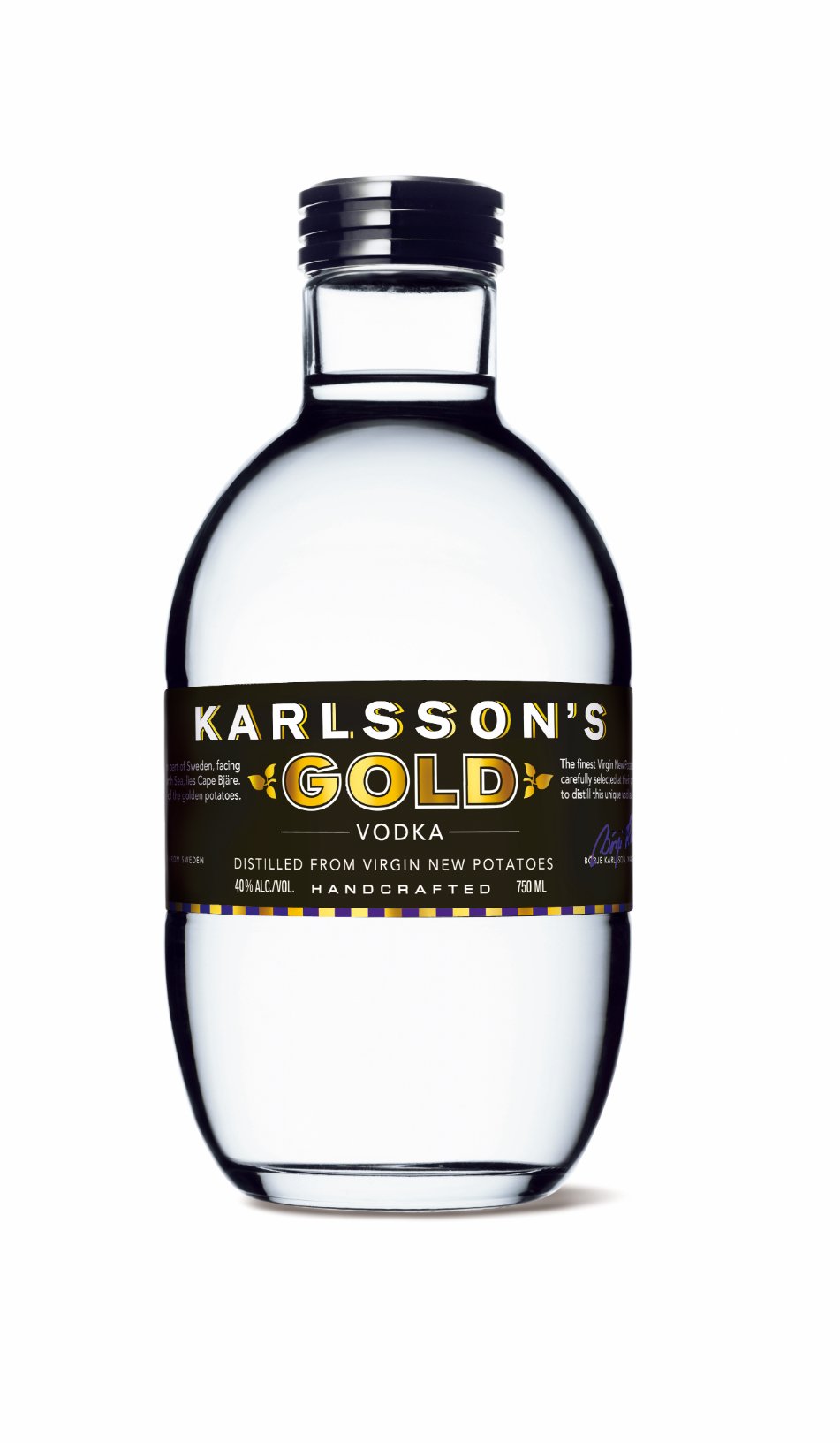
To put it in perspective, I took the picture next to an empty Karlsson's bottle:
That's a lot of potatoes! They (well not these) will be fermented, distilled up to 96% ABV, then diluted back down to 40% for bottling strength.
This post is part of a little project on potatoes and Sweden I'm doing for Karlsson's Vodka. Karlsson's Gold is a blend of seven heirloom potato vodkas.
Read about my adventures to Sweden with Karlsson's and learn how it's made here.
In the process of making many types of alcohol enzymes are used, but I didn't know very much about them. So I decided to do some reading and share what I've learned. Or what I think I've learned anyway.
Enzymes are used in spirits production before fermentation. They are used to expose fermentable sugars in base ingredients so that they can be fermented by yeast. For example, a raw potato with yeast added to it won't produce potato beer (or not much of it). But when heated and with enzymes added then it will.
Let's review spirits production:
The base ingredient is prepared for fermentation. This can be as simple as crushing a grape or stalk of sugar cane, but many other raw ingredients must be prepared by methods such as malting (barley), baking (agave), heating in water (many things, called 'mashing' in whisky), and/or adding enzymes.
The ingredient now has its fermentable sugars exposed, so yeast can do its job and convert these sugars into alcohol.
The result is a beer/wine with a low percentage of alcohol.
The beer/wine is concentrated through distillation.
What Are Enzymes?
Catalysts that perform and speed up chemical reactions. They are present in biological cells. They do a lot of work in nature.
They convert molecules into other molecules. An example of this is the enzyme lactase, which breaks a lactose down into two glucose molecules. People who are lactose-intolerant do not produce the enzyme lactase so they can't process lactose.
Enzymes aren't fuel for reactions – they're not consumed by the reaction they catalyze.
Enzyme activity can be affected by environmental things like temperature, pH, and pressure. (For most fermentable materials, the mash of hot water and raw material is heated to very specific temperatures so that the enzymes will work.)
The enzymes are B,C,and D in this illustration. The material A is broken up. Source.
Common Uses for Enzymes
Some easy-to-understand cases where enzymes are used:
In meat tenderizers that break down proteins into smaller proteins, making it easier to chew.
In stain removers to break down fats or proteins on clothing.
In digestion. From Wikipedia, "An important function of enzymes is in the digestive systems of animals. Enzymes break down large molecules (starch or proteins) into smaller ones, so they can be absorbed by the intestines. Starch molecules, for example, are too large to be absorbed from the intestine, but enzymes hydrolyze the starch chains into smaller molecules, which can then be absorbed."
Enzymes in Beer Production
The website HomeBrewTalk.com has a great, detailed chapter on enzymes in fermentation. They lay out how grains for beer are often mashed (heated with water) to two different temperatures.
Mashing is the process in which the milled grain is mixed with water. This activates enzymes that were already present in the barley seed or have been formed during the malting process. These enzymes work best in particular temperature and pH ranges. By varying the temperature of the mash, the brewer has control over the enzyme activity.
In barley starch makes up 63% – 65% of the dry weight. Starch is a polysaccharide (very large chains of glucose) which is insoluble in water. Brewer's yeast, however, can only ferment monosaccharides (glucose, fructose), disaccharides (maltose, sucrose) and trisaccharides (matotriose).
In order for that starch to be converted into water soluble sugars (fermentable and unfermentable), two processes need to happen. First the starch is gelatenized to become water soluble. For starch found in barley and malt this happens above 140ºF (60ºC). Secondly the activity of the amylase enzymes break the long chained starch molecules into shorter chains.
Enzymes in Scotch Whiskey
The malting process in scotch whiskey is a process to expose enzymes. To make malted barley, the dried grains are soaked in water so that the seeds just start to sprout, then the grain is dried to halt the process. Then when the grain is later mashed (has hot water added to it), the enzymes will convert the starches in the grains into fermentable sugars.
According to Ian Wisniewski in Michael Jackson's Whiskey,
"Growth hormones released by the grain also trigger the creation and release of enzymes that begin breaking down the cell walls and protein layers, in order to access the starch… The enzymes collectively termed 'diastase,' include alpha-amylase and beta-amylase (the latter is already present in barley). These enzymes are essential for the subsequent conversion of starch into fermentable sugars during the subsequent process of mashing."
Enzymes Used in Many Spirits
In other spirits, enzymes are added, which saves the malting step or speeds the natural reaction with enzymes naturally present. This is true in bourbon (from corn), in other spirits from grain (like vodka), and for potato vodka.
Most bourbon mashbills (recipes) contain a certain portion of malted barley. This is because the malted barley provides the rest of the batch with enzymes needed to break down the material into simpler sugars. However, in modern times many (if not all) major bourbon producers also add enzymes to the corn, wheat/rye, and malted barley mashbill to speed things up.
A good overview of the chemistry of this and list of enzymes available for purchase can be found on this IM biotech company site.
From the few potato vodka distilleries that I have visited, it seems that adding enzymes is standard in the process of preparing potatoes for fermentation. So I used this project as an excuse to learn more about enzymes.
If you think about a raw vs. cooked potatoes, they get a bit sweeter after you cook them so we can guess that heat helps break down the starch into sugars- at least partially. Enzymes help with the rest.
Karlsson's uses "virgin new potatoes" to produce their vodka. These are very small, skinless potatoes that are full of flavor that translates into the final spirit.
In Sweden, vodka was originally made from grapes and grains. Then the potato took over as did a government monopoly on production (except for a little export product called Absolut). But when the country joined the European Union, that all changed.
Sweden has a strange relationship with potatoes and vodka.
According to Nicholas Faith and Ian Wisniewski in their 1997 book Classic Vodka, distillation had reached Sweden by the 14th century, though this was used to make medicines. In the 16th century spirits became a luxury beverage, and in the 17th century they became a popular recreational drink for all classes.
Vodka in Sweden was likely made from grapes, then grain. It became a bit too popular as soon as the price came down. In 1775 a law was passed forming a state monopoly on spirits production, but this was abandoned soon after. It would come again later.
According to the book The Vodka Companion: A Connoisseur's Guide by Desmond Begg, "Potatoes, a cheaper raw material than wheat at the time, were first used in distillation in the 1790s."
With the invention of the continuous still and other technological advances, potatoes became easier to use as raw material in the early-to-mid 1800s.
The Swedish Temperance Society was founded in 1837. In 1860 home distillation was forbidden in Sweden. Throughout the mid-1800s, different cities granted exclusive rights to sell vodka to certain groups of tavern keepers. These taverns closed early at night to prevent excessive consumption, and vodka was only served with meals. Profits collected from vodka sales were reinvested in the local community, and in Vodka Politics by Mark Lawrence Schrad, the author asserts that this system was responsible for curtailing excessive consumption throughout the country.
These local city-wide companies were eventually merged into the national retailing monopoly, the Systembolaget, which is still in place today. Vodka rationing – limiting individuals to a maximum amount- continued into the 1950s.
In 1917 Vin & Sprit was formed when the state liquor company purchased the largest rectifying company, giving it a monopoly on manufacture, retail, and importation of all alcohlic beverages. This monopoly lasted until around 1995 when Sweden joined the European Union. They kept control of retailing (Systembolaget) but sold off state-owned production.
Peter Ekelund, the main creator of Karlsson's vodka, says that under V&S control all spirits were supposed to be made from potatoes as (it more like a compuslary agreement than a law). It was a farm subsidy agreement probably dating back to post-WWII. But these were ‘starch potatoes’ that had no real flavor.
That is, all vodka was made from potatoes, with one notable exception.
Absolut History
Absolut vodka was a brand dating to 1879, named for being "absolutely pure." The brand was resurected by Vin & Sprit for its centennial anniversary, and in 1979 was made from grains rather than potatoes.
According to Peter Ekelund, this was allowed because Absolut was solely an export product.
Obviously, Absolut was a huge success and in 1985 it was the largest-selling imported vodka in the USA.
But when Sweden joined the European Union they sold off V&S. Vin & Sprit was bought by Pernod-Ricard in 2008 for 5.69 billion euros.
Return to Potatoes (The Karlsson's Team)
When Absolut was created, this was a government product, so the people who created, blended, and exported the brand didn't take home a chunk of its enormous profits. But many of the same people who helped create it came back together to create Karlsson's, an heirloom potato vodka.
The vodka is named for Börje Karlsson. He is the blender of Karlsson's and was the Head of Laboratory and Product Development of V&S Group during the development of Absolut.
The founder of the brand is Peter Ekelund, who had helped lead the launch of Absolut Vodka in North America.
The bottle designer is Hans Brindfors, the former Art Director of Carlsson & Broman who designed the Absolut bottle.
And they also reunited with Olof Tranvik, who introduced Absolut to Andy Warhol back in the day.
It's pretty cool that some of the same team who helped create the vodka that broke the mold of what Swedish vodka could be gathered to break it again in a return to potato vodka.
When they started making Karlssons a lot had changed since 1979: There were no distilleries left in Sweden that could distill from potatoes anymore.
Last week I had the honor of being awarded the International Cognac Writer of the Year for 2014. The annual award is granted by the Bureau national interprofessionnel du Cognac, the BNIC. They are the industry promotion group for cognac.
Previous winners of the award include David Wondrich and Salvatore Calabrese, so I'm in excellent company.
I was given the award at the annual La Part des Anges charity auction held in Cognac, which this year raised over 237,600 euros for the Children in Crisis charity. The charity's patron Sarah Ferguson, the Duchess of York, was there to host the event. (I sat at the next table over with her assistants.)
My friends Eric Fossard and Thierry Daniel were awarded the Cognac Personalities of the Year award for their running of the Boutique Bar Show in Paris.
In addition to the certificate to hang on the wall of my office, they gave me an engraved bottle to tempt me from storage.
Below are some websites, books, and various resources I've perused to learn about potatoes. I'll probably add more to this list in the future.
Books
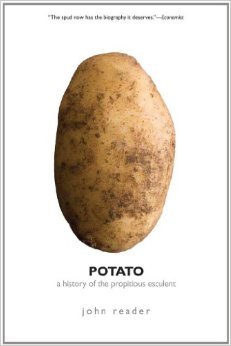
Potato: A History of the Propitious Esculent by John Reader. This book is a narrative history of the potato, rather than a linear history. Some chapters start with a 'fact' then go through the effort of showing how that fact was disproved/corrected. Thus it's not the best reference book in the world (hard to look stuff up and know you've found the real answer), but it does have tons of great information.
Potato: A Global History by Andrew F. Smith. This book has a concise history of the potato that ends on page 52. Subsequent chapters talk about the potato as a food source (how it's eaten around the world), the potato as a crop in the past and today. There is a final chapter of recipes.
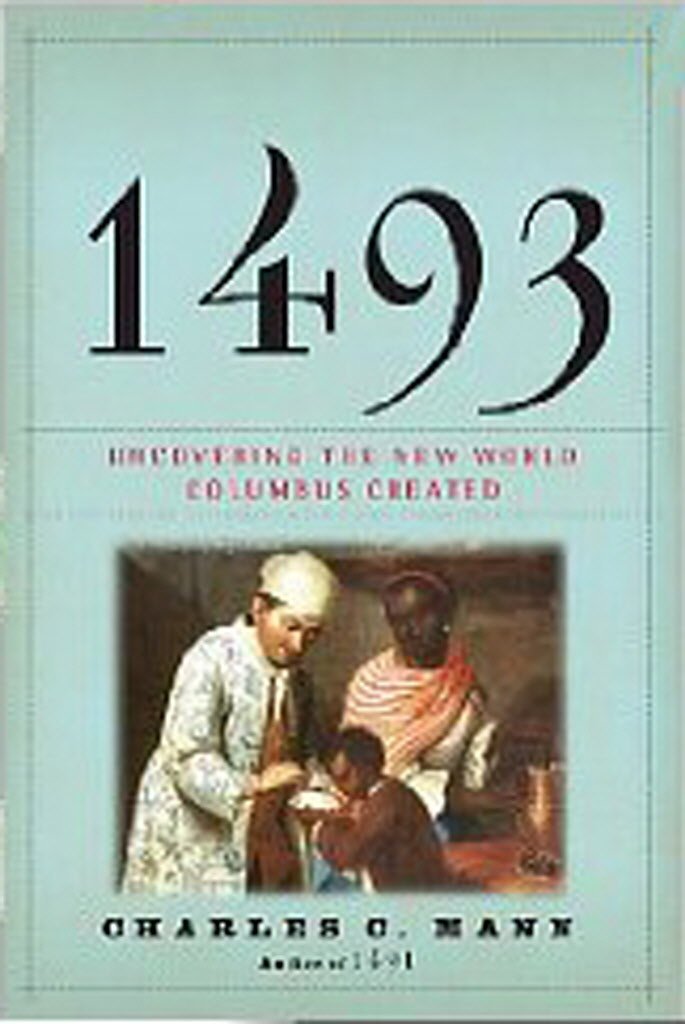
1493: Uncovering the New World Columbus Created by Charles C. Mann. This best-selling book about "how European settlements in the post-Colombian Americas shaped the world." There is a chapter called "The Agro-Industrial Complex" about the history of the potato and its spread around the world, and how the prevention of potato blight neccesitated the agro-chemical industry we know today.
Try Swedish! A website about Swedish products and good information about Swedish potatoes.
Potato Research and Promotional Organizations
The International Potato Center based in Peru. "The International Potato Center was founded in 1971 as a root and tuber research-for-development institution delivering sustainable solutions to the pressing world problems of hunger, poverty, and the degradation of natural resources. CIP seeks to achieve food security, increased well-being, and gender equity for poor people in the developing world."
The Potato Council (UK) "The Potato Council is part of the Agriculture and Horticulture Development Board www.ahdb.org.uk working on behalf of British potato growers and purchasers to promote potatoes."
Potato Goodness "The United States Potato Board (USPB) is the nation’s potato marketing and research organization."
The National Potato Council "The National Potato Council is the advocate for the economic well-being of U.S. potato growers on federal legislative, regulatory, environmental, and trade issues."
There is a very common misconception that most or all vodka is made from potatoes. In reality it's a tiny fraction (I heard 1% at one point), while the rest is made mostly from grains (though some is from sugar byproducts, grapes, or even milk whey). I would love to know how this became the popular idea, but I don't think I'll be able to find out.
Interestingly, from my research the potato history books skim over the history of potatoes in vodka, and the vodka books do too. But I wanted to research when potatoes were used in vodka.
Potatoes didn't come to Europe from their native Peru until around the mid-1500s, yet the first printing of the word vodka is from 1405. Distillation preceded that by at least a couple centuries.
So the original vodka (which doesn't resemble today's crisp, clean version to be sure) was definitely not made from potatoes- grains and grapes had a big head start.
In Poland, "The late 18th century inaugurated the production of vodka from various unusual substances including even the carrot.[21]"
In Sweden, "Although initially a grain product, potatoes started to be used in the production in the late 18th century, and became dominant from the early 19th century.[28]"
According to the book Vodka: A Global History by Patricia Herlihy, "In the early nineteenth century, Poland introduced the plentiful potato as an alternative base ingredient…. Between 1843 and 1851 the European potato blight severely curtailed production."
According to Nicholas Faith and Ian Wisniewski in their 1997 book Classic Vodka, potatoes first came to Poland in 1683, it wasn't until after 1764 that they began transferred from the gardens of the rich to the food of the peasants.
According to the book The Vodka Companion: A Connoisseur's Guide by Desmond Begg, "Potatoes, a cheaper raw material than wheat at the time, were first used in distillation in the 1790s."
As we'll look at in closer detail in another post, Sweden and other Scandinavian countries underwent a long puritanical/temperance movement. As part of this, the government took control of all alcohol production. And it seems that because they thought of alcohol as evil (though sometimes a necessary one), they made it all with the then-lowest-quality ingredient they could find: potatoes.
According to Classic Vodka, "Potato vodka is still subject to a certain snobbery, as though it is a consolation spirit made in the bath-tub. This misconception can be traced back to a time when potatoes were the cheapest raw material for vodka, whereas today they are generally more expensive and labor-intensive than grain.
Karlsson's Note
The ideal potatoes for producing high quantities of raw alcohol would be large and have a high starch content, but Karlssson's vodka uses tiny heirloom varieties (seven of them) in their blend of Karlssson's Gold. These are less efficient, more expensive, and they certainly produce a flavorful spirit.
I'm doing a research project looking at potatoes, sponsored by Karlsson's Vodka.
Potatoes originally come from Peru, but they're only the 18th largest producers of the crop. China and India, which are relatively new producers of potatoes, are the top growers.
Then the US and Russia are nearly tied for third and fourth. I for one, am doing my share of potato-eating and drinking to keep America strong.
Not many potatoes are exported (less than 5% by one calculation); they're not much of a commodity crop.
According to FAOSTAT, the Food and Agriculture Organization of the United Nations- Statistics Division, the top potato-producing countries in 2012 were:
Though I know some Korean soju is distilled from potatoes, and after sweet potatoes regular potatoes are the most common Japanese shochu base ingredient, but I don't know if any Chinese or Indian beverages are made from potatoes.
Karlsson's Potato Vodka Facts
Sweden doesn't crack the top 20 potato-producing countries, but they sure grow potatoes there. In fact, if you search for "Swedish potatoes" you will find a ton of recipes, including something called Hasselback potatoes which looks amazing.
But the traditional summertime potatoes are called new potatoes aka fresh potatoes aka "färskpotatis" which sounds to me like "freshpotatoes" when spoken. The ripen in the summer and their skins are not mature so they slide right off. They are tiny and you eat them lightly boiled with dill and butter, though they're pretty buttery to start with.
It is from these heirloom potato varieties – seven of them- that Karlsson's vodka is distilled. They are distilled separately then blended together. They have also released two limited-edition, single-varietal vintage potato vodkas each with a widely different and robust character.
I visited Sweden a few years ago and wrote about how Karlsson's is made here.
Though the potato arrived in Europe in the late 1500s, it didn't catch on so quick. Partly this was because of the difference in terroir between northern Europe where the temperature and sunlight varies a lot over the year, and their native equatorial Peru. So they were grown around Europe but they weren't as prodigious as the potatoes we know today.
It was on the Canary Islands- closer to Peru than to Ireland in climate- that farmers were able to breed varieties that would later be successful throughout Europe.
There were also publicity issues – though as mentioned in the previous post they were often called aphrodisiacs, they were also believed to be the cause of leprosy. You win some, you lose some.
Potatoes were a different sort of crop than Europe's grains- they were more labor-intensive to plant (one doesn't just scatter seeds) and harvest. It really wasn't until the 1700s that potatoes became a food crop.
By 1700 the potato was grown around the UK, though this seems to be largely in individual gardens rather than as a field crop initially. They may have first been grown commercially in Alsace, France.
One interesting reason for their success as a food/field crop was wars in Europe: armies trampling over the lands wouldn't see the obvious grains sticking out of the ground, and they could camp on the lands and potatoes would still be growing underneath.
"Parmentier Antoine 1737-1813". Licensed under Public domain via Wikipedia Commons
Throughout the 1700s potatoes were eaten not by choice but out of desperation- but it turns out that their a pretty darn good source of nutrients. Frederick The Great of Prussia was a believer, and required their planting across the Germany-Austria region. A French pharmacist named Parmentier (there is a Parisian metro station named after him) was captured during the Seven Years War with Prussia was fed exclusively on potatoes for three years, and brought back this knowledge to France.
He introduced them to the royal court and there there were all-potato themed dinners. Benjamin Franklin and Thomas Jefferson may have attended these dinners and at one of them Jefferson is said to have delighted in French fries and brought the idea back to America.
Potatoes were more rapidly accepted in the UK, where wheat didn't grow all that well but the tubers did. And as grain was a big commodity market, potatoes benefited from not being subject to market and weather whims. John Reader writes:
As a crop that thrived where wheat would not grow, and survived in weather that ruined grain harvests, the potato was to be welcomed by governments and commodity markets alike. Not only because it was a cheap source of food for the poor; not just as a commodity to be bought and sold; nor simply as a cushion that would dampen the severity of fluctuations in grain supply. It was all of these things, but also promised to free up more grain for the markets. If people could be persuaded to grown and eat more potatoes there would be more grain to sell. Thus the potato nudged grain away from its primary signicance as a stable food of the people who grew it, towards a formative role in national and world trade.
In Norway, potatoes were grown by priests who were often farmers. They even had the nickname 'potato priests'. Potatoes came relatively late to Scandanavia. They were grown in aristocrats' gardens in Sweden and Denmark in the 1730s and became a field crop around 1800. Around the same year, they were cultivated in Russia and the Ukraine.
The Potato Blight
Later in the 1900s, anthropologists were able to show that wherever the potato was adopted, populations increased. It was a proven source of nutrition and allowed more people to share space on land. Of course this came with a downside.
In 1845, 90 percent Ireland's 8.5 million person population was dependent on the potato for food, as it grew so well there. And in 1845 and 1846 the potato blight hit and 88 percent of the potato crops failed. From those years and for the next few after, one million people died and another million emigrated.
The world's first celebrity chef, Alexis Soyer, designed and implemented a soup kitchen that fed 26,000 people a day in Dublin. He was also the creator of the first-known blue drink called Soyer's Nectar, but that came later.
We call it the Irish Potato Famine, but that's not at all accurate: the same crop failure happened all over the world. In 1843 it ravaged crops in North America and soon came to Europe, destroying crops everywhere. The cause was a parasitic fungus that grew on potatoes.
The solution to the problem came from a botanist named Millardet, who was also instrumental in helping circumnavigate phylloxera by grafting European grapevines onto American rootstock. He also promoted the solution to "downy mildew" which was a problem for grapes as well as potato leaves. The solution, copper sulphate mixed with lime that is sprayed on the leaves of plants, became known as the Bordeaux Mixture and it is still used on crops today. (It's discovery is credited with starting the agro-chemical industry.)
But as that solution was discovered 40 years after the great blight, how did they stop the disease? They didn't. It was the luck of the weather and of the varieties planted. There were regional outbreaks for years until the Bordeaux Mixture became common. Luckily, none approaching the severity of 1846-47.
The Potato in the US
Potatoes were grown in the USA since the 1600s, but not so much as food. The transition happened when Scotch-Irish people came to the US, as well as subsequent waves of potato-growing peoples from eastern Europe and Scandanavia.
Potatoes arrived in the Colonies in 1621 when the Governor of Bermuda, Nathaniel Butler, sent two large cedar chests containing potatoes and other vegetables to Governor Francis Wyatt of Virginia at Jamestown. The first permanent potato patches in North America were established in 1719, most likely near Londonderry (Derry), NH, by Scotch-Irish immigrants. From there, the crop spread across the country.
Idaho, the present-day largest producer of potatoes, actually did not begin growing potatoes until 1836, when missionaries moved west in an effort to teach the native tribes to grow crops instead of relying upon hunting and gathering methods. However, it wasn’t until 1872 when the Russet Burbank variety was developed, that the Idaho potato industry began to flourish.
The Russet Potato
I love single-origin stories. The potato generally comes from a single place in the world, the Andes of Peru, but all of the Russet potatoes in existence come from a single plant.
One way to avoid potato blight was to cross-breed potatoes to see what happened. In this process, a New York preacher was sent some seedlings from South America and these grew very well and were named the Garnet Chile Potato.
Then a Vermont farmer bred these into the Early Rose, which became very popular. These potatoes were generally seedless, but in in 1872 in Massachusetts an amateur botanist spotted a seed on an Early Rose. He collected and germinated the seeds and a single one of these new plants produced great big potatoes.
He sold the rights to this new potato (apparently that's doable) to a seed company. Then this potato mutated into the Russet-Burbank potato aka the Idaho potato.
And that's where your French fries come from.
Karlsson's Vodka Potato Facts
Those great big Russet potatoes would be a lot easier to use to make vodka, but Karlsson's insead uses tiny heirloom potato varieties. They have less starch than the big potatoes and thus they need to use more of them – about 17 pounds of potatoes for every bottle of Karlsson's.
Read about a visit to see how Karlsson's is made here.
I'm researching potatoes in a little project for Karlsson's Vodka. Today we'll look at how the potato came to Europe.
As mentioned in the previous post, potatoes are native to the Andes mountains and over 3000 varieties are found there.
The Quechua people of the Andes invented a way to preserve potatoes: They would put them out at night when the temperatures were freezing, and covered them during the day. Then they were soaked in water and put out to freeze again. The next day they walked on the potatoes to squeeze out the water content, then spread them out to dehydrate in the sun. They had basically made dehydrated potato flakes like in your box of instant potatoes.
The first description of a potato by a European was published in 1601 from observing potato harvest in 1537. The author described them as a type of truffle. The first print reference to potatoes by name came from observations from another explorer around this same time.
Sir Francis Drake is often incorrectly credited with introducing the potato to Europe.
The first potatoes to reach Europe were brought by the Spanish by the 1570s, probably in the previous decade. They seem to have first been grown in Spain but were found in Germany, Italy, and Belgium by the late 1500s.
They were probably not first grown on the mainland, but on the Canary Islands off the coast of Spain – which is a pretty amazing point of entry for the potato to come to Europe, because that was the point of exit for the sugarcane that was taken to the New World by Columbus.
The potato slowly became a "plant of interest" around Europe according to the book Potato by John Reader. In 1596 they were described in one botany book, and in 1597 it was first illustrated by another botanist John Gerard.
Sweet potatoes were grown in Europe by the early 1600s and many accounts of potatoes confused regular and sweet potatoes – it makes for confusing research still.
Shakespeare refers to potatoes as aphrodisiacs around 1600; a common thought at the time.
In the next post we'll continue looking at potato history in Europe.
Karlsson's Vodka Potato Facts
The potatoes used in Karlsson's Vodka are called "new" or "virgin" potatoes. These are the first potatoes grown in the southwestern tip of Sweden that are harvested before their skin fully develops- when the plants are still flowering. They're considered a delicacy when the first ones are pulled from the ground; sort of the Beaujolais Nouveau of potatoes. I visited Sweden a few years ago and wrote about how Karlsson's is made here.