Blog

  • Notes on the Science of Flavour

    Last week in Sicily I attended the Disaronno Mixing Star Lab. It was two long talks over the course of two days.

    The first was called The Science of Flavour and it was given by food scientist Dr. Rachel Edwards-Stuart.

    Disaronno Mixing Star Lab tastes

    I took a lot of notes – and here they are:

    By adding color to food (and drink) it changes our perception of its flavor. So a redder drink will appear sweeter. Green on a can of soda will make you think there is more lime in it.

    Sugar and salt enhances flavor, so if you want to have something that you want to enhance the flavor you add that. So too does MSG and acidity.

    Acidity as a flavor enhancer: If a food naturally has acidity in it, you can add more acid to boost flavor.

    There was a study on mint gum – they found that the menthone stayed the same over time but as the sugar went away over time, you lose the perception of the mint. So you can dip mint gum in sugar and it will revive the mintyness.

    pH shows sourness, but if sugar is present the perception of acidity will be lowered no matter what the pH meter says.

    Malic acid brings out green apple ripeness in foods/drinks.

    Tartaric acid you get in wine/grapes.

    We did a tasting of pure taste solutions: sweet, salt, umami, acid, bitter. Then we all compared the intensity of them on a scale. It showed a huge range of perception of intensity of flavor. Also, it has been shown that people perceive intensity of taste differently on different days.

    Lemons and limes – the difference in their flavor is due largely to their aromas.

    Some countries in Asia have salty vanilla products, so they associate vanilla with salty rather than sweet.

    We perceive aromas in the same part of the brain where we perceive memory.

    With liquids, you don’t really get the aromas until you swallow. (That’s why wine tasters do that sucking thing.)

    Trigeminal Stimulation – Everything that isn’t a taste or an aroma but is picked up in a chemical sensation in the mouth. Chile/spice, mint/cooling, carbonation.

    Astringency is not technically a trigeminal stimulus (not in the same nerve/brain pathway), but we can categorize it similarly though it’s more of a mouthfeel. Tannins strip away proteins in your saliva.

    Try ginger with a nose clip – it makes it taste way spicier as it enhances that trigeminal sensation.

    Carbonation – bubbles bursting in the mouth activates mechanoreceptors. And CO2 turns into carbonic acid which activates pain receptors. It changes the balance of sweetness and acidity – that’s why flat Coke is so disgusting.

    Research suggests CO2 increases bitter aftertaste and suppresses sweetness, but there is disagreement in the scientific literature.

    Congruent flavors: sugar increases strawberry perception, but MSG for example doesn’t. So the color green + melon + mint are congruent. If you increase any of those elements it increases the overall perception of all of them. Incongruent flavors don’t enhance overall perception.

    Potato chips are put in noisy packaging to increase the perception of crunch and freshness.

    The color of the plate affects flavor perception. Strawberry mousse on a white plate tastes sweeter and more intense than on a black plate. Serving something in a heavy bowl increases perception of density, likeness, value, and fullness vs a light bowl.

    Under blue lighting people liked a certain wine more, but also tasted fruitier and spicier. Under red lighting, it tasted sweeter.

    Music- When they played German music in a supermarket, people bought more German wine, opposite with French music/wine.

    People served same dish with different names perceived the flavor differently.

    Flavour Chemistry in Mixology

    All 5 tastes are water soluble. (Because water and tastes are both charged.) So sugar is soluble in water but olive oil is not. (Sugar is charged and oil is neutral).

    Aromas are not charged – and are fat-soluble. So aromas are not soluble in water. 

    Alcohol will dissolve fat-soluble things as well as water-soluble things. So you get both taste and aromas trapped into alcohol. Makes it a great carrier of flavor.

    The book Modernist Cuisine has tables of ideal infusion time/temp/substance for many ingredients.

    You can use a centrifuge to separate oils, liquids, solids. Then use the oils for fat-washing into spirits.

    In nitrous infusion in a whipped cream charger, nitrous is a neutral gas. In CO2 you get carbonation, plus the carbonic acid affects flavor.

    Saltiness suppresses perception of bitterness, as does sweetness.

    White chocolate and caviar contain the same aroma chemical – triethlyamine (sp?). They make an interesting food pairing. Use FoodPairing.com to look up interesting pairings based on chemistry. 

    MSG is probably not the cause of migranes; it’s something in refried rice when not prepared properly.

    The Main Flavors of Disaronno (according to a trained flavor panel)

    • Bitter Almonds
    • Vanilla
    • Fruit – overripe apple/cherry
    • Sweetness – Caramelized/brown sugar/honey

    When you dilute Disaronno with water, keep the nutty flavor equal, get more fruity flavors.


    • Disaronno Mixing Star Lab Rachel talk slide9
    • Disaronno Mixing Star Lab Rachel talk slide10
    • Disaronno Mixing Star Lab Rachel talk slide12
    • Disaronno Mixing Star Lab Rachel talk slide13
    • Disaronno Mixing Star Lab Rachel talk slide15
    Disaronno Mixing Star Lab Rachel talk slide15


    A mass spectrometer can only pick up 24 flavors in Disaronno. The human nose can pick up more. Some important ones for flavor pairings:

    • Benzdaldehyde = marzipan note. Almonds cherries, peaches.
    • Furfural – in heated food containing sugar, including toffee, whisky, coffee, cakes, and meat. 
    • Ethyl Benzoate – fruits (not citrus)


    Disaronno Mixing Star Lab Rachel2

  • Making Rye Whiskey at Anchor Distilling in San Francisco

    This post is sponsored by Anchor Distilling, makers of three rye whiskeys in San Francisco, California.

    Anchor Distilling makes three unique rye whiskies in a tiny corner of a big brewery in Potrero Hill in San Francisco. I visited, probably for my 6th time, to learn the story of how it all started and how the whiskies are made. 

    In the Beginning…

    OLDPOTREROSTRAIGHTRYEWhen you speak with start-up distillers, you realize that everyone wants to make whiskey, but whiskey takes time to age, it has the expense of barrels to age it in, and it requires space in which to age it. So most new distilleries launch vodka, gin, rum, and/or other unaged products first. That wasn't the case at Anchor Distilling, which launched an aged whiskey first and then gin later.

    "We had a huge advantage in that we were all brewers, and the brewery was bankrolling all this. We didn’t have a time table to get a product out on the market. We could go until we had what we wanted," says Bruce Joseph, Head Distiller of the Anchor Distilling Company. 

    "We were lucky that we were able to spend a lot of time experimenting. There wasn’t a lot of information out there for small-scale distilling. It wasn’t what any bourbon distillers were doing." Joseph (interviewed in May 2014) had been a brewer long before Anchor's founder Fritz Maytag had the idea to launch a distillery. 

    "I was in my early 20s when I started working here. The brewery had just moved into this building. When I started working here there were 13 employees. I thought, 'I’ll do this for a little bit' and I started working here and there was a real sense that these were a group of people on a mission: making beer that the majority of people didn’t want to drink," Joseph says. 
     
    Making products (beer, then spirits) that won't be appreciated by most people ever, and not by hardly anybody for a while after they hit the market, seems to be both a point of pride and the business plan at Anchor. 
     
    Photo 4

    The still for second distillation of whisky and genever
     
    In a 2012 interview of Anchor Brewing and Distilling founder Fritz Maytag conducted by Alan Kropf  of Mutineer Magazine (and now the Director of Education at Anchor), Maytag said his success with the beer company led to an explosion of other creative beer makers, and then it became less exciting the more other people were making equally exciting beers.
     
    "It got to where our competitors were coming out with all kinds of things including things that were kinda goofy. It got to where if you brewed a chocolate-blueberry stout people would say, 'Oh another one of those,' and I didn’t find that very rewarding."
     
    [All quotes from Maytag come from the interview with Kropf, who gave me access to the recording.]
     
    A Plenitude of Points of Differentiation
     
    Bruce Joseph was there for the beginning of the experiments with distillation. He says, "Rye was perfect for Fritz because it was historical and it was hugely unpopular. No one gave a damn about rye whisky at the time." 
     
    Not only was the choice to make rye a bold one, the choice to make it in a pot still was radical. At the time, in 1993, there were no legal pot-distilled whiskies being made in America – it was all made in continuous column stills. 
     
    Furthermore, Maytag decided on a 100% malted rye whiskey to distill.  He said, "The rules say 51% rye (to be legally called rye whiskey by US law) but the rye whiskeys don’t use malted rye- they just use rye- and probably some malted barley and some corn. Just as in Scotland they require that the single malt whiskeys be made with all barley malt mash, I thought, 'Why don’t we make rye whiskey but we’ll make it with malted rye?'"
     
    He continued, "And we thought we could steal the phrase 'single-malt.' We stole it fair and square – the Scots forgot to trademark it!"
     
    Malting is the process (required for all single-malt scotch whisky but with barley instead of rye) where the grains are allowed to germinate in wet conditions, then they're dried. This produces grain that is easily fermentable. (Most bourbons use a portion of malted barley in their recipes as this helps the other grains ferment, though today enzymes also help speed the process.)
     
    Anchor Still

    The still for the first distillation of rye whiskey and genever
     
    Joseph says, "Fritz had that idea that he wanted to do 100% rye. When we did early mashes we all just loved the flavor of the malted rye. It had a certain character and certain quality that was just real attractive. (Maytag described that taste as "a richer, warmer, friendlier flavor".) Once we started doing spirit distillation it just seemed that it was bursting with flavor."
     
     
    Fake It 'Til You Make It
     
    Yet another unique feature of the rye whiskeys made at Anchor is that the fermented mash goes into the still, not a wort. Or, in English: grains are fermented with water and yeast. After fermentation the whole thing goes into the pot still at Anchor.
     
    This is unusual: In Scotland where they use pot stills for single-malts, they separate the solids from the fermented beer before distillation (and the liquid beer is called wort). This prevents those grain bits from sticking onto the side of the still during distillation and burning. 
     
    Additionally, rye is known for being very gummy and hard to distill because of that. Joseph says, "Rye is a sticky, viscous, mess – a brewer’s nightmare."
     
    Luckily, their copper still came with a built-in agitator that can be turned on to keep the liquids in the pot moving so that nothing sticks and burns. Joseph says, "The very first time we did it, if my memory serves me well, we at first used the agitator when we were heating up the mash then turned it off during distillation. It caked onto the inside of the still, and once it’s cooked onto the side you don’t get heat transfer. We learned that in the first day or two."
     
    And I bet somebody had a not-fun job of scraping out the inside of a small 600-liter still. 
     
    Age Is Just a Number, Except in California
     
    The first single-malt rye whiskey from Anchor was aged barely over one year – 13 months. This was 1996, about six years before the whole white whiskey trend came to be. 
     
    Maytag said, "I thought that after 6-8 months our whiskey was just charming. It was kind of almost sweet. And since the (federal) law said that there were no rules about how long it had to be in the barrel – it just had to state the age (if under four years)- I said why don’t we bottle it at one year old?"

    He continued, "Later we discovered we had broken the California law, which was a stupid mistake. But in California to be called whiskey, never mind rye whiskey, you have you to be in the barrel for at least 3 years, and some of the barrels have to have been charred. Which is absurd because there were no charred barrels until about 1840 or so."

    Yes, another unique feature: one of the three single-malt rye whiskeys made at Anchor is aged in a hand-made, air-dried, toasted American oak barrel, while laws for bourbon specify charred oak and that's the standard. It was a combination of Maytag's wine expertise and dedication to make a historically valid whiskey that had led him to the toasted oak decision.  

    "We called it 18th Century-Style Whiskey because we couldn’t call it rye whiskey because it wasn’t aged in charred barrels. (But) that whiskey can’t be called whiskey at any age in California because there are no charred barrels. We still have a product that in California is labelled as a “spirit”; can’t call it whiskey, it’s crazy," he said. 

    This Is How It's Done 

    Old potrero hotalingsfinalAnchor Distilling makes three rye whiskies.

    • Old Potrero Single-Malt Straight Rye Whiskey (sometimes called 19th Century whiskey)
    • Old Potrero 18th Century Style Whiskey 
    • Old Potrero Hotaling's  Single-Malt Whiskey

    They all start with the same distillate, made from fermented 100% malted rye mash. Then they all go into different barrels at the same proof, "a little below the legal limit of 125 proof," according to Joseph. 

    • The Old Potrero 18th Century Style Whiskey is aged in toasted barrels for 2.5 – 3 years, sometimes with a little bit of older whisky mixed in. Joseph says, "Toasted barrels work better for a younger whisky."
    • The Old Potrero Single-Malt Straight Rye Whiskey is aged in new charred oak barrels for 4.5 – 5 years. Joseph says, "We prefer the whisky not to age too long."
    • The Old Potrero Hotaling's  Single-Malt Whiskey is aged in used whiskey barrels. These have always been ex-bourbon barrels, but recent releases will have been aged in used charred barrels that were used to age something else (forthcoming) at Anchor. Joseph says, "We kept tasting it but for the first 7 years we didn’t like it as much as the other whiskies. But finally we tried it after about 8.5 years after we hadn't in a while and we said 'We should have been putting more of this away!' The age of the release changes each year, as there isn't very much of it around. 

    The barrels were aged on-site in Potrero Hill for many years, but now they age in Western Sonoma County in a warehouse that keeps a San Francisco-like temperature year-round. 


    This post about the pioneering spirits created by Fritz Maytag and his team is sponsored by Anchor Distilling. 

  • The Cocktail Menu for ABV in San Francisco, Opening Later This Week

    Abv_logoWhile they haven't crossed all the T's and dotted the I's (or added the prices) to it, the good folks at ABV in San Francisco let me photograph their new menu.

    The bar is in soft-opening mode beginning Tuesday (and they'd really, really appreciate it if everyone didn't show up on Tuesday), and it will be open from 2PM – 2AM after that. 

    Reminder: ABV is a partnership between Erik Reichborn-Kjennerud (owner of Dalva, Dalva Hideout), Ryan Fitzgerald (former Beretta bar manager and Del Maguey Mezcal brand ambassador), and Todd Smith (former bartender at Dalva Hideout, former distributor rep with Pacific Edge, founding Bourbon & Branch bartender). 

    The menu contains 20 cocktails, including 4 non-alcoholic ones, divided by spirit. The menu flips at an angle and the bottle list of spirits is on the underside of the previous page. Click these photos to make them larger – you should be able to read it. 

    Menu cover
    Menu cover
    Menu cover
    Menu cover
    Menu cover
    Menu cover
    Menu cover

    There will also be a food menu, written above the back bar, but I'll let someone else cover that. 

    ABV is at 3174 16th Street, in the former Tokyo GoGo space. 

    ABV Back Bar


  • Making Gin and Hophead Vodka at Anchor Distilling

    This post is sponsored by Anchor Distilling, makers of Junipero gin and Genevieve genever-style gin.

    JuniperofinalAnchor Distilling currently has just three tiny stills in one corner of the large brewery on Potrero Hill in San Francisco. Two of them make their rye whiskeys and Genevieve. The other one makes Junipero gin and Hophead vodka.

    In this post we'll look at the history and production of the spirits produced in one of the stills at Anchor.

    Once Upon A Time

    The first product released by Anchor Distilling was a 13-month aged malted rye whiskey in 1996, but by the time it was launched they had already been working on another product.

    Head Distiller Bruce Joseph says, “As soon as we got our distilling procedures down we started working on Junipero right away. We took I think it was over a year and a half of experimenting before we came up with the recipe. Every Tuesday and Thursday we would meet in the lab and drink gin.”

    Fritz Maytag, former owner/founder of Anchor Distilling, told a story about this testing process in an interview with Alan Krop for Mutineer Magazine back in 2012. Maytag said, “We had a team of people who’d been tasting the whiskeys the whole time. We called it the Water Committee because everything we were doing was top-secret, so we said that if anyone ever asked what we were doing we’d say we were tasting the water (for the beer) every morning.”

    I asked Joseph how much assistance and consultation he and Maytag had with creating not just Junipero, but in distilling in general. He says of Maytag’s working style, “He fully throws himself into (new projects) and he would ask advice, but he also wasn’t afraid to deviate from that. He had very strong opinions about certain things. It wasn’t his way to just turn over a decision to someone from outside.”

    He continues, “Fritz would throw himself into it and since he wanted to make a geneva, he bought a ticket and went to The Netherlands. Very much like he did in the early 70s when he wanted to make ales using traditional English brewing techniques. He went to breweries (in England) that weren’t even making it (that way) anymore and he’d talk to the old-timers working there.”

    In April of 1996 they released Junipero, a bold, high-proof gin very much different from the less-juniper-intensive gins that had just started to change the industry.

    Joseph says, “That was in the mid 1990s when some brands were trying to make lighter gins to woo vodka drinkers. But we wanted that intensity and crispness that would really stand up in a martini; not the softer rounder flavor of some other brands. ”

    How Junipero is Made

    There are many different ways to make gin, which is essentially a neutral spirit like vodka flavored with juniper and usually other botanicals.

    The cheap and quick way to make gin is to add juniper oil and other flavorings to neutral spirit. But like most quality gins, Junipero mixes neutral spirit with real botanicals and redistills the mixture. Of course, it wouldn’t be a Fritz Maytag product if they didn’t at least consider doing it the hardest way possible.

    Joseph recalls, “When we first started, Fritz was looking at producing his own neutral spirit but the amount of mash and space it would take weren’t possible.”

    The base for Junipero is purchased wheat and corn spirit made elsewhere. To that they add their (top-secret) mix of botanicals and redistill it. This is performed in a hybrid-style still (a pot still with a column on top) now common in micro-distilleries for its versatility.

    Gin Still at Anchor Distilling

    The Gin and Vodka Still at Anchor Distilling

    Many gin brands actually make a gin concentrate in the still – they add more botanicals to get a very flavorful gin, then dilute this with both water and more neutral spirit after distillation. Other brands make separate distillations of individual or groups of botanicals, then blend these distillates together and redistill the mixture.

    For Junipero, all the botanicals go into the still at the same time with the base spirit. After redistillation, only water is added; not more neutral spirit. This is usually called “one-shot” gin-making.

    In the process of figuring out how to make Junipero to their liking, Joseph says they attempted putting the botanicals in a ‘basket’ in the steam part of the still (as opposed to mixed into the liquid) as some other brands do, but it wasn’t producing the flavor profile that they were seeking. He says, “We found that the intensity and crispness (we wanted) came from putting it in the still.”

    Junipero is bottled at 49.3% ABV.

    HOPHEAD – Flavored Vodka, Made Like Gin

    In the same still used for Junipero, Hophead Hop Vodka is made. Two kinds of hops are added to neutral spirit and the combination is redistilled.

    HOPHEAD websiteJoseph says they experimented with just soaking hops in neutral spirit to achieve the flavor but that the bitterness was “out of whack” with the flavor and aroma. So they distilled the bitterness out of it.

    Still, Joseph says it wasn’t a cake walk. “It was more difficult that we thought. There’s a lot of sulfur compounds in hops.”

    He didn’t reveal their solution to that problem, though he did mention an attempt at putting more sulfur-retaining copper in the still.

    Hophead is a flavored vodka, made in the style of gin, tasting of the beer for which the company is famous. 

    HOPHEAD is bottled at 45% ABV.


    This post is sponsored by Anchor Distilling, an innovative small distillery in San Francisco.  

  • A Preview of Bombay Sapphire’s New Distillery

    This fall the new Bombay Sapphire distillery will open at the site of Laverstoke Mill in Hampshire, about 2 hours' drive from London. 

    While I was in town for the Most Imaginative Bartender competition we visited the site, still very much under construction (and thus, no pictures allowed). You can see a few more pictures on this Google image search though.

    Bombay Sapphire Distillery. Visualisation 1 by Heatherwick Studio

    Laverstoke Mill is a former paper mill that used to make bank notes for the Church of England, though archivists have found that there has been a mill of one type or another on the site nearly-continuously since the year 903.

    Eco-Forward

    It is situated on a small river that runs right through the middle of it. The river turns a horizontal water wheel (now being repaired) that will help power the new distillery.

    The water wheel is one of several sustainable design features. The distillery in general is powered by a biomass boiler. It is fueled with scrap wood chips, as well as the spent botanicals from distillation. 

    The heads and tails of distillation are sold off to be used for pharmaceutical and other purposes, as is quite standard. 

    They also plan for rainwater harvesting and to use photovoltaic cells for additional energy from the environment. 

    They cool water from the condensor (cool water washes through it and heats up) by piping it outside and running it through a radiator-type thing to release some heat into the air.  Spare heat from the distillation is used to heat the two greenhouses. 


    About Those Green Houses

    The distillery has an on-site horticulturalist overseeing the two swirly 14-meters-high greenhouses (or glass houses, as they call them) that were in the middle of construction while I was there. One will be kept at a Temperate climate; the other a Tropical one. With these two climate settings, they'll be able to grow all ten botanicals used in Bombay Sapphire: juniper berries, corriander, angelica, lemon peel, bitter almonds, orris root, cassia bark, licorice root, cubeb berries, and grains of paradise. 

    People will be able to walk through the greenhouses and the river runs around the outside, so it's as if they're seated in the river. 

    Bombay Sapphire Distillery. Visualisation 2 by Heatherwick Studio

    The Site

    There are actually two sets of stills, a giant brand-new pair, and a pair dating back to the 1800s. Both will be operating. 

    On the grounds there are outdoor areas for seating or walking, a gift shop (but they assure us they'll only sell gin and bar supplies, not key rings and tchotchkes).

    The small river has not only trout in it, but it's visited by otters and kingfishers. To lead themselves around the distillery, guests will have a map that with hidden ink that shows up in light, and a built-in RFID chip so that exhibits will speak to them in their chosen language. 

    The heritage building has a small event space bar and an open bar downstairs for visitors, so there are a lot of large and small spaces both for public and private events.  

    How Bombay Sapphire is Made

    Like nearly all gins, the process starts with neutral grain spirits purchased from other distilleries – basically high-proof vodka. This is brought to Laverstoke in 30,000 liter trucks, which take an hour to offload. This amount of spirit lasts for about 3 days of making gin. The raw spirit comes in about 96.3% ABV but they water it down to 80% before distillation.

    Bombay Sapphire is made with "vapor infusion." This means that unlike many gins, the botanicals do not soak with the neutral spirit in the still. Rather, dried botanicals sit on perforated trays in a column. The steam from the boiling alcohol passes through these trays and picks up the botanical notes. Then the steam passes into the condenser, where it is cooled back into liquid. Here is a blueprint-quality scale diagram of the stills I drew.

    Photo 1

    We had a look into the column where the vapor infusion takes place. The trays are large- let's guess 5 feet accross- and several of them are stacked atop each other. Each tray contains one or more botanicals, neatly arranged. 

    Sapphire2

    The heads cuts in distillation are done by nose – the distiller waits until a fresh citrus aroma comes off the stills during distillation. The cuts, however, are always done at 65% ABV (as long as it still has a good aroma at that point.)

    Distillation lasts about 10 hours in total. Starting this month they'll run the stills 24 hours a day to keep up with demand. 

    After distillation, the gin is at 86% alcohol. It then leaves Laverstoke in trucks, where it is sent to a bottling facility in Warrington. There it is reduced to bottle strength and put in bottles (duh).

     So that's what I know for now. I look forward to seeing it when it opens. 

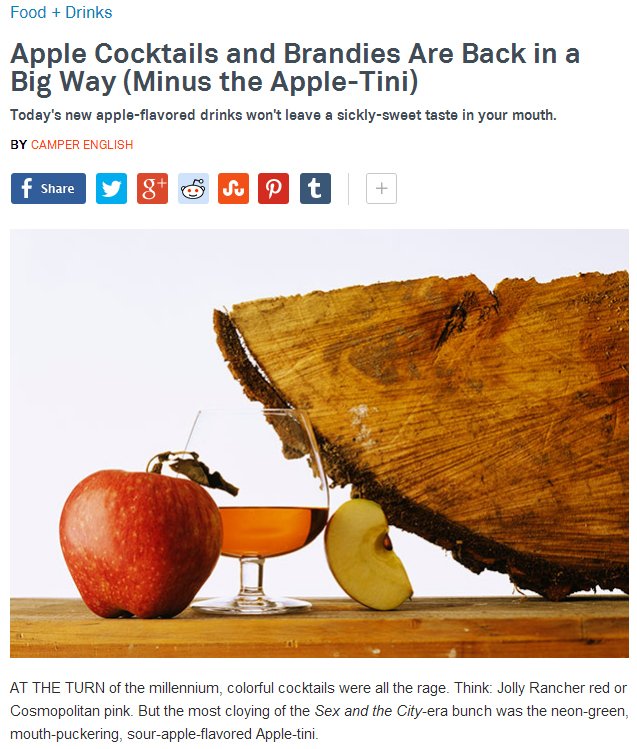
  • All About the Apples (Drinkable Ones, Of Course) on Details.com

    In my latest story for Details.com, I wrote about the return of apples in cocktails and spirits

    The story mentions the return to drinks after the great Appletini shame and lists a ton of mostly-new apple products. 


    Apples

    Check it out here.

  • The US Gin Launch Timeline

    For the purposes of categorizing and tracking the American gin renaissance, I created this timeline of when different gin brands launched in the US, with a number of caveats:

    • GinTimelineScreenShotAs the goal is to closely look at what happened in 1980-2010ish, I didn't include most new brands launched after 2009ish. 
    • The older brand dates may not reflect the real first import date into the US. They are indications that they were probably around a very long time.
    • If the brand reformulated in a meaningful way (ex. Plymouth) I used the re-release date.
    • I have tried to focus on the US, rather than international, release date. 
    • For Type of Gin, I categorized things into Dry, Genever, and Old Tom. I'm not trying to define which are "New Western" or whatever we're now calling the lighter, modern style. Those are labelled as Dry. 
    • This post offers some analysis of the chart and gin history.
    • I cited my sources and have made a strong attempt to be accurate. It is not my intention to misrepresent or disinclude any brand.
    • If you have something to add (missing or incorrect information for brands launched 2009 or before), you can leave a comment below or email me
    • Sorry about the formatting!  


    Gin Brand US Launch Origin Type of Gin Notes Source
    Booths 1740 UK Dry   https://en.wikipedia.org/wiki/Booth's_Gin
    Gordon's Original London Dry 1769   Dry first distillery in US 1934. Looks to have multiple distilleries Wikipedia
    Tanqueray London Dry 1830 UK Dry   Wikipedia
    Boodles 1845 UK Dry First bottled in the United States by Seagram's.  In 2012, redesigned bottle and an alcoholic strength of 80 proof. The botanical recipe remains the same. Has always been made in the UK.

    Wikipedia/PR contact

    According to a former PR employee, "Boodles was invented by the Seagram Company in the 1960’s. I don’t know where the year 1845 came from, but it is nothing to do with any distillery or product launch."

    Seagram's 1857 Canada Dry According to Regan, Seagram's gin wasn't introduced to the US until 1939. https://pernod-ricard.com/551/brands/see-all-brands/local-brands/seagram-s-gin
    Beefeater 1876 UK Dry   Wikipedia
    Boomsma Stirling London Dry 1883 Netherlands Dry   https://www.boomsma.net/
    Bombay Original Dry 1959 UK Dry  Bottle says 1761 Pr Rep 
    Bombay Sapphire 1987 UK Dry   PR Rep
    Cadenhead's Old Raj 1995 UK Dry Launched in UK 1972. "I believe the gin would have been exported to American from around the 1992 to 1995 period." – brand email https://www.the-complete-gentleman.com/SpiritsGinBrandsCadenheadOldRajBlueLabelGin.html
    Bendistillery Cascade Mountain Gin (Crater Lake Gin) 1996 USA Dry Name changed from Cascade Mountain to Crater Lake in 2012. Flavored by post-distillation maceration. email
    Junipero 1996 USA Dry   anchor website
    Citadelle 1996 France Dry 1994 in Europe pr rep
    Tanqueray Malacca (defunct) 1997 UK Dry 1997-2001, then a special edition in 2013 https://en.wikipedia.org/wiki/Tanqueray
    Plymouth Gin 1998 UK Dry Launched in 1793. Reformulated and relaunched in 1990s. Regan
    Beefeater Wet (defunct) 1999 UK Dry   https://summerfruitcup.wordpress.com/tag/beefeater-wet/
    Van Gogh 1999 Netherlands Dry "released in 1999" Regan pr rep
    Bardenay 2000 USA Dry   brand rep
    Tanqueray No TEN 2000 UK Dry   Regan
    Hendrick's 2000 UK Dry   brand rep
    Broker's 2001 UK Dry Broker’s was originally launched in 1998 and it was introduced into the U.S. Market in 2001 PR Rep
    Hampton's 2001 USA Dry   Regan
    Leopold's American Small Batch Gin 2001 USA Dry   Distiller
    Juniper Green Organic London Dry 2002 UK Dry Launched in UK in 2000. importer email
    Martin Miller's 2003 UK Dry UK launch 1999 https://www.martinmillersgin.com/the-gin/
    Sarticious (Defunct) 2003 USA Dry closed but Blade Gin is same recipe made at another distillery brand rep
    Magellan Blue Gin 2003 France Dry   brand contact
    Martin Miller's Westbourne Strength 2003 UK Navy Strength   pr rep
    CapRock Organic Dry 2004 USA Dry "Peak Spirits founded in 2004" Regan Regan
    209 Gin 2005 USA Dry   Distiller
    North Shore Distiller's Gin No 6 2005 USA Dry "north shore distillery est in 2004" Regan distiller
    Zuidam Dry 2005 Netherlands Dry   brand material
    Zuidam Genever 2005 Netherlands Genever   brand material
    Aviation 2006 USA Dry   Distiller
    Bluecoat American Dry 2006 USA Dry   Regan
    Death's Door 2006 USA Dry   Owner
    DH Krahn 2006 USA Dry   https://martini-lounge.blogspot.com/2006/11/dh-krahn-gin-launches.html
    G'Vine Floraison 2006 France Dry   Brand rep
    Rogue Spruce 2006 USA Dry started getting awards in 2007 https://www.grizzlyliquor.com/Packages/Gin/Gin03.htm
    Bulldog London Dry 2007 UK Dry Offices in NY Regan
    Dry Fly Washington Dry 2007 USA Dry "first distilled in Sept 2007" Regan Regan
    Greylock Gin 2007 USA Dry Distillery launched in 2007, not positive about gin. https://berkshiremountaindistillers.com/about-us/about-berkshire-mountain-distillers/
    New Amsterdam 2007 USA Dry   Camper notes
    Rehorst Premium Milwaukee 2007 USA Dry "Opened in 2006" Regan https://www.jsonline.com/business/29543669.html
    Right Gin 2007 Sweden Dry https://altamarbrands.com/our-brands/right-gin/essential-facts/ their website
    Tanqueray Rangpur 2007 UK Dry   Regan
    Genevieve 2007 USA Genever   Regan
    Hayman's Old Tom 2007 UK Old Tom   https://imbibemagazine.com/Old-Tom-Gin
    Blade – Rusty Blade 2008 USA Aged   brand rep
    Citadelle Reserve 2008 USA Aged   pr rep
    12 Bridges (defunct) 2008 USA Dry distillery closed in 2012 https://www.the-complete-gentleman.com/SpiritsGinBrands12BridgesGin.html
    G'Vine Nouaison 2008 France Dry   Brand rep
    Knickerbocker Gin 2008 USA Dry   https://www.mlive.com/kalamabrew/index.ssf/2008/12/_holland_more_new.html
    Organic Nation Gin (defunct) 2008 USA Dry   https://www.organicnationspirits.com/about/
    Whitley Neill 2008 UK Dry "launched sept 2005" in UK brand rep
    Bols Genever 2008 Netherlands Genever   PR
    Boomsma Fine Young Genever 2008 Holland Genever 1883 founded. On US market by 2008 but date may not be exactly correct. https://www.boomsma.net/
    Beefeater 24 2009 UK Dry   Wikipedia
    Blade Gin 2009 USA Dry Same recipe as Sarticious brand rep
    Damrak Amsterdam 2009 Netherlands dry   Regan
    Greenall's Original London Dry 2009 UK Dry 1761 Launch Regan
    Nicholas 2009 USA Dry "first bottle born on april 24, 2009 at 10pm" Regan Regan
    Oxley 2009 UK Dry   brand material
    Port of Barcelona (defunct?) 2009 Spain Dry   https://martini-lounge.blogspot.com/2009/05/review-port-of-barcelona-gin.html
    Ransom Old Tom 2009 USA Old Tom "first batch bottled March 2009" Regan Regan
    Cold River Gin 2010 USA Dry   https://stuffboston.com/2010/10/04/original-gin#.U3p839JdX4U
    Nolet 2010 Netherlands Dry   PR Rep
    Bloom 2011 UK Dry launched in UK 2009-2010 https://www.the-complete-gentleman.com/SpiritsGinBrandsBloomGin.html
    Bols Barrel Aged Genever 2011 Netherlands Genever   PR Rep
    Bombay Sapphire East 2012 UK Dry   pr rep

    The Regan cited as a source is gaz regan's Bartender's Gin Compendium, which has collected information from many gin brands. 


    This post was assembled with the support of Anchor Distilling, makers of Junipero gin and Genevieve genever-style gin. 


  • A Cocktail Meant to Taste Like Money

    The winning cocktail of the 2014 Bombay Sapphire Most Imaginative Bartender competition was Remy Savage of Little Red Door in Paris. His drink, the Paper Anniversary, contained just three ingredients: gin, saline solution, and "paper syrup."

    The homemade paper syrup specifically was meant to reference the government bank notes that were once printed at Laverstoke Mill that Savage had visited earlier in the week. That former mill is the future home of the Bombay Sapphire distillery. (We toured the site and I'll report on that in a later post.)

    For his final drink, Savage was able to source actual bank notes printed at this mill and use them as a garnish. 

    WMIB 2014 Remy Savage (FRA) - Semi-final

    As this was the World's Most Imaginative Bartender contest, the 14 international competing mixologists were encouraged to take inspiration from their visit to England and use it in their cocktail. Other contestants used the taste of British things we'd experienced like tea and jams, or they mimicked the vapor infusion process through which Bombay Sapphire is made.

    Savage used the idea of the printing mill and the smell of books to inspire his paper syrup. He said, "I tried to think of what paper smells like. The challenge was to go from a smell to a taste." 

    His paper syrup contained a base of caster sugar and water, to which he added vanilla, fresh cut grass from outside the hotel, gentian root and (gentian-rich) Suze liqueur, and Laphroaig 10 year scotch for a touch of woody peat. I tried the drink and it was really quite close to paper – the sweet grassy vanilla on entry that quickly faded to a woody dryness from the gentian. Brilliant. 

    The dash of saline solution he says is a common touch they use at Little Red Door to kick up the flavor of cocktails. In this competition rather than a water or neutral spirit base, he used a base of Bombay Sapphire. 

    Paper Anniversary
    By Remy Savage of Little Red Door, Paris

    • 45ml – Bombay Sapphire
    • 15ml – Homemade paper syrup
    • 1 dash – Salt solution

    Stir all ingredients with ice and strain into a cocktail glass. 

    Paper Syrup:

    For 800ml of syrup: 

    • 550g caster sugar
    • 500ml of delicious parisian water
    • 2 vanilla pods

    Cook gently until it the sugar is dissolved. When it has cooled, add:

    • 60ml of Suze liqueur
    • 30ml of Laphroaig 10-year scotch
    • 3g of dried gentian root
    • 15g of clean fresh cut grass

    Let infuse for 24 hours and filter syrup. 

    I'll post more about the contest and the other drinks the bartender created as soon as I get hold of all the recipes. There was a terrific diversity of flavors and styles that came from this contest challenging bartenders to use their imaginations. 

    WMIB 2014 Remy Savage (FRA) - Final Cocktail_Paper Anniversary_Portrait


  • How to Carve Up an Ice Block, Tools to Use, and Making Clear Ice at Home

    There is a lot of ice awesomeness on one page of Saveur magazine's website. 

    In the June/July Drink insert in the magazine I wrote a story on how to break down an ice block into big cubes, spheres, spears, cobbler, shaved, crushed, and other ice shapes. 

    Feature_Super-Cool_Ice-2_1224x533

    Instructions are on the page, along with a very brief history of the ice trade. 

    To accompany the story, Richard Boccato from Hundredweight Ice in New York went to the Saveur studio and broke down an ice block.

    The pieces of ice he made are shown in the images above (and there are a lot more on the site). Saveur also made a lovely video of the process. Here's a still from the video:

    Ice video

    You can see his techniques and tools in the video, plus it's just pretty. The video is at the bottom of this page


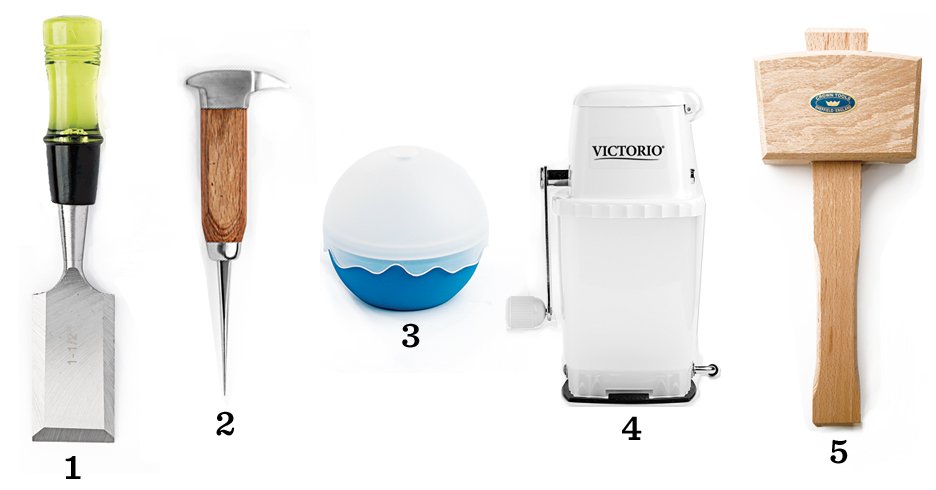
    Then, on another page I suggest some ice tools to buy. The chisel was Boccato's suggestion. I'm getting used to using it still, but it makes sense. 

    Sidebar_ice_tools_936x468


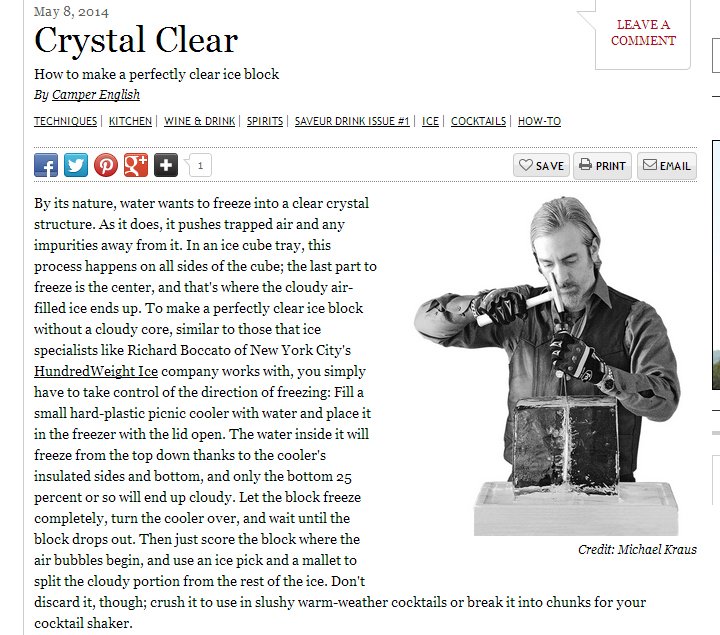
    Finally, I also describe how to make clear ice at home.

    Of course, you've probably already read how to do that here on Alcademics


    Make clear

    So that should satisfy your ice needs for today. 


  • Regional Airline Mini-Bottles in Saveur

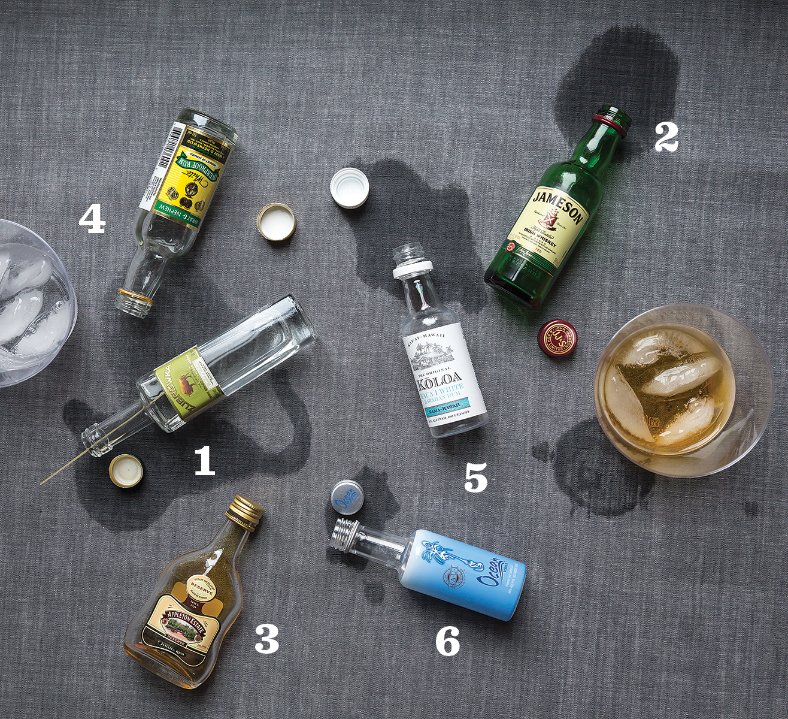
    In the June/July Drink insert in Saveur magazine, I have a bunch of small drink stories. 

    One of them was inspired by my small obsession with airline drink menus, and it's called Sky High

    Feature_sky-high_1200x1316

    It's about how you can sometimes find interesting regional spirits on regional airlines. It was surprisingly hard to track these down and sometimes it was chasing a moving target as airlines changed from one spirit to another. 

    Anyway, give it a read


agave alcademics alcohol Angostura bartenders bitters bodega bourbon bowmore Campari Camper English chartreuse clear clear ice cocktail cocktail powder cocktails cognac colored ice curacao dehydrated dehydrated liqueurs dehydration directional freezing distillery distillery tour distillery visit france freezing objects in ice gin hakushu harvest history how to make clear ice ice ice balls ice carving ice cubes ice experiments jerez liqueur makepage making clear ice mexico midori orange orange liqueur pisco potato powder production recipe Recipes rum san francisco scotch scotch whisky sherry spain spirits sugar sugarcane sweden tales of the cocktail tequila tour triple sec visit vodka whiskey whisky