Blog

  • Distillery Visit: Bushmills in Ireland

    A while back I enjoyed a brief visit to the Bushmills Irish Whiskey distillery, located at the northern tip of Northern Ireland. 

    Bushmills map
    Bushmills is located super close to the Giants' Causeway, a natural phenomenon that brings tons of tourists through town every day. Pretty much all the tours also stop at Bushmills, whether that's for a full distillery tour or just a meal in the visitors' center restaurant. 92,000 people visited the distillery in 2012.  

    Bushmills barrels

    Bushmills doesn't have column stills; all the whiskey made here is triple distilled from 100% malted barley. (Thus the same as single-malt scotch except that it's distilled an additional time.)

    The barley for Bushmills is grown in Cork, down in the south of Ireland. It is malted  and ground into a grist. The water for fermentation comes from a tributary of the Bush River nearby. 

    Like single-malt scotch, the malted barley has added hot water to it in a mash tun, and then its drained. This is to keep the fermentable sugars in the water but get rid of the solid bits that gum up the works. It is transferred to a wash back, where it is fermented with brewer's yeast for about 50 hours. The resulting beer is around 8% ABV.
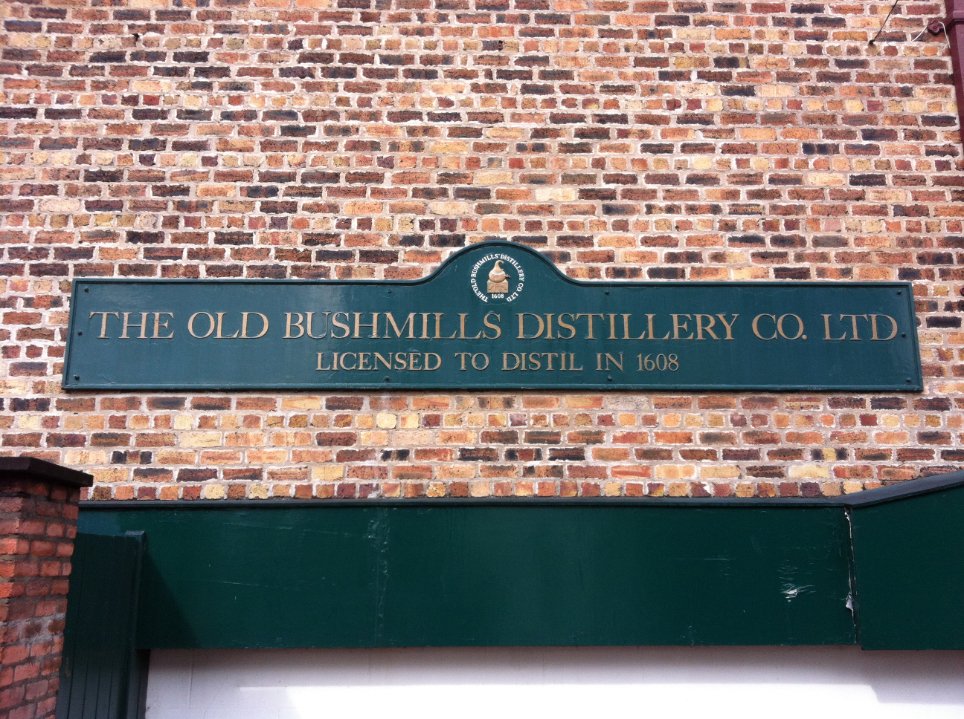
    Bushmills sign

    The beer is then distilled. Bushmills has 10 pot stills (2 wash stills and 4 each feints and spirit stills) in a surprisingly small, crowded room. According to my guide, the whiskey is distilled up to 25-30% ABV on the first distillation, then 70% and 84% after the second and third distillations. 

    Like scotch whisky, they redistill the heads and tails in the next batch so there is no waste. The "pot ale" that is the leftover stuff from the first distillation is made into a syrup and sold for animal feed. The spent barley grain is also sold for animal feed, as it is at most grain distilleries. 

    The water used to dilute the whiskey to final bottle strength is reverse osmosis-filtered municipal water. They put whiskey into the barrel at 63% ABV.
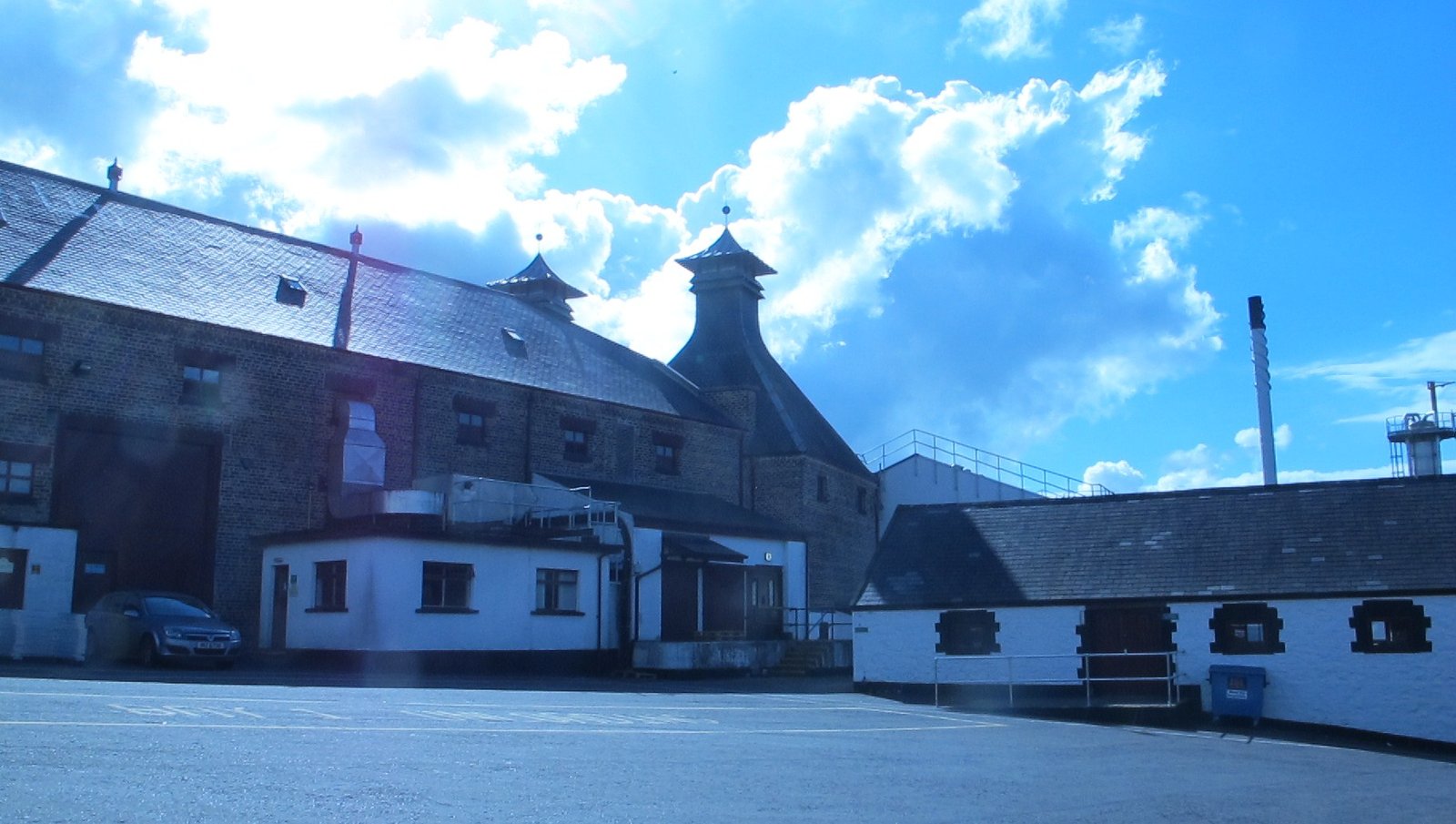
    Bushmills3

    Four different types of barrels are used to age Bushmills: ones that formerly held bourbon, oloroso sherry (from the Paez bodega), port, or Madeira. They said they reuse their ex-bourbon barrels 3 times before they're no longer useful.

    While Irish whiskey by law must be aged a minimum of 3 years, the youngest Bushmills is aged for six, and Black Bush is aged for eight. Both the Original Bushmills and Black Bush are blended Irish whiskeys; made with a blend of triple distilled malt whiskey produced on-site and column distilled whiskey purchased from Midleton (but aged on-site here at Bushmills).
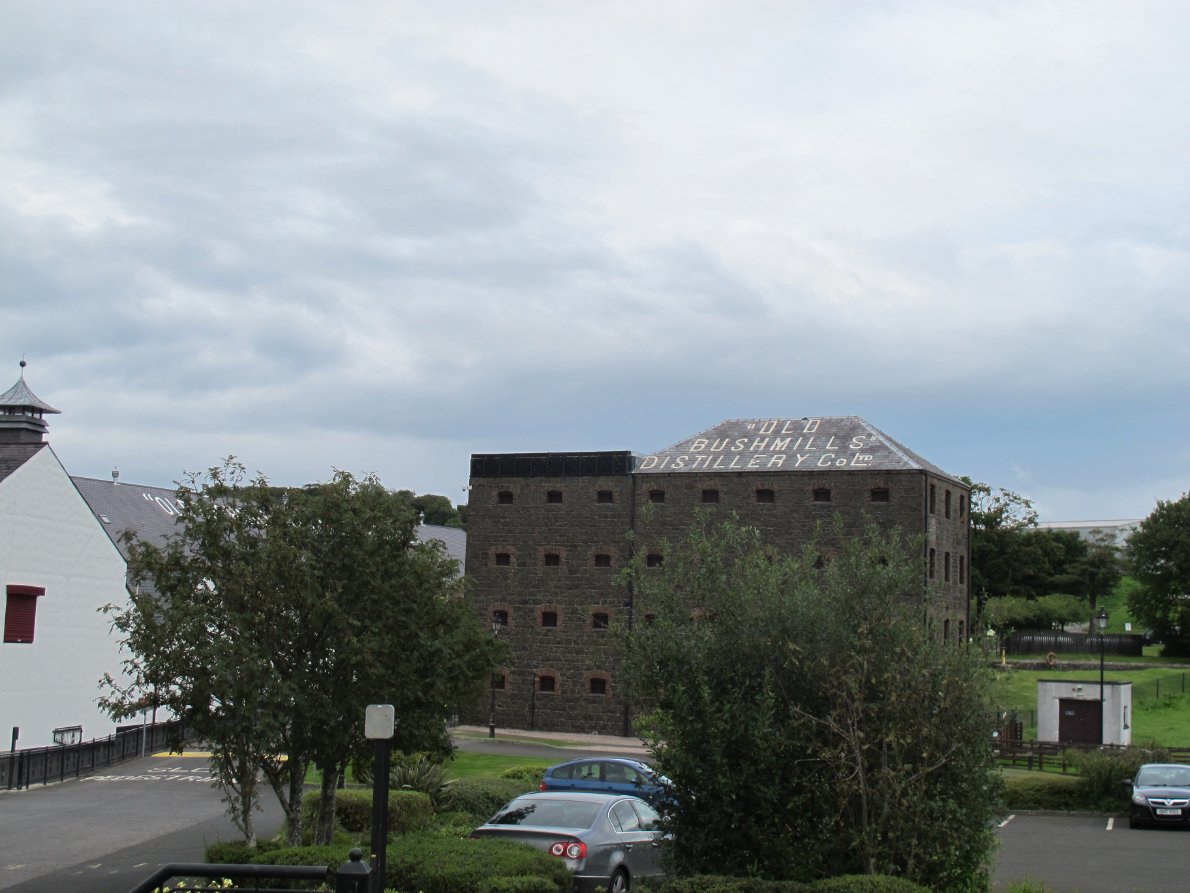
    Bushmills6

    Original Bushmills is 55% single-malt and 45% grain whiskey.

    Black Bush is about 80% single-malt and 20% grain whiskey. It is aged in around 70% ex-sherry casks and the rest in ex-bourbon.  

    The rest of the line are single-malts.  The 10-year-old is about 90% ex-bourbon aged, with the rest sherry. 

    The 16 year old Bushmills is aged in bourbon and sherry casks in equal volumes. Then the whiskey is blended and finished in ex-oirt barrels fro 6-9 months. 

    The 21-year-old is also made up of whiskey aged in bourbon and sherry casks for 19 years, then finished in Madeira casks for 2 years. 

    All Bushmills is bottled at 40% ABV and chill-filtered. The only exception to that was the 1608 that is no longer available. 

    Bushmills sells around 880,000 cases annually, with the US its biggest market. They have 80 acres of land on which the barrels age. As it's such a small distillery, they distill 24/7 throughout the year with the exception of 2 maintenance periods. 
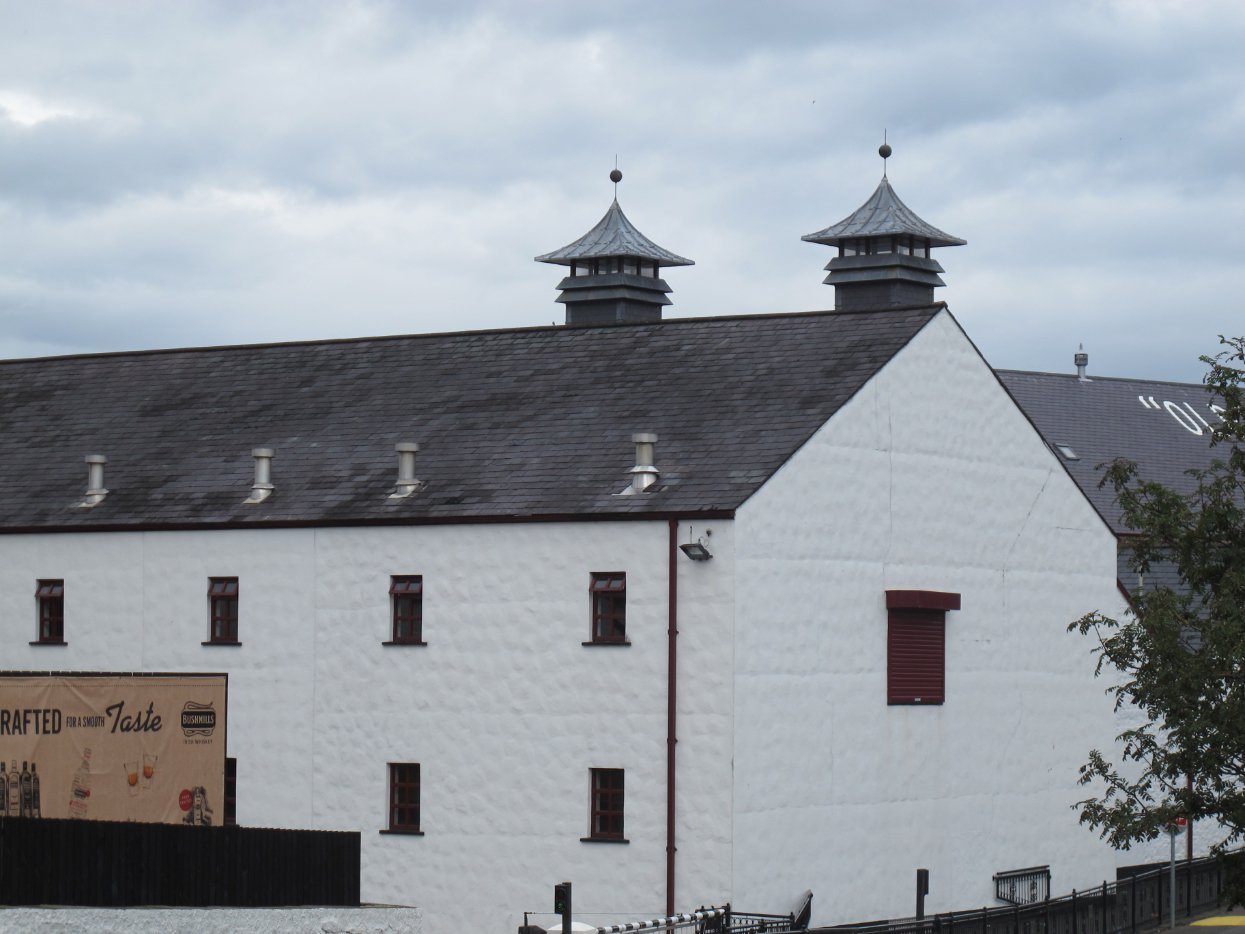
    Bushmills7
    No pictures were allowed inside the distillery, sorry for the lack of razzle-dazzle. 


  • Why Add Sugar to Rum When it’s Made from Sugar in the First Place?

    As mentioned in yesterday's post, rum is distilled from any sugar cane derivative like fermented fresh cane juice or molasses. But some producers add sugar to their finished rum after distillation.

    Sugar1

    Adding sugar to any spirit can soften it and hide some flaws, but if you look at the (allegedly) sweetened rums in this post on RefinedVices.com, you'll notice two general patterns among the rum bottlings that allegedly have sugar added:

    1. They come from big companies that shouldn't need to add sugar to cover a bad distillate. They know how to distill.
    2. They're aged rums, rather than white rums. 

     Well it turns out that adding sugar to spirits also gives them the guise of age.

    Ian Burrell, global rum expert and founder of Rum Experience, commented on the original Facebook post of the sugar values with some really interesting information. He wrote: 

    I recently did a private tasting for 50 consumers with two rums both finished in sherry casks. One was notably sweeter than the other. When I asked the guests to let me know which they felt was the oldest, 80% said the sweeter one. When I asked which they prefer 60% said the sweeter one.

    I then gave them a 3rd rum, which they were unaware was actually Rum no.1 (the dryer rum) with a touch of sugar added to it. All agreed that this was the best rum of the three.

    I then pointed out that Rum number 3 (which was in fact the OLDEST RUM) was the Rum no 1 with sugar added, and that they had perceived the added sweetness as extra aging and smoothness.

    These rums with high levels of sugar added to them are what I call "Dessert Rums" but they still and will always have a place on our bars, restaurant and spirit cabinet because consumers will buy rums (& other spirits) according to how they taste and not how they are made. But WE must educate them, when feasible, that part of the taste that they are appreciating is the added sugar, wine, vermouth, spice, etc.

    What was really interesting about my exercise with the 50 tasters was the ones that preferred the dryer rum also liked whisky. While the “sweeter loving” rum drinkers like cognac.

    That last dig on cognac drinkers? It's because cognac also has a dirty secret: much cognac has sugar added to it too. 


  • How Much Sugar is Added to your Rum?

    It's a funny thing about rum: It all is distilled from a fermented sugar cane derivative (fresh cane juice, molasses, or something in between), but sugar doesn't pass through the distillation process, so some producers add sugar back into the distilled rum to sweeten it up.

    Recently on Facebook, people have posted lists of sugar levels in commercial brands of rum. One reportedly comes from the Finnish government and another from the Swedish government. I won't post them directly here but the lists are here on RefinedVices.com.

    You should really take a look. They show commercial brands of rums with anything from 0 grams/liter of sugar added up to 46 grams per liter.

    **Note – You should verify the content against the originals. The Swedish government's site is: https://www.systembolaget.se (thanks Magnus!) and the sugar content is listed for some individual products. I don't know about the other list so I can't verify its authenticity nor how current either of the lists/measurements are. Furthermore, I do not know if the rums we get in the US are the same as in other countries, even if the labels match.  In other words, do not treat those lists as absolute truth. 

    But how much sugar is that really?

    Allegedly, specific bottlings of rum by brands including Plantation, Bacardi, Zacapa, and Angostura contain between 17-22 grams of sugar per liter. This looks to be the average amount of sugar added by those brands that add sugar. Other brands are either much higher (40 g/l) or quite low (5-9 g/l). 

    So I wanted to know how much sugar is 20 grams and how sweet that makes a liter of liquid taste. So I measured it. My scale isn't the most accurate thing in the world, but here's how 20 grams came out:

    Sugar1

    Sugar2

     Which comes out to a heaping half ounce, or probably a little under 3/4 ounces. 

    Sugar3

    Heck, it's not uncommon for there to be that much sugar added to a single cocktail. And keep in mind that's the quantity for a full liter of rum, not 750 ml bottle.

    I then added the sugar to 1 liter of water to see how sweet it was. In water, it was certainly noticeably sweet, but not soda-sweet. 

    For example, the driest soda I can think of is Q Tonic's grapefruit, orange, and lemon sodas. They have 13g sugar per 8 ounces, which by my calculation means 55 grams of sugar per liter; more than twice as much as is these rums. 

    I'm not saying that you want your rum as sweet as Coke, nor you necessarily want any sugar added to your rum at all. But for these rums having what sounds like a lot of sugar added to them, it's not really a ton. 


  • Buffalo Trace: A Second Visit to the Distillery

    On my last visit to the Buffalo Trace distillery in Kentucky, I took a very cool tour of the property that you can read about at that link.

    On a visit this past February as part of the Bourbon Classic event in Louisville, I had another tour that was completely different and I learned all new stuff. I never mind going to distilleries multiple times as there is always something new to pick up. 

    Buffalo Trace Distillery window view2

    Below are just some miscellaneous facts I picked up, rather than the whole picture. 

    As it has been operating since 1787, Buffalo Trace is the oldest continually operating distillery in the US. They have 100 buildings on a property that stretches 130 acres, with 320,000 barrels aging on-site.

    Buffalo Trace Distillery outside

    Buffalo Trace makes 17 bourbons at the distillery (plus a few other products), distilling five days a week. Despite this, they use just one strain of yeast for all their products. 

    Buffalo Trace Distillery lineup

    In the fermentation process, 2/3 of the mash is 'sweet mash' that has just been fermented, while the remaining third is 'sour mash' that comes as the waste solids of the first distillation. 

    Buffalo Trace Distillery fermenter

    They use four water sources: spring water, reservoir water, river water, and municipal water. The first waters are filtered through sand and used in fermentation. The river water is also used in cooling after distillation (I'm guessing unfiltered). The municipal water is reverse-osmosis filtered to bring spirits down to bottle strength, as is the norm. 

    Buffalo Trace Distillery column still

    There's always more to learn on future visits…

  • How to Pack Liquor in your Luggage

    I travel an awful lot and most of the time I'm bringing packing at least one bottle of liquor with me. (My record was 7 full bottles.) You can read about how much liquor you can pack in your luggage here, which differs per airline. 

    I've never had a bottle of wine or spirits break in my luggage, and I'll chalk that up partially to good luck and partially to good packing. 

    How to Pack Wine or Spirits Bottles in your Luggage

    Mini-bottles go in your shoes. Most people probably don't carry as many mini-bottles and flask-sized samples as I do, but if that's the case there is all that space inside your shoes just waiting to be filled. 

    IMG_7745

    Wrap your bottles in a plastic bag. I usually travel with extra-large Ziplock bags – they don't take up any space in your luggage. Even if I forget, I always carry several plastic grocery bags that I use to hold my dirty clothes and I'll use one of those. Or finally if I don't have one handy (or my clothes are so incredibly stinky that I won't let them roll around in my suitcase), I'll use the hotel's garbage bag or laundry bag hanging in the closet. 

    There are two reasons to use a plastic bag and to wrap the bottle tight. Bottle breaks are the obvious one, but a more common problem is leaks. Bottles with corks and even screwcaps quite often leak a little bit or a lot- especially when they go into the low-pressure cargo hold in an airplane.

    One friend who frequently transports open bottles recommends using plumber's tape on all the caps to seal them. 


    • IMG_7751
    • IMG_7757
    • IMG_7753
    IMG_7753


    Pack Your Suitcase Mostly Full. I am a proud over-packer so my suitcase is nearly always full. Even if you're not, you don't want bottles rolling around, shifting, or banging into each other. Don't pack it burstingly full, of course, because you need room for the bottles.

    Suitcase not full? Then fill the extra space with bubble wrap that you'll use around your bottles on the way home. 

    Pad the Suitcase. If your bottles are right up against the side of your suitcase, they're more likely to break when it gets tossed around by luggage handlers up against hard and soft surfaces.

    My suitcase has space in the top flap for hanging shirts (a built-in suit bag) so that side has built-in coverage. On the bottom of my suitcase right in the middle I'll put any books or magazines I've picked up or finished on the trip, followed by a layer of something soft if I have it. If I have a ton of paper literature I put the rest of it in the outside flap of the suitcase – it not only forms more padding there, but if my luggage is overweight I can throw out or carry-on those papers/books.

    IMG_7765

    Wrap the bottles in pants or sweaters. I have always assumed that when bottles break in luggage it is at the neck, but a survey of my other booze-hauling friends suggests that it's usually the sides that break instead. Regardless, wrap your bottles in heavy material. I typically use jeans, start by wrapping one leg around the neck, then keep wrapping around the bottle. If I don't have any pants available I'll wrap the bottles in t-shirts instead. Or if I have plenty of clean stuff I'll do a t-shirt then a pair of jeans. 


    • IMG_7768
    • IMG_7767
    • IMG_7761
    IMG_7761


    Put a barrier between bottles. You don't want them knocking into each other. Flip-flops are great if you have them since they're foam. 

    IMG_7770

    Pack around the sides. Fill in the rest of the space with your remaining items, making sure to put something at the top and bottom of the bottles. Most often I'll have my dirty clothes bag(s) on one side and shoes on the other. Then a lot of little stuff, toiletries, etc in all the corners. 


    • IMG_7771
    • IMG_7773
    IMG_7773


    Other considerations:

    Room for More. When I'm not sure if I'll run out of space in my luggage for bottles I'll find at my destination, I put a zipper-closed canvas bag in my luggage. That way if I bring home a ton of booze, I can put the extra dirty clothes and toiletries into the zipper bag and check it on the way home. 

    Consider the weight. A full 750 ml bottle of liquor weighs a little under 3 pounds (1400 grams). The weight limit on most checked luggage is 50 pounds. 

    Duty-Free Liquor. If you plan on buying your booze in duty-free, you may have to pack it into your luggage anyway. For example if you're flying into the US and transferring planes, you'll have to check the duty-free items into your luggage at the transfer airport.  That can be a real hassle if you don't plan for it. 

    I prefer to buy my liquor at a store while I'm traveling instead of duty free just for this reason, and more often that not the sale price at duty-free isn't that good anyway. That said, you can get some cool collectors bottles not available anywhere else in duty-free.

    So the best thing to do if you plan to shop duty-free and know you'll have to repack it is to pack your luggage as above with a big hole in the middle where you'll put your bottles. Fill that hole with bubble wrap and bags so they're easy to access when you have to repack your suitcase on the floor of the airport.

    Bottle Transport Bags and Tools

    Some commercial products are meant to take care of the padding and bagging part of this. Most have bubble wrap interior, though some have absorbent material like diaper material. Then most have an outer bag that seals so that even if the bottle leaks or breaks it will all be captured inside. One friend said he used a boating dry bag.

    I have not tried the below brands/products, but a few brands available are:

     If this post was useful, you might also want to read:


  • SF Bar Write-Ups: Mikkeller Bar, Brass Tacks, The Cavalier

    For the website WorldsBestBars.com I write up new (good) bars opening in San Francisco. For November I covered:

    • The Cavalier, a fancy hotel bar/restaurant downtown
    • Brass Tacks, the Hayes Valley bar in the former Marlena's
    • Mikkeller Bar, a downtown beer bar where the staff are actually nice

    Screen Shot 2013-12-14 at 1.19.02 PM

    Check out the write-ups here.


  • Syrups are the New Bitters on Details.com

    Have you looked through your December magazines yet? In just about every one that I get (and I get a lot of them), there is a recommendation for a specialty cocktail syrup of one flavor or another as a suggestion for gifting. 

    By the time I noticed this, I'd already written my latest story for Details.com, which we ended up calling Syrups are the New Bitters. It's not to say that you no longer need bitters now that there are more syrups on the market, but rather where once there was a lack of variety of bitters on the market and bartenders turned into entrepreneurs to develop their own brands, now syrups are at that same place. 

    Screen Shot 2013-12-13 at 10.43.37 AM

    I mentioned many brands specializing in syrups dedicated to particular cocktails, seasonal syrups, and a whole section on tonic syrups. 

    Check it out on Details.com


  • Jim Beam’s Newish Distillery Tour

    I've been to the Beam distillery three times now. I wrote about my first visit in 2008 here, with an additional post about the bottling line. Then I stopped by for another brief visit in 2012 where I got a preview of some of the outdoor displays as part of the new visitors' center. 

    In early 2013, I revisited the Jim Beam distillery during my visit for the Bourbon Classic, held in Louisville. In 2014 the Bourbon Classic will be held on January 31 and February 1. 

    Jim Beam Distillery visitors center

    This time, the new visitors' center, called the Jim Beam American Stillhouse, was fully operational and we went on a really cool tour. I'm not sure if this is the same tour offered to everyone or not, but it quite likely was. 

    As I learned on previous visits, the actual distillery is quite industrial and not super pretty, so they built a new microdistillery where they do small batch versions of bourbon. It makes 1 barrel batches at a time. 

    Jim Beam Distillery experimental still

    They took us through a room where we'd put a scoop of grains into the cooker and saw the small column still, so we were able to see the whole production process though not the actual equipment used to produce Beam for the most part. 

    Jim Beam Distillery sample room2

    But anyway, here are some things I learned:

    • The mash is 6% ABV after fermentation
    • They use 41% sour mash. Other distilleries I visited used roughly 33%. I do not know what the difference that makes in the flavor of the final bourbon.
    • The cooked mash goes through over a mile of pipes before fermentation to chill it without using tons of electricity.
    • The fermentation process takes 3 days.
    • Their fermenters are closed-top rather than open
    • The big column still has 23 plates. It is 5 feet wide and 5 storeys tall.
    • They distill to 125 proof in the column still, then to 135 proof in the doubler
    • They fill 300,000 barrels every year and have 1.8 million barrels in storage.
    • They give their barrels a #4 char
    • The whiskey goes into barrels at 125 proof, which is the maximum
    • There are 72 warehouses where they age whiskey, 28 of them are on-site at the distillery

    While this post focuses on production, between the microdistillery, outdoor displays, visitors' center, and new restaurant on site, the Jim Beam distillery has gone from an industrial distillery to a great tourist attraction. 

      Jim Beam Distillery rickhouse

  • Four Roses Bourbon Distillery: A Second Visit

    In 2008 I first learned about Four Roses Bourbon and its history. Then in 2010 I had the chance to visit the distillery and wrote it up here.

    In early 2013 on a trip to the Bourbon Classic event in Louisville I had a chance to visit a second time. These are some notes from that visit. 

    Four Roses Distillery barrels2

    Four Roses fills 280 barrels per day, a drop in the bucket compared with other bourbon brands. 

    Their corn currently comes from Indiana and rye from Denmark. The grains are smashed up with a hammer mill before cooking. In the cooking process first they add corn and cook it, then cool it and add rye, then cool it more and add malted barley.

    They have 23 fermentation vats and ferment for 75-90 hours depending on the season. About 25 to 30 percent of the fermenting mash is "backset" aka "sour mash" – the solids that come out of the still of the previous batch. 

    The water they use comes from the local river, and they have to stop production if the river water gets too low or too hot in the summer.

    Four Roses Distillery fermenters

    They distill it to 132 proof in the column still, then up to 137-140 proof in the doubler (which is like a continuous pot still – see this post for more info).  Unlike other bourbon distilleries I've seen, the doubler at Four Roses looks like a traditional pot still with a lyne arm rather than just an oval container with no swan's neck at all. 

    Four Roses Distillery doubler

    The whiskey is then diluted to 120 proof before aging in the barrel. 125 proof is the legal limit for this. 

    Four Roses Distillery column

    So hopefully with this post, plus the previous ones on blending and brand history, a fuller picture of Four Roses comes to be. 

  • Distillery Visit: Town Branch Distillery in Lexington, Kentucky

    In early 2013 I visited the Town Branch Distillery in Lexington, Kentucky. At the time it was the newest addition to the Kentucky Bourbon Trail.

    My visit was part of the Bourbon Classic, a great event that is taking place in 2014 on Jan 31 and Feb 1. 

    The distillery goes by a lot of names, so let me try to clarify as best as I understand it. The Town Branch Distillery is owned by the Lexington Brewing & Distilling Company, which is a division of Alltech.

    Alltech is a huge international company dealing with yeast and I believe that yeast is primarily used in animal feed supplements. The company was created by Dr. Pearse Lyons, who studied brewing at Guinness and Harp in his early days. So the yeast connection all makes sense.

    Before the distillery part of the operation was created, they began making beer here. The flagship brand is Kentucky Bourbon Barrel Ale, which is aged for six weeks in ex-bourbon barrels. It's only available in a handful of states, and I recommend trying it if you can get your hands on some. 

    Alltech Distillery Town Branch

    Model display of brewery/distillery

    Distilling

    The distillery was added on to the small brewery and is the stills are housed in a glass-walled room with gleaming copper pots.

    With the exception of Woodford Reserve, all the major bourbons in the US are made in continuous column stills.  At Woodford, they distill three times in copper stills. The first distillation primarily separates the solids in the fermented mash from the liquids (alcohol and water), then the second and third distillation separate most of the water and impurities from the alcohol.

    Alltech Distillery Town Branch still room2

    At Town Branch, there are just two pot stills. The reason they don't need a third distillation is that the mash (beer) doesn't contain solids. (Note that in Scotland they also distill twice, but they have a step where they remove the solids from the beer that they don't usually do in the US.) Town Branch uses something called 'gelatinized corn' as a raw ingredient that they don't have to grind up and cook, unlike most distilleries. 

    The Town Branch Bourbon uses a grain recipe of 72% corn, 15% malted barley, and 13% rye. In the fermentation process they use enzymes and after this is done there are almost no solids left in the mash. 

    The Pearse Lyons Reserve in a single malt, so it uses all malted barley. 

    The beer, which is fermented to around 8% alcohol, is distilled to 28-30% on the first distillation and up to 67-68% on second distillation. 

    After distillation, the Pearse Lyons Reserve ages in new barrels, used barrels, and wine barrels. The cool thing about the used barrels is that they were the ones used for the beer, so in fact they were used once for bourbon, then once for beer, then again for the single-malt.

    The Pearse Lyons Reserve single-malt is aged for nearly 4 years, and the Town Branch is aged for 3.5 years at minimum. They also make a coffee-infused bourbon called Bluegrass Sundown. They use this in a version of the Irish Coffee at the on-site tasting room by adding boiling water and cream on top.

    This visit was a great chance to see a small-batch distillery making American whiskey a different way along the Kentucky Bourbon Trail.

      Alltech Distillery Town Branch display

agave alcademics Angostura bartenders bitters bodega bourbon bowmore Campari Camper English chartreuse clear clear ice cocktail cocktail powder cocktails cognac curacao dehydrated dehydrated liqueurs dehydration directional freezing distillery distillery tour distillery visit france freezing objects in ice hakushu harvest history how to make clear ice ice ice balls ice carving ice cubes ice experiments isle of jura jerez liqueur makepage making clear ice mexico midori molasses orange orange liqueur penthouse pisco potato powder production recipe Recipes rum san francisco scotch scotch whisky sherry spain spirits sugar sugarcane sweden tales of the cocktail tequila tour triple sec visit vodka whiskey whisky