Blog

  • Make Easter Egg Ice for Easter

    Check out this post from a few years back on making ice shaped like Easter eggs. 

    Short answer: water balloons. 

    Coloredeggss
    Cleareggss
    Coloredeggsglasss

  • A Visit to the Nordic Food Lab in Copenhagen

    This February I was lucky to be invited to visit the Nordic Food Lab, which is located on a boat floating in a harbor off Copenhagen. It was formerly the research lab of the world's top-rated restaurant NOMA, and I believe they still have a close relationship and work together on projects. 

    The lab is pretty small: A few work tables, refrigerators and cabinets on both sides of the room, and tons of samples in bottles, barrels, bags, and jars everywhere. It reminded me a lot of my apartment, except that the swaying back-and-forth was coming from the water beneath the boat, not the booze in my belly. 

    There I met Ben Reade, a scientist at the lab. He described some of the cool stuff he was doing, such as:

    Going into the Swedish forest and collecting all sorts of possibly-edible plants

    Nordic food lab  meadow sweet
    and doing all sorts of experiments with them, like making tinctures out of them.

    Nordic food lab  tinctures1
    He also brewed beer and added three different levels of (incredibly bitter) oak moss to it so see how it tasted. 

    I'm not sure what they're doing with this drying (boar?) leg, but they're attempting traditional curing/drying techniques. The one on the right is coated with some sort of wax.

    Nordic food lab  wax leg
    He's also working a lot with fermentation. He made a vinegar from fermented elderflower, which led to us having a long discussion on shrubs and drinking vinegars.

    He was also experimenting with kombucha – we tasted a ton of it with different levels of pear juice to seek the optimum amount.

    Nordic food lab kombucha
    He was also aging vinegar in a mini-solera. How much do I want a set of these barrels?

    Nordic food lab  solera vinegar
    At the end of the visit we got to taste some non-sweet sugar with added lactasol (not sure if I am spelling that correctly). It's a chemical that inhibits the perception of sweetness. So the powder we tried is mostly sugar but it tastes like nothing. 

    Therapeutically it can be given to anorexic people mixed with high-sugar foods as apparently they don't want to eat anything sweet, but of course my thoughts went to cocktail applications: a drop of it in a too-sugary cocktail could dry it right up! (Unfortunately he said it's usually only available in massive-sized quantities.)

    Overall the visit was very cool and very inspiring, making me wish I had more space for more experiments at home. 

    You can read about the work being done at the Nordic Food Lab on their research blog


  • A Tribute to Harry Craddock on the 50th Anniversary of his Death

    In January I flew to London for an event to celebrate the life and career of Harry Craddock, author of the Savoy Cocktail Book. The event was sponsored by Plymouth Gin, which is mentioned by name many times throughout the Savoy. 

    The tour was attended by Plymouth's distiller Sean Harrison, the top London bartenders, and a few special folks flown in from around Europe. Just a few of the bartenders presernt were Ago Perrone, Alex Kratena, Esther Medina, Gareth Evans, Geoffrey Cannilao, Stuart McCluskey, and Nick Strangeway. They helped bring over Erik Ellestad from San Francisco; probably the only person to make every cocktail in the Savoy. 

    American Bar head bartender Erik Lorincz came up with the idea initially, and he was joined by former Savoy head bartenders Peter Dorelli, Salim Khoury, and Victor Gower. Gower had actually met Craddock.  To study Craddock's life, they enlisted Anistatia Miller, co-author of the just-released book The Deans of Drink that is about both Craddock and Harry Johnson. Max Warner, on his last day as brand ambassador for Plymouth, helped lead the show. 

    We began at the recently-discovered grave site of Harry Craddock. Craddock died at age 87 in 1963, unfortunately poor despite a life of fame as a bartender. We toasted to him, took a picture, then piled in to vintage cars from around 1930 (when the Savoy came out) to hit a few spots where Craddock worked.


    793893_10151410633746071_488511214_o

    trip photo

    Craddock was born in 1875 in England, but moved to the US in 1897. He worked there at some of the most popular bars including the Holland House, Hoffman House, and Knickerbocker. He was said to have mixed the last pre-Prohibition cocktail in the USA. 

    He left the US after Prohibition and never returned, though he may have made drinks off the coast of New York on a boat (where it was legal) for millionaires at one time. 

    Harry Craddock Tour gravestone

    The American Bar at the Savoy Hotel

    In the early 1900s, despite having "American Bars" (usually denoting the use of ice and serving the fashionable cocktails of the US), the drinking scene was reportedly quite bad. So Craddock's entrance onto the London cocktail scene was a big deal, and everyone loved his American accent. 

    The Savoy had two female bartenders on staff, including the famous Ada Coleman, creator of the Hanky Panky cocktail. According to Miller, Craddock basically got Colemand and another female bartender booted from their positions at the bar, as he didn't believe woman should be doing that job. (They didn't have Speed Rack in 1921.) Craddock took the Head Bartender position in 1925.


    Savoy

    American Bar. Photo from website.

    Craddock became super famous in his job at the Savoy. In 1927, Madam Tussaud's even had his figure in the famous wax museum. That same year, the American Bar at the Savoy was redorated in the Art Deco style. When the did this renovation, Craddock was permitted to bury a cocktail shaker containing his creation the White Lady cocktail in the walls of the bar. 

    Though the bar has been renovated since then, the shaker has never been found. 

    In 1928, the hotel announced that Craddock had collected 2000 cocktail recipes, both originals and ones from other places. Over 1000 of these were published in the Savoy Cocktail Book in 1930. 

    The Cafe Royal

    Craddock never worked at the Cafe Royal, but it did play a part in his history. The Grill Room there had just been restored to its former glory – the room is a hall or mirrors with gold frames and accents, and red furniture. They specialize in champagne and caviar. According the the website:

     It is in this very room that Oscar Wilde fell in love with Lord Alfred Douglas, Aubrey Beardsley debated with Whistler, David Bowie retired Ziggy Stardust and Mick Jagger, the Beatles and Elizabeth Taylor danced the night away.


    Cafe royal7

    Grill Room at Cafe Royal. At right, Erik Lorincz and Peter Dorelli make a cocktail.


    They do not mention that it was from this bar that the Cafe Royal Cocktail Book was launched in 1937. (The book is significant in that it is the first cocktail book anywhere to include a bunch of recipes with tequila- and Margarita by another name is found in its pages.) The book was not actually a list of original recipes invented at the bar, but was a book of recipes from the United Kingdom Bartenders Guild. 

    Craddock was the co-founder and first president of the guild, along with Cafe Royal's head bartender. Thus our visit. 

    Harry Craddock Tour cars2 (2)

    The Dorchester

    While Craddock was still employed at the Savoy, luxury hotel The Dorchester was renovated in 1938, and they asked Craddock to bury a cocktail shaker with drinks in the walls there also. In this shaker, Craddock put vials containing a Martini, Manhattan, and White Lady, along with recipes and a scroll.  When the bar was rebuilt in 1979, they found this shaker and its contents.

    The next year, Craddock left the Savoy after nearly 20 years and went to work at The Dorchester. 

    Though previously there hadn't been much evidence that Craddock had actually worked at the Dorchester, former Savoy bartender Salim Khoury was given a letter written by Craddock to one of his favorite Savoy customers (who didn't live in London) informing him of his move to the new hotel. 

    Harry Craddock Tour Dorchester
    Since this hotel was recent and built of reinforced concrete, it became one of London's safest buildings during the Second World War. Though we don't know for sure that he served them, Winston Churchill stayed at the Dorchester and so did Dwight D Eisenhower. Given Churchill's fondness for booze, the two probably got together. 

    Though Craddock worked at the Dorchester until 1947, he still opened one more bar; a place called Brown's Hotel in 1951. 

    A Third Burial

    Though our town didn't visit that spot, we returned to the Savoy for a final moment. Cocktails were mixed up and poured into vials. The vials were put into a shaker and sealed. And that shaker was buried in a wall in the Savoy Hotel in tribute to Harry Craddock.

    As Max Warner said, Craddock didn't get a grand funeral, but he certainly deserves a grand day of remembrance. 

    Harry Craddock Tour grave51
    Thank you to Erik, Anistatia, Max, everyone else who helped put on the day, and to Plymouth Gin for making it all happen. 


  • Transform Tap Water into Magical Alpine Fairy-Water (Book Excerpt)

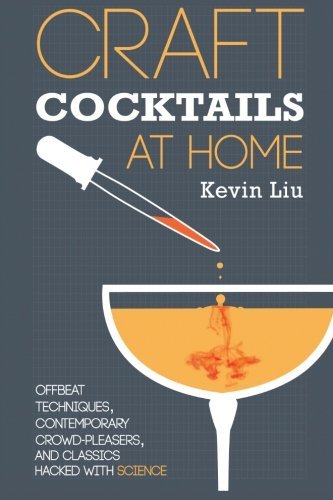
    Craft cocktails at homeToday's post is an excerpt from the new book Craft Cocktails at Home: Offbeat Techniques, Contemporary Crowd-Pleasers, and Classics Hacked with Science by Kevin Liu. 

    The book is heavy on the science, which is awesome. 

    And you can download the Kindle version for free Thursday, February 28 – Saturday, March 2. 

    Liu gave me permission to reprint a huge section on water, which is below. Thanks Kevin! 


    Transform Tap Water into Magical Alpine Fairy-Water

    STOP. Walk over to your sink, pour yourself a glass of water straight from the tap. Taste it. Does it taste delicious? Like fairies extracted dew out of fresh mountain grasses and carried the droplets in tiny hydrophobic blankets to your glass? Then skip this section. You have no reason to start messing around with your water.

    The U.S. Environmental Protection Agency (EPA) actually maintains more stringent requirements for tap water than the Food and Drug Administration (FDA) imposes for bottled water, so if your tap water ain’t broke, you might do more harm than good trying to fix it. BUT if your tap water—like mine—tastes like you’re licking a cast iron skillet with every sip, read on and I’ll show you how to recreate alpine fairy-water out of normal tap.

    Myth: Water should taste like nothing.
    This shouldn’t really come as a surprise to you, but bottled water manufacturers are lying to you. They promote the myth that bottled water is “pure” and that pure water, free from im“pure”-ities, tastes better.

    Ask anyone who’s spent time in a chemistry lab: distilled water tastes nasty. It suffers from two major problems: (1) when air is removed from water, it tastes “flat” and (2) completely deionized and demineralized water is much more able to react with its environment, so it quickly picks up the taste of whatever it’s touching: typically plastic or the chemicals on paper cups (gross).

    It’s not surprising that the most delicious waters in the world all contain signifi-cant amounts of minerals and oxygen. Consider what happens in nature: rain falls on a fairy-mountain. Let’s assume it’s pure at this point. As the water runs down alpine mountain fairy-streams, it passes over rocks and picks up dissolved minerals like calcium, sodium, potassium, and magnesium. And since oxygen is lighter than carbon dioxide, more oxygen gets dissolved in water than carbon dioxide at high fairy-altitudes.

    These facts are not lost on bottled water manufacturers. Read the fine print on your favorite plastic hydration source, and notice how many of them contain minerals in addition to water. Most natural spring waters contain anywhere from 50 to 300 mg/l of stuff other than water, known in the industry as “total dissolved solids,” or TDS. Any water with TDS over 250 can be marketed as “mineral water” in the United States.

    The United Kingdom even requires bottled water to contain minerals –

    “under the UK Bottled Waters Regulations 2007 any bottled water that has been softened or desalinated must contain a minimum of 60 mg/L cal-cium hardness.” 

    When you start dealing with the mass production of water, consistent quality becomes a concern. It’s often easier for industry types to totally distill water and add minerals back into it rather than design filtration processes to produce a specific water profile. This process is called remineralization (more on this later).

    Myth: All bottled waters taste the same.

     In 2001, ABC’s Good Morning America program conducted a blind taste test of tap versus bottled waters. Of the four waters tasted, 45% (the largest group) preferred New York City tap water over bottled brands.

    But what if ABC just got lucky? Tap water can taste great if it comes from a good source and has been properly treated. But it can also easily pick up off tastes along the way from the reservoir to the faucet. New York tap water might start off great at the treatment facility, but the pipes at your house might be contributing metallic or organic off-flavors. Gross.

    Fast forward ten years. In 2009, the investigative journalism organization Mother Jones ran a piece on Fiji bottled water that examined everything about the product from the socio-economic impact the product has had on the small island of Fiji to the brand’s claims that each plastic bottle actually reduces car-bon footprint.

    As part of the research for the article, editor Jen Quraishi conducted a taste test of popular bottled waters using 10 tasters. The results? Volvic mineral water, Whole Foods Electrolyte Water, and unfiltered San Francisco tap came in 1-2-3, out of ten contenders.

    Then, in 2011, the online current affairs Magazine Slate conducted their own blind taste-test of the four most popular bottled waters in the the United States. In their test, not only could the 11-member tasting panel easily differentiate between bottlings, they all clearly disliked tap water and there was a clear win-ner at the end of the experiment: SmartWater.

    Reverse Engineering the Best-Tasting Waters

     I took a look at how each of the bottled waters that dominated these two taste tests are made and made a startling discovery. Both the Whole Foods and SmartWater brands unabashedly admit they contain nothing more than puri-fied tap water, remineralized with a blend of minerals.

    Luckily for me, inquisitive internet-dwellers had already taken the liberty of contacting both Glaceau (the makers of SmartWater) and Whole Foods to as-certain their mineral formulas. Glaceau happily obliged, as did Whole Foods, though the Whole Foods rep cited a total 3000 ppm mineral content that seemed totally off. So I bought a bottle of each and checked the numbers. Here’s all the available data, combined:
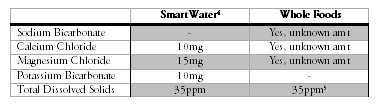
    Chart1

    So in summary, two of the best-tasting brands of bottled water as judged in a blind tasting contained remarkably similar amounts and (probably) ratios of minerals.

    And they’re easy to recreate at home, too. Here are some recipes for water. Ri-diculous? If you think so, you may want to stop this book reading here. It only gets more ridiculous.

    Homemade Electrolyte (Fairy) Water

     1 L Tap Water
    10 g Homemade Electrolyte Concentrate (below)

    Use a reverse osmosis or ZeroWater® filter to produce zero TDS water. Distilled should work too. If in doubt, test your “0 TDS water” with a TDS meter. Add the homemade electrolyte concentrate and shake violently.

    Homemade Electrolyte Concentrate
    1 L Tap Water
    1.50 g Magnesium Chloride
    1.00 g Sodium Bicarbonate
    1.00 g Calcium Chloride

    Use a reverse osmosis or ZeroWater® filter to produce zero TDS water. Com-bine. The mixture will stay cloudy for a while after you add the minerals, though it should clear up in time.

    Notes:
    • Use this concentrate so you don’t have to measure out 10 mg of minerals at a time. That would be annoying.
    • Sodium bicarbonate is nothing more than baking soda. Potassium bicar-bonate can be substituted for people who are sensitive to sodium. Potas-sium bicarbonate is available through beer and wine homebrew stores.
    • Calcium chloride is used both for beer/winemaking and in modernist cooking. Visit retailers who specialize in those ingredients for purchasing options.
    • Magnesium Chloride is available as a dietary supplement. One product I found contained 66.5 mg per 2.5 ml serving, which means you would need 5.7 mL or just over a tsp per liter of water to make Electrolyte Concentrate.
    • Avoid mineral tablets, as these contain binders and anti-caking agents that can affect flavor.


    What Makes Water Taste Good?

     With the exception of magnesium, all of the ions listed in the table above ap-pear in significant amounts in human saliva. However, our saliva’s composition doesn’t at all mirror the ratios presented here. Beyond this simple observation I can only speculate as to why this particular blend of minerals in this concentra-tion tastes especially good.

    One possible explanation may lie in total dissolved solids. I found the following information on a forum post at Home-Barista.com. It quotes the Specialty Coffee Association of America’s (SCAA) Water Quality Handbook:

    The test methodology was blind tasting by six tasters at the SCAA Lab in Long Beach. From page 31:

    “In a tasting conducted by the Technical Standards Committee of the SCAA, coffee was brewed with different levels of TDS to determine if significant flavor differences existed and how much difference actually existed. … The same cof-fee, grind, and brewer were used and the same standard combination of miner-als was used. The only difference was the concentration of the minerals in the brewing water. The first tasting was conducted using three water samples: one contained TDS at a level of 45 mg/L, one at 150 mg/L, and one at 450 mg/L. The coffee that was brewed with 150 mg/L water was chosen as far superior by all who judged the coffee.

    A second tasting was conducted using 125 mg/L, 150 mg/L, and 175 mg/L samples to determine if minor variations in water quality would have an effect on flavor and extraction. The minor changes in the TDS of water were unani-mously discernible by the panel. Acid and body balances were perceived to be off at both 125 mg/L and 175 mg/L TDS, and the 150 mg/L TDS brew was rated superior.”

    So the coffee geeks seem to observe that the level of total dissolved solids is more important than anything else, with no concern as to which solids are actu-ally present. This didn’t make sense to me, so I reached out to a chemical engineer to find out more:

    Joe McDermott on the Taste Chemistry of Water
    Joe is a chemical engineer and a postdoctoral fellow at Harvard University.

    We got in touch because I heard your research area was in water. Tell me about that.

    Sort of—I’m a chemical engineer by trade and my PhD thesis in Chemistry focused on colloidal particles in aqueous systems (the study of tiny stuff dis-persed in liquids). So I know a little bit about water chemistry, but it’s really exciting to be talking about it from the perspective of taste.

    You’ve read through my ideas about making water taste better—what’s your professional opinion?

    What makes water taste good is a really interesting question. From my under-standing of taste receptors, our taste buds are only set up to accept very specific tastes, like sodium chloride for salt or acids for sour.

    I think you’re right that mineral content is important, but I’m not sure why from a taste perspective. My gut instinct is that the cation portion of the min-eral (the positively charged half) has less to do with taste than the anion side. If you look at the periodic table, a lot of the commonly found mineral cations show up really close to each other. There aren’t that many chemical reactions I can think of where Ca+ can’t simply be replaced with Mg+, for example.

    Anions, on the other hand, can vary greatly in structure and complexity. They’re often structured organic molecules. Think about MSG—monosodium glutamate. The anion half is glutamic acid, an important amino acid that serves as a neurotransmitter and has the chemical formula C5H9NO4.

    Why do you think ion concentration is important?

    I work in a world where I need to know how much dissolved ionic material there is in a solution. It matters a lot more than the total dissolve mass because when ions dissolve in water, they change the charge of the water itself, which then changes how particles dispersed in the water behave. In the lab, we deion-ize our water to ensure. But if we get really good deionized water and let it sit out on the counter, it will measure out to 5.6 pH (relatively acidic). That’s be-cause atmospheric CO2 dissolves really readily in water.

    So, does that mean that most water will turn acidic if it’s left out for a long time?

    I haven’t tested this in the lab, but I would think so. In fact, that’s probably one reason why you see sodium bicarbonate (baking soda) or other bicarbonate minerals added to bottle water. Bicarbonates act as a pH buffer—that is, they make it so that it would require more CO2 to dissolve in the water before it actually became acidic. Think of it as insurance for nice-tasting water.

    Here are some rules of thumb for how we perceive acidities found in the normal range for waters.
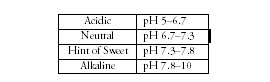
    Chart2

    Resources, Tips, and Tricks
    • You’ll want a digital scale capable of measuring down to 0.01 g (10 mg). Amazon carries many American Weigh models for about $10.
    • My recipe for water is as simple as I could make it and seeks only to make good-tasting water. For many more recipes and resources for reproducing mineral and spring waters with unique taste profiles, see MineralWaters.org, Martin Lersch’s work on mineral water at his blog Khymos, or Darcy O’Neill’s book Fix the Pumps.
    • If you can’t filter your water or create your own magical mineral water, at least let tap water rest for 20 seconds open to air before using. Most tap water is treated with chlorine, but chlorine escapes rapidly into the air, so it’s a good idea to let some of it evaporate off before drinking.
    • Particularly hard water can create unsightly pectin gels or even create a buffering effect that could mess with pH. If in doubt, get a cheap total dis-solved solids meter (about $15 on Amazon) and check your water. When I checked my tap water, it came out to 350 ppm (yikes!).
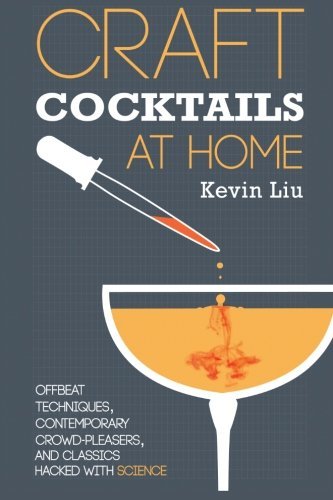
     

    Craft cocktails at homeBuy Craft Cocktails at Home: Offbeat Techniques, Contemporary Crowd-Pleasers, and Classics Hacked with Science by Kevin Liu on Amazon.com. 

  • The Ice King of the Internet

    I was interviewed recently for a story in a magazine for the iPad/iPhone called The Magazine.

    During the interview we were joking that I'm the Ice King of the Internet. The quote didn't make it into the story, but I've adopted that as an official title. Hail your new king! 


    Ice king
    In the story, writer Alison Hallet covers the history of ice in drinks, current ice machines, how bars are using big ice, and how to make big ice at home (with my cooler strategy). I get too much credit for bringing an iceberg from Newfoundland to last year's seminar at the Manhattan Cocktail Classic (that honor belongs to Wayne Curtis), but as long as my glory is increased it is for the greater good.  

    A preview of the story is here, but you'll have to subscribe ($1.99) to get the whole thing. Or sign up for a free 7-day trial, read everything, then decide whether or not to cancel before the week is up. Looks like they have a good amount of booze coverage. 


  • Cocktails in the Champagne Style

    For CLASS Magazine/DiffordsGuide.com, I interviewed Jeff Josenhans of San Diego's US Grant Hotel.

    He's been quietly doing pretty cool stuff over there. He implemented one of the first cocktail herb gardens, has barrel aged cocktails that he is able to sell commercially, and now features the "Cocktails Sur Lie" program. 

    IMG_7075_tn

    Cocktail ingredients (minus the base spirit) are fermented like wine, then put into champagne bottles and fermented a second time like champagne. Then they pop off the caps to get rid of the yeast and add base spirit in the 'dosage' step. 

    As he partnered with a winery production center, he now has the winery do the production work after he develops the recipes, which not only ensures consistency in the bottled beverages, but they can legally sell them at retail. 

    A truly clever part of this system is that the hotel does tons of events, and having these fancy bottled cocktails that pop open like champagne allows them to serve the same quality cocktails as you'd find in the bar at the events- just pop off the cork. 

    Read the interview here


    Grant grill1_tn

    (normally the bottles have a cork unlike in this picture)


  • The Wide World of the Ward Eight

    In my latest column for FineCooking.com, I talk about how the Ward Eight cocktail is everywhere these days. 

    You know how you learn the definition of a word and then suddenly you keep hearing that word everywhere? Over the past month it has been that way with me and the Ward Eight cocktail. 

    I had just finished reading the book Drinking Boston: A History of the City and its Spirits by Stphanie Schorow, in which the author spends a great deal of time discussing this drink and its history. The Ward Eight is the most famous classic cocktail from Boston, supposedly invented at the Locke-Ober restaurant in 1898. 

    In trying to verify the date of the drink's creation, Schorow studies the history of grenadine, the pomegranate syrup used in the drink. It was a new ingredient in America right around this time.

    Coincidentally, I was also studying the history of grenadine on my website. I performed a literature review and drew some conclusions, including the surprising finding that grenadine has been made as an artificially flavored cocktail ingredient forover 100 years!

    In another coincidence, two of my favorite drink writers also decided to look into the Ward Eight in the January 2013 edition of magazines. Historian David Wondrich took a look at the cocktail's history in Imbibe magazine, and writer Wayne Curtis covered the drink in searching for the quintessential New England cocktail in Yankee magazine. 


    Ward eightM

    I went to look up a recipe to put on the post on Fine Cooking, and found that the Ward Eight recipe is different in nearly every book. 

    The simplest is just rye, grenadine, and lemon juice. The most complex is those ingredients plus mint, bitters, and simple syrup. 

    So I settled on a common recipe with rye, grenadine, lemon, and orange juice. Get the recipe here.


  • A Sampling of Sugars from Asia

    Last year at Tales of the Cocktail I gave a talk along, with David Cid of Bacardi, about sugar, syrups, and rum. A detailed write-up of that talk is on the blog Commercial Free Cocktail.

    As part of that talk, I passed around a ton of samples of sugars to taste. Most of these sugars were purchased in Singapore by Michael Callahan, bar manager of 28 HongKong Street. He carried a full suitcase of them for me, so he is awesome. Many of the sugars were taken home by seminar attendees (I encouraged it), or were no longer transportable, but seven of them made it back home with me.

    For those of you not there to taste them in person, I wanted to write them up. It just took me five months to do it. Here are a few notes on the sugars.

    Sugar1

    Japanese Wasanbon Sugar

    This is the famous Japanese wasanbon sugar. I picked up this packet in Japantown in San Francisco. It is labelled as "Baikodo Wasanbo". Here is some information about wasanbon sugar.

    Wasanbon sugar is widely used in the world of Japanese sweets.
    Wasanbon is a domestically produced light yellow sugar that is
    made through a traditional Japanese manufacturing process
    and a particular specialty in the Shikoku region. As wasanbon
    sugar is made entirely by hand and the process is quite
    detailed, mass production is impossible. Due to this and other
    reasons, the price is higher than for ordinary sugar. The raw
    material is chikuto, a kind of sugarcane with a thin stem, and
    the manufacturing process is as follows :
    -Squeeze the liquid out of the chikuto using a squeezer and
    make shiroshita by boiling the liquid down.
    -Put the shiroshita into a big "boat" the size of a tatami (rush-
    mat), and knead it while adding water.
    -Put the kneaded shiroshita into a bag made of hemp on the
    outside and cotton on the inside and wring it.
    -Place the entire bag into a "pressing boat" made of wood,
    hang weights down from the tops of the cabers and apply
    pressure via the principle of leverage.
    -When pressure is applied, molasses is generated from the
    shiroshita. Place the shiroshita remaining in the bag, not
    the squeezed molasses, into the "boat" again and repeat the
    same process three to five times. The shiroshita remains in
    the bag, and is sifted through a sieve after being dried.

    Wasanbon sugar crystals are fine, smooth and soft and melt
    in the mouth while generating an elegant sweetness. In the
    world of Japanese sweets, the taste of sugar is the life of the
    sweet and is a treasured part of all Japanese sweets.

    That information comes from this PDF document, which sugar nerds should definitely read. 

    Tasting Notes: This stuff is delicious. It is soft and powdery and instantly melts on the tongue with a burst of beautiful pure sweetness and a slight afternote of molasses that you want more of (and I kinda hate molasses). Harmonious.

    Sugar2
    Taikoo brand Okinawa Style Natural Black Sugar

    From the back of the package:

    Taikoo Okinawa Style Natural Black Sugar is made from renowned Japanese sugarcane adopting the traditional Okinawa style of production. It is rich in the aroma of sugarcane and suitable for people from all age groups to take as a snack during leisure time. 

    Okinawa Style Natural Black Sugar is ideal for preparing traditional Chinese recipes such as ginger soup, black bean wine, vinegar stew, lycii fructus with longanae arillus soup. It is also a perfect match for making Chinese style dessert such as chilled myotonin and red dates congee. 

    Another website says:

    Okinawan brown sugar is made from sugarcane grown in fields blessed with strong southern-island sunlight and minerals delivered by the ocean spray. Unlike other brown sugar, Okinawan brown sugar has a deep, rich flavor.

    Not only used as a condiment, Okinawan brown sugar pieces are consumed as a sweet accompaniment to tea for relief of fatigue. Brown sugar is especially popular among women for its high iron and calcium content and is used as part of a remedy for anemia. It is also popular as a wholesome food. Use this great product regularly as part of your everyday diet.

    And another website puts it more plainly:

    Many Western women like to eat chocolate for comfort during their period, but Japanese women like to eat black sugar. For Taiwanese women, eating black sugar during their period is also a very common custom, probably because Taiwan is a former colony of Japan. They really eat pieces of sugar like it's candy.

    Actually, the minerals like iron and calcium do help ease the tension and discomfort of a woman's period. Of course the calories of the black sugar do produce a lot of energy for this difficult time too.

    Compare it to a cup of hot chocolate on a winter's day. Ginger and black sugar tea is a popular drink in almost every part of China. Apart from warming up the body, ginger tea also helps to cure colds.

    Tasting Notes: Opening this packet I would swear I was smelling old Swedish licorice candy! It has a thick, raisiny aroma that reminds me of the Swedish licorice pipes. The taste isn't as dramatic as the aroma; a soft and gentle licorice that I can totally see enjoying as candy rather than sweetener. 

    Sugar6
    Thai Gula Merah Jaggery Powder

    From the package, "Star Brand Jaggery Powder is a natural sweetening substance made by concentrating sugar cane juice without any preservatives and colorings. It can be used in brewing coffee, tea, and chocolate drinks and in preparing cakes, kuih, syrups, and desserts."

    Tasting Notes: It doesn't have a strong aroma, smelling like dusty dirt for the most part. In the mouth it tastes of soft molasses mixed with super high sugar notes. Kind of disjointed; as if they just mixed one good light sugar with a too-sweet one.

    Sugar7
    China Rock Honey Sugar

    First off: Best.Name.Evar. 

    The package doesn't have much information in English. It says only, "Ingredients: chrysanthemum, sugar, honey, water," so it appears it's some sort of a mix. 

    It's definitely processed and shaped into these rectangular pieces that look a lot like Rice Kripies Treats. 

    Tasting Notes: It doesn't smell like much of anything, and the flavor is mild as well. It's crunchy like some sort of sugar candy with only a light molasses taste. I am not tasting any honey flavor. Oh well, at least the name is great. 

    Sugar3
    Small Lump Sugar

    The only English words on the package are the ingredients (sugar and water), and "Product of China".

    The lumps are in the size of giant crystals, the average size being about that of Chiclet gum. 

    Tasting Notes: It smells only slightly of molasses but mostly just like rock candy. The lumps don't taste like anything at all until you bite into them, and then it's just like plain sugar, but a lot less sweet than typical white sugar.

    Sugar8
    Ueno brand Kurosato sugar.

    Ingredients: black sugar.

    This one I also found in San Francisco, and it sounds a lot like the other Japanese black sugar mentioned above.

    Tasting Notes: It smells just like the other sugar too – Swedish licorice, but a little darker and more heavily baked. These chunks are much larger than in the other package, and their flavor far more white-sugar-sweet. Less interesting than the other brand of the same. 

    Sugar4
    Gula Melaka Coconut Candy

    The ingredients of this package are coconut and sugar. Inside the package are four cylindrical, molasses-colored pieces of the candy.

    Tasting notes: The smell is delicious, like a combination of maple sugar candy and molasses. The taste is also a bit like maple sugar candies, but more in texture than in flavor. Generally it's more brown sugary than anything else. I don't detect any coconut flavor.

    Sugar5
    Orange Sugar

    This sugar I think Michael Callahan just bought in bulk in Singapore. I asked him for some more information about it. He says:

    This is the famous "Orange Sugar". It is sold as you see it (in baggies) in all the Wet-Markets throughout Singapore. The base is a granulated Gula Merah (Palm Sugar). The coloring comes from additives. I have not found out what the original coloring agents were, nowadays they use modern food dyes. The color is to brighten up a local sweet dish called "Putu Mayam", an Indian dish variation adopted by the Malay people. The dish is all white and the "orange sugar" brought color and also allowed you to see how much you had added. It is wildly inconsistent and I am certain some of them must be carcinogenic. I love playing with it for making syrups as It brings a nice hue and tone to the drink with its touch of pink. 

    Tasting Notes:  It doesn't smell like anything. Though it looks powdery, it's actually really small granules. The flavor is just of sugar, but it is pleasantly mild in sweetness. Nothing earth-shaking, but pretty nonetheless.


    Sugar spiritFor more information on sugar from around the world, check the Sugar Spirit Project index at this link. 

  • 2012: My Year in Boozy Travel

    I decided to add up all the trips I took in 2012 and compare it to last year's travel, and it appears this year I was a total slacker. 

    I took a mere 17 trips this year (22 last year), and flew only 90,000 miles in the air, compared with 150,000 last year. I visited only 5 foreign countries this year (not counting repeats) as opposed to 12 last year. 

    I feel so lazy. 

    In 2012 I visited:

    Still, a pretty good year in all ;

    Port ellen islay scotland4_tn

  • When Did Grenadine Become an Artificial Ingredient?

    We all know that grenadine is supposed to be a syrup made of pomegranate juice and sugar, often with orange flower water added in. But most commercial grenadines are little more than red food coloring and sweetener. 

    We might think that artificially-flavored cocktail ingredients like grenadine all came to be in the post-war 1940s and 50s, or in the disco-drink 1970s, but it turns out that grenadine has been an artificially flavored syrup for over 100 years. 

    As we read in a previous post, pomegranates were brought to California by the Spanish in the late 1700s, and grown commercially before 1917. We've also seen how grenadine became a trendy cocktail ingredient in the 1910s, first showing up in drinks in the 1890s. But was the grenadine used from 1890s through the 1920s real grenadine? 

    Drinking  bostonCoincidentally I recently finished the book Drinking Boston: A History of the City and Its Spirits (2012), in which which author Stephanie Schorow does some deep research on the most famous classic cocktail to come out of the city (and that contains grenadine): the Ward Eight. 

    In trying to find a more specific date of creation of the Ward Eight, Schorow looks into grenadine availability in Boston. She notes that pomegranates were available in Boston in the 1890s, according to a market report in the Boston Globe. 

    But how about grenadine? 

    Grenadine Goes Bad

    Did bartenders ever use real pomegranate grenadine in their cocktails? In the US, maybe, maybe not.

    There was a New York State Supreme Court case in 1872 involving apparently one of the first persons to produce grenadine syrup (at least there in New York) from real pomegranates. He called his "grenadine" or "grenade syrup", then someone else started calling his syrup 'grenade syrup' and there was a suit over using the same words. 

    "THE plaintiff was engaged in the business of manufacturing from the juice of the pomegranate a syrup which he named Grenadine and Grenade Syrup and sold under those names. Subsequently the defendant commenced making a syrup which he sold under the name of Grenade Syrup. The plaintiff obtained an injunction order restraining the sale of any article under the name which he had thus previously appropriated. The defendant alleging that Grenade was a French word signifying pomegranate and that Grenade Syrup was sold in France by that name and denying that the plaintiff could acquire an exclusive right to use a foreign name by being the first to introduce it into this country moved to vacate the injunction order."

    So it appears real grenadine from pomegranates was being made and sold in New York in 1872.

    But it wasn't long before fake grenadine was on the market. I'm not sure when it was first manufactured without pomegranate, but it was quite early on. 

    In a book called The Standard Manual of Soda and Other Beverages: A Treatise Especially Adapted to the Requirements of Druggists and Confectioners (from 1906) the recipe for grenadine extract lists as ingredients clove oil, orange peel oil, ginger tincture, vanilla extract, diluted phosphoric acid, maraschino liqueur, cochineal (which we know is a red coloring made from bugs), water, and alcohol. Note the absence of pomegranate.

    In 1912 there was a ruling in a case called U.S. v. Thirty Cases Purporting to be Grenadine Syrup. (This is covered in the book Drinking Boston.) The government seized the shipment because there was no pomegranate in this grenadine – it was made from sugar, citric and tartaric acids, and 'certain fruits.'

    Interestingly though, the court ruled that because grenadine wasn't as familiar to Americans as lemon and oranges (and that it was only an article of commerce in the US in the last 10-15 years), there was no reason for consumers to expect to get pomegranates in their grenadine. (You can read the court case and decision here.)

    A later court decision ruled that grenadine is not even a fruit syrup, as it's not made with fruit but with citric acid.

     
    Cut pomegrates1_tn

    The Fake Grenadine Backlash

    Did the first US bartenders to use grenadine ever use the real deal? I haven't found incidences in my books of bartenders specifying the word "pomegranate" when talking about grenadine, so perhaps they were always using commercialized artificial grenadine. 

    In later books, authors clearly spelled out their displeasure with the fake stuff, particularly the fake stuff from America.

    Jigger beaker flaskIn the fabulous book The Gentleman's Companion (aka Jigger, Beaker, and Flask) from 1939, Charles H. Baker, Jr. acknowledges the decline in grenadine quality. He says, "Don't be deceived by inferior American imitations of the real thing. Be sure and get the imported."

    David Embury also warned against grenadine. In The Fine Art of Mixing Drinks (1948), he defines grenadine as, "A very sweet, reddish, non-alcoholic syrup mildly flavored with pomegranates. Used primarily for color rather than flavor."

    In 1972, Kingsley Amis said grenadine was, "A non-alcoholic, sweetened sort of pomegranate juice, nice to look at, odd in flavour- I am never sure whether I like it or not. But quite a few recipes include it."

    Modern Grenadine

    Rose's grenadine, the most popular brand, is made from "High Fructose Corn Syrup, Water, Citric Acid, Sodium Citrate, Sodium Benzoate (Preservative), Red 40, Natural and Artificial Flavors, Blue 1." Yum! 

    Hows your drinkSome brands of grenadine that do use real pomegranates are Small Hand Foods, Sitrrings, and Employees Only. PAMA pomegranate liqueur is also made with pomegranate juice, plus vodka and tequila. 

    In Eric Felten's book How's Your Drink? from 2009, he says, "You can no more make a Bacardi Cocktail with red-dyed corn syrup than you can make a chicken salad sandwich with turkey."

    But perhaps they'd been making Bacardi cocktails with turkey all along.  


    PomegranateProjectSquareLogoFor the month of December I'll be looking at the pomegranate and its use in cocktails, including in grenadine and in PAMA pomegranate liqueur, the sponsor of the project. Check out the information developed just for bartenders at PamaPros.com.

    Other posts in this series:

agave alcademics Angostura bartenders bitters bodega bourbon bowmore Campari Camper English chartreuse clear clear ice cocktail cocktail powder cocktails cognac curacao dehydrated dehydrated liqueurs dehydration directional freezing distillery distillery tour distillery visit france freezing objects in ice hakushu harvest history how to make clear ice ice ice balls ice carving ice cubes ice experiments isle of jura jerez liqueur makepage making clear ice mexico midori molasses orange orange liqueur penthouse pisco potato powder production recipe Recipes rum san francisco scotch scotch whisky sherry spain spirits sugar sugarcane sweden tales of the cocktail tequila tour triple sec visit vodka whiskey whisky