Blog

  • The Surprisingly Interesting History and Production of Tabasco Pepper Sauce

    This spring I went to Avery Island, Louisiana, to see how Tabasco pepper sauce is made.

    Avery Island isn't really an island, but more of a dry mound (a salt dome) surrounded by wetlands. It's about 165 feet high and that makes it the tallest point in the Gulf Coast.

    Old map of avery island_tn

    The island is owned entirely by the Avery family, of which the McIlhennys form a branch. The first of them on the island was a man named Marsh, who built the Marsh House in 1818 that is still used for family weddings and other gatherings. Marsh wasn't a pepper sauce maker, but grew sugar cane on the part of the island that he owned. There are remains of three sugar refineries still on the island, and sugar cane is still grown in the surrounding area.

    Marsh's son-in-law, who was an Avery, bought the rest of the island. This Avery's daughter married a McIlhenny, so that's where the families come together. And it was this McIlhenny who invented Tabasco sauce.

    At some point, they discovered that the island was rich in salt deposits. Salt is still mined on the island by the Cargill company, and they've now drilled to 2000 feet below ground to do so. Every night, they detonate an explosive underground to ready some more salt for harvest, and sometimes you can hear the boom from the Marsh House.

    During the Civil War, the families fled New Orleans to live on the island and escape the conflict. But armies need salt, for preservatives and for animals, so the war soon came to them. They were making salt for the Confederate army and the Union army tried to seize the island in a conflict that came to be known as "The Great Salt Expedition." Though this was a victory for the Confederates, the Union won the island just six months later.

    After the Civil War, Edmund McIlhenny, a banker whose industry had been destroyed by the conflict, succeeded in his venture creating a pepper sauce. (It wasn't the first pepper sauce in America, though they were not common. It was said people initially complained that the sauce was too hot, as they applied it in quantities like the ketchup they were used to.) He grew peppers and developed the recipe from 1866-1868, and sold his first Tabasco sauce in 1869.

    Earliest tabasco recipe_tn

    Unlike most brands who tout their recipe as being identical to the original, Tabasco has definitely changed. Initially, the pepper mash was aged for 30 days in jars, then vinegar was added and it aged for another 30 days.

    Making tabasco 1800s_tn

     Tabasco Today

    Today, Tabasco sauce is a global business, but all of it still originates and is processed  on the island. The seeds for all the peppers grown for Tabasco originate on the island, picked from the best plants, then peppers used in the sauce are grown in Guatemala, Mexico, Honduras, Columbia, Ecuador, Peru, South Africa, Zambia, Zimbabwe, and Mozambique.

    Newly planted tabasco peppers2_tn
    Around the world the peppers are all hand-picked, ground up, have eight percent salt added (in South America, the salt they use is actually sent from Avery Island), and then the peppers ferment for a month before they're shipped back to Avery Island.

    Back on the island, the "pepper mash" is aged in ex-bourbon barrels- about 50,000 of them here at the warehouse. The barrels are first de-charred and re-hooped, as the acidity of the mash would eat right through the typical barrel hoops. The pepper mash then ages in a barrel for three years on Avery island, stacked six-high on top of each other.

    Tabasco pepper mash in barrel_tn

    Not only is there salt used in the pepper mash, salt is added on top of each barrel. The barrels have a valve on top that releases carbon dioxide from the fermenting peppers, and it bubbles through the salt. When the fermentation is done, the salt forms a hard rock salt puck on top of the barrel, helping to seal the valve.

    Tabasco pepper mash aging warehouse2_tn
    The three-year-old pepper mash is then added to vinegar and aged for up to 28 days before bottling. Peppers make up about twenty percent of the final product.

    Vat of tabasco sauce_tn
    Vat of tabasco sauce_tn
    Vat of tabasco sauce_tn
    Vat of tabasco sauce_tn
    Vat of tabasco sauce_tn

    The actual peppers register from 40,000 to 50,000 on the Scoville scale, but after aging and dilution the final Tabasco sauce is around 2,500 to 5,000 Scoville heat units.

    Tabasco pepper mash aging warehouse_tn

    Inside the warehouse, we were able to taste the pepper mash- just putting a bit on our tongues and then spitting it out. As expected, it's hot as heck. But as a reward for doing so, we are given a necklace with a spoon attached, engraved with N.S.A.O. N.S.S.S. – allowing us membership into the The Not So Ancient Order of the Not So Silver Spoon.

    My fellow Tabasco taster Amy Sherman made an illustration of me undergoing the initiation.

    Page_1
    After they make the Tabasco sauce, the spent peppers are sold to a pharmaceutical company that makes things like pepper spray and medicinal applications.

    Types of Tabasco

    The main line of Tabasco sauces now includes the Original, Green (jalapeno, the first sauce extension from 1993), Chipotle, Buffalo, Habanero, Garlic Pepper, and Sweet & Spicy.

    Tabasco country store_tn

    But a trip to the gift shop on Avery Island shows just how many other brand extensions there are: Tabasco has hundreds of products it co-brands with, including A1 steak sauce, Hormel Chili, Cheez-Its, Slim Jims, and SPAM. They're all there, along with Tabasco-branded clothing and accessories and just about everything you can put a logo on.

    Tabasco spam and A1 steak sauce_tn

    They also sell some other sauces not available everywhere, like a Raspberry Chipotle and a Family Reserve that's aged up to eight years. They always seem to keep experimenting, and we got to try some prototype sauces.

    Tabasco sauce tasting_tn

     So yeah, it turns out that Tabasco pepper sauce, something we see practically every day and never think about, actually has a fascinating history, production process, and global reach, all from this little island in the Louisiana bayou. 

  • I Peated in your Scotch: A Trip to Laphroaig

    In June I took a short trip to Islay, Scotland to see how Laphroaig single-malt scotch whisky is made. Islay is an island off the coast of Scotland known for its smoky, peaty whiskies.
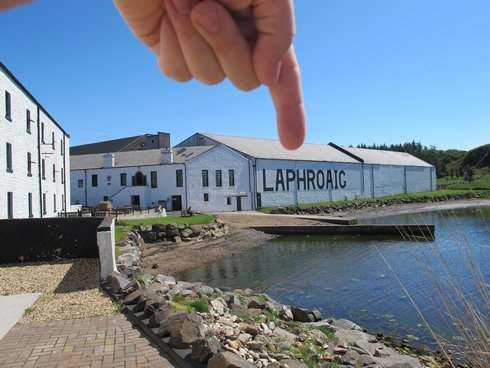
    Pointing Laphroaig Distillery Islay Scotland_tn

    What Laphroaig does differently from other scotch producers, as you'll read, is:

    • Floor maltings
    • Separation of malt flavoring (with peat smoke) and malt drying
    • An uneven number of pot stills
    • Quarter Casks

    Floor Malting

    Laphroaig is one of six scotch makers that floor malts some of its own barley. Floor malting is the historic technique of preparing barley for fermentation. Most of the 100 distilleries in Scotland purchase malted barley from commercial malting plants, and most (all?) of the distilleries that do floor malting also purchase additional malt from commercial malters.

    The other distilleries that malt their own barley are Bowmore and Kilchoman on Islay, Highland Park on Orkney, Springbank in Campbelltown, and The Balvenie in Speyside on the mainland. (Other brands including BenRiach have announced considering it.)

    Malting Floor Laphroaig Distillery Islay Scotland _tn
     In floor malting here at Laphroaig, barley is soaked three times at room temperature (simulating spring rains), then spread out over a floor where it will begin to germinate. During four days in the summer (seven in winter), the malt is turned over with rakes to reduce heat build-up and release Carbon Dioxide that builds up in the piles. Then it is dried to halt germination.

    Laphroaig Distillery Islay Scotland malting barley_tn

    Traditionally, the wet barley was dried over the local fuel source, be that peat (thick blocks of muddy decaying vegetation from bogs, on its way to becoming coal), or actual coal in the case of Highland distillers that had access to coal from the railroads. Now that other sources of energy can be used to blow hot air through the barley to dry it, smoke isn't necessary in the flavor of scotch. From commercial maltings, distillers can specify the level of smokiness they want their malt made.

    Harvesting Peat

    But for distillers with floor maltings who want smoky scotch, that means harvesting the local peat to burn for fuel. We donned Wellington work boots and headed out into the bog.

    The peat for Laphroaig is all harvested by hand. The procedure is to first cut off a top layer of grassy soil that hasn't decayed enough yet and place it on the next row over so it will keep decaying. Then peat is cut in long brick-shaped pieces by pushing down into the muddy peat with a special peat cutting tool, then placing it on the surface grass to dry outdoors.


     Click through the images below to see me harvesting peat.

    • Camper cutting peat Laprhoaig Distillery Islay Scotland3_tn
    • Camper cutting peat Laprhoaig Distillery Islay Scotland_tn
    • Camper cutting peat Laprhoaig Distillery Islay Scotland4_tn
    • Camper cutting peat Laprhoaig Distillery Islay Scotland5_tn
    • Row of peat Laprhoaig Distillery Islay Scotland2_tn
    Row of peat Laprhoaig Distillery Islay Scotland2_tn


    The seaweed and other Islay plant-rich peat harvested here imparts more "peaty" (earthy and medicinal) flavor characteristics to the barley than peat harvested from the mainland (which may be comprised of other vegetation), which imparts more wood smoke flavors.

    After the peat dries outdoors (but before it is too dry, as moist peat gives off lots of the desired smoke), they bring it back to the distillery where it is time to use it to dry the wet barley on the floor of the malting house.

    Dried peat in field Laprhoaig Distillery Islay Scotland2_tn

    I Peated in Your Scotch

    Wet peat is moved into the drying room, which sits a floor above a big boxy fireplace like on a steamship. Down below, peat is shoveled into the fire and the smoke rises to the room above to engulf the wet barley with smoke aroma. I took a turn throwing some peat onto the fire so you could be drinking my handywork in ten or so years.

    Peat fire Laphroaig Distillery Islay Scotland_tn
    Peat fire Laphroaig Distillery Islay Scotland_tn
    Peat fire Laphroaig Distillery Islay Scotland_tn

    Laphroaig is unique in that first they flavor the barley with smoke for 17 hours, and then after that they pump hotter dry air through it for an additional 19 hours to fully dry the barley. Other floor malting distilleries do the flavoring and drying steps together.

    This longer, slower flavoring and drying method changes the flavor profile of the barley, and the finished product – it doesn't just make it smokier. According to Master Distiller John Campbell, when we talk about the phenol profile of a whisky we're talking about 5-7 flavor components. The process of flavoring the barley at Laphroaig particularly brings out 4-ethyl glycol guaiacol and creosole components, present in other whiskies but not to the same extent as in Laphroaig.

    Smoking barley Laphroaig Distillery Islay Scotland_tn

    The malted barley made at the distillery is mixed with malted barley made just down the road at the Port Ellen maltings, along with malted barley from the mainland as well. Now it's time to ferment and distill.

    Fermentation and Distillation

    The water source for Laphroaig is a large reservoir a ways from the distillery, uphill. 

    Water source reservoir Laprhoaig Distillery Islay Scotland_tn

    The dried, malted barley is then ground up and put through the "mashing" process. Hot water is added to the barley and this inspires the enzymes released through the malting process to break the starches into fermentable sugars.

    Next they collect the sugary water and discard the solids, adding yeast to allow the sugar water to ferment over 55 hours into a beer. Then it's ready to be distilled.

    Stills Laphroaig Distillery Islay Scotland2_tn

    At most scotch whisky distilleries, the stills come in pairs. A larger still (wash still) performs the first distillation, and a smaller one (spirit still) paired with it takes on the second distillation.

    Here at Laphroaig, things are weird. There are 3 wash stills and 4 spirit stills. The 3 wash stills are all the same size, but there are 3 small spirit stills and 1 big one with twice the capacity of the small ones.

    One batch of fermented beer fills up 5 wash stills, so what they do is run 3 wash stills to go into 3 small spirit stills, then 2 more wash still runs to go into the one big spirit still. 

    Lynne arms Laphroaig Distillery Islay Scotland_tn

    Campbell says that the large and small spirit stills produce different tasting whiskies, but it's because they run the larger spirit still distillation too fast. (They've been doing it for 40 years that way though, so he's not about to change it.) The big still produces heavier, slightly oilier spirit as opposed to the lighter, sweeter, fruitier spirit that comes off the smaller spirit stills. Regardless, they blend all these together before putting it in barrels.

    Barrel Aging

    The spirit is 136 proof after distillation (68% ABV), but they put it into the barrel at 127 proof, which is common in the industry.

    Warehouse 1 Laphroaig Distillery Islay Scotland_tn

    Nearly all Laphroaig is aged in ex-Maker's Mark barrels. On Islay, they have 8 warehouses holding 50,000 casks. As is now the norm in Islay scotches, they also age some of their stock on the mainland. However, Campbell says that he believes the majority of the whisky used in the single-malt Laphroaig (as opposed to stuff sold to other brands for blending) is aged on the island. He says aging on the island imparts earthier, saltier notes to the whisky.

    The warehouse we visited is four floors tall and is the largest warehouse they use. Campbell says they get great flavor out of the whisky aged in this warehouse, but less color extraction from the wood as in their other warehouses. (The other warehouses are covered with metal and get hotter than the oceanside warehouses with their thick walls.) But putting together the barrels for the final products is the job of the blender.

    Tasting session Laprhoaig Distillery Islay Scotland_tn

     The Range

    10 Year – This is 70% of Laphroaig's single-malt sales. Minimum of 10 years aging in ex-bourbon casks.

    Quarter Cask – After aging 5-11 years in ex-bourbon barrels, a blend is made and then it is further aged in "quarter casks" for 7 months.

    Quarter casks are a quarter the size of a sherry butt, though they are made out of ex-bourbon barrels. They hold 30 gallons as opposed to 55 for bourbon barrels. These smaller casks impart more wood influence into the spirit in a smaller amount of time.

    Triple Wood – This starts with the Quarter Cask liquid, then it is aged for an additional 2 years in ex-oloroso sherry casks.

    I made the point that since quarter casks are actually made out of ex-bourbon casks, this is technically only two woods, not three. Lies! Maybe they should have called it triple barrel instead…

    PX – This is the same product as the Triple Wood (that is actually double wood), except for those additional 2 years it is aged in ex-Pedro Ximenez (PX) sherry barrels instead of oloroso. This bottling is only available at duty-free.

    18 Year Old – A minimum of 18 years in ex-bourbon barrels.

    Cask Strength – This is the 10 Year Old at cask strength. Previously this was a blended product so that each bottle tasted the same (called Original Cask Strength), but now they release this in batches, so it should be a little different with every batch.

    L for Laphroaig Distillery Islay Scotland2_tn

  • Jamaican Rums Bring the Stank on Details.com

    In my second story for Details.com, I wrote about the wonderfully pungent pot-still rums and blends from Jamaica. 

    Bring the Funk: New Jamaican Rums Embrace the Stank

    August 16 is National Rum Day—a virtual invitation for bloggers to post recipes for crappy blender drinks and liquid fruit salads. Not only does this celebrate dumb cocktails, it misses the bigger news about how new rums are embracing bigger, bolder, more assertive flavors. Yes, stankiness is in.

    Read the story here on Details.com.

     The story discusses Jamaican rum-inclusive brands including:

    • Smith & Cross
    • Plantation
    • Renegade Rum
    • Denizen
    • Banks
    • Appleton Estate
    • Wray & Nephew
    • Black Tot

    So go read it!


    • Appleton 50 Yo on white
    • Banks rum
    • Plantation 3 stars
    • Bottle - White Background - 2012 04 28
    Bottle - White Background - 2012 04 28


  • All About Anise

    I attended a good portion of a seminar called Anise: Treasure of the Mediterranean at Tales of the Cocktail in New Orleans this July. Though I couldn't stay until the very end, the seminar was great. 

    The speakers were Jared Brown and Anistatia Miller of Mixellany, Franesco LaFranconi of Southern Wine & Spirits, and Orietta Varnelli of Varnelli. 

    Like all things at Tales of the Cocktail, my memory is spotty when it comes to the seminar, so here are my notes copied and pasted from my iPad. I hope someone writes a book on anise liqueurs (HINT HINT Mixellany) so we can learn more about the topic.

    Here's what I wrote down: 

    • Green anise and star anise are unrelated plants but both contain anethol
    • green anise is fennel
    • you should add water first and then ice when serving anise liqueurs
    • need to make anise spirits on copper alembic- copper interacts with grape spirit. also anise is delicate and too much heat would make it soapy
    • sambuca -1930s miletta (sp?) company created Sambuca
    • Chinchon – lighter and thinner than varanelli
    • Raki – an anise spirit – more intense than others. not much head and tails removed so it's a rougher base spirit
    • Lebanon – Razzouk – arak – more like a grappa base spirit
    • Ouzo – greek – has more than anise and fennel. some have bitter almonds, sometimes licorice
    • Licorice adds the perception of sweetness in spirits. Old Tom gin – some of it had no sugar, but used anise and licorice root in double the amount of juniper.
    • Marie Brizard anisette- 11 botanicals
    • Sambuca – has to be at least 76 proof, and 38 grams of sugar per liter (see comment for a possible correction to this)
    • recipes from some anise products date back to medical journals from 1600s
    • pastis – comes from a word that means lasagna, a mix/mess (referring to louche)
    • sage has 10 times the amount of thujone as wormwood


    Anise seminar 9

    This is how the seminar was described:

    …LOVE ANISE? Then Join Francesco Lafranconi-winner of the TOC 2009 Best Presenter Award- and his illustrious guests: Mrs. Varnelli-CEO of Distilleria Varnelli S.p.a. and Member of The Ordre Internationale des Anysetiers, and the inseparable cocktail couple, Anistatia Miller and Jared Brown-Directors of Mixellany Limited. They will transport you through an incredible historical and cultural journey, including an exclusive tasting of anise-based liqueurs and aperitifs produced among some of the most cultural-rich Mediterranean countries.

    Anise has a history of use as a spice and fragrance. It has been cultivated for at least 4,000 years.

    Since the 12th century, the caravans were bringing anise from China to Alexandria, where the precious seeds were shipped to Genoa and Marseille, two major hubs of the Mediterranean Sea trade, before being sent to Paris to be assigned to Anysetiers. After maceration and distillation of the resulting paste, they used to manufacture drugs, ointments and liquids then they catered Kings and Lords.

    Found in nature two different species of this plant which belongs to the Umbelliferae family: anise (Pimpinella anisum) and star anise, or anise (Illicium anisatum).

    Nowadays, it is becoming increasingly fashionable to satisfy the palate of the guests and for their pleasure, to serve many cocktails containing anise. Finally, in order to be exhaustive, let us not forget its use in its usual form of aniseed aperitif and liqueurs as presented by some major Italian, French, Spanish, Greek and Libanese spirits brands.

    As a special occasion during Tales of the Cocktail, The Ordre Internationale des Anysetiers will launch the FIRST chapter in the United States to revive the legend and tradition of the medieval guild of Anysetier, BIG THANK YOU TO VARNELLI!

    We look forward to having you join as a member of this treasured and historical guild established in 1263!


  • Filtration in Spirits: A Primer

    For CLASS Magazine online at DiffordsGuide.com, I wrote an article about filtration in spirits. This was based on the research I did for my talk on the subject at the Manhattan Cocktail Classic earlier this year. 

    Don't Forget the Filtration Factor
    By Camper English 

    Nearly every spirit undergoes some sort of filtration, yet we rarely acknowledge it as part of production. But filtration makes vodka what it is today, practically defines Tennessee whiskey, is the standard in making white rum, and is changing the look of tequila. Filtration is important.

    Generally speaking, filtration refers to the mechanical process of passing a liquid or gas through a medium that keeps out solids of a certain size. But in spirits, we include carbon filtration (sometimes called carbon treatment) as filtration too. Carbon filtration works differently: by absorption, the adhesion of particles to a surface, like flypaper. 

    I researched filtration in spirits for a talk at this year's Manhattan Cocktail Classic. While I can't claim category-wide or hands-on expertise in this matter, I spoke with several industry sources who know their stuff. Consider this an introduction to the subject.

    The article covers filtration in vodka, rum, tequila, whisk(e)y, and cognac. I hope you'll find it interesting. Get the full story here.

    Filtration in Spirits Diffords
    Update: The story came off the site, so here it is in its entirety:


    Filtration in Spirits

    Camper English


    Nearly every spirit undergoes some sort of filtration, yet we rarely acknowledge it as part of production. But filtration makes vodka what it is today, practically defines Tennessee whiskey, is the standard in making white rum, and is changing the look of tequila. Filtration is important.


    Generally speaking, filtration refers to the mechanical process of passing a liquid or gas through a medium that keeps out solids of a certain size. (Think of a screen door.) But in spirits, we include carbon filtration (sometimes called carbon treatment) as filtration too. Carbon filtration works differently: By adsorption, the adhesion of particles to a surface. (Think of flypaper.)


    I researched filtration in spirits for a talk at the Manhattan Cocktail Classic in May 2012. While I can’t claim category-wide or hands-on expertise in this matter, I spoke with several industry sources who know their stuff. Consider this an introduction to the subject.


    Vodka, Charcoal, Tequila, and Rum


    Early vodka was surely very different from the perfectly clear, nearly-neutral spirit we know today. True, distillation was cruder, performed in pot stills rather than in today’s hyper-efficient columns, but filtration helped rid vodka of lots of nastiness. Much early vodka filtration seems to resemble “fining” in wine and beer – a fining agent speeds up precipitation of impurities in the liquid. Fining agents have included egg whites, milk, gelatin, fish bladders, something called “blood powder.” Vodka has also been filtered through sand and other soils (this process is still used in water treatment), felt, and other materials.


    But activated carbon (charcoal) seems to have the largest impact on vodka and other spirits, or at least it is the most commonly used filtration method. In vintage vodka, charcoal derived from trees was used to clean up the liquid, but today charcoal for filtration may come from wood, nut shells (coconut especially), and even bones. (Fun fact: some white table sugar is clarified using bone charcoal, rendering it non-vegetarian.)


    Vodkas today advertise a range of other material to complement the carbon. These include birch charcoal, quartz sand, and algae (Ladoga), Herkimer Diamonds (Crystal Head), freeze filtration, Z-carbon filter, and silver (Stoli Elit), Platinum (Platinka), Gold (Lithuanian), Lava Rock (Hawaiian, Reyka), and marble (Akvinta). Though many of these methods sound like pure marketing, in fact some of these precious materials like platinum and silver do improve filtration efficiency. (For very detailed information on some vodka filtration technologies, this site https://www.vodka-tf.com/ is quite a read.)


    Charcoal filtering is also commonly used in tequila. According to one tequila producer, this is because the law for tequila production (the NOM) specifies amounts of impurities like esters and furfural that may be present in tequila, and these numbers are difficult to consistency hit with distillation alone. Thus, charcoal filtration cleans up the impurities in tequila a little bit – but also removes some flavor with it.


    Charcoal filtration can remove color as well as flavor and impurities. Many ‘white’ rums are aged a year or more in ex-bourbon barrels, and then filtered for clarity. Charcoal filtration (and other new-at-the-time technologies such as aging and column distillation) helped make Bacardi the popular and later global brand of rum that it is today. This lighter, clear style of rum born, in Cuba, is often called the ‘international style’ that won out in popularity over regional production methods.


    All charcoal isn’t created the same, however. Should you take a dark rum and run it through a water filter repeatedly, you may not lose any color. (I tried.) Some parameters that distillers investigate in choosing the right carbon filtration material include the base material (bone, nut charcoal, wood, etc), the “iodine number” and the “molasses number,” the latter a measurement of decolorization. Activated carbon meant for cleaning up water may not be of any use in stripping color from liquids.


    Decolorization has allowed for a new trend in tequila: aged tequila filtered to clarity. Probably the first tequila to do so was Maestro Dobel, a blend of reposado, anejo, and extra-anejo tequila filtered to near-clarity. In recent months, new brands have followed suit, including Casa Dragones (blanco and anejo mixed together and clarified), Milagro Unico (blanco with ‘aged reserves’), and Don Julio 70th Anniversary Anejo Claro (clarified anejo). In the opposite direction, the first tequila that I’ve seen labeled as ‘unfiltered,’ a special cask-strength bottling of Ocho, has also just hit the market.


    Whisky and Cognac


    In both scotch and in bourbon, there is an increasing trend toward unfiltered whiskey, while chill filtration is still very much the norm. Chill filtration prevents cloudiness in spirits (particularly at low temperatures) and precipitation of particulates in the bottle. It is purely an aesthetic choice, not meant to affect the flavor of the spirit. However, many experts argue that it does alter (flatten) the flavor to some extent. (For a very nerdy analysis of chill filtration, we refer you to this information from Bruichladdich https://www.bruichladdich.com/library/bruichladdichs-guide-to-chill-filtration.)


    As far as I have been able to learn, in chill filtration activated carbon is not used. The spirit is chilled to a certain degree, and then a cellulose or other paper filter is used to remove the esters and fatty acids that are less soluble at low temperatures. Whiskies bottled at higher proofs tend not to cloud, so many cask-strength whiskies and many (if not most) whiskies bottled at 46 percent alcohol or higher are non-chill filtered. Outside the bottle, however, when ice or water is added and they dilute, they may get cloudy.


    Tennessee whiskey has its own style of filtration. After the spirit is distilled but before it goes into the barrel for aging, the whiskey is dripped through or soaked in tubs with about ten feet of charcoal made from sugar maple trees. Contrary to popular opinion, this is in no way required by law, but both Jack Daniel’s and George Dickel employ this technique. Gentlemen Jack is unusual in that it undergoes charcoal filtration a second time before bottling.


    One cognac distiller revealed that filtration in cognac is also standard: cognac is run through paper filters of a specific (depending on the product) pore size to filter out undesired molecules. While most cognac is not chill-filtered, one producer said that when bottles are destined for cold-weather countries (cognac is popular in Scandinavia), it is often chill-filtered to prevent cloudiness in the bottle. It might be interesting to taste chill and non-chill filtered versions of the same cognac. The opportunity is rarely, if ever, afforded in scotch.


    So, some form of filtration is used in about every type of spirit, whether that’s to change the color, clean up undesired impurities or clean out off flavors, to prevent cloudiness, or just to keep out chunks of stuff from floating in your bottle. As with the water used in fermentation, the type of still, and the location/condition of aging barrels, filtration is an important part of the process of making spirits and shouldn’t be so often overlooked.

  • Brown-Forman Cooperage Pics and Videos

    The Brown-Forman Cooperage is located in Louisville, Kentucky. There they make the barrels for Jack Daniels and their other brands. Below are some pictures from my visit.

    You can read about what I saw in my story for CLASS Magazine here

    Brown Forman Cooperage2_tn
    Brown Forman Cooperage2_tn
    Brown Forman Cooperage2_tn
    Brown Forman Cooperage2_tn
    Brown Forman Cooperage2_tn
    Brown Forman Cooperage2_tn
    Brown Forman Cooperage2_tn
    Brown Forman Cooperage2_tn
    Brown Forman Cooperage2_tn
    Brown Forman Cooperage2_tn
    Below are a couple of videos. The first is the machine that puts hoops around barrels. 

    The second video is of the charring process of the barrels. Fire!

  • My Enthronement: The Ordre International des Anysetiers

    I probably won't be part of an enthronement ceremony too many times in my life, so I thought I'd make a big deal out of this one: I was inducted into the first American Chapter of the Ordre International des Anysetiers during Tales of the Cocktail in New Orleans this July. 

    The Ordre International des Anysetiers is a charitable organization that seeks to revive the legend and traditions of the ancient guild of Anysetiers, founded in 1263 in France. 

    DSC_0326_tn

    Just ten of us were inducted: Southern Wine & Spirit's chief mixologist Francesco Lanfranconi, Tales of the Cocktail’s founders Ann and Paul Tuennerman, Liz Williams (Chair of Southern Food and Beverage Museum in NOLA), Laura and Chris McMillan of the Museum of American Cocktails, journalists Camper English and Brenda Maitland, mixologist Jacques Bezuidenhout and importer Paolo Domeneghetti.

    They flew in a multi-national group of officers from various Ordre chapters to lead the ceremony.

    DSC_0041_tn
    During it, we wore a ceremonial collar and were tapped on each shoulder with an anise hammer like being knighted.

    DSC_0149_tn
    We walked away with our ribbon and giant certificate that I guess I'll need to get framed.

    DSC_0221_tn

    And of course, we sealed the deal by taking a sip of an anise liqueur- in this case Varnelli dry anise. Varnelli sponsored the chapter and the ceremony.

    DSC_0152_tn

    I'm not quite sure what my responsibilities to the group are other than spreading a love of anise drinks, but that part I'd do even without the enthroning. 

  • Buffalo Trace Distillery Visit

    This spring I visited 8 American whiskey distilleries, including Buffalo Trace. Buffalo Trace is owned by the Sazerac company. They make Buffalo Trace, Blanton's, Elmer T. Lee, Eagle Rare, Van Winkle, and other whiskey brands, plus the make/own/import other spirits including Rain vodka, Puebla Viejo tequila, and Glenfarclass scotch. 

    Unlike most of the other American whiskey distilleries I visited, Buffalo Trace feels like a campus or a mini factory town. Other distilleries have just the central distillery and bottling line, but the aging warehouses are spread further afield. They're closer by at Buffalo Trace.

    Buffalo Trace Distillery4_tn
    Buffalo Trace Distillery4_tn
    Buffalo Trace Distillery4_tn

    The name Buffalo Trace comes from the paths that the buffalo took to this area, where they would cross the river. The distillery is located where several paths intersected. Our guide Freddie said that this site is also probably where the first bourbons were ever shipped down the river to New Orleans in the early days of bourbon. 

    Here at Buffalo Trace, several rickhouses are built of brick on the outside and have many windows, unlike the typical metal-clad warehouses. However, the inside of the brick warehouses are wooden structures that hold the barrels, not connected to the outside framework. 

    Buffalo Trace Distillery7_tn

    Having all of this close together makes for a good tour- you can walk from building to building  (as I did) and see every part of the distilling, aging, and bottling operation. 

    Buffalo Trace launched the first single-barrel bourbon, Blanton's, in 1984. We saw it being bottled. We also saw the vats for chill filtration, which was helpful as I was about to give a talk about filtration in spirits right after my visit. 

    Buffalo Trace Distillery chill filtration_tn

    We were also treated to seeing the bitters room, where they make Peychaud's and Regan's Orange bitters. I got to try those suckers out of the tap! To make them, they add the ingredients to one of 7 little tanks, age them 2 weeks, filter the solids, let them rest a week, and then bottle them. 

      Buffalo Trace Distillery bitters room_tn
    Buffalo Trace Distillery bitters room_tn

    Visiting Buffalo Trace

    Information about visiting the distillery is found at BuffaloTraceDistillery.com. There are regular tours, hard hat tours, tours specializing in the time right after Prohibition, and even a nighttime ghost tour. 

    Buffalo Trace Distillery packing peanut tree2_tn

  • Blue Cocktails on Details.com

    I attended an awesome seminar on blue drinks at Tales of the Cocktail this weekend, lead by Sebastian Reaburn, Jacob Briars, and Phil Duff. 

    Then I wrote a piece about it for Details.com, the website of Details magazine. It's my first story for the website. 

    Details Blue Cocktails Story

    I learned a lot more in the seminar than is in the story, which is more of a trend piece.

    Fun facts:

    • Phil Duff worked at the same bar Tom Cruise trained at to prepare for the movie Cocktail (not at the same time)
    • The first known blue drink was a non-alcoholic soda called Soyer's Nectar, from 1851. It was created by Alexis Soyer, the first celebrity chef. 
    • Blue cocktails were futuristic. "In the 1860s people were excited about the future; now we're merely afraid," said Jacob Briars.
    • The first known blue cocktail was from 1908.
    • Modern blue cocktails may start with the Blue Hawaiian from 1957 – at the end of the classic rum-heavy tiki drinks at the beginning of the silly ones.
    • Blue cocktails are popular in countries that either never had a super serious classic cocktail phase (Asia) or in places and with people that have gotten beyond it, like New Zealand and the top cocktail bars mentioned in the story.

    Anyway, I hope you enjoy the story on Details.com!


  • Another Way to Make Clear Ice at Home

    I am honored to have as Alcademics readers people who are just as huge cocktail nerds as I am. Many take on projects that I run out of time to do, pass along better information to me, or fill me in on the science I'm missing.

    Kevin Liu, who has recently started the blog Craft Cocktails at Home and also blogs at ScienceFare.org, tested a method of making clear ice that another reader left in blog comments. 

    In this post, he discusses the science of clear ice and two methods to make it at home.

    1. The Igloo Cooler method, pioneered here on Alcademics. (An index of all of the ice experiments on Alcademics can be found here.)
    2. The High-Temperature Freezing method, in which you let water freeze into ice at just below the freezing temperature. It's also simple, and depending on your freezer may not take up as much space.

    Read the post for more info. 

    IMG_7015-480x600

agave alcademics Angostura bartenders bitters bodega bourbon bowmore Campari Camper English chartreuse clear clear ice cocktail cocktail powder cocktails cognac curacao dehydrated dehydrated liqueurs dehydration directional freezing distillery distillery tour distillery visit france freezing objects in ice hakushu harvest history how to make clear ice ice ice balls ice carving ice cubes ice experiments isle of jura jerez liqueur makepage making clear ice mexico midori molasses orange orange liqueur penthouse pisco potato powder production recipe Recipes rum san francisco scotch scotch whisky sherry spain spirits sugar sugarcane sweden tales of the cocktail tequila tour triple sec visit vodka whiskey whisky