…cocktail snobs versus geeks, micro and macro trends in cocktails, what drinks win cocktail contests, why I'm not sick of speakeasies, and much, much more.
Read this interview with me on Mix Pour Sip.

…cocktail snobs versus geeks, micro and macro trends in cocktails, what drinks win cocktail contests, why I'm not sick of speakeasies, and much, much more.
Read this interview with me on Mix Pour Sip.
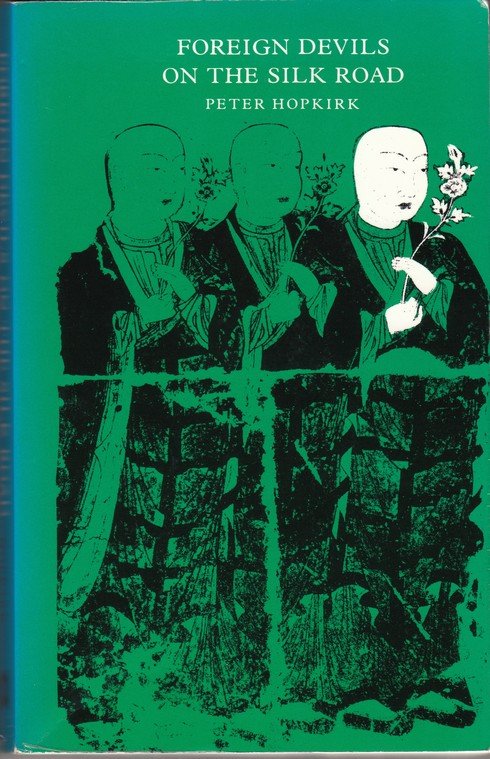
For my book club I read the book Foreign Devils on the Silk Road
In a chapter on finding a hidden library of ancient scrolls at Tun-huang, the author notes (page 175) that they found "a thousand-year-old 'model' letter of apology in Chinese designed for inebriated guests to send to their hosts."
I think you'll find it's still useful today.
Here's the translation:
'Yesterday, having drunk too much, I was so intoxicated as to pass all bounds; but none of the rude and coarse language I used was uttered in a conscious state. The next morning, after hearing others speak on the subject, I realized what had happened, whereupon I was overwhelmed with confusion and ready to sink into the ground with shame…'
The letter adds that the writer will soon come to apologize in person for his transgression. A suitable reply for the outraged hosted is suggested, which Giles translates thus:
'Yesterday, Sir, while in your cups, you so far overstepped the observances of polite society as to forfeit the name of gentleman, and made me wish to have nothing more to do with you. But since you now express your shame and regret for what has occured, I would suggest that we meet again for a friendly talk…'
Sounds like something I've heard from a bartender or two in this millennium.
The SF Chronicle has announced the 2011 Bar Stars, bartenders who deserve special recognition. The introduction by Wine Editor Jon Bonne is here.
The Bar Stars are:
Click the links for the write-ups on each bartender.
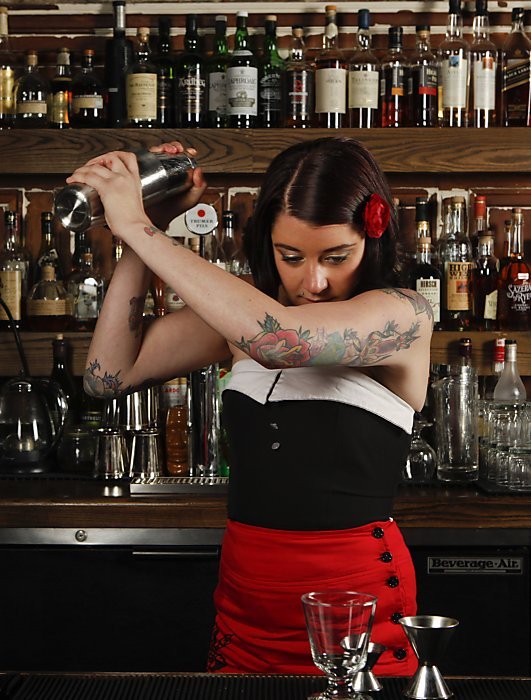
(Photo by Russell Yip/SF Chronicle.)

(Photo courtesy of That's My Jamm)
David Ruiz of Mr. Smith's makes jams and preserves just for cocktails. I wrote about it with a quick note about jam in cocktails historically, and in which bar you can find a mezcal drink with strawberry-raspberry-jabanero jam. Yumz.
Read about That's My Jamm on Tasting Table. The story is here.
Now that we know one way to make crystal clear ice, what are we gonna do with it?
One thing I've wanted to attempt is to make ice balls. These can be carved by hand, but that's a lot of work. The big copper ice ball makers make lovely ice balls, but these cost a ton of money. I've been trying to think of a new solution.
When they send bars the copper ice ball makers, they send an ice cube tray that makes a big enough cube to use in it. Unfortunately that tray produces cubes that are cloudy in the center, for reasons described earlier on this site.
I am a big enough nerd that I have brought my own clear ice to a bar that had the ice ball maker to produce a clear ball. It was lovely.

So I made a first attempt at another way of creating ice balls with conventional equipment: The Stovetop Ice Ball Method.
Don't get too excited: So far it doesn't work.
The theory is that I'll start with a clear block of ice and melt it into a heated metal bowl, creating a half-sphere. Then I'll turn it over and make another half sphere joining that one to form a complete sphere.
I bought a bowl at Ikea that's probably four inches in diameter – too big for a glass but fine for an experiment. I sat the block of ice on it, and set the bowl on the stove burner.

Click the link below (if you see one) to keep reading.
A couple years ago I made Peep straws. Here's the original post.

Here's the Easter Ice project from a couple years ago that I'm reposting. Go here to learn how to make it.


In my story in this Sunday's SF Chronicle, I discuss some ways that cocktail bars are trying to build drinks faster, and how nightclub-type spaces are trying to make better quality cocktails without slowing down.
In theory, we appreciate the extra time and effort bartenders spend on their cocktails – using exact measures of ingredients, thorough shaking or long stirring, and general attention to detail.
But alas, reality.
"People are becoming more accepting of waiting for quality cocktails, but I don't think anybody really wants to wait for anything at all, ever," says Justin Lew.
The story includes mention of how they do it at The Wilson, the Hideout at Dalva, Azul, Rye, and Rickhouse.
Michael Callahan kills it with the end quote. Put it in your brain here.
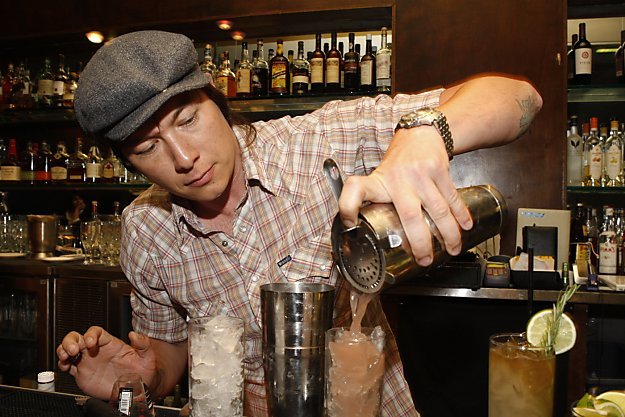
(Photo: Alex Washburn / The Chronicle)
Depending on where you look online, you'll find that there are either three or four categories of Peruvian pisco.This is confusing if you want to write about it.
The Problem
Some sites say that there are four types: Puro, Aromatico, Mosto Verde, and Acholado.
Others say three: Puro (which includes the four aromatic varietals of the Aromatico category above), Mosto Verde, and Acholado.
As far as I know, the national pisco association of Peru has no official information in English. And the two very official-looking websites above have different answers.
The Evidence
But in the process of trying to figure out how many types of pisco there are I think I also figured out why there is confusion. Or rather, I asked enough people who figured it out for me. Particular thanks go to pisco historian/author Guillermo Toro-Lira who scanned in the old laws so we can compare it to the new ones.
When the pisco norm (technical standard) was released in 1989, there were actually five approved categories of pisco. Toro-Lira scanned in the norm for us, which comes from the book: "Crónicas y Relaciones que se refieren al origen y virtudes del PISCO Bebida tradicional y patrimonio del Peró", Banco Latino, Lima Perú, 1990.
Here are the most relevant pages (click to enlarge) especially the second one. As you can see, the five categories are puro, mosto verde, aromatico, aromatizado, and acholado.


The aromatized category allowed for distilling or infusing other fruit into pisco.
But when the norm was updated in 2006 [PDF of it is here], there aromatizado category is gone (maybe that was eliminated between 1989 and 2006; not sure) and Aromatico and Puro are merged into Puro:
5. CLASIFICACIÓN
5.1 Pisco puro: Es el Pisco obtenido exclusivamente de una sola variedad de uva pisquera.
5.2 Pisco mosto verde: Es el Pisco obtenido de la destilación de mostos frescos de uvas pisqueras con fermentación interrumpida
5.3 Pisco acholado: Es el Pisco obtenido de la mezcla de:
– Uvas Pisqueras, aromáticas y/o no aromáticas.
– Mostos de uvas pisqueras aromáticas y/o no aromáticas.
– Mostos frescos completamente fermentados (vinos frescos) de uvas aromáticas y/o no aromáticas.
– Piscos provenientes de uvas pisqueras aromáticas y/o no aromáticas.
What looks to be fair translation of that is here.
The Answer
So, the current law as of 2006 is that there are three categories of Peruvian pisco. Seeing how the law changed, we can understand all the confusion.
agave alcademics Angostura bartenders bitters bodega bourbon bowmore Campari Camper English chartreuse clear clear ice cocktail cocktail powder cocktails cognac curacao dehydrated dehydrated liqueurs dehydration directional freezing distillery distillery tour distillery visit france freezing objects in ice hakushu harvest history how to make clear ice ice ice balls ice carving ice cubes ice experiments isle of jura jerez liqueur makepage making clear ice mexico midori molasses orange orange liqueur penthouse pisco potato powder production recipe Recipes rum san francisco scotch scotch whisky sherry spain spirits sugar sugarcane sweden tales of the cocktail tequila tour triple sec visit vodka whiskey whisky