Blog

  • Carving Big (and clear) Ice Cubes

    After much experimentation I have found one method to make big clear chunks of ice. That method is to put water in a cooler in the freezer, then chop off the top clear layer. Now the trick was to get this into useful sized cubes for glasses. 

    *Update 2021: A better post on cutting up clear ice is here.

    Starting with the slab of ice (this one about three inches thick),

    Top frozen onlys

    I used a heated bread knife to score the ice just about 1/8th of an inch,

    Scored ices

    Then tapped the scratch in several places with an ice pick and found it separated really easily.

    Cut ices

    And I got the whole thing chopped into long spears.

    Slab in spearss

    Bucket of clear ices

    I use these really long ones in a tall glass

    Ice in glasss

    and scored and cut the rest of the spears into big fat cubes.

    Cubes2s

    Cube in glass1s

    Hooray! Time for a drink.

    An index of all of the ice experiments on Alcademics can be found here.

  • Clear Ice Blocks from the Fridge

    In my ongoing experiments trying to make clear ice in the refrigerator, I first tried:

    And had success with:

    Then theorized about the pond method.

    The next step was testing this pond method (trying to freeze ice from the top-down rather than outside-in). To do this, I needed an insulated container on all sides except for the top. My first attempt was with a collapsible beer cooler:

    Cooler1s

    I filled it with plain tap water and let it freeze for three or four days. The container expanded as it froze so the ice was rather difficult to remove. At the end, the block still didn't completely freeze, but as we've learned in earlier experiments the last parts to freeze are where the ice gets the cloudiest. It was also cloudy toward the center but I think that's because I gave the cooler a squeeze in the fridge before it was frozen.

    Iceandcamparis

    The next task was to cut off the cloudy parts so that only the clear ice remained. The first time I did this with a saw. This took a long time and as I learned later was probably not necessary.

    Saw in ices

    But it worked!

    Block1s

    Part Two: Just a Bit Off the Top

    Since I wasted so much of this large block I wanted to try a simpler method: Freezing it from the top down and trying to just pop off the top.

    Once again I filled the cooler with water and froze it, for just a couple of days this time. When I pulled it out of the freezer the water had mostly froze from the top down, though there was a light shell of ice around the shape of the cooler. Thus to get the ice out, I smashed in the sides of the cooler and pulled off the top. It was a bit easier than the entire block to remove from the cooler, but not easy per se.

    Smashed ice1s

    This slab was about four inches thick and wonderfully clear. 

    Top frozen onlys

    The next trick would be trying to cut it down into smaller cubes. More on than in the next post.

    Conclusions: 

    1. To make a big slab of clear ice, start with an even bigger slab of ice and cut off the rest. At least for San Francisco water, the shape of the container matters more than anything else- boiling, filtered, or distilled water.
    2. My collapsible cooler isn't heavily insulated, so the water does partially freeze from the bottom and sides and a better insulator would be ideal.  

    To do:

    1. Find a better insulated container to maximize the "pond effect" so that water only freezes from the top down.
    2. Figure out how to efficiently cut the ice into big cubes.

    An index of ice experiments on Alcademics can be found here.

  • Don’t Forget the Wild Tofurkey

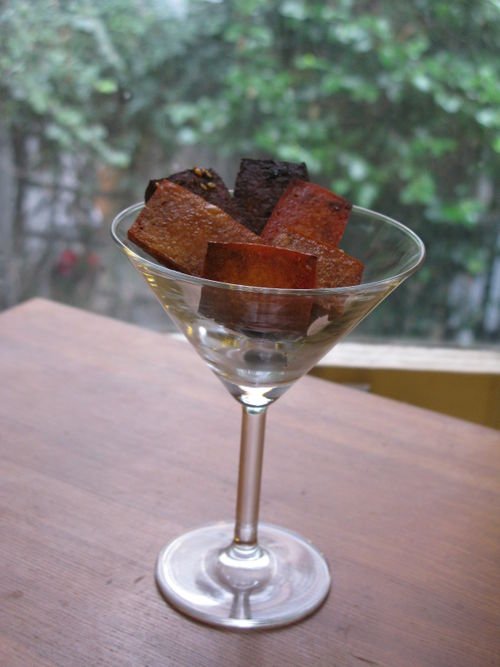
    When you're out shopping for your liquor-loving vegetarian guests for Thanksgiving this year, don't forget to pick up some tofu and booze to make my special Wild Tofurkey dish. It's tofu marinated in a cocktail and baked. Mmm.

    Wildtofurkey

  • Another Clue to Ice Clarity: Slow Freezing Like a Japanese Pond

    The other night a friend of mine told me that she read something about clear ice, which as you may recall is a topic of interest of this blog. Naturally I forgot what she said (we were at a bar, remember) but the next day I found the following email I had sent to myself:

    "Clear ice old japan sawdust"

    The amazing thing is that when you put that into Google the very first story it comes up with is what I assume is the exact thing my friend was talking about. In this story on natural ice (popsicles) in Japan, a person in the story gives a quote that could prove useful. 

    Masao Yoshiara, the fourth-generation president of the company, said: "In Nikko, the daily lowest temperature in winter averages around minus 10 C, ideal for making crystal-clear ice.

    "If it's colder than that, ice can be made quickly but it is not solid enough. Here, ice grows 1 centimeter thicker a day. When ice becomes about 15 centimeters thick over half a month, we cut out ice blocks. If an ice block is thicker than that, it contains cracks."

    Minus 10 degrees Celsius is 14 degrees Fahrenheit. I don't know the temperature of my home freezer, but it's worth investing in a thermometer to find out. Perhaps slow freezing equals clearer ice.

    The other factor we'll have to consider about pond ice is that the bottom never freezes. Thus the air that is a major factor in cloudy ice is still in the warmer water below the surface layer of the ice.

    This is another strategy I've been considering in attempting to get clear ice in the freezer: if I place a good insulator at the bottom and sides of the water container that doesn't cool down nearly as fast as the water (for example a super thick glass bowl, or a pan of ice that sits on a stone surface), will that cause all the air in the water to migrate to the bottom and freeze last?

    This reading inspires a lot more ice experiments to come. I'm glad I emailed myself from the bar.

    An index of ice experiments on Alcademics can be found here.

  • Does Freezing Water in Layers Make Clear Ice?

    Here's a new edition in my ongoing ice experiments. So far, there experiments have been:

    With successes in:

    So far my conclusions have been that (at least with my San Francisco water), temperature and filtering have less of an effect than trapped air that migrates to the center of the freezing cube. Thus I am trying to minimize this effect.

    In this experiment I froze ice in layers in small lasagna pans to see if we had a maximized surface area, hopefully no air would get trapped in the ice and form cloudy parts. Apparently some commercial ice machines such as Kold Draft spray an upside-down mist of water in layers, so this would be the home approximation of that.

    I tried this experiments with tiny layers, medium layers, and large layers in the same sized pan, the difference being that I added more water per layer. I let the water freeze before adding another layer.

    As you can see, none of the layers turned out clear:

    (Tiny layers, medium layers, and large layers left to right.)

    The small sized layers were made only adding a couple of ounces of water at a time, so I can't get much smaller layers than these unless I use a spray bottle. 

    We'll have to call this one a failure. Freezing water in layers does not appear to make clear ice, just ice with smaller layers of trapped air.

    Below is a closeup of the layers for your ice ogling enjoyment.

    Threelayerscloseup

    An index of all of the ice experiments on Alcademics can be found here.

  • Passing the B.A.R.

    This past fall I took the B.A.R., Beverage Alcohol Resource, five-day course in New York. The course has two levels- "Ready" and "Certified", with the only difference in the number of drinks one has to make within a certain time on the practical bartending exam. The course ran for about 12 hours each day for the first four days, with nearly a full day of testing on the last day. It was a real butt-kicker.

    People seemed to come away with different impressions of the course, but what stuck out most to me was what you need to know not just to pass the class, but to say that you're at an expert level in the industry. It's a lot. You need to know:

    1. The science and history of fermentation and distillation from the dawn of time
    2. The history, ingredients, geography, and practical and legal production rules for every major category of spirits
    3. The entire history of bartending and individual history and timelines of dozens of important cocktails
    4. How to blind taste and identify spirits, quality of distillation, barrel type and age, and other production parameters, down to individual brands and bottlings
    5. How to balance drinks, mix drinks, make them fast and of the highest quality possible while providing top quality customer service
    6. How to create new drinks and tweak existing ones based on different mixological strategies
    7. How to blind taste and critique cocktails

    I took 76 pages of notes in those four days, after having read and studied the textbook, attended dozens on lectures by the instructors, read zillions of books, and passed the BAR Smarts course before the course. We sampled a few hundred spirits blind, I practiced bartending until my shoulder ached from shaking, and still tried to find time to study each night before passing out.

    I decided to attempt the BAR Ready certification, thinking that I knew so much about the history and production rules of spirits that I wouldn't have to even study for that part of the test. (Boy was I wrong about that.) Luckily if you don't make all your drinks in time to be BAR Ready you can still pass BAR Certified. And I did, which is awesome.

    My takeaway from the course is not just the new information and skill set gained during the week, but knowing what it takes to stay on top of things going forward: A great and constant amount of work tasting, testing, practicing, learning, and reviewing what you think you already know.

  • SF Cocktail Geography

    Sfist_logo Jay Barmann from SFist.com attended my talk at SF Chefs.Food.Wine and kept the handout. Today he's posted my categorization of nearly every type of cocktail program in the city, which is good, because formatting html is a pain.

    The categories I made up so don't get too hung up on them- it's just how I see them.

    Read it here

    I've been thinking of giving that talk again, because PowerPoint is forever. Let me know if you're into it and maybe I can put something together.

  • Cutting Corners to Make Clear Ice

    In an ongoing set of experiments I've been trying to make clear ice at home. I've tried:

    With some success on the last one. While what would be ideal would be to produce one giant solid block of perfectly clear ice, I haven't figured that out yet. However if the ice is going to be used to shake with or for cooling individual beverages, you don't need a giant block- just big chunks.

    There is a way to accomplish this by cutting corners. And tops and bottoms. We've seen how the air bubble makes the cloudiest part of the ice in the center in vertically-frozen water, and mostly along the bottom of horizontally-frozen water.

    making clear ice

     And I've also found that horizontally-frozen water usually has an edge of very clear ice.

    Clear ice around the edges of the pan of ice

    So with my ice pick, I just cut off the clear edges separated the top from the cloudy bottom
     of the pan ice (easier than you'd expect, as the cloudy ice breaks off easily), and cut around the cloudy middle of vertically-frozen water to end up with a big bowl of clear ice.

    a bowl of very clear ice

    Conclusions: You can make clear ice by cutting around cloudy ice frozen in large blocks. However, you waste about 85% of your ice, and a lot of time.

    An index of ice experiments on Alcademics can be found here.

  • Making Clear Ice by Releasing Trapped Air

    [update: after this post, I figured out the trick to making clear ice – check here for the solution.]

    Finally, I've got a minor success in my clear ice experiment to share. So far in an attempt to make perfectly clear ice in my home freezer, I've tried:

    Noting that water freezes into ice from the outside-in, leaving an air/water bubble that forms the cloudy part of ice, I sought to devise a way to either change the way ice freezes, or to release the trapped air while the ice was freezing.

    First I tried laying a bar spoon diagonally through the water. The theory was that the metal of the spoon might conduct coldness into the center of the ice so that the ice would freeze more evenly. The intended result was a dispersed air throughout the ice rather than just in the bottom/center layer. 

    Spoonwaterandice

    But alas, the intended result did not happen. There does appear to be more air dispersed in the ice, but still the majority of it is in a layer along the bottom.

    Next I tried inserting a straw into the center of a tray of ice to see if the air would escape through the straw. The plan was flawed to begin with, as water would probably just freeze inside the straw so no air could get out.

    Strawwaterandice

    In reality the freezing ice pushed the straw up so that it was only inserted about half an inch into the ice by the time it was fully frozen. This had no effect on the amount of cloudiness.

    For something that did work, keep reading after the jump.

    (more…)

  • Clear Ice and Container Shape

    Today is Ice Day on Alcademics, so stay tuned for more exciting coverage of my ongoing experiments to make clear ice in my home freezer.

    So far, I've tried:

    So far I haven't achieved… anything, but I'm gathering information that should help in the future. In recent experiments, I found that ice freezes from the outside in, which is sort of obvious, but it's important because that's where all the air is trapped that makes the majority of cloudiness in ice. So I wanted to try some different container shapes to test how and where the air bubble forms. 

    In a vertical container, such as these Vietnamese take-out soup containers I've been using, the air bubble forms toward the middle-bottom. (I've set the ice upside-down in this picture.)

    Vertical1s

    Whereas in a flat horizontal container such as a lasagna tray, the air bubble forms in a layer across the bottom of the pan.

    Icepan1s

    The experiment continues after the jump.

    (more…)

agave alcademics Angostura bartenders bitters bodega bourbon bowmore Campari Camper English chartreuse clear clear ice cocktail cocktail powder cocktails cognac curacao dehydrated dehydrated liqueurs dehydration directional freezing distillery distillery tour distillery visit france freezing objects in ice hakushu harvest history how to make clear ice ice ice balls ice carving ice cubes ice experiments isle of jura jerez liqueur makepage making clear ice mexico midori molasses orange orange liqueur penthouse pisco potato powder production recipe Recipes rum san francisco scotch scotch whisky sherry spain spirits sugar sugarcane sweden tales of the cocktail tequila tour triple sec visit vodka whiskey whisky