Blog

  • What is a Blended Straight Bourbon Whiskey?

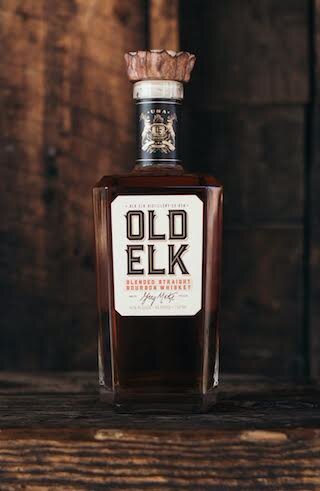
    Old Elk Blended Straight Bourbon WhiskeyI was about to casually add a product to the New Booze page when I realized I didn't know what it was: Old Elk Blended Straight Bourbon Whiskey. 

    I thought that "blended" and "straight" whiskey were at odds with each other, as blended whiskeys must contain at least 20% straight whiskeys in their blend.  

    The press release doesn't address what is a blended straight bourbon is in the description: 

    With four times more malted barley than conventional recipes and a slow cut proofing process which allows more time for flavors to marry between proofing stages, the Old Elk Bourbon recipe transcends tradition to craft a rich, smooth bourbon. 

    “We use traditional ingredients – malted barley, corn and rye – in an innovative, yet steadfast recipe to create a bourbon with smooth, rich flavors that act in harmony with caramel cues brought out by the charred barrels and spicy rye notes,” said Greg Metze, Master Distiller at Old Elk Distillery. “After testing a variety of proofing periods, we found that these flavors come together in a smoother bourbon when the proofing stages are longer. Instead of taking the usual 24 to 48 hours for proofing, we use a slow cut proofing process during which full-barrel proof bourbon is cut and left to rest – and we repeat this patient technique until the ideal character is achieved. It takes significantly longer than most common recipes, but taking the time to proof slowly makes all the difference.” 

     (SRP $49.99), now available in Colorado and California

    So I looked it up. 

    According to the US Government

    (5)(i) ‘‘A blend of straight whiskies’’
    (blended straight whiskies) is a mixture
    of straight whiskies which does
    not conform to the standard of identify
    for ‘‘straight whisky.’’ Products so designated
    may contain harmless coloring,
    flavoring, or blending materials as
    set forth in 27 CFR 5.23(a).
    (ii) ‘‘A blend of straight whiskies’’
    (blended straight whiskies) consisting
    entirely of one of the types of straight
    whisky, and not conforming to the
    standard for straight whisky, shall be
    further designated by that specific type
    of straight whisky; for example, ‘‘a
    blend of straight rye whiskies’’ (blended
    straight rye whiskies). ‘‘A blend of
    straight whiskies’’ consisting entirely
    of one of the types of straight whisky
    shall include straight whisky of the
    same type which was produced in the
    same State or by the same proprietor
    within the same State, provided that
    such whisky contains harmless coloring,
    flavoring, or blending materials as
    stated in 27 CFR 5.23(a).

    So a blended straight bourbon whiskey like this is a blend of straight bourbons that may contain coloring, flavoring, or blending materials. 


     Update: A PR representative for the brand clarified that although Old Elk could legally use additives in its formulation according to the whiskey category it is in, they do not. They wrote:

    Long story short:

    • Old Elk Bourbon conforms to Section 2 Grain Spirits (1)(i) Bourbon Whisky
    • Old Elk Bourbon also conforms to Section 2 Grain Spirits (1)(iii) as a “Straight Bourbon Whisky” except that it is a blend of straight bourbon whiskies from other states, not the same state.
    • Therefore, Old Elk Bourbon is relegated to Section 5 (ii) “A Blend of Straight Bourbon Whiskies” which allows the use of coloring, flavoring or blending materials but does not mandate it.

    Old Elk Bourbon does not use additives, but still falls under the “Straight Bourbon Whiskey” designation since the bourbon whiskies used in the blend were produced in three different states (Colorado, New York and Indiana). They do plan to change that, as they’re expanding their distillery in Colorado.


  • The Gin & Tonic Stage Show at Bar Convent Berlin

    I thought I'd share the awesome stage set-up put on for my talk at the recent Bar Convent Berlin, since it was awesome. I gave a talk on the Weird and Wild History of the Gin & Tonic. The talk was sponsored by Rutte Distillery, and they went all out in creating stage props. 


    IMG_7222

    The talk was divided into six chapters, and for each chapter there was a corresponding panel on the side of the stage. The panels were about 10 feet tall, and my "assistant," brand ambassador Steffen Zimmermann, opened the panel to reveal the illustration. 

    IMG_7216

    Steffen and I got matching suits so that he could be "Maxi-Me." I found suits that have tulips on them to play up the Holland connection of the gin. 

    22405650_10211361482286955_244816248415454052_n

    The panels were based on stories in my book. The first one is a pope transitioning into a blood-sucking mosquito. The most fun one is a scientist discovering the color mauve. The top panel is the scientist discovering the color; the bottom half that opens separately is the scientist wearing a dress as he abandons science for the fashion industry. 


    IMG_7219


    Thanks to Hanna Lee for taking and sending me these pictures, and the Rutte for sponsoring the talk, the props, and the special printing of the book!


    IMG_7208

    22406341_10211361482246954_7050358981630298931_n

  • Boiled Versus Rested Water Clarity with Directional Freezing: A Comparison

    The main water factors that affect ice clarity in an ideal environment:

    • Gasses in water
    • Minerals/other impurities in water

    Factors of the freezing environment that also impact clarity:

    • Rate of freezing (warmer temperatures better)
    • Shape of container, which impacts whether the last part to freeze will crack the ice (as it does in a typical ice cube tray)
    • Jostling/moving of the cooler in a home directional freezing system (cooler with the top off) as this causes bubbles to form earlier

    I've been studying each of these factors carefully, as I may be contributing a section on the science of ice to the Oxford Companion to Cocktails and Spirits (which hasn't been edited/approved yet, and isn't due out for a while so don't get too excited). 

    One factor that has always confounded me is the gasses in water. We know from observation that gas in water becomes trapped in ice in the form of bubbles, whether that's in the center of an ice cube or the bottom of the block using a cooler in the freezer.

    Most kitchen sinks have aerators on them that add more air to water, so that's a factor. But there are also lots of theories (boiling water, freezing then melting then refreezing) that are meant to minimize the air in water. 

    My issue has always been: If trapped air in water is water's natural state, then if you boil the water to eliminate that air, wouldn't air just be re-absorbed into the water when it returns to room temperature?

    Dave Arnold in Liquid Intelligence asserts that you should boil the water, put it in your cooler, let it cool a bit, and then put it in the freezer. I was doubtful that this actually helps, but Dave Arnold is usually right, so I finally decided to test this.

    Click on the image below to expand it greatly. 


    Boiled vs unboiled water ice blocks

    Experiment

    For the first block of ice, I boiled tap water briefly, put it into the cooler, let it cool down for several hours, then froze it on the highest (warmest) setting in my home freezer. 

    For the second block of ice, I used tap water that I poured into the cooler, let it set out overnight, and froze it the same way. The theory of letting it sit overnight was that the air bubbles introduced via the sink aerator and pouring water from one vessel to another would fizz off naturally. 

    For the third block of ice, I put tap water through a Brita filter, and was generally extra careful to not introduce air by splashy pouring. (I was hoping the filtering and light handling would further reduce aeration.)

    Results: The fully cloudy, opaque (unusable) section of of the block is slightly reduced in the boiled water vs. unboiled. If I were making ice in an industrial capacity using coolers, it probably wouldn't be worth the time/effort/heat to boil the water to produce rather than getting it done 5 hours earlier and having a half an inch less usable ice. 

    However, the amount of thin streams of bubbles in the clear part, which look okay but not perfect when cut into cubes (though a bit more dramatic in pictures), seems significantly reduced in the boiled water block.

    Conclusion: Boiling water before freezing in the directional freezing system does appear to improve the clarity of ice, in particular by eliminating bubble streams in the section of ice just before the solidly cloudy final bit.

    It does not improve ice clarity on its own more than directional freezing does in the first place, and therefore won't replace directional freezing (and boiling water was the first experiment I did in trying to make clear ice eight years ago), however it can make directionally-frozen ice better. 

    It seems the natural aeration of water poured from the sink is reduced, though certainly not eliminated, by boiling the water before freezing it. 

    A future experiment (not sure if I'll actually do it) would be to let the boiled water cool down to the same temperature as the unboiled water before freezing, though I doubt this would have any impact. 

    How will I change the way I make ice at home? I will not. I try to use filtered water, frozen in a cooler, removed after 2-3 days so the cloudy bottom part hasn't formed at all. 


  • Bugs are Back in Your Booze

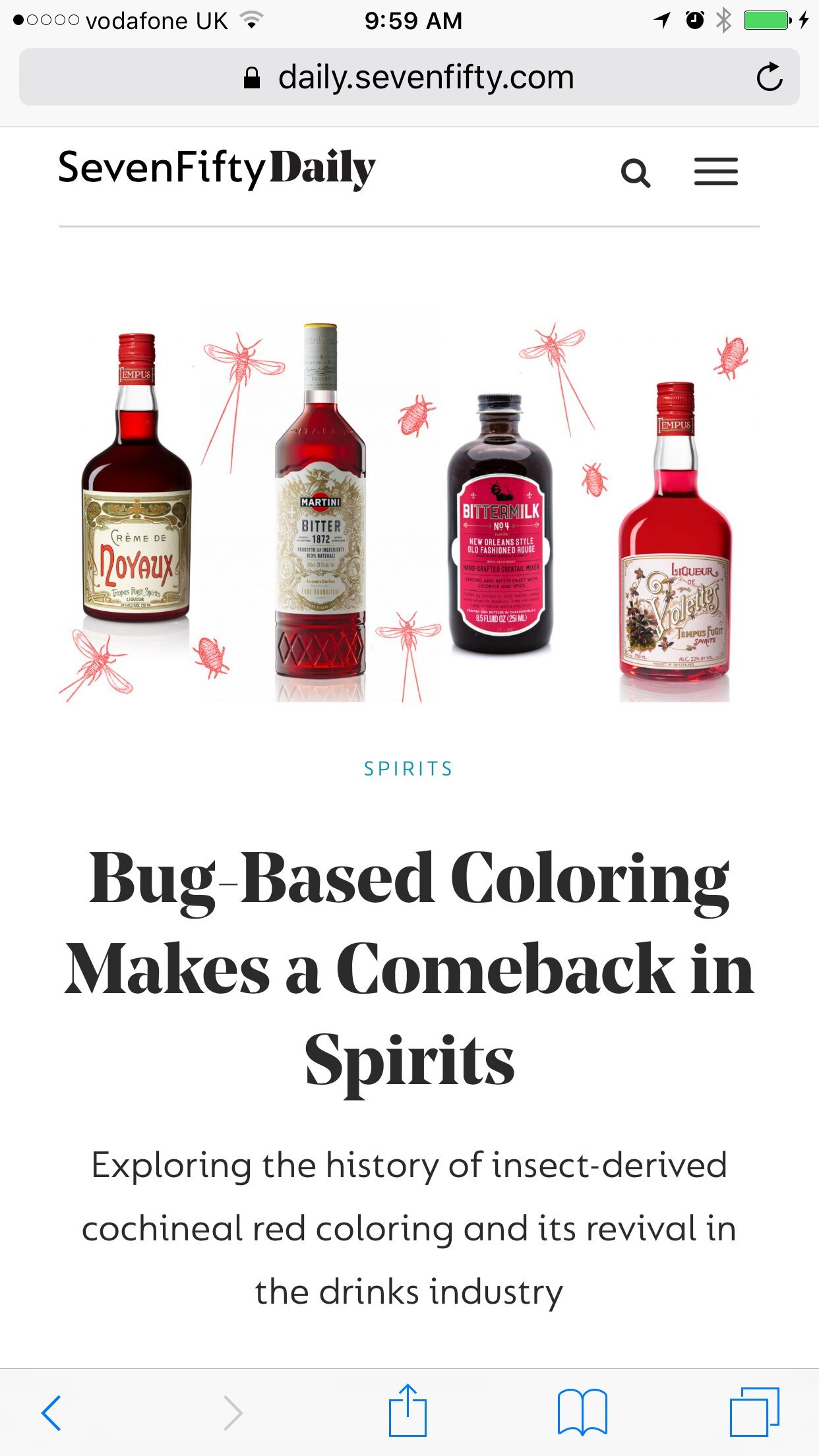
    In my latest story for SevenFifty Daily, I wrote about the return of cochineal coloring in spirits. As you probably know, Campari removed the cochineal from their formula around 2006. Now a lot of brands – some of them Campari substitutes, some not – are putting it back in. 

    Read the story here

    IMG_7945

  • This Guy will have Visited all the World’s 50 Best Bars

    Nico de Soto of Mace in New York has visited 49 out of the World's 50 Best Bars 2016 list. He'll hit the last one shortly, and if his predictions are correct, also finish the 2017 list (announced October 5th in London) soon afterward. 

    I interviewed him for SevenFifty Daily

    Screen Shot 2017-10-04 at 4.36.39 PM

  • Sensors in the Whiskey Warehouse Sending Data in Real-Time

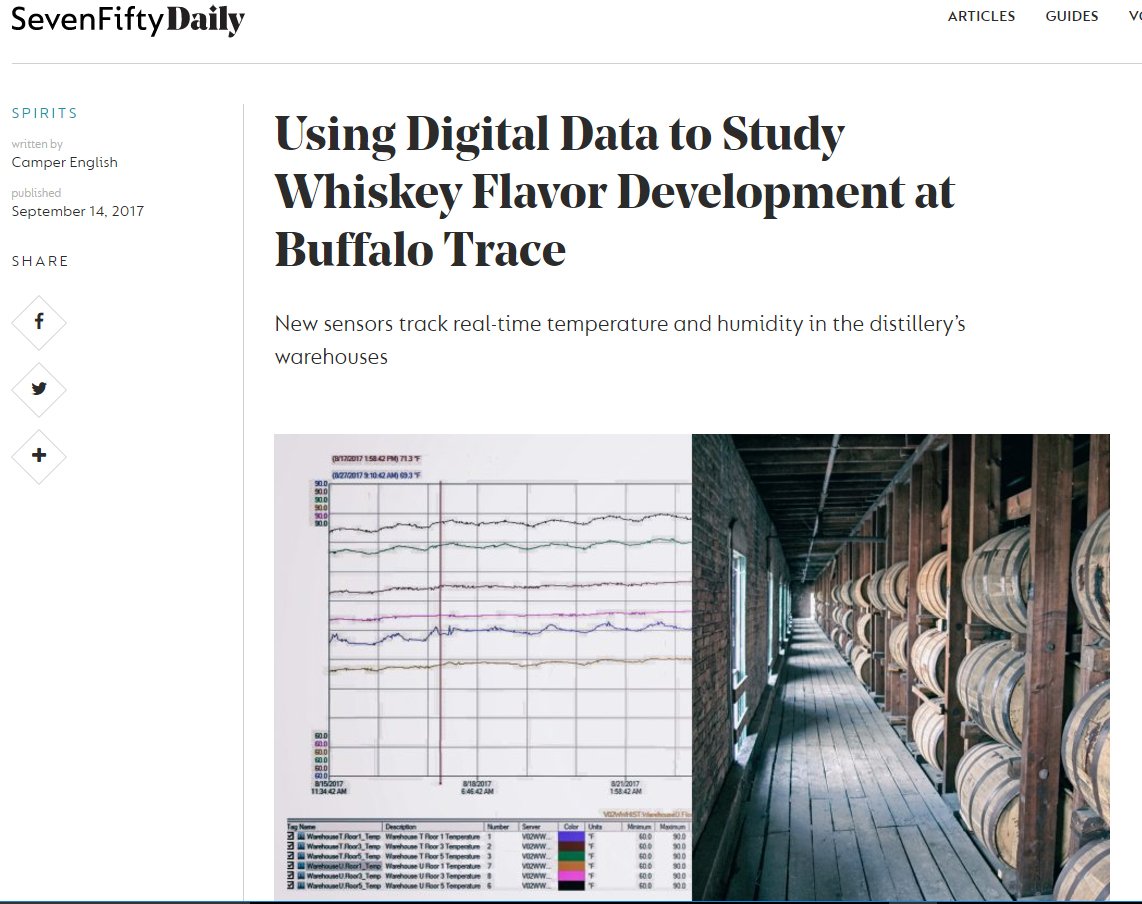
    In my latest story for SevenFifty Daily, I wrote about new temperature and humidity sensors installed in warehouses at Buffalo Trace, and what those could mean for studying aging of spirits and adjusting future blends.

    Check it out here.

    Bt

  • The ROI of TOTC

    TalesIn my latest piece for SevenFifty Daily, I asked a bunch of people about the return on investment of Tales of the Cocktail: How they measure it and how they maximize it. I also interviewed Tales' founder Ann Tuennerman to get her advice on how to maximize the event as an attendee or small brand sponsor, and addressing the question, "Is Tales too big?"

    I think there's some really good information and insight throughout the story, especially for people and brands experiencing some growing pains as Tales seems to grow ever larger. 

    Please check it out


  • New Business Models for Large Format Cocktail Ice Providers

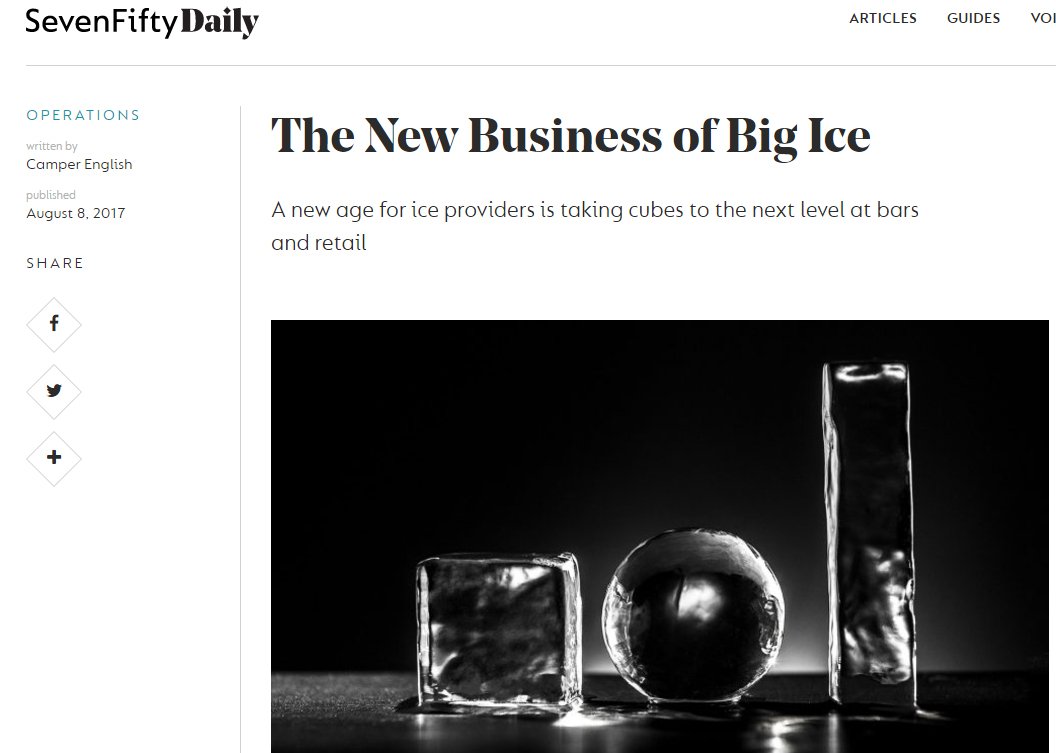
    Large format cocktail ice providers have been around for a while, but now big cube/sphere/spear providers are branching out into new shapes, sizes, making machines, and pushing into retail. 

    In a story for SevenFifty Daily, based in part on my talk at Tales of the Cocktail, I wrote about what several companies are doing to bring more larger clear ice to more people. 


    Big ice copy

  • Copyright, Trademark, and Patents for Bars, Brands, and Booze Recipes

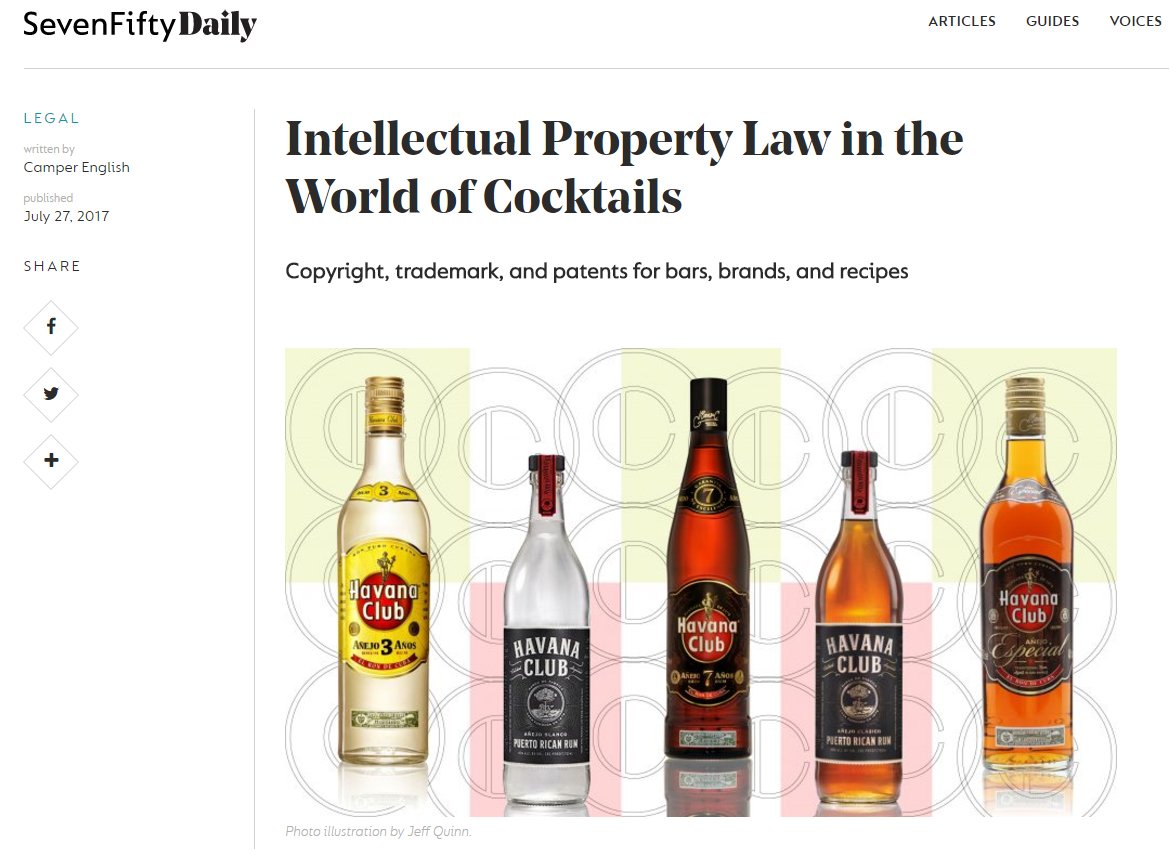
    CopyrightMy second story for the new industry-facing site Daily.SevenFifty.com is up! 

    For this one, I covered a Tales of the Cocktail seminar called Intellectual Property Law Issues in Cocktail Land. It was lead by Trademark Attorney and Hemingway enthusiast Philip Greene, along with John Mason, a lawyer with Copyright Counselors,  Steffin Oghene of Absolut Elyx, and Andrew Friedman of Liberty in Seattle. 

    It clarified the basic definitions of copyright, trademark, and patents, and there were tons of interesting examples – including the Curious Case of the Copper Pineapple!


    Check it out here


    The seminar description was:

    If I make a Dark ‘n’ Stormy, do I have to use Gosling’s Black Seal Rum? What about the Painkiller, will Pusser’s Rum sue me if I use another brand? What about those iconic (and sometimes poorly made) New Orleans classics, the Sazerac, Hurricane and the Hand Grenade, will I get a cease and desist letter from anyone if I make them at my bar claiming trademark infringement? I keep hearing about Havana Club becoming available again from Cuba, but didn’t I also hear that Bacardi is planning to market their own Havana Club? What’s up with that? And speaking of Bacardi, didn’t they sue bars and restaurants back in the 1930s because those establishments failed to use Bacardi Rum in the drink? Is that true, and how did that turn out? Did I hear correctly that Peychaud's Bitters was the center of a trademark dispute way back in the 1890s, with the same family that founded Commander's Palace? And if I create a great drink and give it an awesome name, can I patent or copyright the recipe, and trademark the name? What if I get hired by a bar or restaurant to develop their beverage program, will they own the rights to the drinks that I invented or can I retain ownership rights in the recipes and names? Join the one veteran Tales presenter who is uniquely qualified to moderate this topic, Philip Greene, intellectual property and Internet attorney by day Trademark Counsel for the U.S. Marine Corps) and cocktail historian on the side (co-founder of the Museum of the American Cocktail and author of two cocktail books, To Have and Have Another: A Hemingway Cocktail Companion and The Manhattan: The Story of the First Modern Cocktail, in an in-depth, informative and fun seminar, and learn how to make (and enjoy samples of) some of these contentious classics while discussing this highly intellectual topic!


  • Science of Spirits Aging on the new SevenFifty Daily

    I'm contributing to a new website called SevenFifty Daily. It's an offshoot of SevenFifty, a site/tool to make ordering alcohol for bars from distributors easier. 

    Thus, the site's content is positioned mostly for the industry- bartenders, managers, distributors, and brands. My first assignment (out of four!) was to cover a seminar at Tales of the Cocktail called Better Drinking Through Chemistry


    Screen Shot 2017-07-24 at 9.00.14 AM


    The topic was the science of barrel aging spirits – what we know about, and how brands use that information to develop topics with specific flavor profiles. 

    The seminar was pretty geeky, but the hardest part was getting up the next morning at 7AM to write it up after a full day at Tales. (If you've been, I'm sure you can sympathize.)

    Anyway, please give the story a read and check out the other content on Daily SevenFifty as they've already got quite a bit of good stuff.


agave alcademics Angostura bartenders bitters bodega bourbon bowmore Campari Camper English chartreuse clear clear ice cocktail cocktail powder cocktails cognac curacao dehydrated dehydrated liqueurs dehydration directional freezing distillery distillery tour distillery visit france freezing objects in ice hakushu harvest history how to make clear ice ice ice balls ice carving ice cubes ice experiments isle of jura jerez liqueur makepage making clear ice mexico midori molasses orange orange liqueur penthouse pisco potato powder production recipe Recipes rum san francisco scotch scotch whisky sherry spain spirits sugar sugarcane sweden tales of the cocktail tequila tour triple sec visit vodka whiskey whisky