Blog

  • Ice Trends in Drinks International Magazine

    The April issue of Drinks International magazine, which I just received in the mail, contains a series of articles about trends at the World's 50 Best Bars

    I wrote the one about ice, which should come as a surprise to nobody at this point. 


    • Photo 2
    • Photo (2)
    Photo (2)


    Unfortunately the story isn't online yet, so I just wanted to alert subscribers to look for the ice story on page 15 of the insert. 

    If the story appears online, I'll be sure to update this post with the link.


  • Specialty Cocktail Ice Providers

    This is a list of specialty cocktail ice providers – companies that make large, clear ice such as 2-inch cubes, spheres, and spears. Many of them also make sculpture ice but this list is not for that. 

    I haven't put them in any order, so you'll have to look through the list to find ones in your area. 

    Outside USA

    Ice cube

    Image: Chisel-It

    USA


    An index of all of the ice experiments on Alcademics can be found here.

  • Freezer Harvest: The New Ice Era on ModernFarmer.com

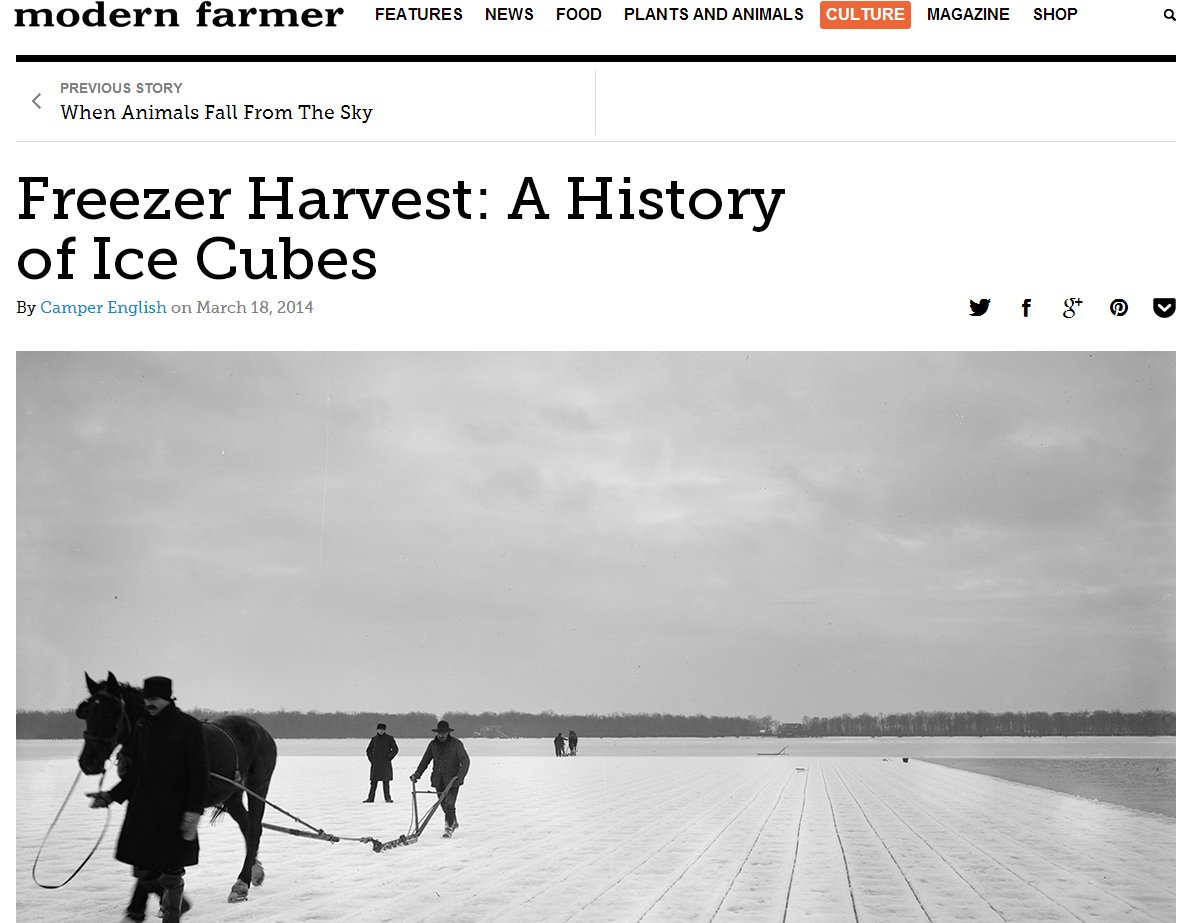
    I have a big story on ice up today on ModernFarmer.com. 

    It covers the history of ice in cocktails from the first person to sell pond ice internationally through to today's booming cocktail specialty ice businesses. 


    Modern farmer ice story

    I think you'll like it. Have a read.

    For all the stories about ice here on Alcademics, check out  the Index of Ice Experiments

  • Turquila? The Weird World of Meat-Distilled Mezcal on Details.com

    In my latest story for Details.com (upgraded to a feature!) I wrote about pechuga-style mezcals

    These are mezcal redistilled with seasonal fruits and nuts, plus a chicken or turkey (or deer or rabbit or pig) hanging in the still. 

    I thought there were only a couple on the market, but there are at least 8 different brands available in the US. I looked into the origins/history of pechuga and how a few of them differ from each other. 

    Plus: 26 different bars in which to drink it. 

    Have a look!

    DetailsMezcalStory

  • The Great Decline in Irish Whiskey

    Kilbeggan stackIrish Whiskey was once one of the most popular spirits in the world and declined from thousands of distilleries down to just two by the late 1900s. Sales are once again skyrocketing on the back of Jameson's success, but things were pretty grim for a while.

    I knew many of the causes of the decline in Irish whiskey, but learned a few more in conversation with Kilbeggan brand ambassador John Cashman. Here are reasons that he laid out.

    1. The Irish Temperence Movement in the late 1830s that flared up again later in the century.

    2. The invention of the continuous/column Coffey Still, patented in 1830. Irish distillers were hugely reluctant to adopt the column still (despite Coffey being an Irishman) that they thought diluted the flavor of their whiskey. Before the invention of the column still, Irish whiskey was far lighter in flavor than scotch whiskey, and more popular because of it. However, the scots adopted the column still for making blended whisky and saw great leaps in sales because of it. 

    3. The Irish War of Independence, which ran from 1919 – 1921 and the retaliatory Anglo-Irish Trade War after. This pretty much killed the top market for Irish whiskey: Britain. 

    Kilbeggan coffey stills4. US Prohibition, which ran from 1920-1933. This killed the second largest market in America. 

    5. World War II, which ran from 1939-1945. Ireland was neutral in the war. American soldiers developed a taste for scotch, rather than Irish, whiskey. So that continued afterward. 

    In 1966, Irish Distillers was formed to stave off the continuing slump of the category by merging three big producers together. In 1972, Bushmills also joined the group so that there was only one company and two distilleries making all Irish whiskey. 

    When I was in Ireland recently I heard that there were 16 distilleries operating, being built, or in the planning stages.  It's the dawn of a new era. 


  • A Visit to the Kilbeggan Distillery in Ireland

    A while back I visited the Kilbeggan Distillery in the middle of Ireland. Kilbeggan is in partnership with the Cooley distillery, a much larger one (without a visitors' center) that was once independent but is now owned by Jim Beam. They make not only Kilbeggan Irish whiskey, but also Tyrconnell, Greenore, and Connemara. 

    Kilbeggan map
    The distillery dates back to 1757 and they claim it is the oldest licensed distillery in Ireland. You'll note that Bushmills claims they were founded in 1604 but Kilbeggan disputes that. 


    • Kilbeggan Sign
    • Kilbeggan stack
    • Kilbeggan oldest distillery sign
    • Kilbeggan sign (2)
    Kilbeggan sign (2)


    While today Kilbeggan is a working distillery, the stuff that is working is a tiny part of the overall distillery, and most of what you see on the visit is a somewhat-working display. That said, it's a really, really cool display. 

    Most of what one sees- the huge gears and equipment- dates back to the the 1860s to 1880s. It's all wonderfully steampunk. 

    The distillery is situated near a small stream where they pulled their water and powered the operations. The water powered the water wheel which powered the millstones that ground the grains that were used as the raw material for distillation. They also used the stream to cool liquids by running pipes through it.


    • Kilbeggan water wheel2
    • Kilbeggan water wheel3
    • Kilbeggan water wheel5
    • Kilbeggan view
    • Kilbeggan9
    Kilbeggan9


    Inside the distillery there is a 150 horsepower steam engine. This would have been used only a couple of times each year when the river was too low or two high to generate power. The engine still works and they turn it on a couple of times each year.


    • Kilbeggan8
    • Kilbeggan4
    • Kilbeggan7
    • Kilbeggan5
    Kilbeggan5


    The old stills are nearly round in shape and though they're exposed to the elements now, they used to be indoors. They triple distilled the spirit here in the olden days, as is traditional for Irish whiskey. They also have original Coffey stills on display which were used to make column-distilled spirit.


    • Kilbeggan old stills1
    • Kilbeggan old stills2
    • Kilbeggan coffey stills
    • Kilbeggan wood fired7
    Kilbeggan wood fired7


    According to my host John Cashman, Ireland stopped using peat when they could import coal by train, around the 1940s.  

    The strange bulbous building is an old warehouse that they now use primarily for dumping casks before transporting it to Cooley for bottling. In the warehouse they have a few special barrels including one that was laid down in honor of President Obama's election, and another one specifically for the band Mumford & Sons. 


    • Kilbeggan storage (2)
    • Kilbeggan barrels
    • Scale
    • Kilbeggan mumford and sons
    • Kilbeggan barack obama barrel
    Kilbeggan barack obama barrel


    They are distilling at Kilbeggan, just in a small section with two tiny stills. They use a course grind of barley (because they use old wooden wash tubs that can't handle smaller grains) and ferment it for about 3 days until it reaches 6-8% ABV. They then distill it twice in tiny stills, first up to 20-22% then up to 68-70% ABV. 

    The still for the second distillation is actually the oldest working pot still in the world, according to Cashman. It comes from the old Tullamore distillery. (Part of the reason it has survived so long is that for a good while it was only used to distill water.)


    • Kilbeggan active stills
    • Kilbeggan active stills3
    Kilbeggan active stills3


    During a tasting of the product range, Cashman made an interesting claim: "The smoothness of Irish whiskey is not due to triple distillation but it's due to our climate. It is the lack of extreme (temperature fluctuations) that allows Irish whiskey to age at a mild and mellow pace." 

    I got to try the range of whiskies made at Kilbeggan and/or Cooley:

    • Greenore Single Grain – an Eight year old grain (column distilled) whiskey
    • Kilbeggan – a blend of Cooley grain whiskey and malt whiskey distilled at Kilbeggan
    • Kilbeggan 18 Year, which has been discontinued
    • Kilbeggan Distillery Reserve Malt, which is aged 3-4 years ina quarter cask
    • Tyrconnel, apparently the biggest selling Irish whiskey in the US before Prohibition. It is a single malt that is finished in casks: Madeira, port, or sherry. All of them are 46% non chill filtered
    • Connemara, which is the peated Irish whiskey made at Cooley. It is 100% peated single-malt with no age statement. It's peated to just 14 ppm phenol but since the whiskey is so light the peat has a stronger effect. They use 4, 6, and 8 year old whiskies in the blend.
    • Connemara Turf Mor, which is a heavily peated (54 ppm) single malt aged 3 years and sold at cask strength
    • Connemara Bog Oak – a blend of 3 year Turf More and 18 year Connemara that are married in a barrel with "bog oak" cask ends

    Kilbeggan tasting

    Kilbeggan is one of the coolest looking distilleries I've visited, somewhere in technology between the amazing wooden gristmill of George Washington's distillery at Mount Vernon and the rhum agricole distilleries of Martinique with their huge working gears. It's defnitely worth a visit if you're driving across Ireland. 


  • How Much Pappy Van Winkle is Left After 23 Years in a Barrel?

    Vanwinkel23_1__99283.1358021587.1280.1280The most sought-after bourbon in the world, Pappy Van Winkle 23-year-old, begins life as 53 gallons of new-make whiskey at 114 proof. 

    What's left in the barrel after 23 years is a mere 14 gallons of bourbon at around 135-140 proof. What makes it into the bottle is even less. 

    So I decided to run the numbers on how much Pappy Van Winkle is left in the barrel every year after evaporation (aka the "angel's share").

    According to Harlen Wheately, Master Distiller at Buffalo Trace, the angel's share is 10 percent for the first year (because whiskey is absorbing into the wood of barrel as well as evaporating), then 4 percent for the next 8 years after that, then around 3 percent per year after that. 

    (They store the future Pappy in barrels in the parts of the warehouse with the least evaporation as they know they want it to age for a very long time.)


    Pappy Van Winkle 23 Countdown
    Year Angel's Share (Percent) Math Total
    1 0.1 53 -(.10)*53 47.7
    2 0.04 =D3-(D3*B4) 45.792
    3 0.04 =D4-(D4*B5) 43.96032
    4 0.04 =D5-(D5*B6) 42.2019072
    5 0.04 =D6-(D6*B7) 40.513830912
    6 0.04 =D7-(D7*B8) 38.89327767552
    7 0.04 =D8-(D8*B9) 37.3375465684992
    8 0.04 =D9-(D9*B10) 35.8440447057592
    9 0.04 =D10-(D10*B11) 34.4102829175289
    10 0.03 =D11-(D11*B12) 33.377974430003
    11 0.03 =D12-(D12*B13) 32.3766351971029
    12 0.03 =D13-(D13*B14) 31.4053361411898
    13 0.03 =D14-(D14*B15) 30.4631760569541
    14 0.03 =D15-(D15*B16) 29.5492807752455
    15 0.03 =D16-(D16*B17) 28.6628023519881
    16 0.03 =D17-(D17*B18) 27.8029182814285
    17 0.03 =D18-(D18*B19) 26.9688307329856
    18 0.03 =D19-(D19*B20) 26.1597658109961
    19 0.03 =D20-(D20*B21) 25.3749728366662
    20 0.03 =D21-(D21*B22) 24.6137236515662
    21 0.03 =D22-(D22*B23) 23.8753119420192
    22 0.03 =D23-(D23*B24) 23.1590525837586
    23 0.03 =D24-(D24*B25) 22.4642810062459
           

    According to those calculations, there are 22.4 gallons left in the barrel, but this assumes that the alcohol percentage stays the same as it started. 

    The actual final proof is around 140 (70% ABV), so the 14 gallons that Wheately reports are equivalent to about 17.2 gallons at the original proof of 114 (57% ABV). That's a lot closer to the calculated number. 

    Wheately filled me in on some other practical factors for the math discrepancy.

    “We have done a lot of proprietary work to determine the real proof drop while the barrels are aging so I wouldn’t want to reveal all our info…. (but)

    While processing such small batches you get quite a bit of loss during the bottling process during the filtration process.

    Also, during the course of 23 years there tends to be other factors such as leaks that increase the loss and are difficult to put numbers to.

    A typical/perfect 23 year old barrel of wheated bourbon should yield about 14 wine gallons with about a 1-2 gallon loss during bottling which gets it down to 12-13 wine gallons recovered.”

    So when you're paying for a bottle of Pappy Van Winkle 23 even at non-surge pricing, you're not just paying for the raw materials used to make and the time spent to age what's in that bottle, you're also paying for the raw materials and aging of 39 gallons of bourbon that evaporated before it got to the bottling facility, and a total of nearly 80% of the original juice that didn't make it into the bottle. 


  • Gamsei, A Hyperlocal Molecular Mixology Bar in Munich

    Saveur 100 cover officialI've been bursting waiting for the Saveur 100 issue to come out so I could write more about Gamsei, a bar I visited in Munich this fall and included in the January issue of the magazine. 

    The story is now online at Saveur.com, with a lot more info below.

    Gamsei online


    Gamsei comes from Matt Bax, the founder/co-founder of Der Raum and Bar Americano in Melbourne and Tippling Club in Singapore.

    From the write-ups of Gamsei, it sounded like a place with a lot of rules (you have to wear slippers inside, no sugar in the drinks, no photos allowed) but much of that was either incorrect or more like a general policy than a rule. 

    The seating in Gamsei is on bleacher-style steps on either side of the central "bar", which is more of a low counter like you'd find in a science lab. Those slippers are for people who sit on the upper levels, so their muddy/wet shoes won't drip on the people below them. 

    I had also heard all about the hyper-local vision of the bar but not about the high-tech aspect of it. I was expecting a simplistic Japanese take on in-season cocktails, so the rotovap and liquid nitrogen came as a pleasant surprise.

    Really, what Bax has done is just taken the idea of preserving local bounty and given it an exciting update. The bartenders forage in the forests (he said he checks with a plant expert to make sure certain things aren't poison before using them) and buy stuff at farmers' markets in season and use them fresh or preserve them using old-world techniques like fermentation, syrup-making, kombuchas, drying, etc. as well as new-world techniques like running infusions through the Rotavap so that they never spoil and flash-freezing other ingredients with liquid nitrogen.


    As mentioned in the story, my favorite drink was the Lindenbluten, a local "lime blossom" (not the citrus tree) leaf and flowers frozen into an ice cube, and that ice cube used to chill and flavor house-carbonated local vermouth. Simple, elegant, beautiful. (But a terrible picture, sorry.)

    Gamsei2

    At service, you get a mix of simple-looking drinks as well as some of the tricks you might expect from Bax – liquid nitrogen, beer foam, a drink in a flask. I had one that came with a a puff of cotton candy ("candy floss" to our European friends) that you use to sweeten a cocktail made with caraway liqueur, brandy, and riesling. 


    Gamsei1

    That puffy thing is cotton candy that you add to the cocktail to sweeten it.


    All-in-all, the philosophy isn't that complicated and the rules aren't that strict. It's a unique set-up for a cool bar concept. Absolutely worth a visit when you find yourself in Munich. (And Munich is pretty darn worth a visit on its own- I've gotta get back there soon.)

    Here's the menu from that day:


    Gamsei menu

    The arrows direct you from lighter starter drinks to richer heavier ones.


  • A Wide Range Of Amari & Cocktails In Which To Use Them in Saveur Magazine

    Saveur 100 cover officialIf you hadn't heard, your host Camper English is the Contributing Drinks Editor at Saveur Magazine now. Hooray!

    The current January issue is the annual Saveur 100: "Our favorite places, tools, ingredients, cookbooks, recipes, restaurants, and more."

    I have two small bits in the magazine. The first is on Amari (plural of Amaro) and cocktails to use them in.


    Amari online

    Read the story with tasting notes here and the cocktail recipes are in slideshow format here.

    For the cocktail recipes, I sourced them from:

    • Max Grecco of Vasco in Sydney, Australia
    • Renato “Tato” Giovannoni of Florerèa Atlántico in Buenos Aires
    • Jackson Cannon of Island Creek Oyster Bar in Boston
    • Patrick Poelvoorde of San Francisco's Park Tavern

    Thanks fellas. 


agave alcademics Angostura bartenders bitters bodega bourbon bowmore Campari Camper English chartreuse clear clear ice cocktail cocktail powder cocktails cognac curacao dehydrated dehydrated liqueurs dehydration directional freezing distillery distillery tour distillery visit france freezing objects in ice hakushu harvest history how to make clear ice ice ice balls ice carving ice cubes ice experiments isle of jura jerez liqueur makepage making clear ice mexico midori molasses orange orange liqueur penthouse pisco potato powder production recipe Recipes rum san francisco scotch scotch whisky sherry spain spirits sugar sugarcane sweden tales of the cocktail tequila tour triple sec visit vodka whiskey whisky