Blog

  • Buffalo Trace Distillery Visit

    This spring I visited 8 American whiskey distilleries, including Buffalo Trace. Buffalo Trace is owned by the Sazerac company. They make Buffalo Trace, Blanton's, Elmer T. Lee, Eagle Rare, Van Winkle, and other whiskey brands, plus the make/own/import other spirits including Rain vodka, Puebla Viejo tequila, and Glenfarclass scotch. 

    Unlike most of the other American whiskey distilleries I visited, Buffalo Trace feels like a campus or a mini factory town. Other distilleries have just the central distillery and bottling line, but the aging warehouses are spread further afield. They're closer by at Buffalo Trace.

    Buffalo Trace Distillery4_tn
    Buffalo Trace Distillery4_tn
    Buffalo Trace Distillery4_tn

    The name Buffalo Trace comes from the paths that the buffalo took to this area, where they would cross the river. The distillery is located where several paths intersected. Our guide Freddie said that this site is also probably where the first bourbons were ever shipped down the river to New Orleans in the early days of bourbon. 

    Here at Buffalo Trace, several rickhouses are built of brick on the outside and have many windows, unlike the typical metal-clad warehouses. However, the inside of the brick warehouses are wooden structures that hold the barrels, not connected to the outside framework. 

    Buffalo Trace Distillery7_tn

    Having all of this close together makes for a good tour- you can walk from building to building  (as I did) and see every part of the distilling, aging, and bottling operation. 

    Buffalo Trace launched the first single-barrel bourbon, Blanton's, in 1984. We saw it being bottled. We also saw the vats for chill filtration, which was helpful as I was about to give a talk about filtration in spirits right after my visit. 

    Buffalo Trace Distillery chill filtration_tn

    We were also treated to seeing the bitters room, where they make Peychaud's and Regan's Orange bitters. I got to try those suckers out of the tap! To make them, they add the ingredients to one of 7 little tanks, age them 2 weeks, filter the solids, let them rest a week, and then bottle them. 

      Buffalo Trace Distillery bitters room_tn
    Buffalo Trace Distillery bitters room_tn

    Visiting Buffalo Trace

    Information about visiting the distillery is found at BuffaloTraceDistillery.com. There are regular tours, hard hat tours, tours specializing in the time right after Prohibition, and even a nighttime ghost tour. 

    Buffalo Trace Distillery packing peanut tree2_tn

  • Blue Cocktails on Details.com

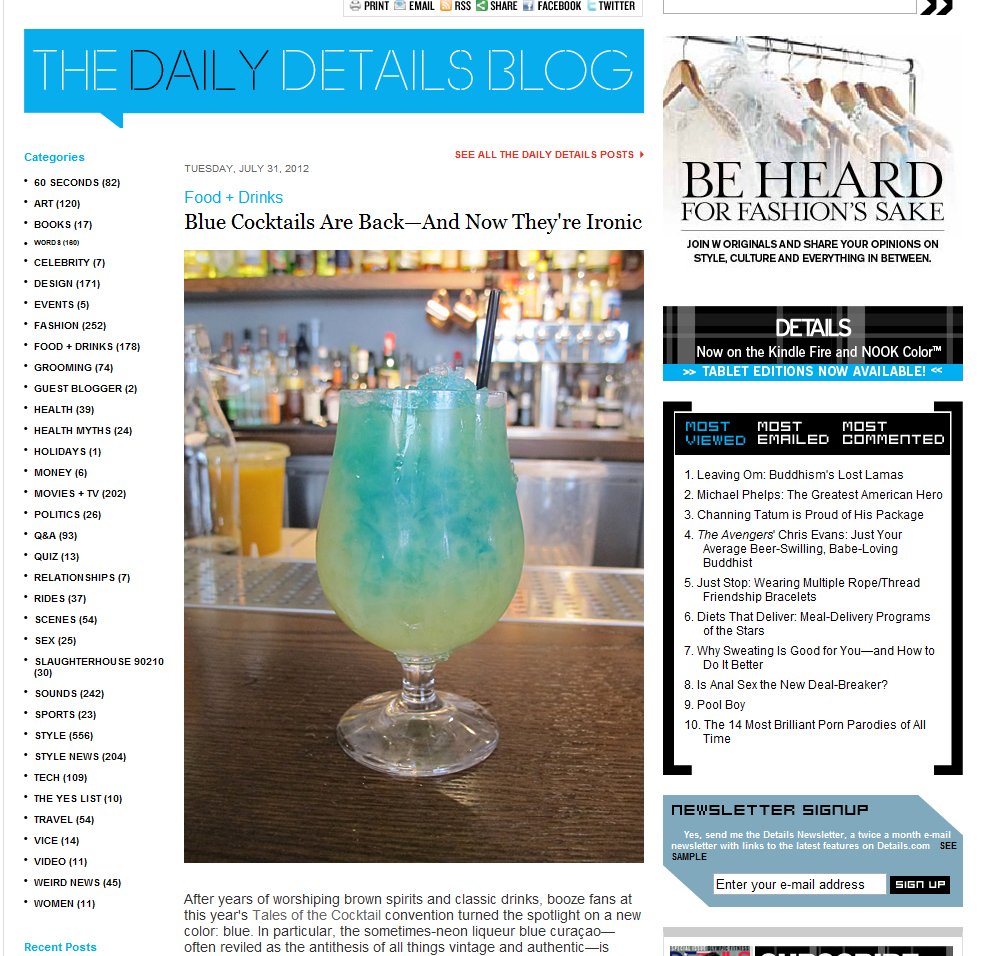
    I attended an awesome seminar on blue drinks at Tales of the Cocktail this weekend, lead by Sebastian Reaburn, Jacob Briars, and Phil Duff. 

    Then I wrote a piece about it for Details.com, the website of Details magazine. It's my first story for the website. 

    Details Blue Cocktails Story

    I learned a lot more in the seminar than is in the story, which is more of a trend piece.

    Fun facts:

    • Phil Duff worked at the same bar Tom Cruise trained at to prepare for the movie Cocktail (not at the same time)
    • The first known blue drink was a non-alcoholic soda called Soyer's Nectar, from 1851. It was created by Alexis Soyer, the first celebrity chef. 
    • Blue cocktails were futuristic. "In the 1860s people were excited about the future; now we're merely afraid," said Jacob Briars.
    • The first known blue cocktail was from 1908.
    • Modern blue cocktails may start with the Blue Hawaiian from 1957 – at the end of the classic rum-heavy tiki drinks at the beginning of the silly ones.
    • Blue cocktails are popular in countries that either never had a super serious classic cocktail phase (Asia) or in places and with people that have gotten beyond it, like New Zealand and the top cocktail bars mentioned in the story.

    Anyway, I hope you enjoy the story on Details.com!


  • Another Way to Make Clear Ice at Home

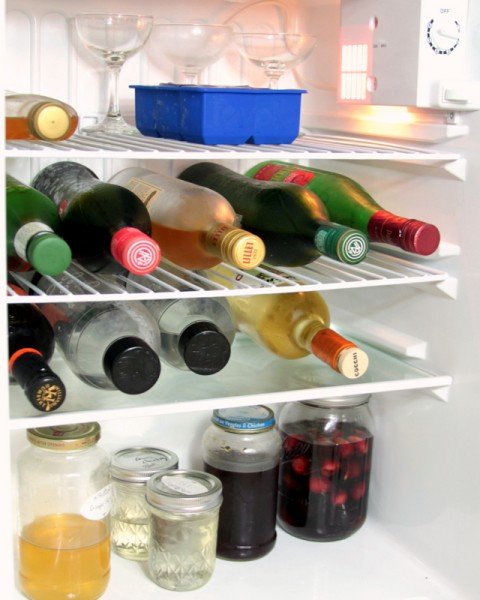
    I am honored to have as Alcademics readers people who are just as huge cocktail nerds as I am. Many take on projects that I run out of time to do, pass along better information to me, or fill me in on the science I'm missing.

    Kevin Liu, who has recently started the blog Craft Cocktails at Home and also blogs at ScienceFare.org, tested a method of making clear ice that another reader left in blog comments. 

    In this post, he discusses the science of clear ice and two methods to make it at home.

    1. The Igloo Cooler method, pioneered here on Alcademics. (An index of all of the ice experiments on Alcademics can be found here.)
    2. The High-Temperature Freezing method, in which you let water freeze into ice at just below the freezing temperature. It's also simple, and depending on your freezer may not take up as much space.

    Read the post for more info. 

    IMG_7015-480x600

  • Heaven Hill Distillery Visit

    This spring I visited 8 American whiskey distilleries, including Heaven Hill.

    Heaven Hill Distillery8crop

    Heaven Hill makes whisky brands Evan Williams (the second largest bourbon after Jim Beam), Elijah Craig, Bernheim Wheat Whiskey, Old Fitzgerald, Rittenhouse Rye, and Georgia Moon Corn Whiskey, plus they make and/or own Burnett's vodka, Hypnotiq, Lunazul tequila, and many other brands. They are the only company that makes all of  bourbon, rye, corn whiskey, and wheat whiskey. They have nearly 1 million barrels in storage. 

    Though the visitors' center and many rickhouses are here, the distillery is elsewhere – the distillery and many warehouses burned down in a major fire in 1996. After the fire they purchased the Bernheim distillery in Louisville to do the distillation, along with some rickhouses there. 

    Heaven Hill Distillery visitors center_tn

    For three generations, master distillers at Heaven Hill have been descendants of Jim Beam. 

    Heaven Hill Distillery beam family tree_tn

    We visited one of the warehouses – actually the rickhouse in which several "whisky of the year"s have aged. It is seven floors tall and we walked to the top for the view. Most of those "best whiskies" were aged on the top floor here.

    Heaven Hill Distillery rickhouse_tn

    Our guide pointed out where the distillery was that burned down. 

    Heaven Hill Distillery view from rickhouse_tn

    For all their bourbons, they use a single mashbill. (They didn't give out the specific numbers but said it's about 70% corn and 10% each rye and malted barley. Update: see the comments for specifics.) Between all the brands, age and proof are the only differences; not the recipe. When they distill a spirit and put it into a barrel, it's not designated to be a specific brand – they pull barrels as needed to make specific flavor profiles of their products. 

    Heaven Hill Distillery2_tn

    Visiting Heaven Hill

    The Bourbon Heritage Center opened in 2004, and still looks shiny and new. Inside, you get the typical displays of bourbon history and the history of the company, plus there is a cool round bar tasting room inside.  

    There are several tours available – mini tour inside the visitors' center, an 1.5 hour tour that visits a rickhouse as I did, a trolley tour around downtown Bardstown, and a 3 hour "Behind the Scenes" tour. More information about visiting Heaven Hill is here.


  • Noilly Prat Vermouth: The Differences Between Original Dry, Rouge, and Ambre

    In yesterday's post I discussed how Noilly Prat vermouth is made, as learned on my visit to the vermoutherie in Marseillan, France. Today I want to talk about the differences between the types of vermouth they make. 

    In most parts of the world, Original Dry is the only Noilly Prat. The Rouge is primarily for the US market, and the Ambre is available in a few liquor stores in Europe and at the distillery. (The Rouge is also available at the distillery.) 

    Three types of Noilly Prat Marseillan France_tn

    Noilly Prat Original Dry

    One-year-aged clairette and picpoul wines, aged, fortified sweet mistelle wine the from muscat grape, a raspberry and lemon-infused distillate are combined and infused wtih herbs and spices. The filtered results of this are then aged for three more weeks. 

    The Original Dry is macerated with 20 ingredients. These include: 

    • Chamomille. This is the dominant note. As a delicate dried flower, this maceration is done separately from the main maceration. Chamomille gives the vermouth both a slight bitterness and the dry finish. 
    • Nutmeg.
    • Bitter orange peels from Tunisia. 
    • Gentian. This adds bitter and earthy notes. Gentian is used in gin and many perfumes to add base notes. 
    • Wormwood. By European law, all vermouth contains wormwood. The word "vermouth" actually comes from the German word for wormwood.

    Three types of Noilly Prat Marseillan France (2)_tn

    Noilly Prat Rouge

    This is Noilly Prat's sweet vermouth, which was created in 1956. It uses the same base wines, but also includes caramel coloring to give it its red hue. (Many people assume sweet vermouths are made from red wines- nope!) The Rouge calls for the same 20 ingredients as the Original Dry, but used in different ratios than the dry. It then adds an additional 5 ingredients not found in the Original Dry, for 25 ingredients in total. These ingredients include:

    • Cloves
    • Coco beans from Venezuela
    • Saffron
    • Quinine (like in tonic water)

    Noilly Prat Ambre

    This is basically a special 'distillery edition' of vermouth, only available here and in a few important wine shops in Europe. It is amber in color and much sweeter than the Original Dry- in fact sweeter than the Rouge. It contains all of the 25 herbs and spices used in Rouge, plus 24 additional ingredients, for a total of 49 herbs and spices. These include:

    • Cardamom
    • Lavender
    • Cinnamon
    • Rose petals
    • Vanilla

    There is also an Extra-Dry coming to the US market this fall, but I'll save that for another post… Update! Here is a post about the Extra-Dry vermouth

  • Making Vermouth: A Trip to Noilly Prat in Marseillan, France

    Though vermouth as an essential ingredient in cocktails, I never gave much though to its production, figuring it was just a simple infusion of herbs in fortified wine. It turns out there is a lot more to it than that. 

    This June I visited Marseillan, France, the home of Noilly Prat vermouth. There, it is pronounced "No-ah-lee Pra" or "No-ah-lee Praht". 

    This brand is considered the first commercial dry-style vermouth in the world, dating to 1813. The recipe was created then in Marseilles by Joseph Noilly. His son moved production to Marseillan in 1850 and his when his grandson-in-law joined the company it became Noilly Prat. In the early 1970s Noilly Prat was purchased by Martini & Rossi, and that company was purchased by Bacardi in the early 1990s. 

    Marseillan france map
    Marseillan france map

    Marseillan is a small fishing town in the Southeast of France, located near the vineyards of the Languedoc region, which abut the oyster farms separated from the Mediterranean Sea by a small strip of land. Not coincidentally, Noilly Prat Dry is served with oysters in the region, and oysters are served everywhere.

    Marseillan France6_tn

    Vermouth is a fortified, aromatized wine. So let's get into how it is made. 

    The Wines in Noilly Prat

    Three kinds of wine go into Noilly Prat Original Dry: Picpoul, Clairette, and muscat for the sweetening mistelle. Many of the wines are grown next to the ocean Mediterranean Sea, adjacent to the oyster farms. What grows together, goes together. 


    Vineyard Noilly Prat Marseillan France1_tn

    Those rows of things in the water beyond the vines are oyster tables

    Vineyard Noilly Prat Marseillan France1_tn


    Picpoul is an AOC wine in the area, smelling and tasting citrusy and a little tart. It too pairs with the local seafood. It makes up 60 percent of the wine in Noilly Prat. 

    Clairette, making up the other 40% of the wine blend in Noilly Prat, is less acidic than picpoul. It is fruitier and less citrusy than picpoul.

    These wines are usually harvested in September. Noilly Prat doesn't own the vineyards but purchases them from local cooperatives. In fact, they buy wines, not the grapes themselves. The wines are 12.5 to 14 percent alcohol by volume, and not aged in oak (yet).

    The Mistelle is the sweetening agent for Noilly Prat. Is is made from the partially fermented muscat grape juice. Fermentation is stopped by adding spirit (neutral sugar beet spirit) before it fully completes, leaving the wine very sweet at around 100 grams per liter sugar content. 

    The room where the mistelle ages is filled with huge vats. It dates back to around 1850. The vats were so big they were installed first, and then the building was built around them. In this room the mistelle ages for a year. 

    Mistelle room Noilly Prat Marseillan France3_tn
    Mistelle room Noilly Prat Marseillan France3_tn

    Aging The Wines

    In the olden days,wines would have been sent out on boats to their destinations, aging in barrels along the way. However with faster transportation the wine was not the same. So Noilly Prat began replicating the aging step with their unique method called L'Enclos. 

    Behind the front building at the Maison of Noilly Prat is a courtyard, and in this courtyard are 2,000 barrels where the picpoul and clairette wines age separately outdoors for a full year, oxidizing and taking on aspects of the salty sea air. 

    LEnclose barrels Noilly Prat Marseillan France12_tn
    LEnclose barrels Noilly Prat Marseillan France12_tn

    LEnclose barrels Noilly Prat Marseillan France12_tn

    The barrels are watered regularly to minimize evaporation of the wine


    Before aging these wines are fortified (with neutral sugar beet distillate) to 18 percent for picpoul and 16 percent for the clairette. We sampled wines aged about 6 months from the barrels – the picpoul wine still tasted very citrusy (apparently picpoul means something like "lip stinger") but took on an oxidized smell that reminded me of flan. The Clairette also tasted oxidized and quite salty, reminded me a little bit of manzanilla sherry.

    All the wine for Noilly Prat ages in this one courtyard, though they have more room in other courtyards should we start drinking more vermouth.

    The barrels used are all more than 30 years old, some of them more than 100 years old. I believe they said they purchase them from scotch whisky distilleries, but they didn't look to me like ex-bourbon barrels but ex-sherry butts and ex-port pipes as they were all larger than the typical 55 gallon barrels of bourbon.  

    As the barrels are so old (thus quite neutral and won't lend woody characteristics to the wine), there is a cooperage repair shop on site, located in a building where they used to distill absinthe. 


    Eiffel staircase Noilly Prat Marseillan France (2)_tn

    In the cooperage. That staircase? Designed by a guy named Eiffel.


    Infusing the Vermouth, and One Last Aging 

    Indoors in the Vermoutherie, the aged wines and aged mistelle are transferred here. Another distillate now comes into the equation: Lemon peels and raspberries are macerated in neutral sugar beet spirit for one week and then redistilled in a pot still to 76 percent alcohol. This flavored distillate is then used to further fortify the wine.


    Still Noilly Prat Marseillan France_tn

    Pot still of the same kind used to make the lemon-raspberry flavored distillate.


    In 2050 liter oval pine wood vats, the aged picpoul, clairette, and mistelle, plus the flavored distillate, are infused with the custom blend of herbs and spices for three weeks. 

    Every day during this period a person stirs the macerating wine for two minutes with a special sickle-shaped tool for the purpose. 

    La Salle Des Secrets Noilly Prat Marseillan France (2)_tn
    La Salle Des Secrets Noilly Prat Marseillan France (2)_tn

    La Salle Des Secrets Noilly Prat Marseillan France (2)_tn

    Stirring the macerating herbs


    After maceration, the vermouth is filtered in a big rotary filter to remove the herb particles. The vermouth is then further aged 3 more months in the same sized vats that hold the mistelle. 

    In tomorrow's post, I'll discuss the different herbs and spices (plus a few other production differences) used in Noilly Prat Original Dry, Rouge, and Ambre. 

    But I hope this post makes it clear that producing vermouth (at least this vermouth) is no simple business. I no longer just twist open a bottle and dump it into my cocktails- I now pour a bit into a glass with a single ice cube and savor it on its own first. Props.

    Logo Noilly Prat Marseillan France_tn

    Next Up: Read about the differences between Noilly Prat Original Dry, Rouge, and Ambre

    Then read about the new Extra Dry on the US market in summer 2013 and the difference between Original Dry and Extra Dry.

  • A Sneak Peak at Jim Beam’s New Visitors’ Center

    I previously visited the Jim Beam distillery in Kentucky and got a great in-depth tour of the facilities (read about it here), but until recently regular tourists have only had a pretty mediocre visitor's experience. They didn't get to see the actual distillery as it's a very industrial workplace. 

    Now they're greatly expanding the visitors' center, with a set of new outdoor displays as to the history and process of making Jim Beam, plus a big new building. Tourists will also take a shuttle and get to go to the bottling line – which I saw and wrote about before and it's pretty amazing, even if you've seen 30 other bottling lines. 

    Below are some pictures of the new exhibits.  


    Jim Beam Distillery2_tn

    The old Jim Beam visitors' center that will become the tasting room
    Jim Beam Distillery new visit exhibit_tn

    A display of vintage distilling on the new walking path

    Jim Beam Distillery new visit exhibit_tn

    Future cooperage exhibit at new Jim Beam visitors' center

    Jim Beam Distillery new visit exhibit_tn

    New Jim Beam visitors' center

    Jim Beam Distillery new visit exhibit_tn

    Picture of new Jim Beam visitors' center
  • Maker’s Mark Distillery Visit 2012

    This spring I visited the Maker's Mark distillery, along with seven other American whiskey distilleries in Kentucky and Tennessee. I had previously been to Maker's Mark and wrote about my visit here. As you'll read, I learned a lot of different stuff on this trip. 

    Makers Mark Distillery8_tn

     Maker's Mark uses a mashbill of 70% corn, 16% soft red winter wheat, and 14% malted barley. Bourbon must be a minimum of 51% corn but 70+ is normal. Malted barley is always used to aid in fermentation, and the remaining percent is usually made of up rye or wheat, more often rye. 

    At Maker's they prepare the grains a little differently than at other distilleries. They use a roller mill to crunch up the grains, rather than a hammer mill. This cracks the husk of the wheat but leaves it intact. The husks do go into the boiler with the other grains, but they boil it at a relatively low temperature so it won't break down and become available to the yeast for fermentation. They also cook their grains (to prepare them for fermentation) in an open-topped cookers, rather than pressure cooking them. 

    The grains are then fermented with yeast for three days. 

    Makers Mark Distillery fermenting grains_tn

    The fermented grains are then distilled, up to 120 proof in the column still, and then up to 130 in the doubler. We smelled the two distillates: The first was very oily and minerally. After the second distillation it smelled fruity and light, like a typical white dog. 

    Makers Mark Distillery column still_tn

    They put the new spirit into barrels at 110 proof. Most of the warehouses for Maker's Mark at six storeys tall. They are the only bourbon distillery that rotates all of their barrels throughout the aging process. Barrels are first racked on the top floors, then moved after two years and then moved lower again after another two. 

    Makers Mark Distillery Rob Samuels_tn

    Maker's 46, a new bourbon from Maker's Mark, begins as the same distillate, aged for the same amount of time. It is then aged an additional 8-11 weeks in barrels with 10 seared French oak staves in the barrels. They do this only in the winter, as that way the liquid sucks flavor out of the staves rather than sucking liquid into the wood of the staves as it would do in the hotter months of summer. I think the final product tastes like wood-spiced Maker's Mark- pretty tasty. 

    Visiting Maker's Mark

    Free tours are available. Check the Maker's Mark website for more information. 

  • Woodford Reserve Distillery Visit

    This spring I visited eight American whiskey distilleries, including Woodford Reserve. 

    Woodford Reserve Distillery building_tn

    Woodford Reserve's distillery is in a charming setting, nestled down next to a stream in a little valley. The distillery is in a grey stone building dating to 1838, though everything inside it is new. Like most American whiskey distilleries, it changed names and owners many times over the years, changing to the Woodford Reserve distillery in 2004.

    Woodford Reserve grounds3_tn
    Woodford Reserve grounds3_tn

    Woodford Reserve is made from a mashbill of 72% corn, 18% rye, and 10% malted barley. They use limestone-filtered well water to ferment the grains in Cyprus wood fermentation vats. They ferment for six days – quite a long time. The fermenting grains taste very sour, kind of like sour green beer. 

    Woodford Reserve Distillery fermenter2_tn

    The sour mash process is where you take leftover grains that have been fermented back into the new batch of grains that are going to be fermented. Here at Woodford Reserve, they "sour in the cook" as opposed to souring in the fermenter. That means they add the last batch's spent grains to the new grains when it is being cooked, previous to when yeast is added for fermentation. Sour mash is known for keeping consistency between batches, but also it is acidic and helps reduce bacteria in the new batch.

    Woodford Reserve is unique in that they make a portion of their whiskey in pot stills. The stills look much as they do in Scotland, but here there are three of them. In Scotland, after the grains have fermented they separate out the grain solids from the sugary beer and only distill the liquids. In bourbon, solids and liquids are put together into the column still. So at Woodford Reserve, they put solids and liquids into the first pot still and distill it only up to 20 percent alcohol. For the most part they are just separating out the solids in this step, taking care not to burn them into the inside of the still.

    Woodford Reserve Distillery 3 stills_tn

    The second and third distillations bring the alcohol up to 55 percent and 78 percent (this is just under the legal limit of 80 percent maximum distillation percent for bourbon), and then it is put into barrels. The spirit goes into the barrels at 55 percent alcohol. 

    The rickhouses for the aging spirits are heated for Woodford Reserve. They put a temperature sensor in a barrel on the ground level. When it reaches 60 degrees Fahrenheit, they heat the warehouse until the spirit reaches 85 degrees and then turn off the heat. This makes for faster cycles of the spirit moving in and out of the barrel wood. 

    Woodford Reserve Distillery rickhouse3_tn

    Woodford Reserve is aged for an average of 7.3 years, and when they take it out of the barrel, they've lost about 50% of the whiskey to evaporation. 

    After aging, the pot distilled spirit is blended with column distilled spirit (distilled elsewhere) to make the final bottling blend. They do not say at which ratio these two spirits are blended for the bottle (and they didn't mention the column spirit at all until it came up in conversation), but say that it changes depending on flavor.  

    Woodford Reserve Distillery barrel_tn
    Woodford Reserve Distillery barrel_tn

    Visiting Woodford Reserve

    Tours of the Woodford Reserve distillery cost $7. It is the most visited distillery on the Kentucky Bourbon Trail, despite the fact that they only sell 165,000 cases of bourbon annually- a tiny fraction of what Jim Beam sells. For more information, visit the Woodford Reserve website.

    Woodford Reserve grounds4_tn
    Camper at Woodford Reserve Distillery_tn

  • Best Business Bars in Entrepreneur Magazine

    I contributed a few write-ups to Entrepreneur Magazine's annual Best Business Bars story. It is the July issue, hitting newsstands now.

    I wrote about Azucar Lounge in San Francisco, Drago Centro in Los Angeles, and ROOF at TheWit in Chicago. 

    EntrepreneurBBB

    Pick it up at the newsstand or read it online here.


agave alcademics Angostura bartenders bitters bodega bourbon bowmore Campari Camper English chartreuse clear clear ice cocktail cocktail powder cocktails cognac curacao dehydrated dehydrated liqueurs dehydration directional freezing distillery distillery tour distillery visit france freezing objects in ice hakushu harvest history how to make clear ice ice ice balls ice carving ice cubes ice experiments isle of jura jerez liqueur makepage making clear ice mexico midori molasses orange orange liqueur penthouse pisco potato powder production recipe Recipes rum san francisco scotch scotch whisky sherry spain spirits sugar sugarcane sweden tales of the cocktail tequila tour triple sec visit vodka whiskey whisky