Blog

  • On FineCooking.com: Homemade Grenadine and the Jack Rose Cocktail

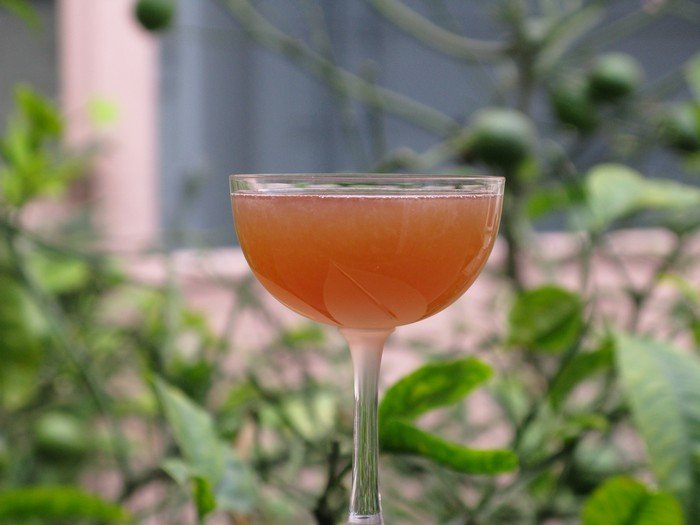
    Please check out my latest blog entry on FineCooking.com. It's about making your own grenadine and the Jack Rose cocktail. 

    Jack rose closeup_tn

    Read it here, and feel free to comment (over there) on your own grenadine or Jack Rose recipe improvements. 

  • Cognac Cocktails in the Los Angeles Times Magazine

    My first story for the LA Times Magazine is now online. It is in the Sunday, December 7, 2010 print edition. 

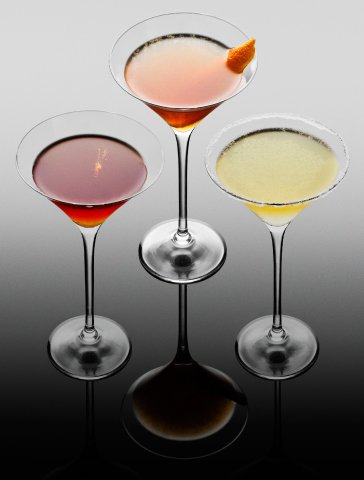
    Cognac cocktails la times(Photo by Bartholomew Cooke)

    The story is a brief airing of a pet peeve: Why are there so few cognac cocktails being served when we're supposedly in the midst of a classic cocktail renaissance? 

    The article also includes four recipes from Damian Windsor of the Roger Room. 

    Read and enjoy!

  • Does Refreezing Clear Air-Free Ice Result In a Large Clear Block?

    This is an experiment in my ongoing project to make clear ice. I've figured out a way to do it using an Igloo cooler. This experiment is an attempt to make clear ice without one. 
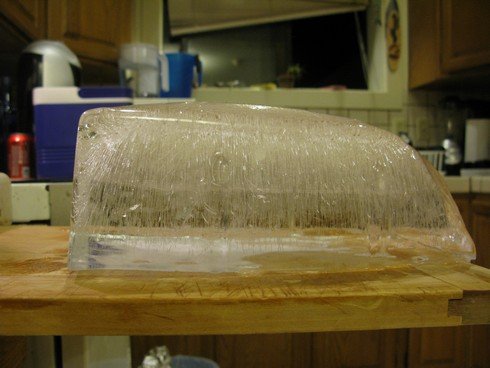
    Clear block side_tn

    A long time ago, I tested the theory that freezing, thawing, and refreezing water makes clear ice blocks. After 13 tries I determined that it refreezing water does not make clearer ice

    However, it recently occurred to me that I could test out something else. If we take just the clear part of ice (leaving behind the cloudy, air-rich stuff), melt it and refreeze it, will the new ice be clear? 

    A bar in San Francisco refreezes their Kold-Draft cubes. One bartender told me he thought it makes clearer ice than with just tap water, but still not completely clear. 

    If this experiment works, then someone anyone could refreeze small bits of clear ice into large blocks. Efficient? Nope. But interesting.

    (Oh, and long story short: this experiment was inconclusive. Don't want to make you read if you're not into it.)

    Anyway, step one was to make clear ice, as I do using the Igloo cooler method. I made two partial blocks of ice. I let the water freeze in the cooler, then knock off the thin skin that forms around the bottom of the cooler (full of water).
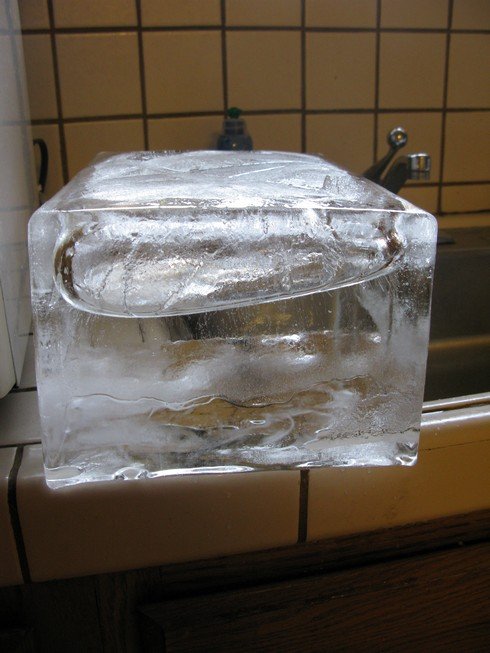
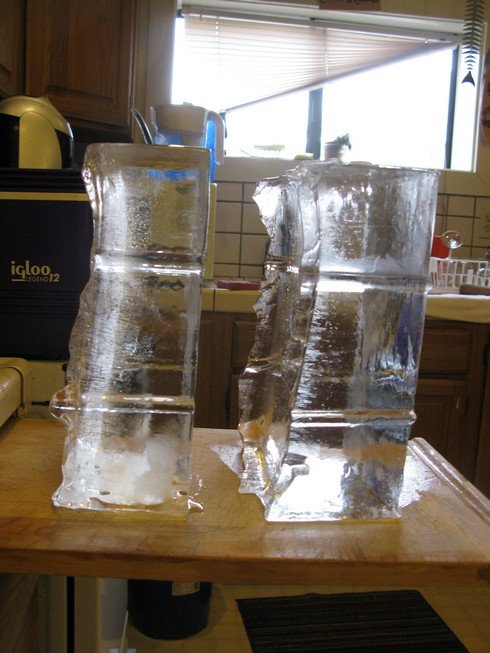
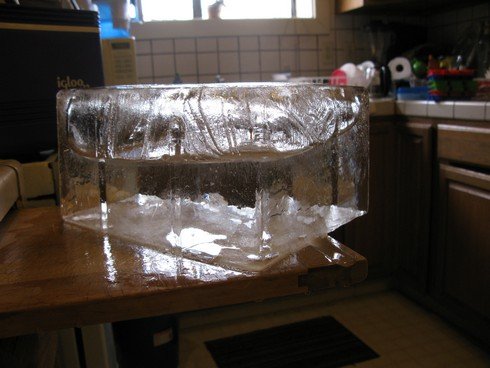
    Second clear block_tn

    Two clear slabs_tn
    Then I took these two clear slabs, broke them into large chunks, and put them into the cooler to melt.
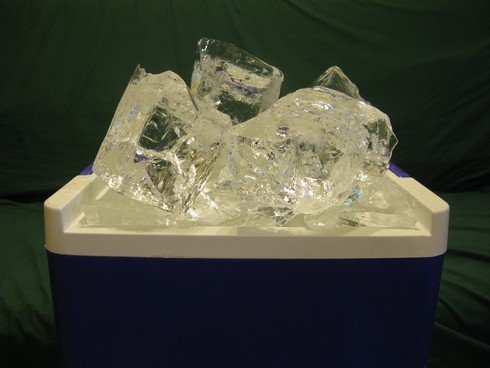
    Clear chunks in cooler_tn
    After it melted, I refroze it. 

    Refrozen slab_tn
    The ice in the picture above is upside-down from how it was in the cooler. Here's a closeup. 
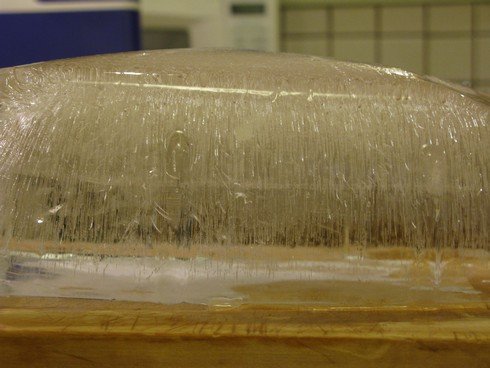
    Refrozen closeup_tn
    At first view, it looks a little cloudy in the middle of the bloc- but I think that's because I had to move my refrigerator a couple of times during this process and jostling the container does seem to make cloudier ice. 

    Looking just at the cloudy part at the bottom end (top in the picture above), I can't really say whether it's less cloudy than it is with regular tap water. This experiment is inconclusive.

    My theory is that as the water cools down or warms up to room temperature it reabsorbs a standard amount of air, and this experiment won't work. However:  

    If I repeat this experiment (and I probably will), I should:

    • Make the clear ice as normal, but not break up the slab into chunks. This saved time but probably adds air. 
    • Use more refrozen water in the cooler when refreezing. Here is was a little too hard to tell what percentage of ice was cloudy, so I could not compare it with the time I did this experiment with regular water. 

    The icesperiments continue!

    An index of all of the ice experiments on Alcademics can be found here.

  • Cutting Blocks of Ice with an Icepick

    update 2021 Better ice cutting pictures are on this post.

    To cut the large blocks of clear ice that I make at home using and Igloo cooler (methodology here), I have always busted out the saw I bought for that reason. 

    However, last week I gave a talk on ice at Portland Cocktail Week with Evan Zimmerman and Jim Romdall. During the talk one of them (Evan I think) mentioned how you use an ice pick to cut apart a block of ice the easy way.

    I cringed thinking of all the time I'd spent sawing when this way is like 1000 times easier. I hope I can save you from the same fate.

    1. Start with your slab of ice. The one in this picture is about 5 inches thick.

    Pick on slab_tn

    2.  Tap a line across the top where you want the ice to break. The ice will chip off and form a little groove. 

    Score line closeup_tn

    3. Tap in one point in the center. Poke hard. Poke poke poke. 

    Tap on center_tn

    4. The ice should break in two roughly along the line. Hooray!

    Two pieces2_tn

    5. Repeat the process to break it into smaller pieces. 

    Four pieces_tn

    An index of all of the ice experiments on Alcademics can be found here.

  • More Fun with Ice: The Time Bomb

    The fun with ice continues! In ongoing experiments freezing things in ice, I decided to try freezing food coloring in the middle of an ice cube. Then when the ice melts, the coloring will release and change the drink. 

    Ice in glass_tn
    Click on the link below to see how I did it and what happened. 

    (more…)

  • Using Salt Walter as an Insulator to Make Clear Ice

    This blog post is a continuation of this experiment.

    In this experiment, I wanted to test out another way to insulate an ice cube tray to make clear ice. Inspired by a comment from another blog entry by a reader named Gael, I decided to try salt water as an insulator rather than just plain water as in the last experiment. If it worked, this would be a way to make clear ice at home without taking up too much freezer space.

    I took a small food container and put it into a slightly larger one. The smaller container held only water. The outer container held water with table salt. The theory is that the salt water would not freeze, so it would act as an insulator for the ice, and control the direction of freezing so that it would only freeze from the top-down (as with the cooler method).

    Salt water bath_tn

    I didn't use a ton of salt. As you can see, the outer container's water did freeze lightly,though it was soft. The bottom did not completely freeze, as you can sort of see here.

    Outside of salt water bath_tn

    The inner container did seem to freeze toward the bottom.

    Salt water bath ice_tn

    In better-insulated containers, the cloudy part is only on the bottom of the container. Here, it is concentrated but raised slightly above the bottom of the container.

    In this case the inner container sat directly on the bottom of the outer container, so it wasn't greatly insulated on the bottom. My theory is that this is why the cloudy part of the ice is raised above the bottom.

    To improve this experiment, I would put raise the inner container off the bottom of the outer container, and probably use a greater amount of salt in the salt water. 

    As the outer container here is only slightly larger than the inner container, this system is more space-efficient than the Igloo cooler for many people without large freezers.

    There's more work to do on this…

    An index of all of the ice experiments on Alcademics can be found here.

  • Welcome Back, Harvey Wallbanger

    With the new formula of Galliano and a renewed interest in the fern bar, the Harvey Wallbanger is about due for a comeback. 

    Wallbanger_outdoors_tn_lg
    In my latest post for Fine Cooking, I investigate the cocktail. Have a look, and remember that comments make me happy and keep me employed.

  • Making Clear Ice Without a Cooler

    In a set of experiments, I showed that you can make clear ice by controling the direction of freezing. The container I've been using for this is an Igloo cooler. When using it, the ice freezes from the top-down and all the cloudiness in the ice forms at the bottom of the container rather than in the middle of the block.

    I wanted to show that you can do this without a cooler as long as you have some sort of insultation that accomplishes the same thing as the cooler. In this case, I chose a bigger pool of water as an insulator.

    As a control I froze a plastic take-out container of water in the freezer.

    Control ice_tn

    As usual, it is cloudy over a large area, mostly in the center. This is because the water freezes from the outside-in. The last part of the ice to freeze contains air and any impurities, and is cloudy.

    So then I took the same container and put it into a larger container. The smaller container sits on cubes to keep it off the bottom of the larger container.

    Ready to freeze2_tn

    Both containers were filled with water to about the same level. The purpose of this is to use the outer container of water as an insulator. The water inside the smaller container would then freeze only from the top-down instead of outside-in, because the water surrounding it would freeze later (because it is so big).

    Done freezing_tn

    Finished freezing_tn

    The results show that this worked- the cloudy part of the ice was the last part to freeze at the bottom of the container.

    What this means:

    • Directional freezing works as long as there is an insulated jacket around the container. The ice freezes only from the top-down, pushing the cloudy part to the bottom.
    • This property could be exploited to make an ice cube tray that makes cloudy-on-the-bottom ice. Picture, for example, an ice cube tray that was insulated with a jacket on the sides and bottom. 
    • So now I can do more experiments to make an insultated jacket that is practical.

    An index of all of the ice experiments on Alcademics can be found here.


  • Germany, Ensslin, Aviation, and Blue Cocktails

    My latest post on FineCooking.com is up. It's typical of my thought process: I was going to write about my time in Germany and ended up talking about a German bartender who wrote an American cocktail book in which the Aviation cocktail was first mentioned and later forgotten. 

    Read it here

    Aviation close1_tn

    (I took this picture- not bad for me!)

  • The Tequila-Sherry Connection

    Every time I look for sherry I find tequila there too. What is it with the tequila people and the sherry people being the same people?  

    Steven Olson aka Wine Geek is both a tequila and mezcal ambassador and also a sherry ambassador. 

    Jacques Bezuidenhout, Partida tequila brand ambassador and sometimes sherry ambassador, also created of the La Perla cocktail with both tequila and sherry. 

    George Sandeman of the Sandeman sherry and port family is a huge tequila fan. 

    On a recent trip to Spain with Steve Olsen were Phil Ward and Katie Stipe of Mayahuel, the tequila-and-mezcal bar in New York. 

    Gitane restaurant in San Francisco has a drink with tequila, PX, lime, and ginger beer. 

    And just the other day I got a recipe pitch from Espolon tequila with this recipe from H. Ehrmann of Elixir:

    Ashes to Ashes

    1.5 oz. Espolón Tequila Reposado
    .5 oz. Pedro Ximenez Sherry
    1 oz. Lemon Juice
    1 tsp. Sweetened Cocoa Mix
    .25 oz. Agave Nectar
    1 pinch Ground Cinnamon

    Place all ingredients in a mixing glass, fill with ice, cover and shake well for 10 seconds. Strain up into a cocktail glass. Garnish with cinnamon dust.

    I also love both sherry and tequila, but I don't know what they have to do with each other. 

    What gives? 

agave alcademics Angostura bartenders bitters bodega bourbon bowmore Campari Camper English chartreuse clear clear ice cocktail cocktail powder cocktails cognac curacao dehydrated dehydrated liqueurs dehydration directional freezing distillery distillery tour distillery visit france freezing objects in ice hakushu harvest history how to make clear ice ice ice balls ice carving ice cubes ice experiments isle of jura jerez liqueur makepage making clear ice mexico midori molasses orange orange liqueur penthouse pisco potato powder production recipe Recipes rum san francisco scotch scotch whisky sherry spain spirits sugar sugarcane sweden tales of the cocktail tequila tour triple sec visit vodka whiskey whisky