Blog

  • Making Crystal Clear Ice in Wired Magazine

    Run screaming to the newsstand to pick up the June issue of Wired magazine, because there is a story by me in it. Sure it's only 100 words long and it's about how to make clear ice, something you may have read about here, but you can consider it a collector's item. 

     
    Wired-cover_1806

     Update: The article is online here

  • The New Alcademics Banner

    My experiments with ice continue. I've got a routine down to make clear chunks of ice and now I'm experimenting with freezing objects into it. As you can see I have some room to improve but I did make a groovy, if a bit large, new banner for Alcademics.

    Icebanner6width1000

  • The Olive Centipede: The Frightening New Release in the Torture Garnish Genre

    (this post is a joke about this movie)

    The Olive Centipede was created by Dr. Heiner, a disturbed German bartender formerly famous for his flair garnishing techniques. The evil Dr. Heiner decided to create a garnish centipede, made from sewing three olives together along the olives' digestive tracts, pit-to-pimento.

    Olivecentipededrawing

    Unfortunately for the olives, the surgery was a success. A hideous, hideous success.

    Olivecentipede4s

    The poor olives tried to escape Dr. Heiner's laboratory/ultra-lounge.

    Olivecentipede3s

    But were unsuccessful.

    Olivecentipede2s

    And now Dr. Heiner wants to create an even more hideous centipede garnish made from twelve olives.

  • Blending Scotch Whisky at Morrison Bowmore

    After my visit to the Bowmore and Auchentoshan distilleries, our group stopped by the headquarters of their parent company, Morrison Bowmore. (This company is in turned owned by Suntory, and is distributed in the United States by Skyy Spirits.)

      Blending lab 7

    There we met with Senior Blender Iain McCallum, who is sort of a legend even though he’s less than 40 years old. He's engaging, fast, fun, and smart as heck. If given the opportunity to attend an event he hosts, I highly recommend it. (If given the opportunity to go out drinking with him afterward, I recommend that too even though he may hand you a shot of Malibu mixed with coffee liqueur.)

    In the aged spirits category, a brand may choose to promote its distiller (in charge of distilling), warehouse manager (in charge of aging), distillery manager (in charge of the whole process locally), or the master blender. We spent time with Bowmore's distillery manager on Islay and Auchentoshan's distiller in Glasgow.

    The blender's job is (obviously) to blend whiskies from the various barrels into the final product to stay consistent with the desired flavor profile of the bottling. (Single malts are not single barrels, remember, and they may come from various years as long as they're distilled at a single distillery.) This person will not only assure quality of product, they'll have an incredibly good/trained nose and palate for doing this.

    Ian blending room6

    In the blending room, we sampled a few new bottlings coming out from Auchentoshan and Bowmore- but not for several months. More on those at a later date.

    We also had the honor of tasting Bowmore Gold, which is every bit as wonderful as I remember it. The Black, White, and Gold Bowmore expressions are long-aged in Vault No. 1, the below sea level barrel warehouse on Islay. The thing about long aged Islay whiskies, particularly Bowmore with its lower phenol (smoky) content than other Islay whiskies, is that after a long time aging the smoke starts to dissipate and new flavors come through. 

    I finally had the opportunity taste the Black Bowmore, one of the most thrilling (also expensive) whiskies I’ve ever tried. It had a few flavor notes in common with Bowmore Gold (I was again reminded of the “banana sandpaper” that doesn’t exist in nature ), plus papaya and mango notes, and a mysterious and slightly darker nature. Wonderful, wonderful stuff. 

    Black bowmore3

    (Iaian McCallum with a bottle of the original Black Bowmore.)

    The only disappointing (I use this term very relatively) part about the visit is that I didn’t get the chance to try the White Bowmore. But that gives me a pretty good reason to come back.

  • An Auchentoshan Distillery Visit

    On the last day of my trip to Scotland with Bowmore, we went to another distillery, Auchentoshan. This distillery is located just outside of Glasgow, on a former estate.

    Auchentoshen distilery10

    Auchentoshan is in the Lowland region of Scotland, one of just five single-malt-producing distilleries there. It’s also unique as the only scotch distillery that triple distills all of its whisky. This gives it a lighter flavor profile than most single malts, and a thinner body/mouthfeel. This makes it both an entry-level whisky for drinkers new to the category, and one  that can be easily mixed into cocktails.

    Auchentoshen distillery4

    Scotch whisky distilleries usually (always?) have stills in pairs for two distillations; a smaller one for the second. Rather than adding a third still at the end of the process, Auchentoshan has an ‘intermediate still’ between the other two. 

    Auchentoshen stills1

    (I couldn't fit all three stills in the picture. They do exist, though.)

    The spirit is distilled to a high alcohol percentage before the final distillation that will make the cut of the heads and tails. (Previous to that, they're mostly concentrating alcohol. The final distillation/cut will pick out the desired flavor elements for the whisky by discarding portions of the distillate.) According to Auchentoshan's distiller Jeremy Stephens, the higher level of alcohol sitting in the still forces the volatile aromatics in the alcohol to rise to the top first, rather than the heavier, oilier compounds that they want to avoid in this whisky.

    Auchentoshen barrel aging warehouse2

    After a trip through the distillery, we took a spin through the one of the aging warehouses then went for a tasting.

    The Auchentoshan line includes the Classic, which bears no age statement but holds scotch most between five and eight years old, all aged in ex-bourbon casks. The twelve year old contains about 25% whisky aged in ex-sherry casks. We sampled the 18 and 21-year-old expressions as well, along with a 1988 Bordeaux finished bottle that I really liked. The Three Wood is matured in ex-bourbon, ex-oloroso sherry, and ex-Pedro Ximenez casks.

    Barrel aging at morrison bowmore

    And then it was on to the blending room… see the next post.

  • Aging and Terroir on Islay


    Bowmore barrel5


    When we last spoke, I was talking about the distillation process of Bowmore, the Islay single malt scotch whisky that I visited a few days ago. The malting and distillation are only the first two weeks in the life of a scotch whisky: the aging time in barrels is where the liquid spends the vast majority of its existence- and where it gains much of its flavor.

    At Bowmore, they use ex-bourbon barrels primarily from Heaven Hill, ex-sherry barrels, and miscellaneous ex-wine barrels for special blends.  


    Tasting glasses bowmore


    Different ratios and preparations of bourbon and sherry barrels are used for the various bottlings. The 12-year-old and 18-year-old expressions are a blend of scotch from ex-sherry and ex-bourbon barrels. The 15-year-old “Darkest” bottling is a 12-year-old finished for three more years in ex-sherry casks. 

    Bowmore aging warehouses on Islay are located right next to the sea. The partially-below-sea-level No.1 Vaults are the most famous, as that's where Black, White, and Gold Bowmore are from.

    No 1 malts

    The Terroir Question

    Bowmore distills with a percentage of barley malted on site, along with a majority of commercially malted barley from the mainland. Distillery Manager Eddie MacAffer said that though there are differences in the flavor profile of the peat from Islay versus the mainland, he didn’t feel they were significant.

    The aging barrels are also mixed: some Bowmore casks age on Islay and others on the mainland, but according to Eddie MacAffer this has more influence on the flavor of the final blend.

    Camper English: At Bowmore you have the combination of the local peat, local malting with the stuff from the mainland and you have aging in both locations as well. Can you taste the place in Bowmore, do you think?

    Eddie MacAffer: The fact that we do mature our whiskies in the old warehouses right beside the seaside, the sea air definitely has an influence on the maturation, with the slow, steady, and the cool situation that it's in, in my opinion definitely has an influence on the final product; the flavors and the tastes that come off from it.

    Camper English: Do you think that's where you see the most influence of the location is there, as opposed to the peat or the local malting?

    Eddie MacAffer: Obviously we  put the peatiness in , but definitely the location that it matures in is definitely gives it the biggest influence on the taste; right beside the sea. 

    Water mark on wall barrels are beneath sea level

    (Distillery Manager Eddie MacAffer shows where sea level is in the Bowmore No. 1 Vaults.)

  • A Visit to Bowmore on Islay in Scotland

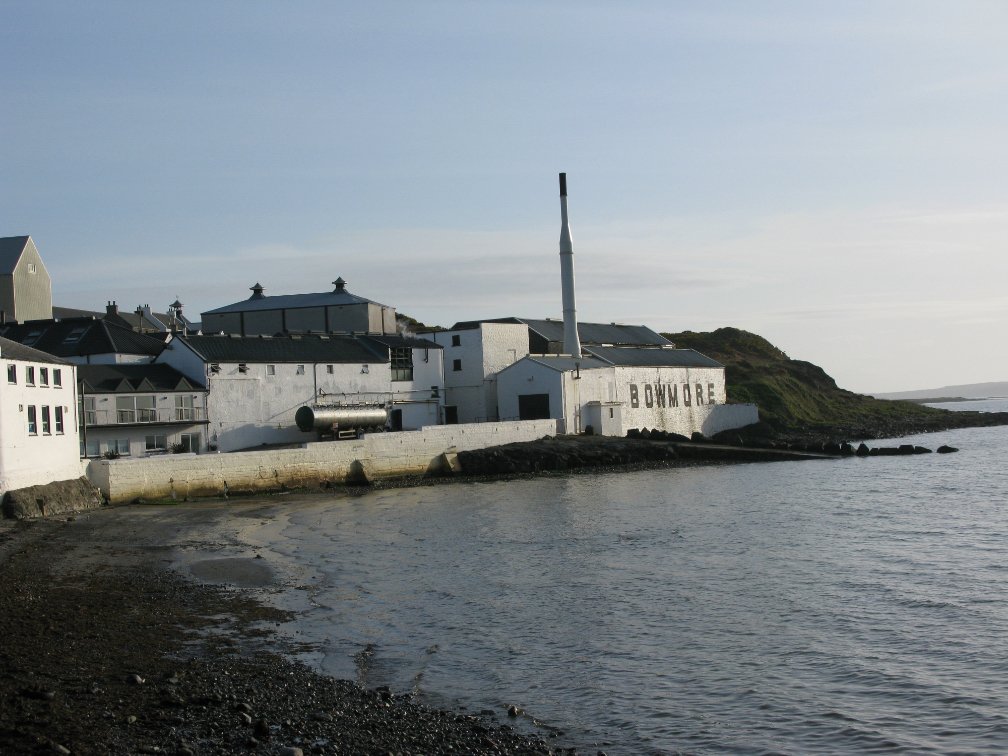
    Hello from Islay! I'm in Scotland on a trip with Bowmore.
    Bowmore Islay 006
     

    After a first night of bar exploration and jetlag adaptation in Glasgow, I was ready for the press trip to begin. I spent the morning blogging about the previous night, then had a day to explore Glasgow. I can't say I learned a ton about the city, except that I love the look of Glasgow University and had a great time exploring the Kelvingrove museum. 

    By the next morning I'd met up with the rest of the group and we flew together to Islay. To get there by car/bus and ferry apparently takes almost nine hours, but the flight was just 45 minutes from the Glasgow airport.  

    Over the course of the day, the weather changed from the Islay/Scotland weather you see all the time- mildly raining with low visibility- to sunny and bright in the later afternoon/early evening. Islay always looked to me like it is built for dreary weather, with all white buildings as the one color that looks good in the fog, but when it's sunny it takes on a happy little seaside town feel. 

    Bowmore Islay 002
     

    I should mention that we're in the town of Bowmore, the capital city of Islay, but are driving to various spots on the island to sample other restaurants and attractions.

    But first, the distillery tour. As you probably know, Islay single malt scotch whiskies are known for a smoky/peaty flavor profile, often with seaside flavors like seaweed and salt. Bowmore has less of the seaweed/iodine flavors so present in Laphroaig, but to my palate is still dominated by a smoky charred flavor with a lurking sherry cask flavor present in different amounts depending on the bottling's expression. I didn't realize that there is actually a lot less phenol content- the amount of smokiness/peatedness in scotch- than other brands. Bowmore comes in at about 25 parts per million, whereas I believe Laphroaig comes in at 40 and Ardbeg at 60.
    Camper cuts peat3
     

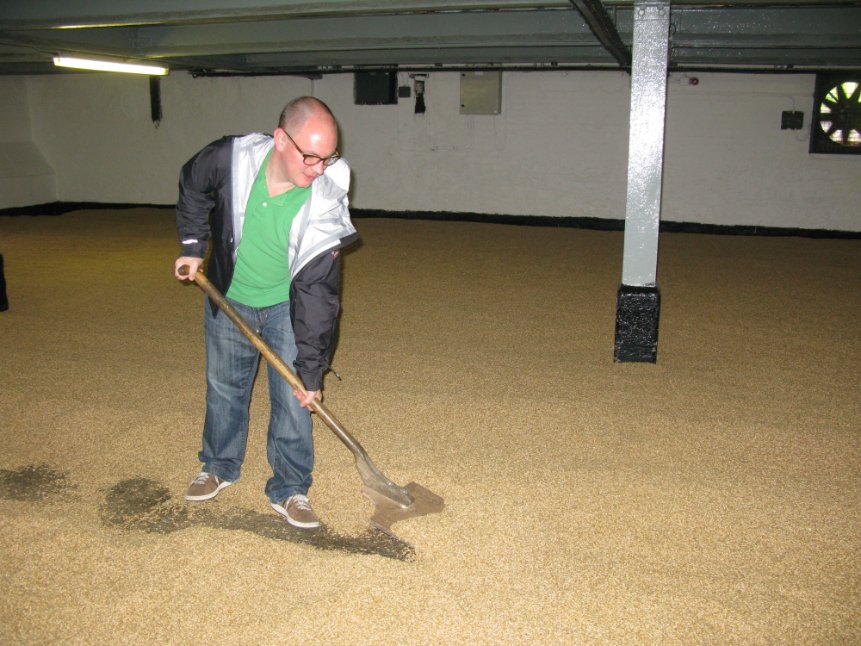
    At Bowmore, like at Laphroaig and The Balvenie, they malt some of their own barley. This involves purchasing barley, soaking it in three cycles over a 24 hour period, spreading it out on a malting floor, and turning the malt over again and again until the grain germinates and sends out a little shoot about one-quarter the length of the grain. 

    Gerinating barley2
     

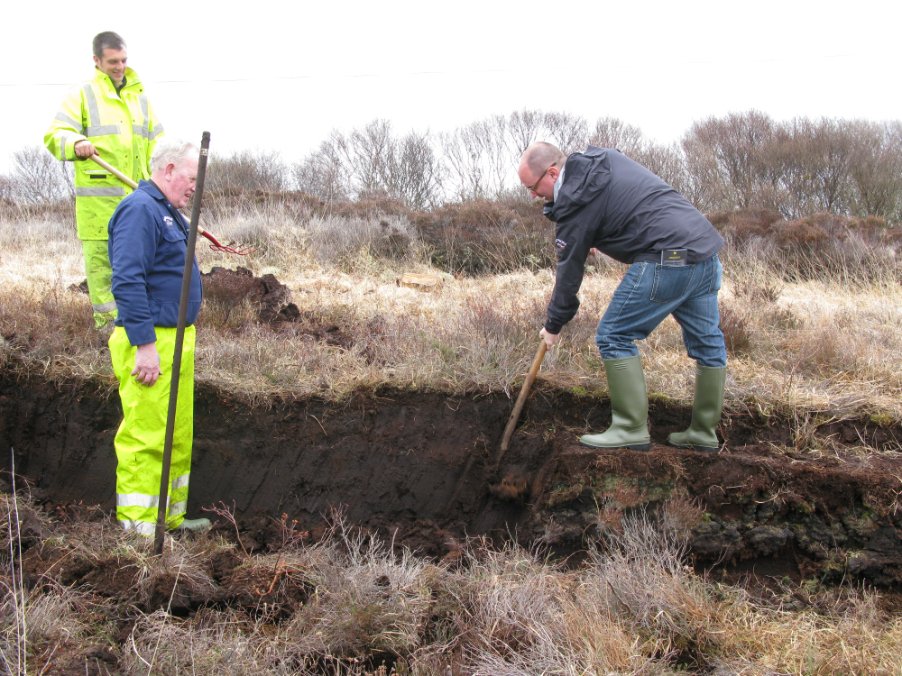
    Germination is then stopped by drying the barley with a combination of hot air and peat smoke to the desired level of smokiness. I actually got to harvest peat from a bog, turn and rake some barley, and even step into the kiln after it had recently stopped blowing the peated air through it. 
    Camper turning malt 3
     

    At this point  the malted barley is ready to be fermented and distilled. Allowing the grain to germinate starts an enzymatic process that will convert starches in the grain to sugars when hot water is added again. The malted barley is ground to separate the floury innards from the husk, then this is washed with hot water in three cycles to release the sugar.

    The grain is then discarded (sold to farmers as cattle feed) and the sugar water is fermented and then distilled. The new make spirit is then aged in ex-bourbon and/or ex-sherry casks for the different expressions. We took a look into Vault No. 1, where the barrels of Bowmore Gold were housed, some beneath sea level adjacent to the salt-crusted warehouse sea wall. 

    Bowmore stills2
     

    More posts from Bowmore to follow!

  • Dashing Don Lee and Greg Boehm’s Old Tools

    On Monday April 5th, Greg Boehm of Cocktail Kingdom and Don Lee of Momofuko Ssam Bar gave a talk at Rickhouse in San Francisco.

    Gregboehmtoolsession

    Boehm's plane was delayed so Lee gave an impromptu talk on one of his bar science projects. (When I last spoke with him, he was measuring the BRIX count of sugar syrup in all the bars in New York.) Recently he's been trying to determine how much is a "dash" of bitters in a drink.

    Lee noted that different bottles of bitters release different amounts of liquid in a dash; not only just between brands but also between different-sized bottles of the same brand, and within one bottle when it is very full or very empty. (I currently have a jumbo sized Angostura bottle and the darn thing spits out a dash before I can tip it over far enough to get it in the glass.)

    As a starting point of his experiment, he measured the average size dash (in weight) from the middle 80% of a ten-ounce Angostura bottle, a Regan's Orange Bitters bottle, and Angostura in a Japanese dasher bottle. He found that Angostura released a smaller amount on average than Regan's. He also found that the 90 ml Japanese bitters dasher bottle delivered extremely consistent results (but only 1/4 of the size of a Regan's dash), probably because the long neck allowed for a consistent launching distance for the liquid.

    Future experiments might include testing how sensitive the palate is to these minute differences in dash size, so that we'll know how much difference a dash makes.

    When Greg Boehm arrived he was mostly playing show-and-tell with his vintage barware. Boehm collects functional barware, imports barware from Japan and other countries to sell, and is now beginning to make recreations of vintage barware when nothing as good is being made today. I learned a few things:

    • Patents on cocktail shakers seem to start around 1880
    • Brazil and Argentina are the only two countries that use uniquely-shaped shakers; Brazil's with a built-in strainer that seems pretty handy until you start bashing it with large Kold-Draft ice cubes and Argentina's a conical shaker that's really hard to separate.
    • All of those fancy-shaped shakers (penguins, bells, zeppelins) were launched at the end of Prohibition in the 1930's
    • Japanese barspoons are not really meant for measuring, but for stirring and pulling out a drop of liquid from the glass. I noticed this in Japanese bars in Singapore- that instead of the bartender tasting the drink using a straw, they taste it by putting a drop of the drink on the back of their hand then licking it off.
    • The reason many barspoons (like this one) have the flat end is that they're based on apothecary spoons that were used to crush pills.
  • California Rum

    Last week I visited the St. George Spirits distillery to sample their new rum, Agua Libre, and watch them distill more of it.

    The new release was distilled from fresh California-grown sugar cane juice (not molasses) and aged for two and a half years in French oak barrels.

    From the media contact:

    After pressing 25 tons of sugar cane from Kalin Farms of Southern California's Imperial Valley, with a press imported from India, they distilled 750 individually numbered bottles. We still need to slap some labels on the bottles and will probably start
    selling them late May/early June for $60 a bottle at the store in
    distillery tasting room.  Bar Agricole will be the first account to
    carry the rum when they open in May.

    Agualibresmall

    This isn't the first rum released from St. George Spirits though. They also made Eurydice, a rum exclusive to Smuggler's Cove in San Francisco. Distiller Lance Winters said that one was made from different varieties of sugar cane, and if I remember correctly it was aged in an ex-bourbon barrel as well as French oak. I've just had each of the rums once but if I remember correctly both are grassy and vegetal, but Eurydice is a lot more funky/gamey than Agua Libre.

    I really like the Agua Libre and I think fans of agricole rums and Smith & Cross will really like this one as it's sort of a combo of the two styles.

    As for the new rum being distilled on the day of my visit, it is made from sugar cane grown in Brawley, California. The grower, Carson T. Kalin, was at the distillery to speak to us and I sort of nerded out on sugar cane. The farm is apparently located at California's last sugar beet processing facility, (I didn't know sugar beets even grew in CA) and so far the sugar cane is purely experimental. Kalin said he is trying to find varieties suited to the hot and dry weather that would be watered by irrigation as there isn't the rainfall of the tropics there. And as sugar can has the opposite growing season of sugar beets, they could always be harvesting.

    In the short term, the only thing the cane is being used for is making rum. They harvest the sugar cane by hand rather than by machine, because the sugar cane crushing machine in the distillery needs to use tall stalks of cane rather than the small segments the machine produces. After crushing the cane in the distillery, they ferment the cane juice for 15 days before distilling. I tried the fermented sugar can juice and it was crazy sour and I am glad nobody took a picture of the face I made. Luckily, once through the still and a couple years in the barrel and it fixes it right up.

  • How Beachbum Berry Saved Easter


    BeachBumBerryRemixedCoverMy friends were throwing a zombie-themed Easter party (raising from the dead, get it?) and planned cocktails to serve at it. They had a Painkiller, Hemmingway Daiquiri, and Dark n' Stormy on the menu. Obviously something was missing: the Zombie.

    As they went shopping for booze and mixers, my friend kept texting me about specific ingredients. Grenadine? Oh just make that with POM Wonderful and sugar. Cinnamon syrup? You can borrow mine. Passionfruit syrup- wait a minute, that's not in my Zombie recipe…

    The Zombie is one of those drinks with a long history and an obscured recipe due to secret ingredients, as tiki bar owners back in the day had to prevent staff poaching by not even sharing their drink recipes with their own bartenders. They'd have to use "Don's Mix" in certain quantities rather than grapefruit-cinnamon syrup, which is what Don's Mix turns out to be. Because of this, every bar offered its own take on the Zombie so even in the 1940s there were tons of recipes for one drink. 

    How do we know this, and the real Zombie recipe? Because Jeff Beachbum Berry tracked down people who knew the recipe, and the history of this and other tiki cocktails.

    I used the Bum's latest book, Beachbum Berry Remixed, to find the recipe for the Zombie served at Easter. I actually made two different versions; the original (3 rums, 2 liqueurs, 2 syrups, bitters, lime) and the Simplified Zombie (2 juices, one syrup, two rums). There are three other Zombie variations listed in the book, but I figured two were plenty. The drinks were a hit and Easter was saved.

    Another classic tiki drink with many variations is the Mai Tai. Beachbum writes in the book about the history of the drink, which was contested by Don the Beachcomber and Trader Vic. It may be the case the Trader Vic's recipe was inspired by one of Don's, but not Don's Mai Tai. It's an interesting history, and one that the Bum speaks about at different events.

    He'll next be at Smuggler's Cove in San Francisco giving the talk April 24 and 25. The tickets may be sold out already: check here.

agave alcademics Angostura bartenders bitters bodega bourbon bowmore Campari Camper English chartreuse clear clear ice cocktail cocktail powder cocktails cognac curacao dehydrated dehydrated liqueurs dehydration directional freezing distillery distillery tour distillery visit france freezing objects in ice hakushu harvest history how to make clear ice ice ice balls ice carving ice cubes ice experiments isle of jura jerez liqueur makepage making clear ice mexico midori molasses orange orange liqueur penthouse pisco potato powder production recipe Recipes rum san francisco scotch scotch whisky sherry spain spirits sugar sugarcane sweden tales of the cocktail tequila tour triple sec visit vodka whiskey whisky